
Last fall I watched a surgery applicant sit in an empty workroom between cases, refreshing his email every 30 seconds. He’d applied to 22 programs—“targeted,” his dean had said—and by mid-October he had exactly three interview invites. The applicant next to him, clearly not smarter, not stronger on paper, had ten invites. The difference? She’d applied to 45.
Let me walk you through what was actually happening behind the scenes in those programs—and why the “20 vs 40” decision in competitive fields is not just about money. It’s about math, psychology, and how programs quietly protect themselves at your expense.
The Math They Don’t Explain to You
Most students think this is the question: “Are 20 programs enough for my stats?” That’s not the real question.
The real question is: “How much random noise can my application survive?”
Because competitive fields—derm, ortho, ENT, plastics, neurosurgery, radiation oncology, IR, certain elite IM programs—are not a clean meritocracy. They’re messy. Screens, biases, timing, who opened your file, how over-applied their region is this year. All of it.
| Category | Value |
|---|---|
| 10 | 1.2 |
| 20 | 3.5 |
| 30 | 6 |
| 40 | 8.5 |
| 50 | 9.5 |
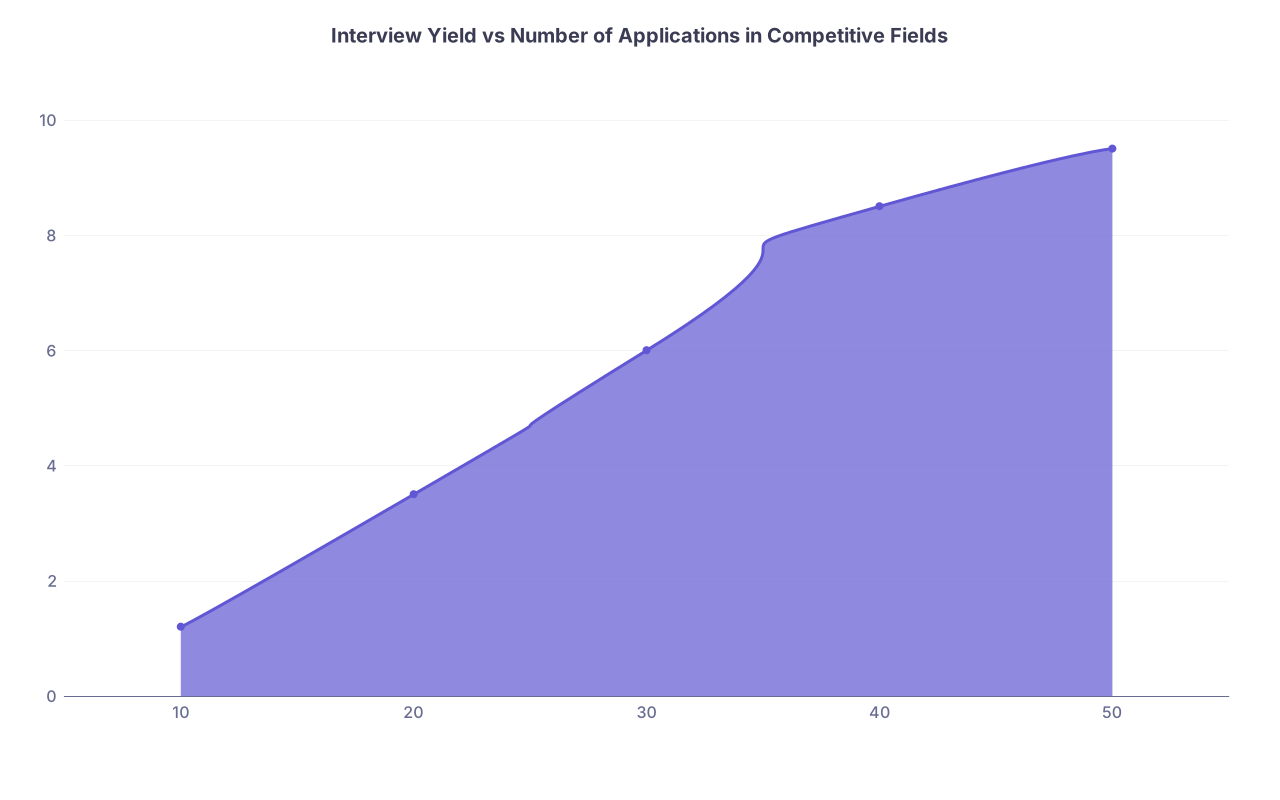
That line chart is roughly what I’ve seen over multiple cycles from real applicant data (surgery, derm, ortho):
- Around 20 programs in a competitive field: you’re often sitting in the 3–5 interview range if you’re reasonably competitive.
- Around 40: that jumps to 7–9 interviews.
- Beyond ~45–50: returns start flattening for most applicants.
Here’s the uncomfortable part: the difference between 3–5 interviews and 7–9 interviews isn’t just “a little more breathing room.” Below about 5 interviews in a competitive field, your match probability drops off a cliff. Program directors know this; applicants usually do not.
Why 20 Feels Reasonable but Acts Dangerous
“Twenty is fine. Just apply smart.” I’ve heard this line from deans who have never run a rank list in their life.
From the PD side, here’s what 20 applications actually means for you in a competitive field.
1. You’re Assuming Rational Behavior That Doesn’t Exist
You think: “I’ll apply to 20 where my stats fit.”
Reality: programs aren’t selecting on a smooth curve.
Here’s what usually happens in a competitive program:
- First pass: an admin or chief resident uses hard filters (Step 2 score, visa status, graduation year) and cuts the pile from 1,000 to 400.
- Second pass: an APD scans for home students, rotators, personal connections, and big-name letter writers. Down to 150.
- Third pass: PD and faculty pull out “known” schools and applicants with hooks: AOA, research year with same specialty, high-impact publications. Down to 80–120.
If you applied to 20 programs and happen to be at 5 schools that heavily favor home students, 5 that over-screen by Step score that year, and 5 that got flooded with applicants from your region… you get unlucky. Mediocre signal. Few invites.
Are you a worse applicant than the person who applied to 40 and hit more favorable combinations? Not necessarily. You just gave randomness too much power.
2. You’re Underestimating Just How Many Slots Are Already Spoken For
Let me say what PDs will not say publicly: a significant chunk of interview slots in competitive programs are functionally “reserved.”
Not always in a corrupt way. Just reality:
- Home students
- Students who rotated there
- Applicants with letters from people the PD actually knows
- “Strong push” emails from big-name chairs
So when a program lists “70–90 interview slots,” the truly open, merit-based spots may be 30–40. At most.
Now multiply that by your 20-program list. You didn’t really “access” 20 full interview pools. You accessed a fraction of them.
When you apply to 40, you broaden the number of unspoken-for slots you bump into. That’s the part no one explains.
The Hidden Traps of “Applying Smart” to Just 20
Every cycle I see the same pattern: someone applies to 20 “carefully chosen” programs, then is stunned by how random the results feel.
Let me show you what actually goes wrong.
Trap 1: Overconcentration in One Region
Students love geography. “I want to stay in the Northeast” or “I need to be on the West Coast.”
Programs, meanwhile, don’t care about your housing preferences. They care about filling their class without scrambling.
Here’s what happens when you target 20 programs in one hot region (say, NE or California) in a competitive specialty:
- Those locations are over-applied every single year.
- Local med schools have pipeline relationships and get the first look.
- Regional chairs call each other to push their favorites.
You’re quietly competing with:
- Strong local home students
- A ton of away rotators
- People with powerful regional connections
Apply to 40 with smart geographic diversification, and suddenly you’re showing up in places that are slightly less saturated—Midwest academic centers, strong Southern programs, solid but non-brand-name places that still train you well.
In PD rooms, I’ve heard versions of this more times than I can count:
“We’re stacked with Harvard/Columbia/Stanford this year; let’s at least look at some of these Midwestern kids where we’ll actually have a chance to sign them.”
If your 20 are all in the hyper-competitive coastal bubble, you’re the one squeezed out.
Trap 2: Overconfident “Reach-Heavy” Lists
Another common story: the applicant with a gorgeous CV who still gets burned.
- Step 2: 260+
- Multiple publications
- Strong letters from recognizable names
They aim high. Too high. Their 20 programs are almost all “top 20” in their field, with maybe one or two nominal “safeties” that aren’t really safe.
Then October comes and they discover a basic truth: the other 260+ applicants also applied to those same 20 programs. Many with stronger inside ties than they have.
More programs in competitive fields doesn’t just help weak applicants. It protects strong ones from overestimating how special they look from the outside.
What Actually Changes When You Go From 20 to 40
Let me strip away the fluff. When we look at applicants in competitive specialties who move from ~20 to ~40 programs, these are the real differences I’ve seen on selection committees.
Difference 1: Number of Interview “Entry Points”
Think of each program as a separate lottery. You don’t just need interviews; you need independent chances to appear in a rank list.

With 20 applications, if 8–10 of those programs are structurally biased away from you (heavy home crop, different Step cutoffs, weird screening preferences), you might come out with 3–4 interviews. Sometimes less.
When you double to ~40, you:
- Catch more “normal” mid-tier academic programs that need strong but not perfect candidates.
- Hit more places where your exact profile fills a niche: nontraditional background, high research, strong Step but weaker clinical grades, etc.
- Multiply the probability that someone on a committee personally likes your story or school.
On the PD side, this is what it looks like:
“You know, we could bring in this person from [Your School]. They’re not from a usual feeder, but their research lines up with Dr. X, and their personal statement is actually interesting. Let’s add them to the invite list.”
At 20 programs, that conversation may never happen. At 40, it happens several times.
Difference 2: Protection Against Bad Timing
Here’s something brutal that you will never see written on any official website: your application can get buried by timing alone.
Scenarios I’ve actually seen:
- A program’s screening chief is on vacation the week your school batch releases. They only deeply review later batches.
- A faculty member doing the first-pass review is in a terrible mood the afternoon they get to your last name on the list.
- The PD got burned by an applicant from your school three years ago and quietly dings most from there now. Petty, but real.
With 20 applications, one or two bad-luck incidents like this hurt a lot. With 40, it’s noise.
Difference 3: The Psychological Cushion
This one’s less talked about but very real.
Watching someone go into November with 2–3 interviews in a competitive field is ugly. Panic sets in. They:
- Start over-emailing coordinators and PDs with awkward “updates.”
- Tank their performance on the few interviews they have because they’re desperate and overly intense.
- Burn energy second-guessing every choice instead of preparing well.
Contrast that with the applicant sitting on 7–10 interviews spread across a wider range of programs. They walk into rooms more relaxed. Ask better questions. Project less desperation and more genuine interest.
From across the table, I’ve seen it. PDs and interviewers respond better to candidates who don’t look like they’re clinging to the last lifeboat on the Titanic.
When 20 Might Be Enough (and When It’s Suicide)
Let’s be clear: I’m not saying every single human being in a competitive field must hit 40 applications. There are edge cases.
When ~20–25 Can Be Reasonable
You might get away with ~20–25 if:
- You’re applying to a competitive field at a truly elite home program that loves its own and you’re clearly top-tier there.
- You have multiple strong away rotations in that same specialty with explicit promises of support and backing.
- You have at least one nationally known letter writer who is emailing PDs for you by name, and you know they actually do that.
Even then, the people who play the 20-application game successfully usually also:
- Are geographically flexible
- Have AOA or equivalent
- Have Step 2 in the top decile for the specialty
These are not most applicants.
When 20 Is Flat-Out Dangerous
I’d call 20 programs reckless for you in a competitive specialty if any of the following are true:
- You’re at a non-elite med school without a strong presence in that specialty.
- You don’t have home or away rotations in that field at big-name programs.
- Your Step 2 score is good but not outstanding for that field (e.g., 240–245 in ortho/derm/ENT).
- You’re geographically picky (coastal-only, one region only).
- You’re a non-US MD/DO or an IMG trying to crack a super competitive field.
In those situations, 40 isn’t “overkill.” It’s standard self-preservation.
The Money and Fatigue Argument (And What PDs Secretly Think)
Let’s talk about the two standard objections to applying to 40 programs.
“It’s Too Expensive”
Yes, ERAS costs add up. But I’ve sat in rank-list meetings where the chair says, without irony:
“They applied to 18 in this specialty and 10 in [backup specialty]? That’s… concerning. Either they did not get good advising or they’re unrealistic.”
PDs in competitive fields know the numbers. When they see a student who didn’t apply broadly, they quietly question judgment.
Am I saying you should go into debt without thinking? No. But if you’ve already invested:
- 4 years of med school
- Board fees
- Rotation travel
- Research time
Then deciding to “save” a few hundred dollars on application fees in a competitive matching environment is just bad risk management.
You do not want to be the person spending a fifth year doing research or a prelim year because you tried to save $600 at the wrong moment.
“I Don’t Want to Get 30 Interviews; I Can’t Go to All of Them”
In competitive fields, I’ve almost never seen this be a real problem.
| Category | Value |
|---|---|
| 0-3 | 10 |
| 4-6 | 40 |
| 7-9 | 30 |
| 10-12 | 15 |
| 13+ | 5 |
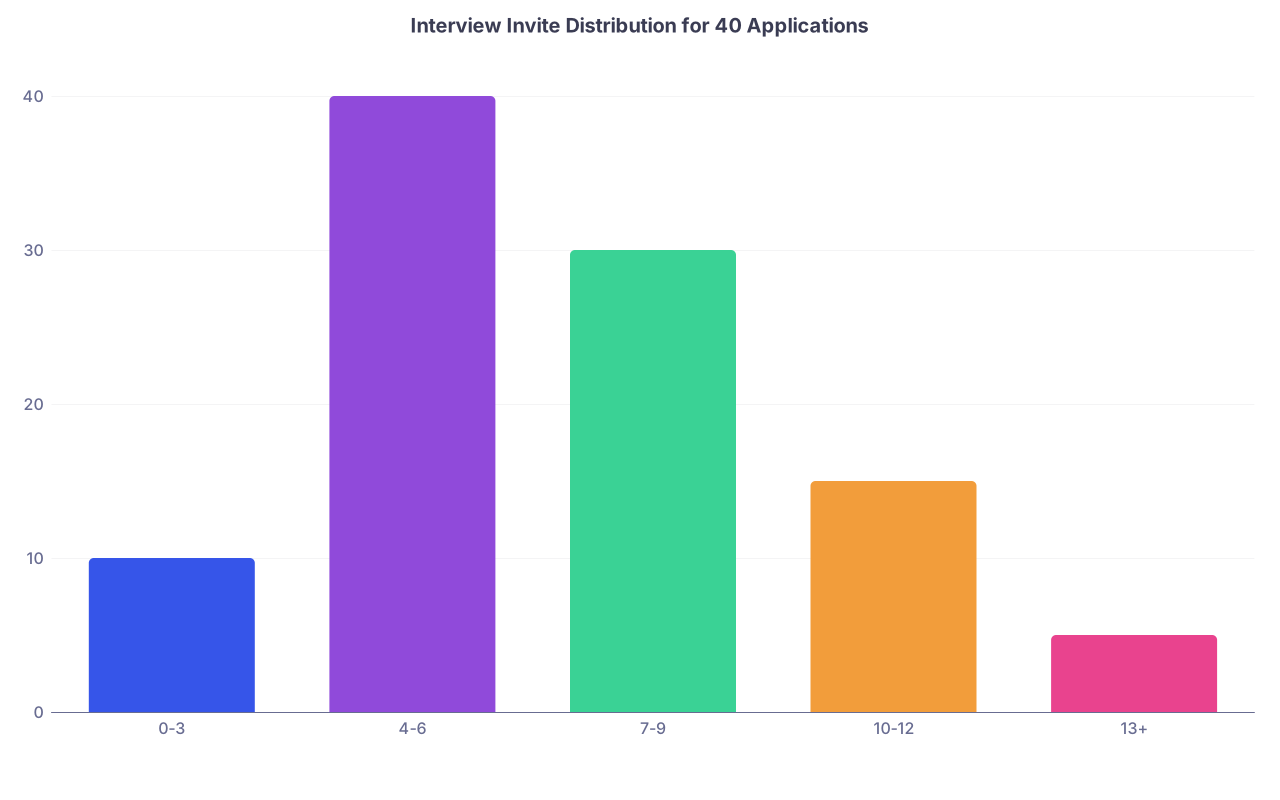
Rough distribution, based on real past years in some specialties:
- The majority of “40-application” competitive-field applicants land in the 4–10 interview range.
- Only a small fraction crack 13+ interviews—and those are usually hyper-competitive unicorns.
If you’re in that top fraction, good. You can decline early interviews strategically and still sleep at night.
How to Expand from 20 to 40 Without Just Throwing Darts
The solution is not “double to 40 randomly.” Smart breadth beats blind breadth.
Here’s how I’ve watched strong applicants expand intelligently.
1. Anchor with 10–15 Core Targets
These are your:
- Home program
- Places where you rotated
- Long-standing dream programs
- Logical regional fits (family, spouse, prior ties)
You’d apply to these regardless.
2. Add 10–15 “Solid Academic but Not Flashy” Programs
These are programs with:
- Decent case volume
- Average or above-average reputation
- Not on every premed’s fantasy list
You find them by:
- Asking residents in the specialty, “Where are the underrated places that train well?”
- Looking at match lists from mid-tier med schools, not just top-10s.
- Checking where faculty you respect trained—often you’ll see strong but less-hyped names pop up.
| Category | Number of Programs |
|---|---|
| Home + Away Rotations | 8–10 |
| Regional / Personal Ties | 8–10 |
| Solid Mid-Tier Academic | 12–15 |
| Geographic Stretch Options | 5–8 |
3. Add 5–10 Geographic Stretch Programs
This is where a lot of applicants get sheepish. “I don’t really want to live there.”
I’ve heard PDs say, out loud:
“Honestly, the person who’s willing to come to [less trendy city] and work hard usually ends up with plenty of cases and a strong experience. Half of our grads go to competitive fellowships anyway.”
You don’t have to rank them highly in the end. But having them on your list increases your overall interview count, which increases your match security everywhere.

What PDs Say About Applicants Who Apply Too Narrowly
Here’s the kind of commentary I’ve heard in real rooms.
About the applicant who applied to 18 derm programs, all “top 20”:
“I like them, but this is someone whose advising was off. They aimed at all the same places as the strongest applicants in the country. If they don’t match, are they going to blame us? They might end up scrambling.”
About the applicant with 42 ortho programs, wide geography, and solid but not insane stats:
“This is someone who understands what they’re up against. I don’t have to worry they’re going to implode if they don’t end up on the coasts. They want the field.”
That second perception matters. You’re not just a PDF; you’re interpreted. How broadly you applied sends a signal about your understanding of reality.
What Happens If You Overshoot and Don’t Need All 40?
Worst case if you “over-apply”:
- You withdraw from some interviews early once you realize your invite volume.
- You spend a little extra on ERAS fees.
- You have options.
Worst case if you under-apply in a competitive field:
- You spend a year in research you did not want.
- You take a prelim year in a different field hoping to reapply.
- You watch classmates with weaker stats but broader application strategies move on.
Seen all of those. More than once.

| Step | Description |
|---|---|
| Step 1 | Apply to 20 programs |
| Step 2 | Apply to 40 programs |
| Step 3 | Reasonable match odds |
| Step 4 | High risk of not matching |
| Step 5 | Strong match position |
| Step 6 | Interviews 5 or more |
| Step 7 | Interviews 4 or fewer |
| Step 8 | Interviews 8 or more |
| Step 9 | Interviews 5 to 7 |
| Step 10 | Interviews 4 or fewer |
Notice something: 40 doesn’t guarantee you safety. But it drastically shifts your odds of landing in the “reasonable to strong” interview territory instead of the danger zone.
Where I Draw the Line
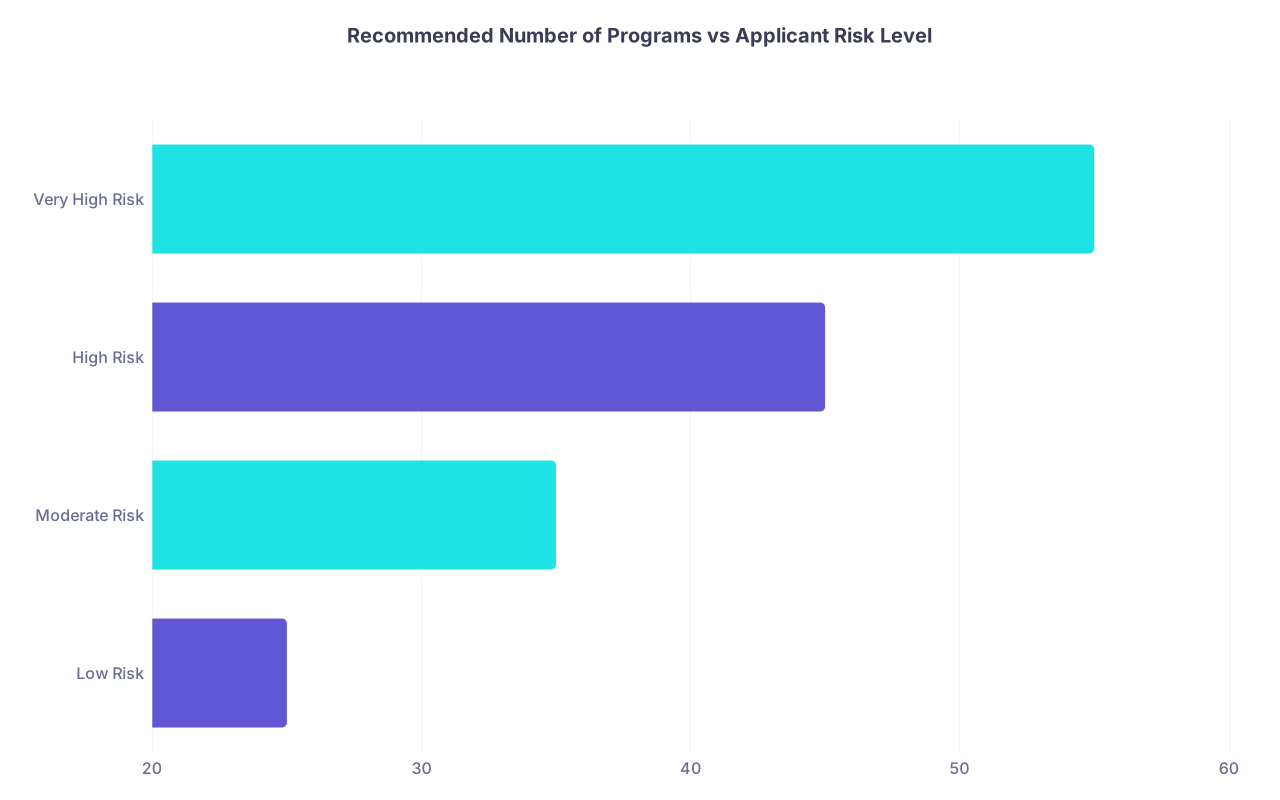
If you’re aiming at a competitive field and you’re not clearly in the very top tier—top school, top scores, strong home program pipeline—I’d set this as a blunt rule:
- Below 25 programs: you’re gambling.
- 25–35: acceptable if you’re moderately strong and geographically flexible.
- 35–45: where most serious applicants should live.
- 50+: only if you have multiple risk factors (IMG, nontraditional, low Step relative to field) and real financial flexibility.
| Category | Value |
|---|---|
| Low Risk | 25 |
| Moderate Risk | 35 |
| High Risk | 45 |
| Very High Risk | 55 |
This is closer to how PDs and specialty advisors in competitive fields think privately. They just rarely spell it out this directly.
FAQs
1. If I’m dual applying (competitive + backup), should I still go up to 40 in the competitive field?
If your primary goal is to actually match in the competitive field, yes, you usually should. What I’ve seen work best: 35–45 in the competitive field, then a strategic, not massive, number in the backup—often 15–25. When someone does the reverse (25 competitive, 40 backup), what they’re really signaling is that they’ve emotionally given up on the competitive field, and PDs in that field can often smell it.
2. Will applying to more programs hurt me if some of them are clear “reaches”?
Not in the way you think. There’s no penalty for being rejected silently. What’s dumb is applying to 20, making 15 of them huge reaches, and then acting surprised when you only get a couple of interviews. Applying to 40 with, say, 10–15 reaches, 20 realistic targets, and 5–10 “safer but solid” programs is actually rational. Commit the sin of being over-ambitious when you have a wide base underneath you, not when you’re standing on 20 programs and a prayer.
3. Is there any situation in a competitive specialty where you’d strongly recommend more than 50 programs?
Yes, but it’s rare and usually involves multiple stacked risk factors: IMG without US clinical experience, very low Step relative to the field, no home program in that specialty, and inflexible geography. For most US MD/DOs in competitive fields, once you cross ~45–50, the extra yield per program becomes pretty small. I’ve seen people apply to 80 derm or ortho programs out of pure panic. It didn’t save them. Smarter breadth at 40 would have done more than panicked breadth at 80.
Key takeaways:
- In competitive fields, 20 applications leaves you heavily exposed to randomness, screening quirks, and regional saturation; 40 starts to neutralize those forces.
- PDs quietly expect serious applicants in competitive specialties to apply broadly; too-narrow lists signal poor advising or unrealistic thinking.
- If you’re not clearly at the very top of the heap with strong home support, 35–45 programs in your competitive field is usually the rational, not excessive, choice.