
The most common residency application error is not under‑applying. It is building an application list that is “all reach, no safety.”
You will hear a lot of macho nonsense about “swinging for the fences” and “only applying where you’d actually be happy.” That mindset is how objectively qualified, hard‑working applicants end up unmatched, scrambling, or reapplying. Not because they were bad applicants. Because their list was bad.
Let me be blunt:
If your program list looks impressive on paper but does not include realistic safety options, you are gambling your entire career on your ego and poor risk assessment.
This article is about not making that mistake.
What “All Reach, No Safety” Actually Looks Like
You probably think you would never do this. Let me show you the quieter versions of this mistake that I see every year.
Classic patterns of a reach‑heavy list
-
- 30 applications
- 18–22 are “Top 20” or big‑name university programs
- 6–10 are mid‑tier, but very geographically desirable or highly competitive metro areas
- Zero true safety programs (lower‑tier, less desirable location, historically more IMG‑friendly, etc.)
-
- Applicant says, “I have to be in New York / California / Boston / Chicago.”
- Applies to 25–35 programs, all in one or two competitive metro regions
- Their stats are average for the specialty
- They tell themselves proximity to family or partner justifies the risk
- They do not include any realistic options in less dense areas of the same state or neighboring states
Prestige‑or‑bust list
- Applicant has solid, but not elite, credentials
- Applies almost exclusively to university or large academic centers with strong research reputations
- Avoids community programs because they “want an academic career” or “better fellowship chances”
- Refuses to acknowledge that their application does not match the typical profile of those top departments
-
- Step score(s) below national mean or a repeat score, red flags like a leave, failed course, or gap year
- Still applies to the same spread of programs as a clean, above‑average applicant
- Convinces themselves “programs are holistic now” and “they will see how much I have grown from my struggles”
- Safety programs either absent or very few, usually late add‑ons
Here is the core problem:
A “safety” is not defined by how you feel about it. It is defined by data.
How Risk Really Distributes Across Your List
You are not great at intuiting risk from program logos and vibes. No one is. Use numbers.
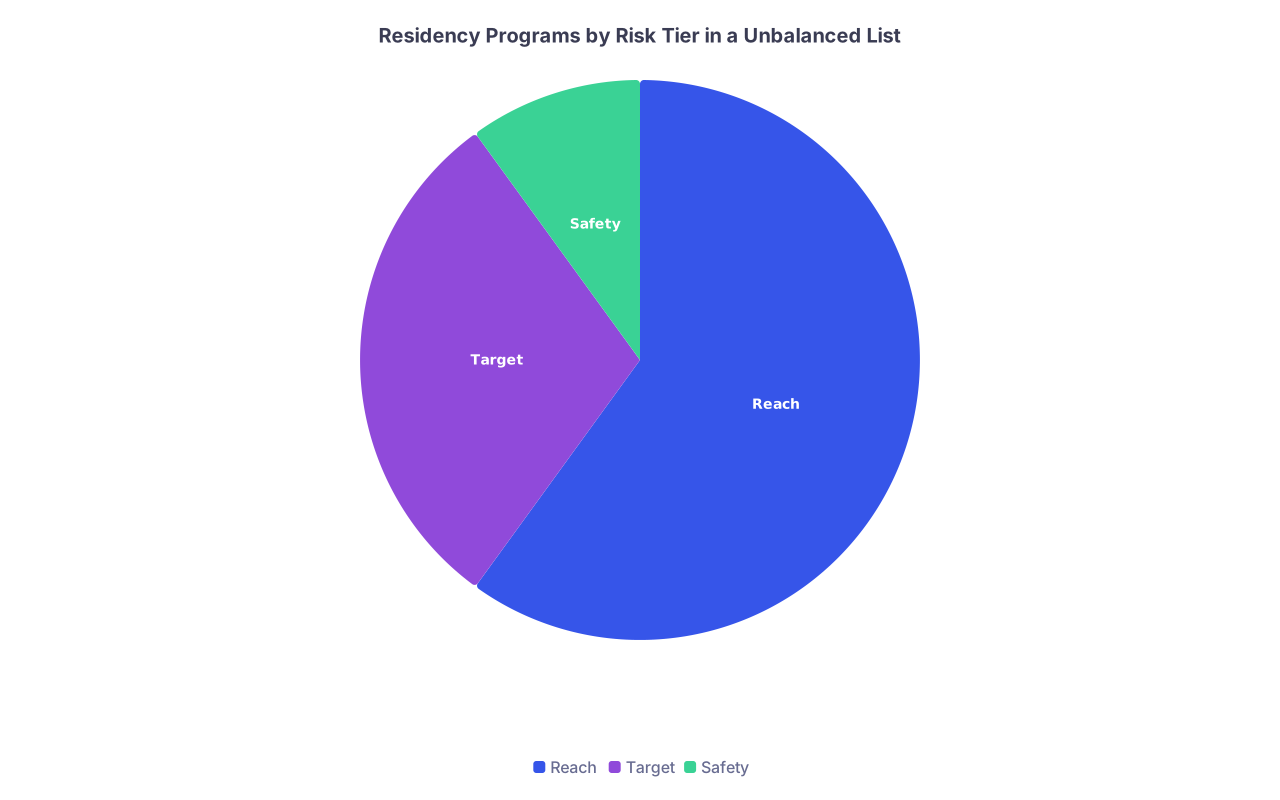
| Category | Value |
|---|---|
| Reach | 60 |
| Target | 30 |
| Safety | 10 |
In an “all reach, no safety” list, most of your applications sit in the “low probability” bucket. That is the definition of self‑sabotage.
What qualifies as reach / target / safety?
This is not perfect science, but your list should be honest:
Reach
- Programs where your scores, grades, and research are clearly below their usual matched residents
- Programs in extremely desirable locations that are flooded with high‑end applicants
- Programs with internal candidates heavily favored
Target
- Programs where your metrics, letters, and experiences roughly match their historical residents
- You can reasonably expect to get a few interviews if you apply widely in this tier
Safety
- Programs that have:
- A history of taking applicants with scores or profiles like (or weaker than) yours
- More community‑based or less famous reputation
- Less saturated geography (not NYC, SF, LA, Boston, Chicago, Miami for most specialties)
- You would not be thrilled to brag about matching there on day one. But you absolutely can train there and become a competent physician.
- Programs that have:
Where people go wrong: they emotionally relabel target programs as safety programs and reaches as targets. That is how the entire list slides upward into fantasy.
Why “All Reach” Lists Fail Even Strong Applicants
You might say, “But my scores are good. I did research. I will be fine.” No. I have watched people with Step 1 pass, Step 2 in the 240s–250s, decent research, and solid clinical grades go unmatched in competitive specialties because their lists were not built to protect them.
The residency match is not purely meritocratic. It is also:
- Random – Who actually reads your application.
- Noisy – What the department needs this year (more IMG? more DO? more home students?).
- Constrained – Programs have politics, informal quotas, and personal preferences.
You reduce that randomness by diversifying your list. Not by believing you are different.

The psychological traps that push you into all‑reach
Ego protection
- “I would rather go unmatched than go to [non‑prestigious program].”
- Translation: “I would rather take a huge permanent career risk than tolerate temporary discomfort to my ego.”
Peer comparison
- You see classmates bragging about their lists full of name‑brand places.
- You match their energy instead of matching their stats.
Family expectations
- Parents or partners pushing for specific cities, institutions, or perceived prestige.
- You build a list to satisfy them, not to maximize your chance of training.
Misreading anecdotes
- You hear, “My friend matched derm with a 235.”
- You never hear that she had 10 publications, a home program advocate, and rotated at 3 places that loved her.
- You only see the score and think, “I can too.”
Do not confuse survival bias stories with strategy. You never meet the people who tried the same approach and quietly went unmatched.
How Many Programs? The Number Is Useless Without the Mix
You want a rule like “Apply to 40 programs and you are safe.” That rule does not exist.
You can apply to 80 programs and still blow up your match if they are the wrong 80. What matters is distribution.
Rough distribution guidelines (not gospel, but safer than vibes)
Assuming you are applying in a moderately competitive specialty (IM, Peds, FM excluded; Derm, PRS, Ortho are more extreme):
| Applicant Profile | Total Programs | Reach | Target | Safety |
|---|---|---|---|---|
| Strong | 25–35 | 20–30% | 40–60% | 20–30% |
| Average | 35–50 | 15–25% | 40–50% | 30–40% |
| Below Avg / Red Flags | 45–70 | 10–20% | 30–40% | 40–60% |
For primary care (FM, IM, Peds), safety vs reach shapes differently, but the logic is identical: a meaningful chunk of your list must tilt in your favor.
For ultra‑competitive fields (Derm, PRS, Ortho, ENT, Neurosurgery), you must be even more brutal with yourself. Many “average” applicants in those fields should be dual‑applying, not just adding a few “safety” programs within the same specialty.
Red Flags That Your List Is “All Reach, No Safety”
Here is a quick self‑audit. If more than two of these are true, your list is not safe.
- More than 50–60% of your programs are in:
- CA, NY, MA, DC, Chicago, Miami, or other traditionally oversubscribed urban centers.
- You are applying predominantly to:
- University‑based or big‑name academic medical centers.
- You are avoiding:
- Community, hybrid, or “less famous” programs even if they have solid training.
- You have:
- A failed Step, repeated year, remediation, or major gap, but still fewer than ~40–50 total programs in a competitive specialty.
- You cannot clearly name:
- At least 8–10 programs where your stats are clearly above their historical averages.
- You describe programs you have no realistic shot at as:
- “Safer” because “they are not as famous as [big name].”
If you read this and feel defensive, pay attention to that. That is how people talk right before they build a dangerous list.
How to Add True Safety Programs Without Sabotaging Your Future
The objection I hear all the time: “If I go to a weaker program, I will never get a good fellowship or job.”
This is exaggerated. Yes, some doors are narrower. But from a weak program with strong performance you can:
- Match into solid fellowships.
- Build research later.
- Move geographically after training.
From being unmatched, your options shrink drastically.
Criteria for a genuine safety program
A program counts as safety only if:
Your metrics are clearly above their recent resident profiles
- If they publish resident schools and scores, you are above the mean.
- If they are IMG‑heavy or DO‑friendly and you are a US MD with decent scores, that likely helps.
Location is less saturated
- Mid‑size cities, smaller metros, or more rural locations.
- Less “destination” areas.
History of taking applicants like you
- Your school has matched there.
- They routinely interview and rank applicants from your background.
You would actually attend if it were your only match
- This matters. A “safety” you plan to rank at the bottom but secretly not attend is not real protection.

| Step | Description |
|---|---|
| Step 1 | Build Initial List |
| Step 2 | Check Stats vs Programs |
| Step 3 | Add Community and Less Competitive Regions |
| Step 4 | Review Red Flags |
| Step 5 | Recalculate Distribution |
| Step 6 | Finalize List |
| Step 7 | Enough Safety? |
| Step 8 | Red Flags Present? |
The Hidden Cost of Going Unmatched vs. Matching at a Safety
Let us be very clear about the stakes.
Cost of going unmatched
Time
- You lose at least one year. Sometimes more if you need to repair major red flags or retool your application.
Money
- Extra exam fees, application fees, away rotations, maybe unpaid research or prelim year.
Psychological damage
- The hit to your confidence is not trivial. I have watched strong people spiral.
Stigma and narrative
- You now have to carry “unmatched” in your story.
- Every program next cycle wonders, “Why did others pass on them?”
Cost of matching at a “safety” program
- Ego discomfort for a few months
- Possibly:
- Less research infrastructure.
- Fewer big‑name mentors.
- More effort required to secure top fellowships.
But you are a physician in training. Your income, career, and identity are moving forward. You are not sitting outside the system trying to claw your way back in.
Given those two paths, choosing “no safety, all reach” is simply bad risk management.
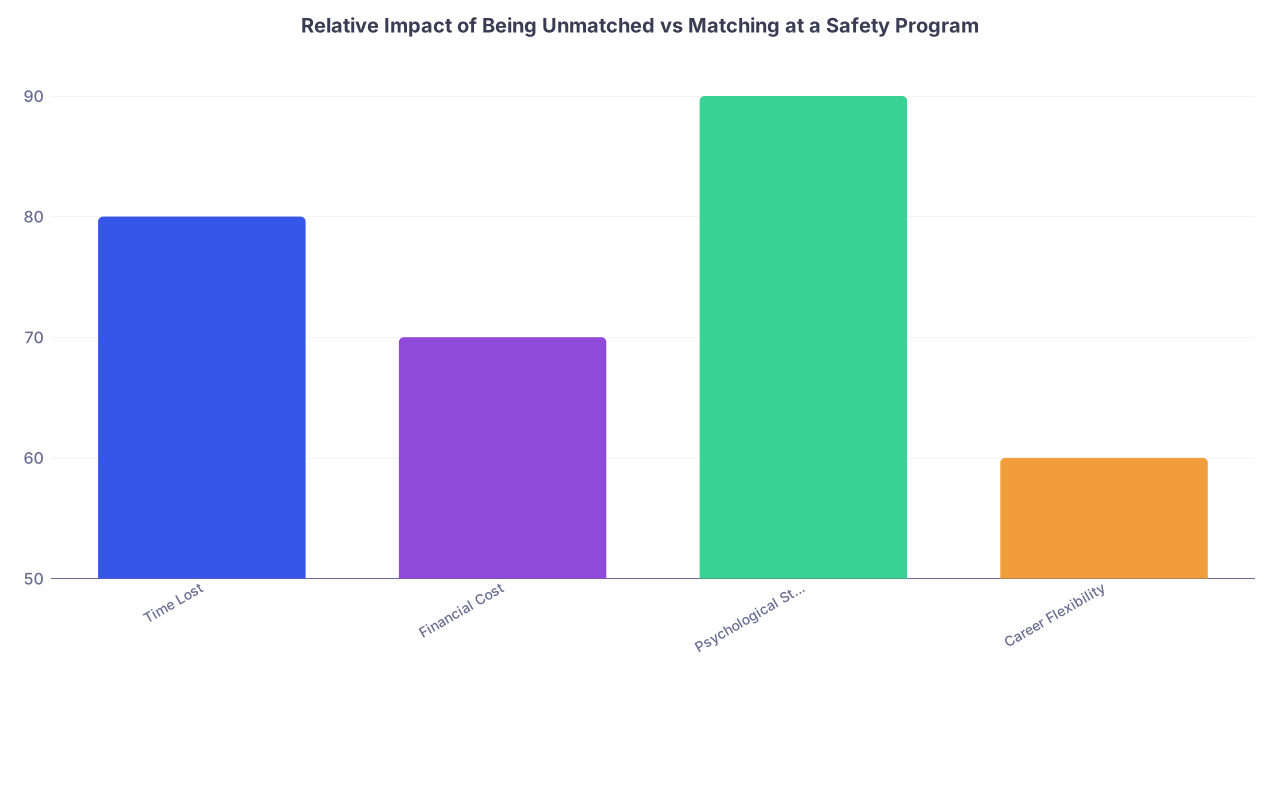
| Category | Value |
|---|---|
| Time Lost | 80 |
| Financial Cost | 70 |
| Psychological Stress | 90 |
| Career Flexibility | 60 |
(Think of those bars as “harm level” from going unmatched. Safety program harm is far lower on every axis.)
Concrete Steps to Fix a Reach‑Heavy List This Week
Here is how you clean this up before the damage is permanent.
Get real benchmarking
- Use:
- NRMP Charting Outcomes for your specialty.
- Program‑specific data (resident profiles, med schools, DO/IMG mix).
- Compare your:
- Step 2 score
- Clinical grades
- Research output
- Class rank if available
- Decide honestly if you are below, at, or above the typical matched candidate.
- Use:
Mark each program R/T/S
- Go through your entire spreadsheet.
- Label each as Reach, Target, or Safety. Not what you wish it was. What it actually is.
- If more than ~30–40% are Reach, you have a problem.
Intentionally add safety programs
- Search:
- Less glamorous cities and regions.
- Community and hybrid programs with good reviews from residents.
- Aim to add:
- 8–15 genuine safeties, depending on specialty and your risk level.
- Search:
Talk to someone who will not flatter you
- Program director, advisor, or recent grad in your specialty.
- Show them:
- Your stats.
- Your labeled list.
- Ask: “Where am I delusional? Where do I need more safety?”
- If no one is disagreeing with you on anything, you are probably talking to the wrong people.
Decide what you care about more: location, prestige, or matching
- You do not get to optimize all three.
- For most people, the correct priority is:
- Matching
- Training quality
- Everything else (location, prestige, coat color, cafeteria food)
Be honest about that. Then fix your list to reflect your actual priorities.
FAQ (Exactly 5 Questions)
1. How many residency programs should I apply to if my stats are average for my specialty?
For most moderately competitive specialties, an average applicant is safer in the 35–50 program range. But again, this number is useless unless the distribution across reach, target, and safety is sane. Applying to 40 reach‑heavy programs is worse than applying to 25 with a balanced mix.
2. Is it really that dangerous to focus my list on one city or region?
If that region is highly competitive (major coastal metros, academic hubs), yes, it is dangerous. You drastically increase the chance that local saturation and internal candidate preference squeeze you out. If you tie your entire career to one city, you must accept a higher unmatched risk. You cannot fix that by just “applying to more programs” in the same crowded location.
3. I have a major red flag (failed Step, remediation). Should I even bother with reach programs?
You can include a small number of reach programs, but they should not dominate your list. If you have serious red flags, your safest move is a list where 40–60% are true safety programs and reach programs are a minority. The mistake is acting like your red flag does not exist and building the same list as a clean applicant.
4. Are community programs really acceptable, or will they ruin my fellowship chances?
A community program will not “ruin” your career. It may require more hustle to build research and connections, but many residents at community or hybrid programs match into strong fellowships every year. What ruins careers is being unmatched or spending years trying to re‑enter training. Your skill, work ethic, and mentorship matter more than the logo on your badge.
5. What if I truly would rather reapply than attend my safety programs?
Then you need to interrogate whether those are real safety programs for you. If there are programs you would actually refuse to attend, do not list them at all. But then be honest: you are choosing a higher risk path. If you decide to accept that risk, do it consciously, not while pretending your all‑reach list is somehow “balanced.” For most people, that trade is not worth it.
Key takeaways:
- An “all reach, no safety” list is not brave. It is reckless.
- Your protection in the Match comes from distribution across reach / target / safety, not just total number of applications.
- Matching at a solid safety program beats being unmatched by a mile, every single time.