

The quiet bias against your country’s medical training is often more dangerous than open hostility—and you will face it.
If you’re an IMG, you’re not just applying as “you.” You’re dragging your entire country’s reputation into every Zoom interview, every ERAS screen, every sideways comment someone makes about your med school.
Let’s deal with that head‑on.
You’re not going to “inspire” program directors out of their stereotypes by being nice and hoping they notice your worth. You need a strategy—before ERAS, on paper, and in the room.
This is that strategy.
1. Understand the Stereotypes You’re Actually Fighting
You cannot counter what you haven’t named. Let me lay out the stuff people will rarely say to your face but will absolutely think.
Common quiet assumptions US faculty make about certain countries’ medical training:
- “Their clinical exposure is mostly observation, not hands-on.”
- “They memorize well but can’t manage patients independently.”
- “Their exams are easier; their ‘honors’ mean nothing here.”
- “Their schools inflate grades; we can’t compare them to US schools.”
- “They’ve never worked in a system with our EMR, insurance, or interdisciplinary teams.”
- “Communication and professionalism expectations may be different.”
- “Their research isn’t rigorous or is poorly supervised.”
And then there are country-specific stereotypes:
- Some regions: “Great diagnosticians, weak on documentation.”
- Others: “Strong test-takers, weak on bedside communication.”
- Others: “They cut corners / don’t follow guidelines.”
- Others: “Corruption, bought rotations, paid-for research authorship.”
Is all of that fair? No. Does it exist? Yes. I’ve heard versions of every one of those from attendings doing rank meetings.
You’re not going to fix global bias. Your job is much narrower:
- Identify which 2–3 stereotypes hit your country/school the hardest.
- Systematically give programs proof that you’re the exception—and ideally, that their stereotype is outdated.
2. Diagnose Your Specific “Country Penalty”
Not all IMGs are fighting the same fight. A graduate from Charité in Germany is dealing with something very different from a graduate of a tiny unaccredited offshore school.
You need an honest read on how your background lands in US eyes.
Here’s how to get it:
Talk to IMGs from your country who matched recently
Ask very specific questions:- “What did interviewers question about your training?”
- “Did anyone make comments about your med school or country?”
- “What did they seem skeptical of—clinical skills, documentation, language, professionalism?”
Look at where your school’s alumni actually match
If 90% match into community IM programs and almost nobody hits competitive fields, that’s a signal. Not about your worth, but about what biases you’re walking into.Ask US mentors directly
If you’ve done US rotations, ask an attending you trust:- “If a PD was skeptical about my country’s training, what do you think they’d worry about?” Then shut up and let them talk. The discomfort you feel hearing it is data.
Now write down your top three “likely doubts.” Something like:
- Clinical autonomy
- Documentation/EMR
- Communication/culture fit
Those become your targets.
3. Build a Paper Trail That Contradicts the Stereotype
You don’t wait for the interview to start fixing this. You start in ERAS.
Your application must visibly contradict the lazy assumptions about your country’s training.
a) US clinical experience that actually means something
If your country is viewed as “weak clinically,” you don’t fix that with one 4-week observership and a smile.
You need:
- Hands‑on US clinical experience if at all possible (acting intern, sub‑I, externship). Not just shadowing.
- At least 2 strong US letters that explicitly say things like:
- “Functioned at the level of a US graduating medical student.”
- “Managed 8–10 patients with increasing independence.”
- “Accurate, thorough documentation in our EMR.”
Get your letter writers to hit those points. Do not be vague. Tell them directly:
“My background as an IMG sometimes raises concerns about clinical autonomy and documentation. If you feel it’s accurate, could you comment specifically on those aspects?”
Good attendings will understand exactly what you’re doing.
b) Exam performance that shuts people up
If your country’s exams are seen as “too easy,” your Step scores and other standardized tests are your weapon.
If you can, you want:
- Step 2 CK at or above the program’s average matched score.
- OET / TOEFL (if needed) with high marks, especially in speaking.
Programs use these as a proxy: “Okay, at least the knowledge base is there.”
c) Concrete description of clinical training
Do not assume US faculty know anything about your system. They often don’t.
In your ERAS experiences, specify:
- Patient volume (“Managed 15–20 inpatients daily under supervision of attending.”)
- Setting (“Tertiary care teaching hospital serving 1.5 million population.”)
- Responsibilities (“Led daily rounds, wrote notes, placed orders under supervision, called consults.”)
You’re translating “random foreign rotation” into something a US PD can compare to their own med students.
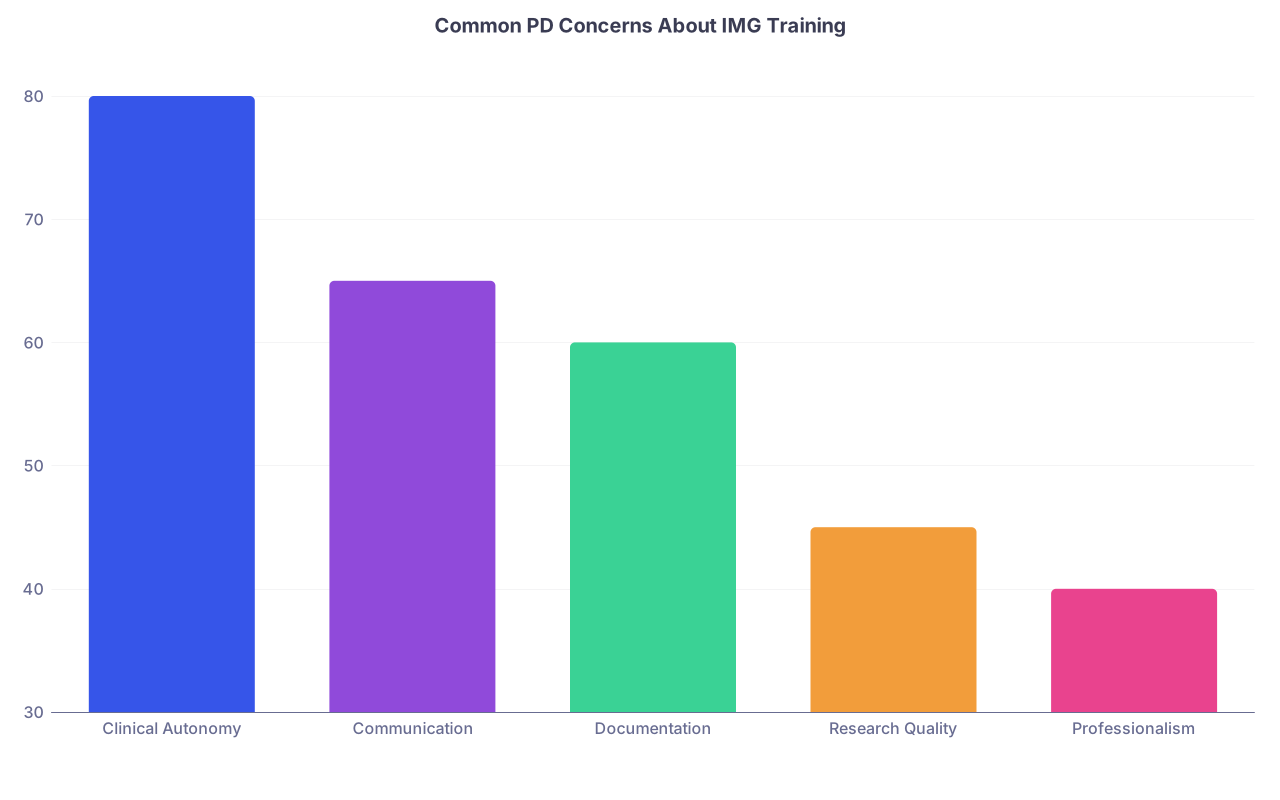
| Category | Value |
|---|---|
| Clinical Autonomy | 80 |
| Communication | 65 |
| Documentation | 60 |
| Research Quality | 45 |
| Professionalism | 40 |
4. Rewrite Your Personal Statement Around the Bias You’re Facing
Most IMG personal statements are generic: “I love internal medicine because…” Nobody cares. Your statement is a surgical tool.
You’re aiming for:
- One or two very clear examples showing how your specific training environment produced strengths that matter in the US system.
- One subtle but strong demonstration that you understand the gaps and have already filled them.
Example pattern if your country is known for high volume but low structure:
- Paragraph 1: Very short story about your first few months in a chaotic hospital—too many patients, too few resources, and how you had to become efficient and clinically sharp quickly.
- Middle: How you realized US systems emphasize structure, documentation, and guidelines—and how your US rotations forced you to layer that on top of your existing high-volume experience.
- Last part: One clinical vignette in the US where you used the speed and diagnostic pattern recognition from home + the documentation and team communication you learned here.
You’re not writing an apology letter for your country. You’re showing:
- “Yes, I know what you’ve heard about where I trained.”
- “Here’s what’s actually true in my case.”
- “Here’s why I’m more prepared for your residency than someone who never had to deal with those constraints.”
5. Prepare Direct, Calm Answers for Loaded Interview Questions
At some point, someone is going to question your country or your training. Sometimes it’s subtle, sometimes not.
You do not look offended. You do not get defensive. You also do not dodge.
You answer like this is the 20th time you’ve heard that concern and you have data.
Scenario 1: “How is medical training in [your country] different from the US?”
Bad answer:
“Training is actually very good. We see a lot of patients and learn a lot.”
Better answer:
“In my school, clinical exposure started early, in third year. By my final year I was managing 15–20 inpatients daily under supervision, with a big focus on physical exam and clinical reasoning.
The main differences from what I’ve seen in the US are:
- Less emphasis on documentation and EMR.
- Fewer formal structured teaching sessions, more learning on the job.
- Higher patient volume, but sometimes less advanced technology.
Because of that, I made sure my US rotations focused on documentation, guideline-based care, and working in multidisciplinary teams, so I’d have both perspectives.”
You’re acknowledging the limitation without trashing your own system.
Scenario 2: “We sometimes worry that graduates from [region] have less hands-on experience. How would you respond to that?”
Try something like:
“That’s a fair concern, and it varies a lot by school and hospital. In my case, as a final-year student I was:
- Writing daily notes,
- Presenting on rounds,
- Placing orders under supervision,
- Calling consults,
similar to a sub‑intern role here.
Then during my US rotation at [Hospital], I functioned as part of the intern team. Dr. X wrote in their letter that I ‘functioned at the level of a US sub‑intern in managing a full patient load and documentation.’ So I understand why that stereotype exists, but my personal training has been very hands-on.”
Notice what you’re doing:
- You don’t argue whether the stereotype is “true” in general.
- You show why it doesn’t apply to you, with receipts.

6. Turn “Weaknesses” of Your System Into Clear Advantages
Your country’s system is not just a liability. It gave you things US grads often lack.
Do not just say “My training was challenging.” That’s generic. Show very specific, residency-relevant strengths your environment built:
Examples:
- High volume → comfort managing many patients, triaging acuity, handling pressure.
- Limited diagnostics → strong physical exam skills, differential building, cost-consciousness.
- Resource constraints → creativity, problem-solving, prioritization.
- Different disease patterns → unique exposure (e.g., TB, rheumatic heart disease, advanced presentations).
- Hierarchical systems → you learned to advocate for patients even within rigid structures.
Then you link those to US expectations:
- “Because I trained in a system where I might see 30+ patients in a clinic day, I’m comfortable managing high volume while staying organized.”
- “Working without immediate CT/MRI for every headache forced me to lean heavily on history and exam, which has been very helpful in my US rotations as well.”
You’re not bragging. You’re explaining why their bias is actually short-sighted.
7. Deal With Microaggressions and Backhanded Comments Without Losing Ground
Someone will say something stupid. A resident, an attending, even a PD.
Things I’ve heard:
- “Oh, so you’re a ‘Caribbean grad’—couldn’t get in here the first time?”
- “Did you buy your research position?”
- “Do you actually get to touch patients there?”
- “You must be good at memorizing; our system requires more critical thinking.”
You have three priorities:
- Protect your dignity.
- Keep the door open (this person might still be writing an eval).
- Leave a subtle correction.
Example responses:
Comment: “Do you guys actually use EMRs back home, or is it all paper?”
Response:
“We’re mostly paper-based, and I agree that was a gap I needed to close. During my US rotations I’ve used Epic extensively, writing full notes and placing orders under supervision. So by now I’m comfortable with both systems.”
Comment: “Some programs say grads from [your region] struggle with professionalism. What do you think of that?”
Response:
“I’ve heard that concern too. Standards and culture can be different across systems. For me, working in US hospitals, I’ve adapted to the expectations here by [specific example: pre-rounding reliably, communicating changes promptly, using closed-loop communication]. My evals from those rotations consistently highlighted reliability and teamwork, so I think my actions speak for themselves.”
Comment (more pointed): “A lot of foreign schools are basically businesses. How do we know your training was solid?”
Response (steady, not hostile):
“You’re right that there’s a wide range of schools outside the US. Mine is [describe briefly: public teaching hospital, affiliated with…]. Our students take [national standardized exams / international exams], and many graduates are now in US residencies at [name 1–2 programs if you can].
Beyond that, I think what matters is what I’ve done since—my US clinical work, Step scores, and letters. Those show how I perform in the same environment as your current residents.”
You’re not there to win a debate about global medical education. You’re there to show you can handle uncomfortable questions like a professional.

| Step | Description |
|---|---|
| Step 1 | Recognize stereotype |
| Step 2 | Stay calm |
| Step 3 | Name concern directly |
| Step 4 | Provide specific counter evidence |
| Step 5 | Link to US experience |
| Step 6 | End with readiness for residency |
8. Use Data and Structure To Reassure Risk-Averse Programs
Program directors are not villains. They’re risk managers. With limited interview slots, they tend to favor:
- What they know.
- What has worked before.
- What looks predictable.
Your job is to convert “unknown foreign variable” into “low-risk, well-understood candidate.”
Practical moves:
Highlight alumni from your school in US programs
In your CV or interview:- “Graduates from my school are currently residents at [X, Y, Z US programs]. Seeing their paths encouraged me to pursue similar training.”
Show progression within US systems
If you can:- Observership → externship → research → USCE with responsibility.
That sequence says: “I’ve been tested in your environment repeatedly and I stick.”
- Observership → externship → research → USCE with responsibility.
Use your CV to show stability and professionalism
- Long-term commitments (multi-year research, sustained volunteering, leadership).
- No pattern of bouncing around every few months.
Programs worry about IMGs ghosting, struggling with communication, or not understanding the grind. You show the opposite: you commit, you finish, you grow.
| Concern About Training | Concrete Countermeasure |
|---|---|
| Limited hands-on experience | Multiple USCE with strong letters describing autonomy |
| Weak documentation/EMR | Notes and orders in Epic/Cerner during US rotations, letter mentions |
| Overemphasis on memorization | Research, QI projects, case discussions that show reasoning |
| Questionable exam rigor | Strong Step 2 CK, maybe extra exams (e.g., ITEs, in-service where possible) |
| Professionalism/culture gap | Consistent long-term roles, mentorships, strong professionalism comments in evals |
9. Decide When (and How) To Address Country Bias Proactively
You don’t need to bring up stereotypes in every interview. That can come off paranoid or bitter.
You consider raising it when:
- Your country has a notorious reputation (everyone in GME knows it).
- Or an interviewer hints at it but doesn’t quite say it.
How to do it without sounding defensive:
“In the past, I know some programs have had concerns about how well graduates from [my country/region] adapt to US residency, especially concerning [clinical autonomy/communication/etc.].
Because I was aware of that, I made sure to…
- Seek out US rotations where I had real responsibility,
- Focus on documentation and interprofessional communication, and
- Ask my attendings to give me honest feedback.
Their feedback, and my letters of recommendation, reassured me that I’ve closed those gaps and that my background is now a strength rather than a liability.”
Short. Factual. Controlled.
You are signaling:
- Self-awareness.
- Proactivity.
- Emotional maturity.
That combination is more important than whatever your dean said in your MSPE.
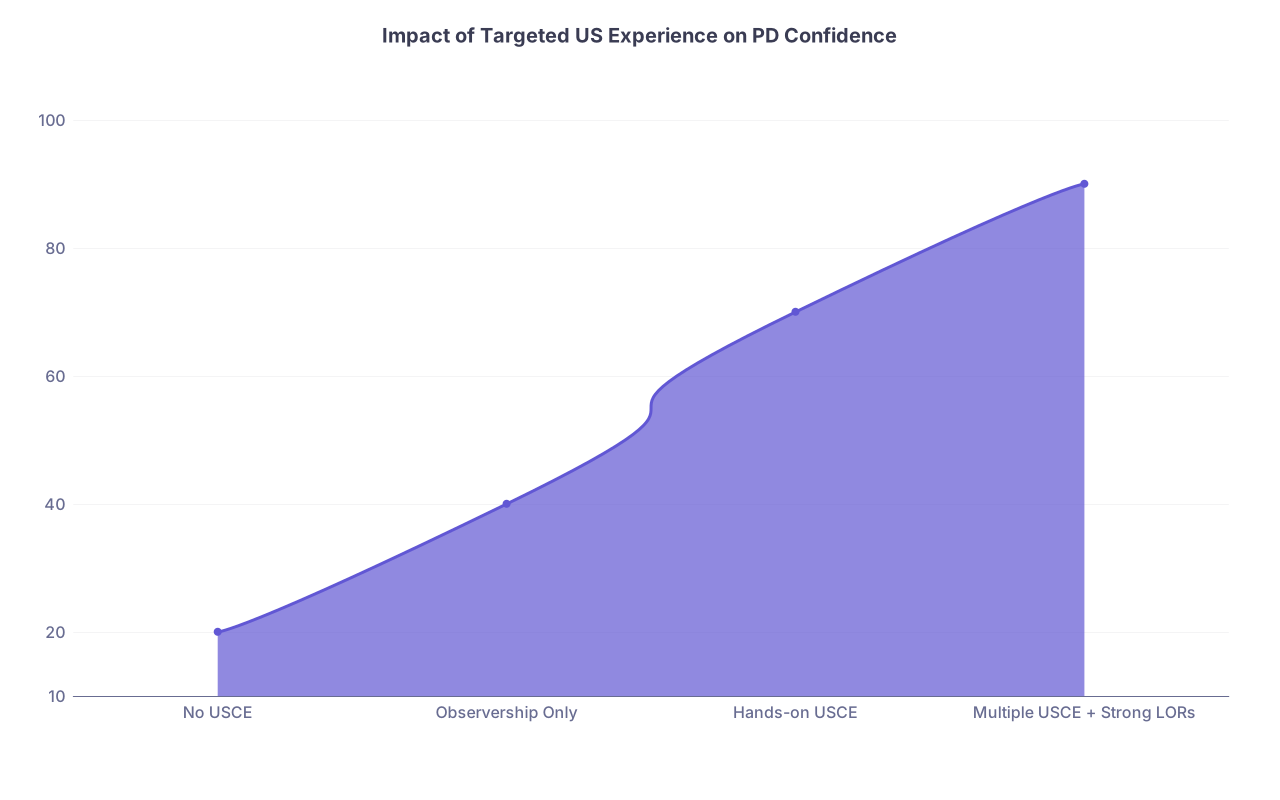
| Category | Value |
|---|---|
| No USCE | 20 |
| Observership Only | 40 |
| Hands-on USCE | 70 |
| Multiple USCE + Strong LORs | 90 |
10. Mental Game: Not Internalizing the Stereotypes
Here’s the part nobody talks about. This stuff gets under your skin.
You hear enough comments about “foreign grads” and suddenly every misstep feels like you’re proving them right. That’s how people burn out or become overly apologetic in interviews.
You need a mental framework:
- Their stereotype is about a distribution, not about you.
- Your job is to show where you sit on that distribution.
- Their bias might slow you down, but it doesn’t define your ceiling.
Practical things that help:
- Have 1–2 mentors (ideally in the US) who can reality-check you: “No, that was not about your country; that was just a tough question.”
- After bad moments, write down exactly what was said, then write a better answer. Turn it into fuel.
- Do mock interviews specifically focused on “awkward” questions—country, accent, training differences.
If you walk into interviews trying to “prove you belong,” they will smell insecurity. You walk in like someone who already knows their own value and is simply presenting the evidence.
Not cocky. Calm.
11. If You’re Early: Build These Defenses Before You Apply
If you’re still 6–24 months out from ERAS, you have a chance to design your application roughly like this:
- At least 2 substantial US rotations with real responsibility.
- One US mentor willing to be brutally honest and write a detailed letter.
- Documented QI or research work that shows you can function in US academic culture.
- A personal statement and answers that directly address your top 2–3 country-level concerns.
Think of it as preemptive damage control. When a PD says, “We worry about X with graduates from that country,” your file and your story should already scream: “I know. Here’s what I did.”
Open a blank document today and write down three things:
- The top three negative stereotypes you suspect exist about your country’s training.
- One specific experience or achievement you already have that contradicts each one.
- One concrete step you can take in the next 30 days to strengthen your case for each (a rotation to arrange, a letter to request, a mock interview to schedule).
That’s your to-do list. Don’t just hope the bias won’t show up. Assume it will—and be ready when it does.


