
The people who say “accent doesn’t matter, only merit does” are lying to you—or at least ignoring reality.
You and I both know it. You see it when a friend with a perfect Step 1 and glowing LORs doesn’t get interviews. You see it when attending physicians slow down their speech for some residents but not others. And you definitely feel it every time you hit “join meeting” on Zoom and wonder if your first sentence will secretly decide your fate.
Let me say the scary part out loud: yes, your accent can affect how people perceive you.
But here’s the part nobody tells you clearly enough: it’s almost never the accent itself that blocks the match. It’s what the interviewer thinks your accent means—communication problems, patient misunderstanding, team friction. Those are the landmines. And those are what you can actually do something about.
You’re not crazy for worrying about this. I worry about this. A lot.
Let’s unpack it properly.
What Programs Really Worry About With “Strong Accents”
They don’t care that you don’t sound American. They care they might have to repeat orders three times on a hectic night shift, or that Mrs. Johnson with COPD won’t understand her inhaler instructions.
They aren’t ranking “American-sounding” first and “foreign-sounding” last. They’re thinking:
- Will this resident be safe on call?
- Will patients understand them enough to give informed consent?
- Will nurses and consultants get frustrated and start bypassing them?
- Will I have to deal with complaints that “your doctor doesn’t speak clear English”?
It’s ugly, but it’s the job. Residency is a communication-heavy profession.
Here’s what I’ve actually seen:
- An IMG with a heavy accent but crystal-clear structure to their answers, who checked for understanding and spoke slowly, absolutely crushed interviews and matched IM at a solid university program.
- Another IMG with much lighter accent but mumbled, rushed through words, and couldn’t repeat a question clearly—several programs literally wrote “communication concerns” in post-interview notes.
So yeah, the accent is visible. But what matters is whether it interferes with communication, not whether it sounds like CNN.
To make this less abstract:
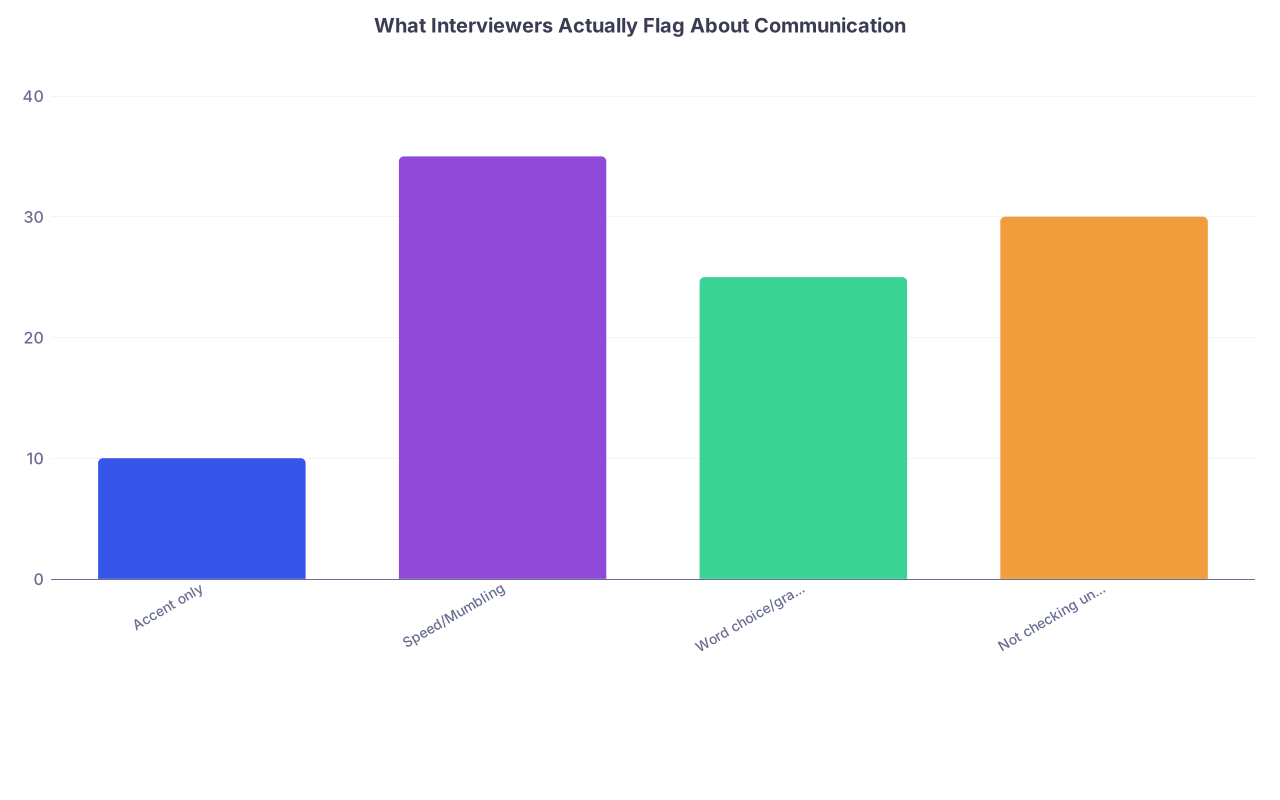
| Category | Value |
|---|---|
| Accent only | 10 |
| Speed/Mumbling | 35 |
| Word choice/grammar | 25 |
| Not checking understanding | 30 |
Those numbers aren’t from some perfect study; they’re roughly what faculty talk about behind closed doors. Accent by itself is rarely the main complaint.
The Worst-Case Scenario You’re Afraid Of (Let’s Say It)
I know the narrative in your head. Something like:
“I’ll join the Zoom room, say ‘Hello Dr. Smith, thank you for meeting with me today,’ and they’ll instantly decide ‘too foreign, next.’ My entire application, my Step scores, my research, my letters—wasted because of how my first sentence sounds.”
If you’ve ever replayed your own recorded voice and thought, “Oh God, I sound like this?”—yeah, same.
Here’s the harsh truth and the uncomfortable comfort:
- There are biased people who will hear your accent and mentally downgrade you.
- But residency selection isn’t usually one person deciding in a vacuum. It’s a committee. With notes. With some people who are used to working with IMGs and actually value them.
- And most programs have had fantastic IMGs with strong accents who outworked everyone and made them look good. That memory fights against knee-jerk bias.
Is there a non-zero chance one interviewer dismisses you based on accent before you finish your second sentence? Yes.
Is it likely that every interviewer at every program will do that, to the point you can’t match anywhere? No. That’s catastrophizing. (And I say that as someone who catastrophizes professionally.)
Your goal isn’t to erase all bias. That’s impossible. Your goal is to make your communication so obviously functional and safe that their brain switches from “accent?” to “oh wow, this person is clear, composed, and easy to follow.”
The Line Between “Strong Accent” and “Communication Concern”
Let me draw the line clearly, because programs actually talk about this.
You’re usually fine if:
- Your sentences are structured and easy to follow.
- You don’t rush. You leave small pauses.
- You pronounce key medical words understandably, even if not perfectly.
- When asked to repeat or clarify, you don’t get flustered—you calmly rephrase.
- Your facial expressions and body language match what you’re saying (smiling, nodding, leaning in a bit).
You might be in trouble if:
- People regularly ask you to repeat basic questions in normal conversation.
- Even your IMG friends sometimes say “wait, say that again?”
- On Zoom, your words blur together when you get nervous, and you know it.
- You avoid speaking up in rounds because you’re afraid no one will understand you.
That second category? That’s not “accent.” That’s understandable hesitation, anxiety, and speed making things worse. All of which you can change.
Think of it like this: the bar is not “sound like a native speaker.” The bar is “can a tired nurse at 3 am understand your verbal order the first time?”
If yes, you’re already over the line. The rest is polishing.
Concrete Things You Can Do Before Interviews (That Actually Work)
I’m not going to tell you “just be confident, you’ll be fine.” You don’t need motivational posters. You need a plan.
1. Get brutal, specific feedback—then fix patterns
Not from your mother. Not from your best friend who says “you sound fine.”
You need at least one of these:
- A US-based friend (med or non-med) who’ll be honest.
- A communication coach / ESL instructor used to working with professionals.
- A resident or attending who has supervised IMGs and is willing to give you 20 honest minutes.
Ask them to listen to you answer 3 common interview questions:
- “Tell me about yourself.”
- “Why this specialty?”
- “Tell me about a time you made a mistake.”
Record yourself. Send it to them. Ask very plainly:
- Do you understand everything I’m saying the first time?
- When do I become harder to understand—fast parts, long sentences, certain words?
- Are there specific sounds or words that are consistently unclear?
Write patterns down. Then intentionally fix patterns, not random words.
2. Slow down more than feels natural
Every IMG I know—myself absolutely included—speeds up when nervous. That’s when accent becomes “unintelligible.”
If you feel like you’re speaking at 0.75x speed, it probably sounds normal to them.
Practice this:
- Take your “Tell me about yourself” answer.
- Record it at your normal speed.
- Now record again deliberately 20–30% slower, with small pauses between phrases.
- Compare. The “slower” one almost always sounds more confident and easier to follow.
Make that your default.
3. Script and drill your “first 60 seconds”
The most anxiety comes from the beginning of the interview. That’s when your brain screams “They’re judging how I sound!”
So you script and over-practice the first minute so hard that your mouth can do it while your anxiety is having a meltdown in the background.
For example:
“Good morning Dr. Smith, thank you for taking the time to speak with me today. I’m Dr. [Name], an international graduate from [School, Country]. I’ve spent the last year in the US working on [Research/Observership/Clinical Experience] at [Institution], and I’m very excited to learn more about your program.”
You say this 50 times. Out loud. On camera. Until it becomes muscle memory. Then that first impression—the “oh no, how do I sound?” moment—is not improvised. It’s controlled.
4. Practice with real online conditions
Don’t just talk to the mirror. Simulate reality.
Use Zoom or whatever platform you’ll likely use. Get a friend to call in. Record the session.
Then listen to it with cruel honesty. Ask:
- Do I cut off the interviewer?
- Do I wait half a second after they finish before speaking? (lag is real)
- Do I talk over them when I get nervous?
- Does my audio quality make my accent sound worse?
If your mic is trashy and echoes, your accent will sound heavier and less clear. A $20 USB mic or decent headphones can make a ridiculous difference.
5. Watch how successful IMGs with accents speak
Find YouTube videos of accented physicians or residents explaining topics. Look for people whose accent is strong but still easy to follow.
Watch:
- How they pause.
- How they over-articulate key words.
- How they keep their sentences shorter.
- How they use facial expressions and hands to reinforce what they’re saying.
You’re not copying their accent. You’re copying their clarity habits.
How Programs Actually Evaluate You (Not Just Your Voice)
Just to keep your brain from spiraling too far, zoom out for a second.
Programs aren’t listening to your voice in a vacuum. They’re comparing dozens of things at once:
| Factor | How Much It Competes With Accent Concern |
|---|---|
| USMLE scores | High |
| US clinical experience | High |
| Letters of recommendation | High |
| Interview content quality | Very High |
| Professionalism | Very High |
| Accent / speech clarity | Medium |
An accent that slightly increases “processing effort” in the listener’s brain can absolutely be outweighed by:
- Strong clinical reasoning in your answers.
- Clear, organized stories.
- Obvious humility and teachability.
- Evidence you’ve functioned well in US healthcare already.
I’ve watched ranking meetings where:
- Someone said: “I had to really focus to catch everything at first, but their cases were excellent and they were very thoughtful. I’d absolutely work with them.”
- Another: “They were native-speaking but all their answers were vague. I don’t know how strong they are clinically.”
Guess who went higher on the list.
Bias Is Real. So Are Workarounds.
I’m not going to gaslight you with “Just be yourself, you’re enough!” You are enough as a human, yes. But as an applicant in a competitive, biased system? You need strategy.
Here’s the brutal but empowering truth:
- You probably can’t delete your accent without years of immersion—and you don’t need to.
- You can absolutely make your communication sharp enough that most reasonable interviewers will not see you as a risk.
- A small subset of programs or interviewers will always prefer “native-sounding.” You will not change them. You just don’t build your future around them.
Where you have leverage is this triangle:

| Step | Description |
|---|---|
| Step 1 | Accent |
| Step 2 | Clarity |
| Step 3 | Speed and Pausing |
| Step 4 | Structure of Answers |
| Step 5 | Perceived Safety |
You can’t fully control A. You can aggressively control C and D, which feed into B, and that’s what creates E—perceived safety. That’s what programs care about.
How to Stop the “I’ll Never Match Because of My Accent” Spiral
Your anxiety will not disappear. Mine certainly doesn’t. But you can contain it.
Do this mentally:
Separate “unfair” from “impossible.”
Yes, it’s unfair that you have to think about this while some US grads mumble through interviews and still match. But unfair ≠ impossible.Aim for “clearly understandable,” not “sound American.”
You’re setting yourself up to feel like a failure if the goal is accent erasure. The goal is functional clarity. That’s enough.Anchor to actual outcomes, not fears.
Thousands of IMGs with far stronger accents than you match every single year. Not just in FM, but in IM, neuro, psych, even some surgical fields. You don’t see them all, but they’re there doing sign-out and morning rounds right now.Control your controllables; accept the rest as noise.
You can fix speed, structure, practice, audio quality, comfort on camera. You can’t fix an interviewer annoyed they have to concentrate. That’s their problem. Don’t build your self-worth around them.

Quick Reality Check: Are You Actually “Too Foreign” or Just Self-Critical?
A cruel question, but necessary.
If you’ve spent years in an English-speaking environment, work with patients, and people rarely ask “What did you say?” in daily life—you might be overestimating how “foreign” you sound. Because you’re hyper-aware of every mispronounced syllable.
Try one small experiment:
- Record a 2-minute answer.
- Send it to two US-based people: one friend, one stranger (communication coach, online speaking community, or even a resident you message politely on Reddit/Discord).
- Ask a blunt, binary question:
“If I spoke like this on a busy clinical team, would you worry about not understanding me?”
If both say “No,” that’s your signal: this is now anxiety, not reality. You can still polish, but the catastrophe scenario (“they won’t understand me at all”) is not grounded.
If at least one says “Yes, I’d struggle,” that doesn’t mean “don’t apply.” It means: you’ve found a genuine, fixable problem. You’re ahead of all the people who’ll find out too late, during the actual interview.
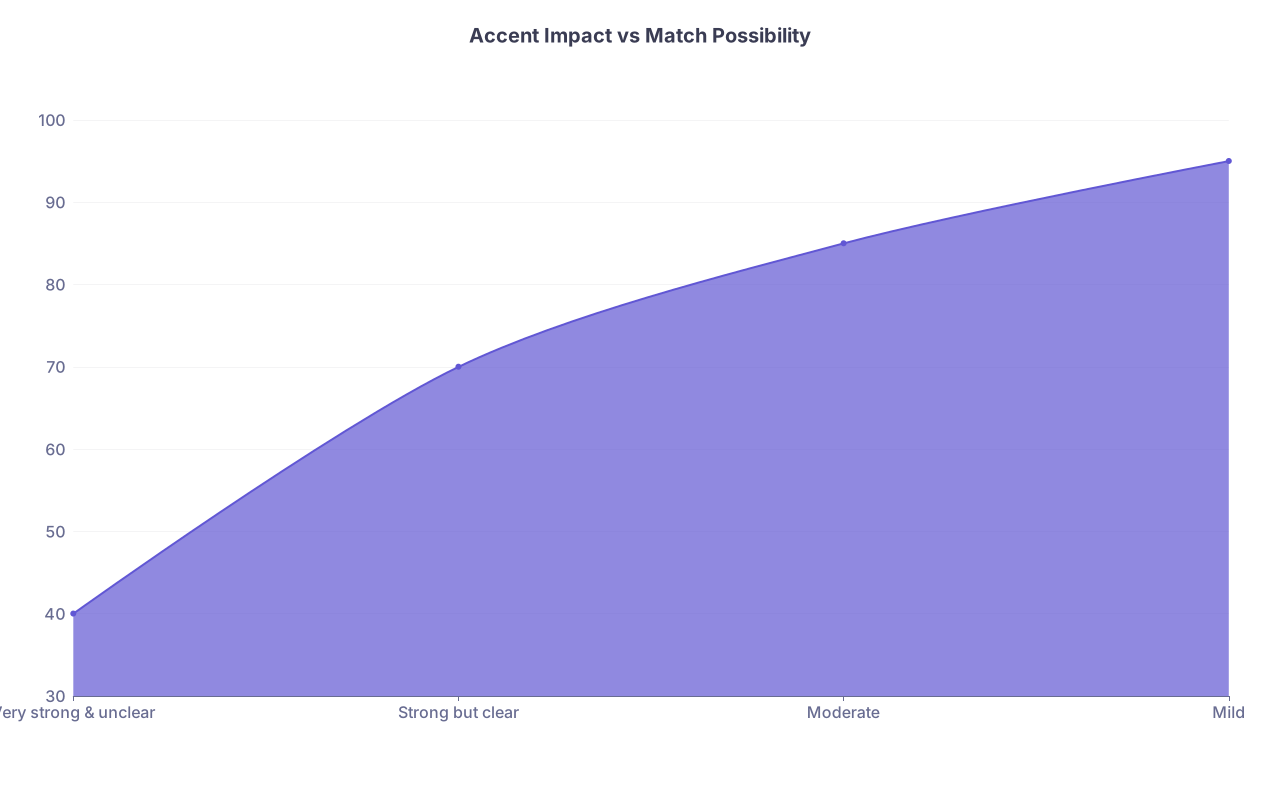
| Category | Value |
|---|---|
| Very strong & unclear | 40 |
| Strong but clear | 70 |
| Moderate | 85 |
| Mild | 95 |
That rough curve? The match probability doesn’t drop to zero just because your accent is strong. It drops when your clarity is low and you don’t improve it.

FAQ (The Questions That Keep You Up at 2 AM)
1. Will an accent alone automatically block me from matching?
No. Accent alone almost never blocks the match. What blocks you is when the accent combines with fast speech, poor structure, and anxiety so that interviewers worry about safety and understanding. If they can comfortably follow you during a 20–30 minute interview—even if they notice your accent—you’re in the safe zone. You don’t have to sound native; you have to sound understandable.
2. Should I mention my accent or communication work in the interview?
Briefly and strategically, you can. Something like: “Early in clinicals I got feedback that I spoke quickly and was sometimes hard to follow, so I’ve worked on slowing down and checking for understanding with patients. It’s actually made me better at explaining things simply.” That shows self-awareness and improvement. Don’t apologize for existing; frame it as growth, not as a flaw you’re begging them to overlook.
3. Is it worth paying for a communication coach or accent reduction course?
If you genuinely get feedback that you’re hard to understand, a short, targeted coaching block can be very helpful—especially for identifying specific sounds and habits sabotaging you. But don’t fall into the trap of thinking you need to buy your way to a “perfect American accent.” That’s overkill. Focus any paid help on clarity, pacing, and professional speaking skills, not erasing your identity.
4. I already had one interview where they seemed to struggle with my accent. Should I give up this cycle?
No. One awkward interview doesn’t predict all the others. Use it as free data. Right after, write down what seemed to go wrong—did they ask you to repeat? Did you start rushing? Did tech issues make audio worse? Then adjust. Practice those weak spots before your next interview. Programs differ a lot; some are very used to working with IMGs and won’t flinch at your accent as long as they understand you.
If you remember nothing else:
Your accent does not have to be your enemy. Confusing communication is. Focus on clarity, not sounding native. And stop assuming every interviewer secretly hates your voice—they’re too busy trying to figure out if you can take care of their patients at 3 am. If you can show them “yes,” your accent is something they’ll notice… and then move past.