
The average IMG starts serious Match prep a year too late. That is why so many good doctors end up unmatched.
You are starting two years before Match. That gives you a real advantage—if you use every month deliberately. I am going to walk you through exactly what that looks like.
Assume this: you are targeting a Match that is 24 months away. For example, you want to start residency July 2028; your Match is March 2028; ERAS opens September 2027. We start the clock in September 2025.
I will break it down:
- Year −2 (24–13 months before Match): Foundation and exams
- Year −1 (12–1 month before Match): Application build and execution
- Final 6 months before Match: Interview season and rank strategy
At each point: what you should be doing, what should already be done, and what is now urgent.
Big Picture: Two‑Year IMG Match Game Plan
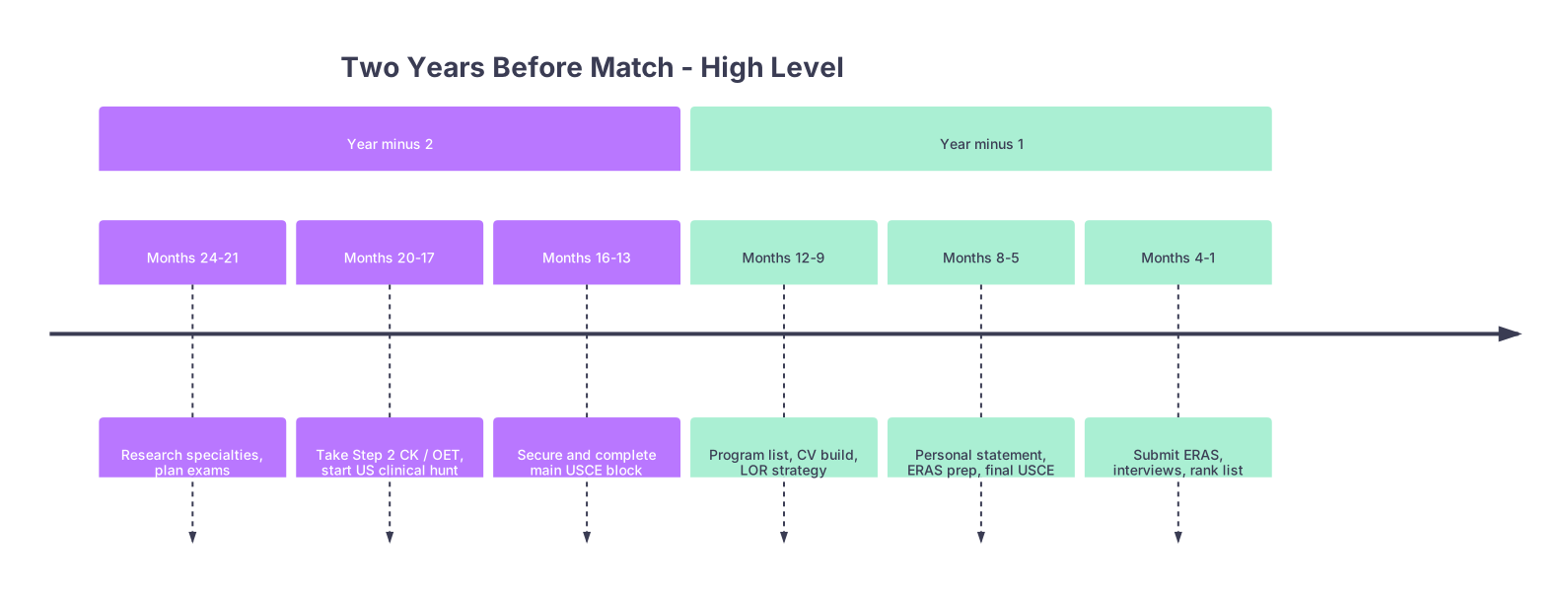
Before we zoom into months, you need the strategic map.
| Period | Event |
|---|---|
| Year minus 2 - Months 24-21 | Research specialties, plan exams |
| Year minus 2 - Months 20-17 | Take Step 2 CK / OET, start US clinical hunt |
| Year minus 2 - Months 16-13 | Secure and complete main USCE block |
| Year minus 1 - Months 12-9 | Program list, CV build, LOR strategy |
| Year minus 1 - Months 8-5 | Personal statement, ERAS prep, final USCE |
| Year minus 1 - Months 4-1 | Submit ERAS, interviews, rank list |
Here is the brutal truth: as an IMG, you must be boringly above average in three areas to compensate for your disadvantage.
| Component | Safe Target for IMGs |
|---|---|
| USMLE Step 2 CK | ≥ 240 (higher for competitive specialties) |
| USCE Duration | 8–12 weeks total |
| Strong US LORs | 3–4 from US faculty |
If these numbers scare you, good. They should. This is the bar you are up against.
Months −24 to −21: Choose Your Lane and Lock Your Exam Strategy
At this point you should stop being vague about “doing residency in the US” and decide on a realistic path.
1. Pick a primary specialty and a backup
By Month −24, you should:
- Decide if you are going for:
- Internal medicine, family medicine, pediatrics, psych (most IMG‑friendly)
- Or a tougher field: surgery, OB‑GYN, radiology, anesthesia (higher scores + stronger CV needed)
- Choose:
- 1 primary specialty
- 1 backup (usually more IMG‑friendly)
Wrong move I see constantly: “I am open to anything.” Programs can smell that. It reads as desperation.
2. Map your exam sequence
By Month −23, you should have a written exam plan:
- If you still need:
- Step 1 (if still offered / required for your pathway)
- Step 2 CK
- OET Medicine
- Any country‑specific licensing exams (PLAB, etc.) that you are juggling
Create a hard timeline:
- Target Step 2 CK no later than Month −17
- OET finished by Month −15
- ECFMG certification ready before ERAS opens (Month −11 at the latest; −13 is safer)
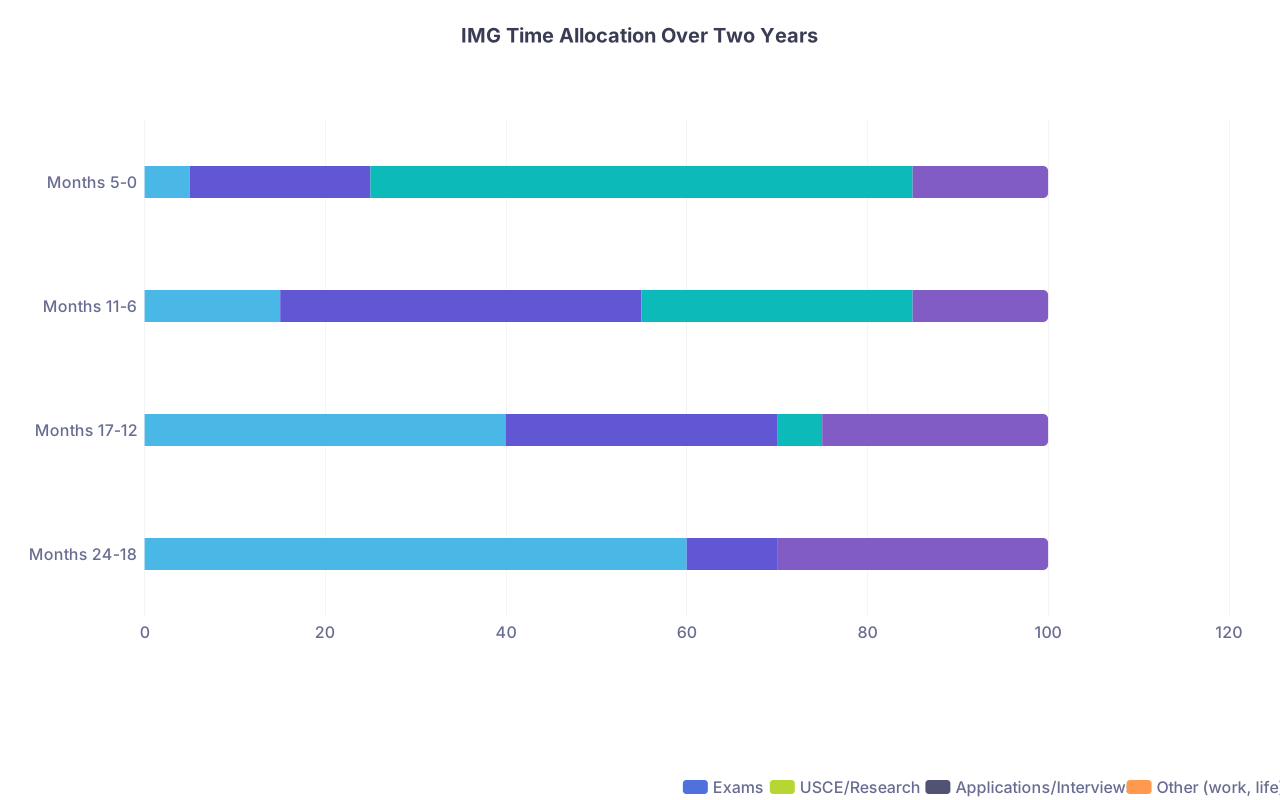
| Category | Exams | USCE/Research | Applications/Interviews | Other (work, life) |
|---|---|---|---|---|
| Months 24-18 | 60 | 10 | 0 | 30 |
| Months 17-12 | 40 | 30 | 5 | 25 |
| Months 11-6 | 15 | 40 | 30 | 15 |
| Months 5-0 | 5 | 20 | 60 | 15 |
If you are still early in medical school, shift this by year, not by month. But the sequence stays the same: exams → USCE → applications.
3. Start serious USMLE prep (or upgrade your current effort)
By Month −24:
- Commit to a primary resource set (for CK: UWorld, NBME assessments, online video course if you need structure)
- Set weekly question count goals (150–200 Q/week minimum once fully ramped)
- Schedule your first NBME baseline at Month −22 to see where you actually stand
Bad pattern I keep seeing: people “study” for 18 months but never schedule an exam. At Month −24, you schedule the month you intend to test. Otherwise this entire two‑year plan collapses.
Months −20 to −17: Step 2 CK, OET, and the USCE Hunt
At this point you should move from planning to execution.
1. Crush Step 2 CK
Target exam: around Month −18 to −17.
Four concrete checkpoints:
- Month −20:
- UWorld ~50% done, average >60%
- First NBME completed → if below 220, you need to tighten your schedule
- Month −19:
- Dedicated period starts (4–8 weeks depending on baseline)
- Month −18:
- Last NBME/Free 120 within 10 points of your target
- Month −17:
- Sit for Step 2 CK
Do not drag the exam into Year −1. You need that year for USCE and application building, not for chasing scores.
2. Plan OET Medicine and ECFMG steps
By Month −19:
- Register for OET Medicine if your pathway requires it
- Book a test date that lands between Months −18 and −16
By Month −17:
- Start your ECFMG certification checklist:
- Verify your med school eligibility
- Confirm you are on track with diploma / transcripts
- Understand any country‑specific delays (I have seen people delayed 6+ months because their school was slow signing forms)
3. Start serious US clinical experience (USCE) hunting
At this point you should be aggressively pursuing USCE for the upcoming 12–16 months.
You need to:
- Decide your main USCE type:
- Hands‑on electives/rotations (best, if still a student)
- Hands‑on externships (for graduates)
- Observerships (lowest value, but still better than nothing)
- Identify:
- 10–20 hospital‑based electives/externships to target
- 3–5 paid rotation companies as backup (expensive, but useful if you lack contacts)
Timeline:
- Month −20 to −18: send first wave of emails to programs and physicians
- Month −18 to −16: finalize at least 8–12 weeks of USCE scheduled across Months −16 to −6
If you wait to book USCE until Year −1, you will get leftovers and weaker letters.
Months −16 to −13: First USCE Block and Early Networking
By now, Step 2 CK should be done or almost done. If not, you are already behind.
At this point you should be physically stepping into the US system.
1. Complete your first major USCE block
Ideal structure:
- 4 weeks: core specialty (e.g., internal medicine inpatient)
- 4 weeks: sub‑specialty or related field (e.g., cardiology, nephrology, or outpatient IM)
During these rotations, you should:
- Show up early. Not “on time.” Early.
- Volunteer for presentations (journal club, short case summaries)
- Ask explicitly about letters during Week 3 if you have performed well:
- “Dr. Smith, I am planning to apply for US residency in about a year. If you feel you know my work well enough, would you be comfortable writing a strong letter of recommendation for me?”
You are not there to “observe American medicine.” You are there to earn US letters and authentic advocates.
2. Start building your “Program Story” file
By Month −14, you should maintain a simple document (Google Doc, Notion, whatever) with:
- Cases or patients that changed how you think (for personal statement later)
- Names of attendings, fellows, residents who liked working with you
- Programs where you felt you could fit well
- Any suggestion you got: “You should consider our residency; we take IMGs”
Later, during applications, this document will save you weeks of staring at a blank screen.
Months −12 to −10: Turn Experience into a Strategy
We are now 1 year before Match. This is where many IMGs are only just starting. You are not.
At this point you should be pivoting from “collect experiences” to “build an application.”
1. Lock in your remaining USCE
By Month −12:
- Confirm your second USCE block:
- 4–8 additional weeks between Months −10 and −6
- Ideally in your target specialty and preferably at a program that writes good letters for IMGs
By Month −10:
- Your total projected USCE should be:
- 8–12+ weeks committed
- At least 4–8 weeks already completed
2. Draft your program targeting strategy
By Month −11:
- Build a spreadsheet with:
- Columns: Program name, city, specialty, IMG‑friendliness, Step 2 averages (if known), past IMGs from your school / country, visa offered, notes
- Start with:
- 80–120 potential programs for IM / FM
- Fewer if specialty is tight but then you must be more selective
Use tools and clues:
- Program websites
- NRMP Data Reports
- Talking to recent matched IMGs from your region
- Observed culture during your USCE (you will learn very fast which programs respect IMGs and which do not)
Your list will shrink and sharpen as you learn more, but you need this skeleton now.
Months −9 to −7: CV, Research, and Letters
At this point you should focus on the parts that are slow to build: publications, letters, and a credible academic record.
1. Tighten your academic profile
By Month −9:
- If you have gaps (like no research, no QI projects, no teaching), fix that now:
- Join a small retrospective chart review with an attending you met
- Help with a quality improvement project on the ward (antibiotic stewardship, discharge planning, etc.)
- Do a case report with a US physician from your USCE
- The goal is not to become a “research monster.” The goal is to look engaged and academically awake.
2. Systematically secure US letters of recommendation
Your target by Month −7:
- 3 strong US LORs in your primary specialty
- 1 additional letter (US or home country) as backup
Practical timeline:
- Week 3 of each rotation: ask for the letter
- Immediately after: email them:
- Your CV
- Personal statement draft (even early version)
- Bullet points reminding them of specific patients or tasks you handled
By Month −7, all letters should be:
- Written
- Uploaded to the correct portal (ERAS or appropriate system)
- Confirmed (you follow up; never just “hope”)
Months −6 to −4: Personal Statement, ERAS, and Final Prep
Now we enter the direct pre‑application phase. No more vague planning.
At this point you should be converting your past 18 months into a sharp narrative plus a polished application.

1. Write your personal statement (and stop rewriting it endlessly)
Timeline:
- Month −6:
- First draft based on your “Program Story” file
- Month −5:
- Second and third revisions after feedback from:
- One US mentor (attending, fellow)
- One peer who matched recently
- Second and third revisions after feedback from:
- Month −4:
- Final version locked, only minor language edits after that
Your statement must answer three questions, clearly:
- Why this specialty?
- Why you, specifically?
- What kind of resident will you be?
Do not turn it into your entire life story. Programs are busy; they will skim.
2. Build and polish your ERAS CV
By Month −5:
- List every relevant experience from the last 5–7 years:
- Clinical, research, leadership, teaching, volunteer, employment
- Translate vague roles into specific impact:
- “Participated in clinic” → “Managed 6–8 patients per day, performed focused histories and physical exams, presented to attending, documented notes”
By Month −4:
- Your ERAS entries should be:
- Free of typos
- Quantified where possible (numbers of patients, hours, etc.)
- Grouped logically (do not spam with ten micro‑volunteering entries)
Months −3 to −1: Application Submission and Interview Readiness
Now we are weeks away from ERAS opening and submission.
At this point you should be operating on a strict week‑by‑week schedule.
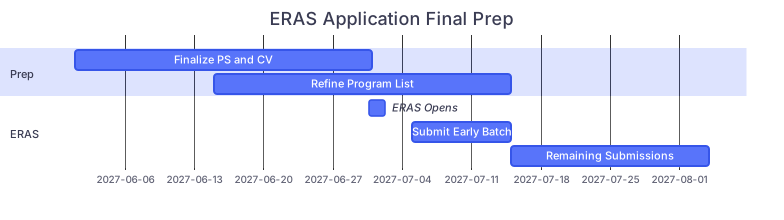
| Task | Details |
|---|---|
| Prep: Finalize PS and CV | a1, 2027-06-01, 30d |
| Prep: Refine Program List | a2, 2027-06-15, 30d |
| ERAS: ERAS Opens | milestone, 2027-07-01, 1d |
| ERAS: Submit Early Batch | a3, 2027-07-05, 10d |
| ERAS: Remaining Submissions | a4, 2027-07-15, 20d |
(Shift dates to match your exact year; the structure is what matters.)
1. Finalize and tier your program list
By 2–3 weeks before ERAS opens:
Divide your list into tiers:
- Tier 1: Dream but plausible (based on your scores, USCE, and visa needs)
- Tier 2: Solid realistic targets
- Tier 3: Safety programs with strong IMG history
Decide your application volume:
- Most non‑US IMGs in IM/FM: 80–120 programs
- Slightly fewer if you have outstanding scores and USCE
2. Submit ERAS early, not “on time”
When ERAS opens:
- Aim to submit within the first 1–2 weeks, fully complete
- Avoid adding major pieces later (like new letters) unless truly necessary
Programs form first impressions from early applicants. As an IMG, you do not want to show up in the late pile.
3. Start interview prep before you get invites
By Month −2:
Draft answers for the classic set:
- “Tell me about yourself.”
- “Why this specialty?”
- “Why our program?”
- “Tell me about a challenging patient situation.”
- “Explain any gap / exam failure / low grade.”
Do at least 3–4 mock interviews:
- One with a US physician or senior resident
- One recorded on your phone, then review your own performance
If English is not your first language, you need to be especially sharp here. Fluency on paper does not guarantee fluency when anxious on Zoom.
Interview Season to Rank List: Months 0 to +3 (Leading into Match)
Interviews will usually start 1–2 months after ERAS submission and run into early winter. For a March Match, think roughly October–January.
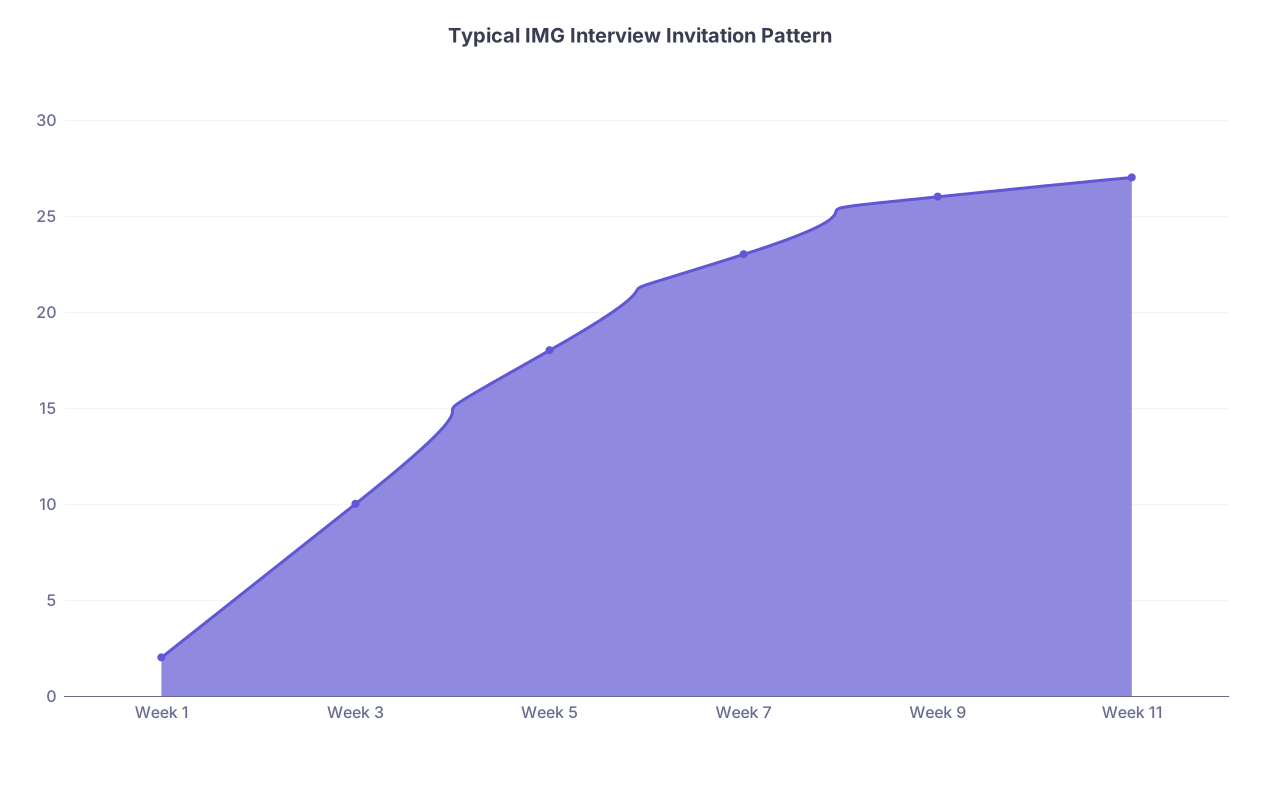
| Category | Value |
|---|---|
| Week 1 | 2 |
| Week 3 | 10 |
| Week 5 | 18 |
| Week 7 | 23 |
| Week 9 | 26 |
| Week 11 | 27 |
The invitations cluster early. If you have nothing by mid‑season, you adjust.
1. During interviews: convert from “applicant” to “colleague”
At this point you should not be learning how the US system works. You already did that through USCE. Now you show them you fit.
On each interview day:
- Be ready with:
- 2–3 specific stories that demonstrate your clinical judgment
- 1–2 examples of working in teams with limited resources (many IMGs shine here)
- Thoughtful questions about the program that go beyond “Do you sponsor visas?”
Take structured notes immediately after:
- Who you met
- What they seemed to value
- Red flags (weak teaching, malignant culture, no IMG support)
You will need this when ranking.
2. Mid‑season reality check
If by mid‑interview season (say, December for March Match):
- You have 0–2 interviews:
- Consider applying late to a limited set of additional programs if they are still reviewing
- Aggressively email programs with genuine connection (your US attendings can occasionally email PDs on your behalf; do not abuse this)
If you have 6–10+ interviews in a reasonably IMG‑friendly specialty: you are in competitive range. Focus on performing well, not on panicking.
3. Build your rank list logically, not emotionally
When NRMP opens rank list entry (usually January):
- Rank all programs where you can realistically function and would attend if matched
- Do not play “strategy games” like ranking a safety first. The algorithm favors your true preferences.
I have seen too many IMGs sabotage themselves by:
- Under‑ranking mid‑tier programs because they were “less prestigious”
- Over‑ranking a program that clearly disliked IMGs because of location or name
Use these filters in order:
- Malignant / unsafe → off the list
- Visa sponsorship certainty (if needed)
- Educational environment
- Geography and personal life

Two‑Year IMG Blueprint – Compressed
By now you see the pattern: each phase sets up the next. Let me compress it into the three things that matter most.
Front‑load the hard constraints.
Finish Step 2 CK, OET, and ECFMG certification early. Book USCE 6–12 months ahead. If you try to do these in the last year, you will fight the clock and lose.Turn every experience into a future asset.
Rotations become letters. Cases become personal statement stories. Research becomes bullet points with real numbers. Do not just “do things”; harvest them.Stay on a calendar, not on vibes.
At each milestone (−24, −18, −12, −6, −3 months), you should be able to say:- “These exams are done.”
- “This many weeks of USCE are completed / scheduled.”
- “These letters are secured.”
If you cannot, adjust aggressively. Not softly.
Follow that, and two years from now you are not just “hoping” on Match Day. You are watching a plan reach its final step.