
The idea that IMGs are “capped at community” for life is lazy, defeatist, and wrong.
But I get why it feels true. Because when you’re an IMG, people don’t talk to you in probabilities. They talk in absolutes.
“You’ll never get GI as an IMG.”
“Cards? Forget it unless you’re at a top university.”
“Just be happy with any community job.”
You hear that enough times and your brain helpfully translates it to: I’m done. Ceiling reached. Game over at PGY-3.
Let’s slow down. Not sugarcoat. But not catastrophize either.
You absolutely can get fellowships as an IMG. Even competitive ones. But the path is narrower, the margin for error is smaller, and yes—the name of your residency program matters more than people want to admit.
Let me walk through the actual landscape, not the Reddit version of reality.
What IMGs Actually Get in Fellowship — Not the Myth Version
You’re probably imagining two futures:
- You stay “stuck” in a random community program, never get a fellowship, and work forever as a generalist even if you hate it.
- You somehow “beat the odds,” get GI at a big-name university, and then magically everything is perfect.
Real life is messier.
There are IMGs in every single fellowship: GI, cards, heme/onc, pulm/crit, endo, even derm and interventional stuff. I’ve seen IMGs at Mayo, Cleveland Clinic, MGH, Hopkins, MD Anderson. Are they the majority? No. But they’re there.
Here’s the rough truth:
- Your IMG status doesn’t automatically cap you at community.
- But your training record and residency environment heavily shape your fellowship ceiling.
- You can move from community → academic via fellowship. It’s done all the time.
- Some people stay community for residency and get academic fellowships later.
- A few people really are capped—usually by their profile, not just their IMG label.
To make this less abstract, look at the general pattern I’ve seen:
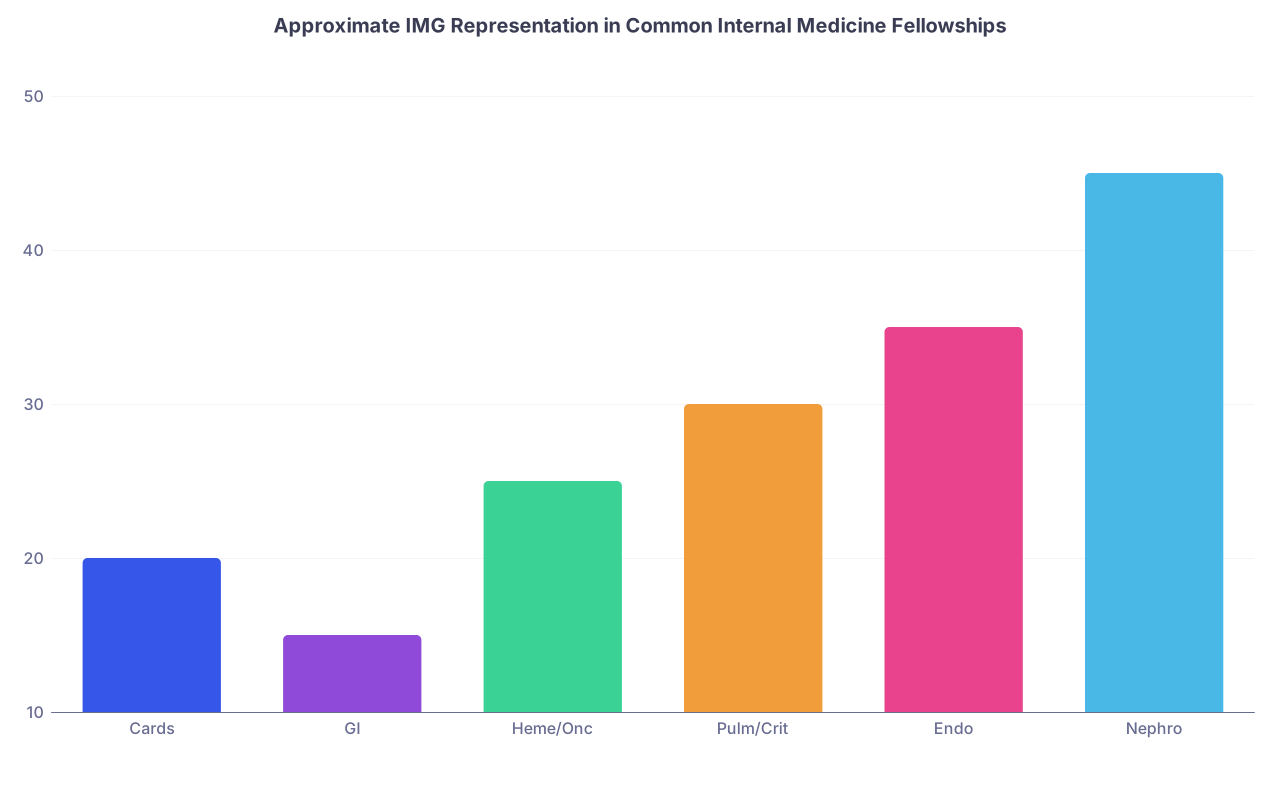
| Category | Value |
|---|---|
| Cards | 20 |
| GI | 15 |
| Heme/Onc | 25 |
| Pulm/Crit | 30 |
| Endo | 35 |
| Nephro | 45 |
These are not official numbers, but they’re in the ballpark of what you’ll see flipping through program rosters: IMGs present, often 1–3 per class, more in some specialties than others.
So no, you’re not locked out.
You are, however, playing on “hard mode.”
The Three Things That Matter Way More Than You Want Them To
Everybody wants some secret hack: “What if I do an observership at Harvard?” “Will one case report in GI fix my application?”
No.
Fellowship selection for IMGs is brutally simple under the surface. If you strip away all the fluff, most PDs are quietly asking three questions about you:
- Can this person handle the level of medicine we practice?
- Do I trust them not to collapse under pressure?
- Is there any obvious reason not to rank them?
And those three questions get answered by three main buckets:
1. Your Residency Program’s Reputation
Yeah, this hurts.
Programs are not “all the same.” Everyone in your hospital might say, “Fellowship is what you make of it,” but when fellowship PDs scan your CV, they absolutely care where you trained.
There’s a quiet hierarchy:
| Residency Type | How PDs Often See It |
|---|---|
| Big-name university + quaternary | Very strong pipeline |
| Solid university + affiliates | Strong, reliable |
| Community with strong academics | Variable but can be very good |
| Pure community, low research | Needs standout individual file |
If you’re at a big-name academic center, the default assumption is: “You can handle complexity” and “We know your attendings.”
If you’re at a smaller community program, the default assumption is: “Maybe good clinically, but we don’t know the training environment.”
That doesn’t kill your chances. But it means you can’t just be “good.” You need to be undeniably strong relative to others from similar or stronger programs.
2. Your Paper Trail: Scores, Evaluations, and Letters
Scores still follow you. Not in the obsessive Step 1 way of med school, but they’re not irrelevant.
- Strong Step 2 / Level 2 and in-training scores = you understand medicine and test reasonably well.
- Mediocre or low scores = you’ll need something else (research, killer letters) to counterbalance.
Then there are your letters. Here’s the harsh part:
A generic, polite letter from a random community attending does not compete with a detailed, glowing letter from a well-known academic faculty member in that fellowship field.
Fellowship PDs absolutely recognize names. Even regionally.
And they read between the lines:
- “Hard worker, pleasure to work with” = baseline.
- “Best resident I’ve worked with in the last X years; I would recruit them myself” = gold.
- Vague, short, or lukewarm letters = red flag, even if not obviously negative.
3. Your Fellowship-Relevant Track Record
This is where you can actually move the needle.
If you want cards, they will look for:
- Cardiology rotation performance
- Cardiology letters
- Any research or QI in cards
- ECG conference involvement, echo exposure, etc.
Same for GI, heme/onc, pulm/crit, whatever.
If your entire record looks like “generic IM resident, no specific angle,” then you’re basically hoping to win against people who have carved a clear path toward that specialty.
This is the part you can actively build—even from a community program.
But I’m an IMG in a Community Program. Am I Screwed?
Let me answer this the way you’re actually asking it:
“I’m an IMG. I’m not at some famous academic powerhouse. I don’t have a PhD. I don’t have 10 PubMed articles. I’m tired and the system already feels rigged. Is it over for me?”
No. But you cannot coast.
You have to treat fellowship like a multi-year project, not a last-minute ERAS application.
What You’re Up Against (Reality Edition)
If you’re aiming for something competitive (GI, cards, heme/onc, sometimes pulm/crit), your competition includes:
- US MDs at big-name programs with built-in fellowship pipelines
- IMGs at high-powered university programs with strong mentors
- People with multiple first-author publications in the field
- Residents with PDs who can literally text another PD and get them looked at
Compare that to: “I’m PGY-3, I decided last month I kind of like GI, I have no GI research and my letters are from random hospitalists.”
You see the gap.
But here’s the part no one tells you:
A lot of IMGs from community programs do get fellowships, because while everyone else talks, they quietly start playing the long game from PGY-1 or early PGY-2.
The Long Game Strategy If You’re IMG + Non-Top-Tier Program
Let me lay it out plainly. This is the stuff that actually shifts your trajectory.
Step 1 – Pick a Specialty Early Enough to Build a Story
You don’t need to commit PGY-1 day one. But by mid PGY-2, you can’t still be in “maybe GI, maybe cards, maybe pulm, I’ll see” mode if you’re aiming competitive.
Pick one. Commit to exploring it seriously. Your ERAS app must look coherent, not like you threw a dart in August of PGY-3.
Step 2 – Attach Yourself to 1–2 People in That Field
Even at small programs, usually you’ve got at least:
- One cardiologist who loves teaching
- One GI doc who occasionally does a talk
- One heme/onc attending who’s been around forever
You don’t need 10 mentors. You need 1–2 who actually care and will go to bat for you.
You say things like:
“I’m really interested in [specialty]. I know I’m an IMG and I’m at a smaller program, so I’m trying to build the strongest, most honest application I can. Would you be open to meeting a couple times to talk about projects or how I can get there from here?”
That level of honesty + initiative stands out. Most people never say this out loud. They just silently panic.
Step 3 – Get Involved in Any Project That Touches the Field
Stop obsessing over “real” vs “fake” research. Case reports. Retrospective chart reviews. QI projects. Local presentations. Regional posters.
All of that helps.
You aim for a pattern like:
“Across PGY-1 to PGY-3, this resident clearly leaned into [specialty]: multiple rotations, local presentations, one or two publications or abstracts, strong letters from people in the field.”
That story reads very differently than:
“No real connection to the field until July of PGY-3.”

Step 4 – Maximize the Few Things You Control
You don’t control where you graduated from. You don’t suddenly become US MD. But you do control:
- Your in-training exam effort (yes, PDs notice if you go from 30th percentile to 70th)
- Whether your notes are good, your sign-outs clean, your reputation solid
- Whether attendings fight over having you on their team—or avoid you
A shocking number of fellowship decisions come down to: “They’re excellent clinically and everyone loves working with them.”
That matters more than one extra poster.
Step 5 – Apply Widely, Realistically, and Repeatedly
Here’s another thing no one warns you about: a lot of IMGs match fellowship on their second try.
They do this path:
- PGY-3: Apply once. Maybe no interviews or only a few low-yield ones.
- Post-residency: Work as a hospitalist for 1–2 years, keep doing research, strengthen publications, get newer stronger letters.
- Reapply with a significantly better story.
I’ve seen IMGs go from 0 interviews → multiple fellowship offers by doing this.
You’re not a failure if you don’t match on the first try. It just sucks. Emotionally. Financially. Ego-wise. But it’s not a final verdict.
Are Some IMGs Basically Capped? Yes. But Not for the Reason You Think.
Let’s be brutally transparent.
There are situations where your ceiling is lower, and pretending otherwise is cruel. The usual patterns:
- Very low scores + weak clinical reputation + no fellowship-specific work = you’re not “capped” as an IMG, you’re capped by your file.
- Huge professionalism issues or multiple bad evaluations = fellowship PDs run away, regardless of IMG vs US MD.
- Being chronically disorganized, late, difficult to work with = no letter can fully hide that.
If you’re an IMG with:
- Decent scores
- Solid clinical work
- No major red flags
- At least some connection to the field through letters / projects
You’re not capped at community by default. Your ceiling may be lower than a US MD at Harvard, sure. But lower ceiling ≠ no ceiling.
The Other Path: Using Community and Then Moving Up
Here’s the part people underplay: you can use fellowship as your upgrade move.
Example that I’ve literally seen:
- IMG does internal medicine at a small, unknown community program.
- Works like hell. Becomes “that resident” everyone trusts.
- Gets a couple of posters and a small publication in heme/onc.
- Matches heme/onc at a mid-tier university program with a cancer center.
- Uses that name + 3 years of solid performance to get an academic attending position at a bigger place.
If you looked only at where they did residency, you’d think they were “capped at community.” They weren’t.
Is this easy? No.
Is it possible? Yes.
Is it automatic? Absolutely not.

| Step | Description |
|---|---|
| Step 1 | IMG at Community or Mid-tier Program |
| Step 2 | Likely Generalist or Non-Comp Fellowship |
| Step 3 | Targeted Fellowship Prep |
| Step 4 | Apply PGY-3 |
| Step 5 | Fellowship then Job Upgrade |
| Step 6 | Hospitalist + More Research |
| Step 7 | Reapply to Fellowship |
| Step 8 | Reassess Goals / Less Competitive Path |
| Step 9 | Performance Strong? |
| Step 10 | Matched? |
| Step 11 | Matched on 2nd Try? |
How to Stay Sane While Playing This Stupidly Stressful Game
Let me just say the quiet part: this is exhausting.
You’re on 28-hour calls, trying not to miss DKA and PE, and at the same time you’re supposed to be some strategic career architect thinking 3 years ahead.
Your brain goes:
- “What if I pick the wrong specialty?”
- “What if fellowship PDs laugh at my application?”
- “What if I waste years chasing something I’ll never get?”
You’re not crazy for thinking like this. But anxiety makes you either freeze or flail. Neither helps.
Do this instead:
Pick one working plan for now.
Example: “I’m going to pursue pulm/crit seriously for the next 12 months. I can re-evaluate later, but for now, I’m leaning in.”Act like your chances are low—but nonzero.
That mindset weirdly helps. You respect the difficulty, but you don’t treat it as impossible. You behave like: “I might be the exception if I actually do the work.”Keep one backup door open that you can live with.
Maybe that’s hospitalist life with academic interest, maybe a less competitive fellowship (like nephro or endo) where you can still work in a subspecialty.Stop comparing to unicorns.
There’s always going to be that IMG with a 260, 15 papers, and a T32 fellowship lined up. Their story is not your baseline. It’s an edge case.
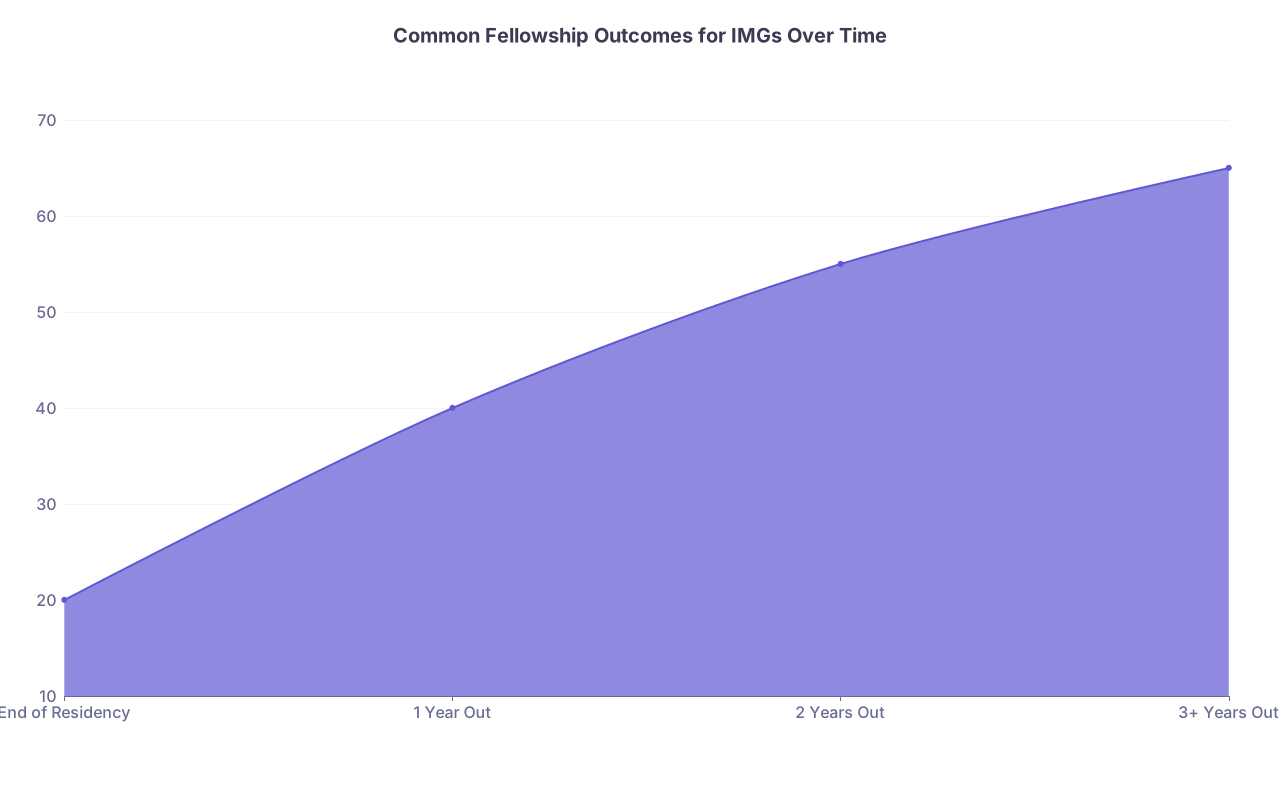
| Category | Value |
|---|---|
| End of Residency | 20 |
| 1 Year Out | 40 |
| 2 Years Out | 55 |
| 3+ Years Out | 65 |
(The point of this illustration: a lot of IMGs don’t match fellowship immediately after residency. Their chances improve as they build experience, research, and connections over time.)

So… Am I Capped at Community?
If you want the most honest one-sentence answer:
You’re not automatically capped at community just because you’re an IMG—but you will be capped if you act like fellowship is a lottery instead of a multi-year, deliberate project.
IMGs do match competitive fellowships. From community programs. From mid-tier places. After a hospitalist gap. With non-perfect scores.
But every single one of them, in my experience, has at least these three things in common:
- Someone in the specialty who really knows them and will go to war for them in a letter.
- A track record that looks like intentional preparation, not last-minute panic.
- A willingness to tolerate rejection, regroup, and try again.
If all you do is survive residency and “see what happens,” then yeah—you’ll probably end up staying generalist, probably in a community job.
Not because you’re an IMG.
Because the system rewards people who treat fellowship like a serious, planned move—not an afterthought.

FAQ (Exactly 6 Questions)
1. I’m an IMG in a small community IM program with no big research—should I still try for a competitive fellowship like cards or GI?
Yes, but go in clear-eyed. If you’re early PGY-1 or PGY-2, you still have time to build a focused story: get exposure in the field, secure at least one strong letter from a subspecialist, and do something scholarly (case reports, QI, posters). If you’re late PGY-3 with nothing in that direction, your chances on the first try are low. You can still apply, but seriously consider a hospitalist year or two to build a stronger profile before reapplying.
2. Do I have any chance at an academic fellowship if my residency is pure community with no university affiliation?
You’re not excluded, but you’re starting farther back. The key will be: (1) glowing letters that make PDs take you seriously despite the program name, (2) any regional or national presentations that show you can engage beyond your local hospital, and (3) in-training scores and evaluations that are clearly strong. You’ll probably need to cast a very wide net and be willing to apply more than once. The first cycle might just be about seeing who’s even willing to interview someone from your background.
3. My scores aren’t amazing (e.g., Step 2 in the low 220s / equivalent). Is fellowship still realistic as an IMG?
Yes, especially for less cutthroat specialties and if the rest of your application is strong. A mediocre score doesn’t kill you if you’ve got stellar clinical performance, excellent letters, and real involvement in the field. What it does do is make it harder to break into the absolute most competitive combinations (like IMG + small community residency + low scores + aiming GI/cards at top-10 programs). You can still do fellowship, but you might have to aim slightly lower tier initially and build from there.
4. Is it better to take any fellowship I can get, or wait for the specialty I really want?
This is where people get trapped. If you’re truly passionate about, say, GI but end up taking nephro “just to have a fellowship,” you might regret it long term. On the other hand, waiting 3 cycles for GI with no significant improvement in your application is just self-punishment. Rule of thumb: if you’re willing to actually do the specialty for 30 years, it’s reasonable to take it even if it wasn’t your first dream. If you’d be miserable, it might be better to be an excellent hospitalist and reapply once or twice to what you actually want—with real improvements each time.
5. Does doing a hospitalist job hurt my fellowship chances compared to going straight in?
Not automatically. In fact, for IMGs, a hospitalist gap can help if you use it right. PDs like seeing: (1) consistent, strong clinical work, (2) ongoing involvement with the specialty (moonlighting on the related service, research with specialists, etc.), and (3) a clear upward trend in your CV—more projects, better letters, more responsibility. What hurts is disappearing for 2–3 years, doing nothing academic, and then suddenly deciding to apply out of nowhere.
6. What’s one concrete thing I can do this week if I’m an IMG resident who wants fellowship but feels overwhelmed?
Pick one subspecialty you’re seriously considering and schedule a 15–20 minute meeting (even just a hallway conversation if that’s all you can get) with a trusted attending in that field. Tell them directly: “I’m an IMG and I really want to end up in [specialty]. I know it’s competitive and my background isn’t perfect. What would you do in my position over the next 6–12 months?” Then actually write down what they say and pick one thing to act on in the next two weeks—whether that’s joining a small project, signing up for their clinic, or planning an elective month with them.
Open a blank note or document right now and write at the top:
“If I want [your specialty] as an IMG, my next 3 concrete moves are…”
Fill in three specific actions you’ll take this month. Not someday. This month.