It’s August. You’ve finally confirmed it: your medical school just got recognized by a new authority (maybe ECFMG eligibility, maybe WFME accreditation, maybe your country’s degree is now accepted by the GMC/USMLE/etc.). You’re excited. Then you start looking at residency program websites and see line after line: “We prefer graduates from LCME/COCA-accredited schools” or “We do not sponsor visas” or “We typically do not consider applicants from newly accredited schools.”
You feel your stomach drop.
You worked your tail off. You passed the exams you were allowed to sit for. But now you’re up against skepticism you didn’t cause and can’t fix at the institutional level.
This is the situation: your medical school is technically acceptable now, but many residency programs still see it as an unknown quantity. You need to convince them you’re not a risk.
Let’s talk about exactly how you do that.
1. Understand What You’re Up Against (So You Can Target It)
Residency programs aren’t being “mean” when they hesitate about a newly recognized or newly accredited school. They’re being conservative. They’ve been burned before.
Here’s what’s actually in their heads, even if they’ll never say it on the website:
- “We don’t know this school. Will their grads pass boards?”
- “We can’t afford a resident who fails Step 3 or in-training exams.”
- “We don’t have time to filter 3,000 applications by hand. We rely on shortcuts.”
- “Is this another diploma mill with a shiny new certificate?”
You’re not going to fix this by saying, “But my school is now recognized by X!” They already know the accreditation line. That’s table stakes.
You have to attack the real concerns:
- Predictable performance (USMLE/COMLEX, in-training exams).
- Clinical readiness (can you function like a US grad on day 1?).
- Professional reliability (no drama, no visa chaos, no professionalism disasters).
- Risk to their board pass rates and accreditation.
Translate that into your job: demonstrate, with receipts, that you’re low risk and high yield despite the new-school label.
2. Make Your Application Look “Boringly Safe”
Let me be blunt. With a newly recognized school, you do not want to be “interesting.” You want to be obviously safe.
Programs will forgive almost anything from a well-known Caribbean or European school. They’ll forgive almost nothing weird from a brand-new school they don’t trust yet.
You neutralize that by over-performing in the parts of the application they trust most:
- Standardized exams
- US clinical experience
- Concrete letters from known people
A. Your Scores Need To Do Extra Work
If your school name triggers doubt, your scores have to shut that doubt down.
Aim for:
- Step 2 CK: at or above the average matched score for your target specialty.
- OET/IELTS (if relevant): high, not just “pass.”
- Any in-training or national exams from home country: strong, if you can show them.
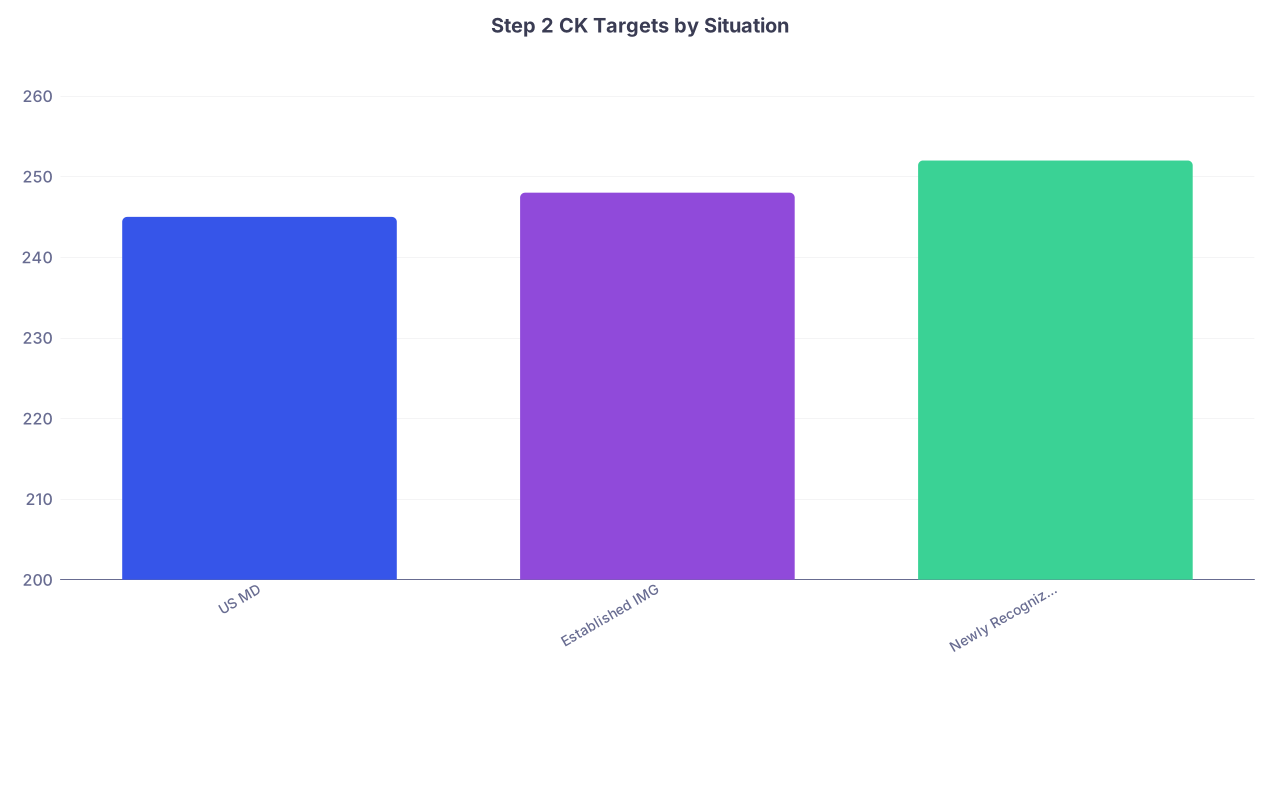
Here’s how your Step 2 needs to look relative to your situation:
| Category | Value |
|---|---|
| US MD | 245 |
| Established IMG | 248 |
| Newly Recognized IMG | 252 |
If typical matched applicants in your specialty are sitting around 245–248, and you’re a newly recognized IMG, you really want to be a few points above that. Is that “fair”? No. But it’s the reality.
If your Step 2 CK is average or below:
- You can still match, but you’ll have to compensate harder on:
- Clinical performance in the US.
- Letters from US faculty.
- Targeting lower-competition specialties and programs that historically take more IMGs.
B. Build a Clean, US-Style Clinical Track Record
Programs do not trust curriculum descriptions from unknown schools. They trust:
- Your US clinical evaluations.
- Who writes your letters.
- How you talk through cases in interviews.
You want:
- At least 2–3 months of US clinical rotations in the specialty you’re applying to, ideally at:
- Community programs that have residencies.
- University-affiliated hospitals.
- Not just observerships. Hands-on electives or sub-I style rotations are gold. Externships are good. Pure observerships are weak unless you have no other options.
If your school only just got recognized and you couldn’t get formal electives:
- Use external clinical experiences:
- Externships via private companies (choose carefully, some are garbage).
- Longitudinal observerships (3–6 months in one place) where you can:
- Present cases.
- Attend conferences.
- Show up consistently.
And then you need that translated into convincing letters.
3. Use Letters of Recommendation as Your Primary Weapon
Your school’s name is weak. Your letter writers’ names are your counterbalance.
A strong US letter from a known faculty member or PD is worth more than any marketing line about your school’s new accreditation.
You want at least:
- 2 letters from US physicians in your target specialty.
- 1 letter can be from your home institution (chair, dean, or department lead), but only if it’s detailed and credible.
Prioritize letters from:
- Program directors
- Associate program directors
- Department chairs
- Long-standing attendings in teaching hospitals
What you need them to say, explicitly or implicitly:
- “I have worked with many US grads and IMGs. This candidate is at least on par with our US seniors.”
- “I would rank this person highly in my own program.”
- “Their clinical judgment, work ethic, and professionalism are excellent.”
Do not settle for generic fluff like “hardworking and pleasant.” That reads as faint praise and does nothing to mitigate the school issue.
When you ask for a letter, say something like:
“Because my medical school is newly recognized and not widely known, some programs may have concerns about my training background. I’m hoping your letter can speak specifically to how I compare to typical US seniors or current residents you work with.”
Yes, that’s direct. Yes, you should still say it.
4. Rewrite Your Personal Statement For This Exact Reality
You don’t mention “my school is newly recognized” in a whiny or apologetic way. You mention it strategically and then crush the concern.
Bad version:
“My medical school is newly accredited, and I hope programs will give me a chance…”
That screams insecurity.
Better structure:
- 1–2 sentences max explaining context.
- Then pivot hard to evidence of competence.
For example:
“I trained at [School Name], a recently recognized institution in [Country], where early cohorts faced the challenge of proving our training in external environments. Because of that, I intentionally sought out rigorous clinical exposure in the United States, including rotations at [Hospital/Program] and [Hospital/Program], where my evaluations consistently rated me at the level of a US senior student.”
And then you talk about your cases, your learning, your growth. Not your school’s drama.
The point: acknowledge, then redirect to proof.
5. Learn to Talk About Your School Without Sounding Defensive
This will come up in interviews, either directly or indirectly.
What not to do:
- Start listing every accreditation your school has.
- Blame the system, the country, previous governments, COVID, etc.
- Get emotional, even if you feel it (and you have every right to).
You want a calm, factual, almost boring answer.
Common questions and how to handle them:
“I’m not very familiar with your medical school. Can you tell me about it?”
You:
“Of course. [School Name] is a relatively new medical school in [City, Country]. We follow a [US-style / UK-style / problem-based / integrated] curriculum, with [X] years of basic science followed by [Y] years of clinical rotations in [teaching hospitals A, B, C]. The school recently gained [WFME/ECFMG/Ministry] recognition, which has allowed graduates to pursue licensure and training abroad.
Practically, for me, that meant I needed to demonstrate my readiness through standardized exams and US clinical rotations, which is why I completed [US rotations] and focused heavily on Step 2 CK, where I scored [score].”
Short. Controlled. Not a TED talk about accreditation politics.
“We haven’t had residents from your school before. Why should we feel confident?”
You:
“That’s a fair concern. I’d focus on the parts of my application that you can benchmark.
My Step 2 CK score is [score], which is [above/around] the average for matched residents in [specialty]. In my rotation at [US site], the attending physicians documented that I performed at the level of a US senior, and Dr. [Name], the [role], specifically stated in her letter that she would be comfortable having me as a resident in her own program.
I realize my school’s name doesn’t carry a track record yet. But my individual performance and my clinical evaluations do, and I’d invite you to look closely at those.”
You are calmly telling them: judge me, not the logo.
6. Target Programs Rationally, Not Wishfully
Some programs will never touch you. Not now. Not in five years. They barely take established IMGs; they are not starting an experiment with a brand-new school.
You need to segment programs into three rough buckets:
| Program Type | Likelihood to Consider You | Strategy |
|---|---|---|
| Top-tier academic with minimal IMG history | Very low | Skip or apply to a tiny handful as lottery tickets |
| Mid-tier community/university-affiliated that routinely takes IMGs | Moderate to high | Main target; customize communication |
| IMG-heavy community programs (esp. in underserved areas) | High | Broadly apply; use faculty/grad connections |
How to identify the second and third groups:
- Check recent resident lists.
- Look at current residents’ med schools.
- If you see a bunch of:
- Caribbean schools
- Eastern Europe
- Middle East
- South Asia
- Latin America …you probably have a shot, especially if:
- They’ve taken people from recently accredited or lesser-known schools before.
Then you push deeper: talk to people.
7. Use Networking to Bypass Automated Skepticism
ERAS filters will kill you at some places, no matter how good you are. “IMG = auto screen out” is real.
Your workaround: human beings.
I’ve seen candidates from totally unknown schools get interviews at brand-name programs because:
- They rotated there and impressed people.
- Their letter writer emailed the PD directly.
- A current resident advocated: “This person is excellent; please review.”
Three practical moves:
Before applications open
- Cold email residents and fellows from your country / region / language group at target programs.
- Ask specific questions. Don’t send “Can you advise me?” novels.
- Example: “I noticed your program has several IMGs, and I’m from a newly recognized school in [Country]. Did your program have any specific concerns about your background, and is there anything you’d advise I emphasize in my application?”
After you apply
- If you have a powerful letter writer (PD, chair), politely ask if they’d be willing to email 2–3 PDs where they think you’d fit.
- Not 20 programs. 2–3 carefully chosen ones that actually match your profile.
If you’ve rotated at the program
- Email the clerkship director / key faculty 1–2 weeks after ERAS opens:
“I’ve applied to [Program Name] and listed you as a letter writer. I wanted to reiterate how much I valued my time there and that [Program] is one of my top choices. If there’s any additional information I can provide to support my application, I’m happy to send it.”
- Email the clerkship director / key faculty 1–2 weeks after ERAS opens:
You’re not begging for an interview. You’re nudging them to actually look at your file instead of letting filters bury you.
8. Stack Extra Proof: Research, QI, and Outcomes
If your school is new, you want to look like an outlier overachiever from that school. When PDs think, “We don’t know this place,” you want them to then see:
- US-based research with recognizable co-authors.
- Presentations or posters at US conferences.
- QI projects with direct relevance to residency.
These don’t cancel a bad Step 2 or awful rotations, but they absolutely tilt borderline decisions your way.
Good signs for a skeptical PD skimming your CV:
- “Poster at ACG / SGIM / ATS / ACC / ASN / APA” etc.
- “Co-author: [name they recognize].”
- “Peer-reviewed article (even if not first author).”
Your goal is for them to subconsciously think: this person operates in our ecosystem already.
9. Anticipate Visa + Timing Issues Clearly
Newly recognized schools often also mean:
- First cohorts navigating ECFMG certification.
- First time your country’s degree is accepted for a certain exam.
- Visa officers confused at consulates.
Programs hate unpredictable immigration situations.
You should be able to say:
- Exactly which visas you’re eligible for (J-1 only vs H-1B OK).
- Your exact ECFMG timeline:
- “I will have ECFMG certification by [specific month/year].”
- Any previous US visas you’ve successfully held (B1/B2, F1, etc.).
Spell this out cleanly in your ERAS application and, if needed, a short sentence in your personal statement or a follow-up email:
“I am ECFMG certified and eligible for J-1 sponsorship. My Step 3 is scheduled for [month], so I will also be eligible for H-1B sponsorship if your program offers it.”
Clarity reduces perceived risk.
10. Mentally Prepare for Unfairness—and Keep Going Anyway
Let me be harsh for a second: some places will judge you based on your school name alone and never admit it. You will not change them. Stop trying.
Your job is not to convince the entire US GME system to respect your school. Your job is to find the subset of programs who are:
- Open to IMGs.
- Willing to look closely at individuals.
- Able to be convinced by performance and references.
You don’t need 100 programs to love you. You need 10–15 to interview you, and 1 to rank you high.
This will mean:
- Applying somewhat more broadly than a US grad.
- Expecting a lower interview yield.
- Playing the long game (including SOAP or reapplying if needed).
But people from totally unknown, newly accredited schools match every year. The pattern is consistent: their applications look boringly strong and their references are undeniably positive.
11. Concrete Example: What This Looks Like in Practice
Let’s walk through a realistic case.
- School: Newly recognized in Eastern Europe, first ECFMG-eligible cohort 1 year ago.
- Exams: Step 1 pass (if applicable), Step 2 CK 252.
- Clinical:
- 4-week IM rotation at a US community hospital with residency.
- 4-week cardiology observership at large academic center.
- 8-week sub-I style rotation via an externship company (hands-on history/physical, notes, presentations).
What they do right:
They get a letter from:
- The US community IM attending saying: “On par with our US seniors; I’d be comfortable with them as a PGY-1.”
- The academic cardiologist saying: “Strong clinical reasoning, excellent communication.”
- Home institution department chair outlining their rank in class and exam performance.
They frame the school situation in PS and interviews as:
- “Newly recognized → I proactively proved myself through US exams and rotations.”
They target:
- Mostly community IM programs with high IMG presence.
- A few university-affiliated mids.
- A couple of reach academic programs where they had letter writers.
Outcome: They get 8–12 interviews, mostly community, a couple of solid university-affiliated programs. They match at a place where IMGs are common, not at Mass General. That’s a win.
12. Today’s Next Step
Do one concrete thing right now:
Open a document and write a 5–6 sentence “school explanation script” you’d be comfortable saying in an interview. Something like:
- One line about where your school is and its curriculum style.
- One line about its new recognition / accreditation, without drama.
- Three to four lines immediately pivoting to your exams, US rotations, and letters.
Read it out loud. If you sound defensive, rewrite until you don’t.
That script will anchor your personal statement, your email outreach, and your interview answers. Once you own that story, you can stop flinching every time you see your school’s name on the screen—and start showing programs why betting on you is not a risk at all.