
The biggest threat to an IMG residency application isn’t a failure. It’s a lie—or even just a suspicious gap.
Let me say the scary part out loud because that’s what’s looping in your head anyway: Can being fully honest actually get you rejected everywhere? Can one misstep doom your entire career if you admit it?
You’re not crazy for worrying about this. You’re an IMG in a system that already feels stacked against you. Add a failed Step, a repeated semester, a professionalism note, a massive gap, or a withdrawn application, and suddenly “just be honest” sounds like terrible, naïve advice.
So you end up stuck between two bad options in your head:
- Tell the full truth and get filtered out.
- Hide or “soften” the truth and live in constant fear of being found out.
I’ve watched people pick both. I’ve watched both blow up.
Let’s untangle what’s actually dangerous, what’s survivable with the right framing, and where the line is between smart transparency and self-sabotage.
The Ugly Truth: Programs Hate Surprises More Than They Hate Imperfect Records
Here’s how program directors really think, boiled down into a sentence:
“I can work with a failure. I cannot work with someone I don’t trust.”
I’m not sugarcoating this: as an IMG, you don’t get as much benefit of the doubt. But that bias cuts in a specific way. They will absolutely screen out:
- Inconsistent dates
- Missing exam attempts
- “Magically cleaned up” academic histories
- Vague or evasive explanations
Because those scream: this person hides things.
What they can sometimes work with:
- A Step failure that’s followed by a solid pass
- A repeated semester with clear improvement
- A leave of absence for health/family with a clean return
- A bad year with a believable turning point
Do these hurt? Yes. Will some programs auto-ditch you? Yes.
But those are not usually what gets people blacklisted. What gets people blacklisted is dishonesty, or even the appearance of it.
And that’s the part nobody tells you when they say “just be honest.” You’re not just being honest. You’re being strategically honest, in a way that:
- Matches what ERAS, transcripts, and USMLE reports already show
- Answers the obvious question before they have to ask
- Makes them feel safer, not more nervous about you
What You Must Always Disclose vs What You Can Choose to Explain
You’re probably terrified you’ll overshare and tank yourself. Or undershare and get caught.
Let’s draw a hard line: there are things you legally / procedurally must disclose, and things that are more “do I explain this or not?”
| Issue Type | Must Disclose? | Should Explain? |
|---|---|---|
| Failed USMLE/COMLEX attempt | Yes | Usually |
| Course/rotation failure | Yes (if shown) | Often |
| Repeat year/semester | Yes | Yes |
| Leave of absence | Yes | Yes |
| Academic probation | Yes | Yes |
| Minor gap (1–3 months) | Implicit | Maybe |
That’s the logic side. But your brain isn’t logical right now. You’re thinking things like:
- “If I don’t mention this failure in my personal statement, is that lying?”
- “If they don’t directly ask, can I just… not talk about it?”
- “What if my medical school wrote something vague in the MSPE that sounds way worse than reality?”
So let’s go failure by failure.
Common IMG “Red Flags” and How Honest You Actually Need to Be
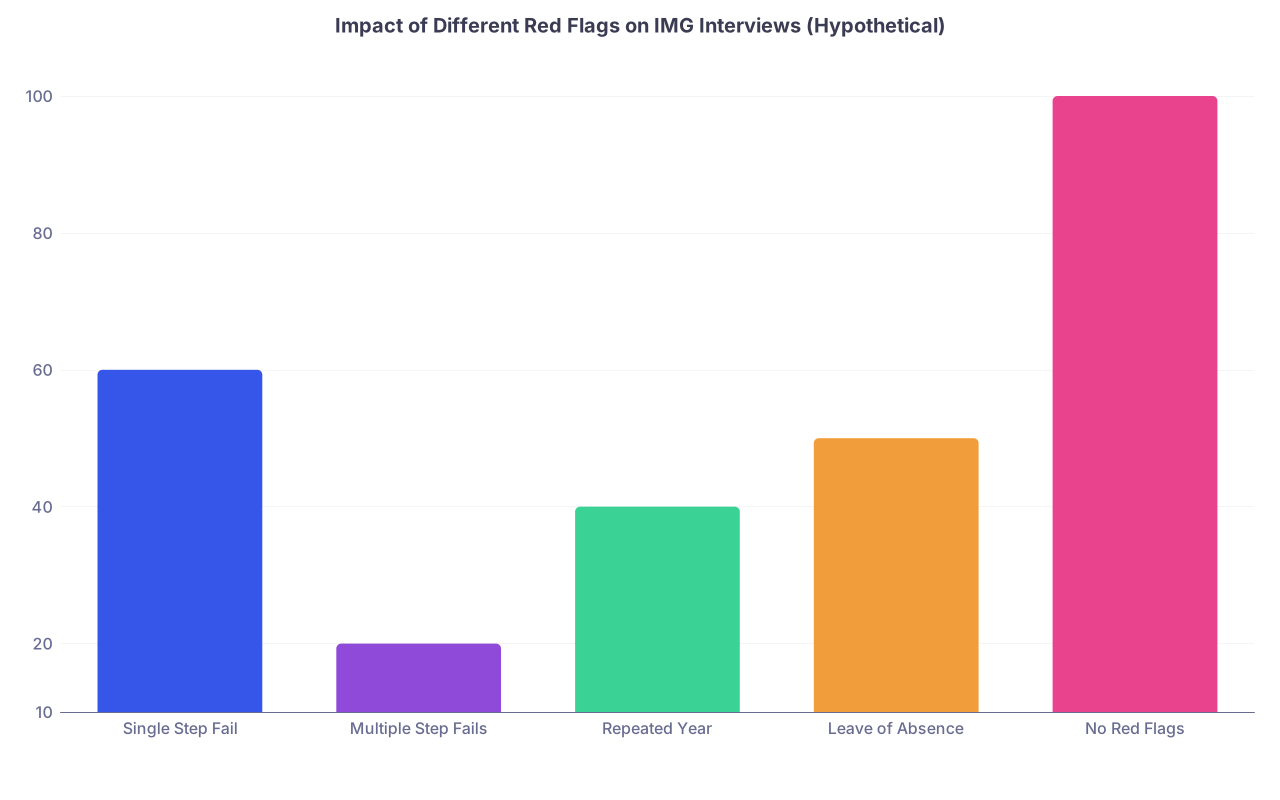
| Category | Value |
|---|---|
| Single Step Fail | 60 |
| Multiple Step Fails | 20 |
| Repeated Year | 40 |
| Leave of Absence | 50 |
| No Red Flags | 100 |
These numbers are illustrative, not real data—but the pattern matches what I’ve seen: some red flags are survivable, some are brutal, but none justify lying.
1. Failed USMLE Attempt
This is probably your biggest anxiety monster.
Reality:
- Programs will see every attempt. You can’t hide it.
- Many will filter you out automatically, especially in competitive specialties.
- Some community programs and IMG-friendly places genuinely don’t care as much if the later scores are solid and your story checks out.
How honest to be:
- On ERAS: You have no choice. It shows.
- Personal statement: You don’t have to bring it up unless it’s central to a growth narrative, but if your failure is recent or severe, avoiding it might make you look evasive.
- Interviews: If they ask, you answer directly. No dancing.
Safe way to address it in a PS or interview:
- One clear sentence stating what happened.
- One or two sentences on why (without sounding like you’re blaming the universe).
- More emphasis on what changed and proof of improvement.
Example structure (not copy-paste, just structure): “I failed Step 1 on my first attempt after underestimating the exam and balancing it poorly with clinical duties. That experience forced me to completely rebuild my study approach, seek structured guidance, and prioritize practice questions. On my second attempt, I scored ___, and since then I’ve maintained that disciplined approach in my clinical work and Step 2 preparation.”
You’re not groveling. You’re not dumping your entire trauma. You’re saying: “Yes, this happened. Here’s why it won’t happen again.”
What not to do:
- Blame everything on one crisis (“My uncle was sick, my laptop broke, my roommate was loud…”—it just sounds unstable).
- Over-explain to the point where it seems like you’re still making excuses.
- Pretend it’s not a big deal. They decide what’s a big deal, not you.
2. Failed Course, Clerkship, or Rotation
This one terrifies IMGs because it feels like a character judgment, not just an exam.
Can you hide it? If it’s on your transcript or MSPE: no. They’ll see it.
You should explain if:
- It’s a core rotation
- It’s mentioned in your MSPE
- It looks isolated and “weird” if left unexplained
Again: brief, factual, then growth.
Example framing: “In my third year, I failed my initial internal medicine clerkship due to poor time management and difficulty adjusting to a new clinical environment. I met with my supervisors, repeated the clerkship, and passed with a higher evaluation after focusing on organization and seeking ongoing feedback. Since then, all subsequent rotations have been completed successfully.”
You’re terrified they’ll think, “Weak. Unsafe. Can’t trust them.”
But many faculty quietly think, “Okay, they got knocked down, then figured it out. That I can use.”
3. Repeated Year or Semester
This is one you must address in your application, somewhere. Otherwise your dates look off and it raises more questions.
Higher-risk if:
- It’s due to academics or professionalism. Less risky (but still needs explanation) if:
- It’s for health, family, or visa issues.
This isn’t where you pour your entire life story. A short, controlled explanation is enough.
Academic reason example: “I repeated my second year after failing multiple courses while misjudging how much independent study medical school required. I met with academic advisors, adopted a structured study schedule, and sought peer support. I passed all repeated courses and have since completed my remaining years without further academic issues.”
Health/family reason example: “I took a leave and extended my studies by one year due to a significant family health crisis that required my presence. I remained in good academic standing and returned to full-time study once the situation stabilized, completing all subsequent requirements without delay.”
You’re allowed to be a human with a life—programs just want to know you’re stable now.
The Things You’re Most Afraid to Say Out Loud
Let’s hit some really uncomfortable “what ifs” that I know are sitting in your chest.
“What if I had a professionalism incident?”
If your school documented it in the MSPE, you can’t just pretend it didn’t happen. If it’s not documented, you’re in a greyer zone.
If it is documented:
- You need to address it in a very calm, grown-up way.
- Not in a long, emotional monologue. In a short, accountable paragraph.
Something like: “In my ___ year, I received a professionalism concern related to [brief issue—chronic lateness, incomplete documentation, etc.]. I accepted responsibility, met with faculty, and implemented specific changes, including [two concrete habits]. I haven’t had any further professionalism issues, and my later clinical evaluations reflect that improvement.”
If it’s not documented anywhere, and it was minor and resolved, you don’t need to dig your own grave. You’re not required to pre-confess every negative feedback you ever received.
“What if my gap looks suspicious?”
You know the moment you write:
2019–2021: Gap
…your heart drops.
You don’t have to dump your trauma file on ERAS. But complete silence is rarely safe with a long gap.
You can be honest and still private:
- “Family responsibilities and self-study for USMLE exams”
- “Personal health issue, resolved without long-term impact; used time to prepare for USMLE and clinical observerships”
- “Visa and financial challenges while preparing for USMLE and securing U.S. clinical experience”
If they want details in an interview, you can set boundaries. You can say: “It was a personal health/family situation that’s now completely stable; I’m fully cleared and functioning. Most of that period I spent focused on exam prep and clinical exposure, which you can see in my scores and experiences.”
You’re not lying. You’re not oversharing. You’re giving them what they actually want to know: “Are you okay now? Will this disrupt residency?”
Where Honesty Can Actually Hurt You (And How to Avoid Oversharing)
There is such a thing as saying too much. Radically confessing every insecurity is not bravery. It’s self-sabotage.
Places IMGs often overshare:
- Personal statement becomes a misery memoir.
- Turning every minor setback into a full chapter.
- Bringing up issues they can’t even see in the file.
Rule of thumb:
If it’s:
- In your transcript
- In your MSPE
- In your score report
- In your ERAS history (withdrawn Match, etc.)
…then you should have a clean, controlled explanation ready somewhere (personal statement, ERAS “additional information,” or for interviews).
If it’s:
- A bad grade that didn’t cause repeat/fail
- A harsh comment in feedback that isn’t in official records
- A personal insecurity like “I’m older than average”
- A moment you “almost failed” but didn’t
…that’s not something you need to spotlight.
You’re not writing a confession. You’re writing an application.
The One Thing That Will Destroy You: Inconsistency
Programs cross-check:
- ERAS dates vs. CV.
- Transcript vs. what you claim.
- MSPE vs. your narrative.
- USMLE report vs. your “story” about prep.

| Step | Description |
|---|---|
| Step 1 | Application Submitted |
| Step 2 | Standard Review |
| Step 3 | Consider with Context |
| Step 4 | Trust Concern |
| Step 5 | Reject Early |
| Step 6 | Any Failures or Gaps? |
| Step 7 | Consistent Story? |
You can have a failure and still end up in box E. You can have a “perfect” story and land in F if they sense you’re hiding something.
What that means for you:
- Don’t shift dates to “look better.”
- Don’t erase attempts or experiences.
- Don’t invent full-time activities you barely did.
Your goal isn’t to look flawless. It’s to look reliable.
How Honest Can You Safely Be? The Practical Line
Let me answer your core question directly, the one you’re too scared to ask:
“How honest can an IMG safely be before it becomes suicidal for their Match chances?”
Here’s my blunt answer:
- You must be 100% honest about anything that is or will be in an official record.
- You should be selectively, strategically honest about major red flags—brief, accountable, and focused on growth.
- You should not volunteer every weakness that isn’t documented and doesn’t materially affect your readiness for residency.
If you’re still stuck, try this test for any detail you’re debating:
- Does a program already see evidence of this somewhere?
- Would hiding it create a mismatch if they dig one layer deeper?
- Does sharing it help them trust me more, or just make them worry about my stability?
- Can I point to concrete proof that I’ve improved since then (scores, rotations, letters)?
If:
- It’s visible,
- They’d notice if you skipped it,
- And you can show improvement—
Then you probably need to address it head-on, but briefly.
FAQ: Scared-But-Serious IMG Edition
1. If I don’t mention a Step failure in my personal statement, are programs going to think I’m hiding it?
Not automatically. They already see it in your score report, so it’s not like you’re “caught.” The question is: does the rest of your file show clear recovery (good later scores, solid clinical work)? If yes, it’s okay to let the data speak and save the explanation for interviews. If your failure is recent or dramatic, a short clarification in the PS or ERAS “additional info” can help show you’re not dodging it.
2. My medical school MSPE says I had “professionalism concerns,” but doesn’t explain well. Do I bring it up myself?
Yes. If they see “professionalism concerns” with zero context, they’ll imagine the worst. You don’t need to write a novel, but you should give a plain explanation that shows accountability and resolution. One short paragraph—what happened, what you did about it, what’s changed, and evidence you’ve had no further issues.
3. I have a 2–3 year gap while living abroad and studying for exams. Will programs think I was doing nothing?
Some might. That’s why you shouldn’t leave it blank. Label the period in ERAS with something like “Full-time USMLE preparation, family responsibilities, and later clinical observerships,” and make sure your later activities (observerships, exams, research) actually line up with that. You don’t have to prove every single month—but you do need a coherent story.
4. Can I “shorten” a repeated year in my dates so it doesn’t look like I repeated?
No. That’s the kind of thing that gets people into real trouble. Transcripts and MSPE will give it away. If the dates don’t match, you instantly look dishonest. It’s better to own the repeat year with a clean explanation than to be the applicant whose documents don’t add up.
5. What’s one concrete way to check if I’m being “too honest” or “not honest enough”?
Print (or open side by side) your:
- Transcript
- MSPE
- USMLE report
- ERAS CV
Then look at your personal statement and any “additional information” text. Ask:
- Did I explain every major negative that appears in those official documents, at least briefly?
- Did I add extra “confessions” that aren’t visible anywhere else and don’t really help them trust me?
If you’re explaining something that’s invisible and minor, you may be oversharing. If you’re not explaining something glaring that any reader would question, you’re probably under-explaining.
Here’s your next step, today:
Open your transcript, MSPE, and USMLE report. Circle every red flag—failures, repeats, big gaps, formal concerns. Then, for each one, write one 3–5 sentence explanation that is factual, accountable, and ends with how you’ve improved. Don’t polish yet. Just get them out of your head and onto the page. That’s the version of honesty that protects you instead of destroying you.