
The biggest mistake early‑stage IMGs make is thinking they can “start getting serious” one year before applying. That’s already late. If you want a real shot in the US match, your planning horizon is three full years. Minimum.
You’re not just catching up on exams. You’re building a file that convinces skeptical program directors to bet on an unknown medical school from another country. That takes time, sequencing, and zero wasted steps.
Here’s your three‑year, pre‑Match planning guide—month by month, then year by year—so at every point you know: “Right now, I should be doing this.”
Big Picture: Three‑Year IMG Roadmap
Before we zoom in, you need the frame.
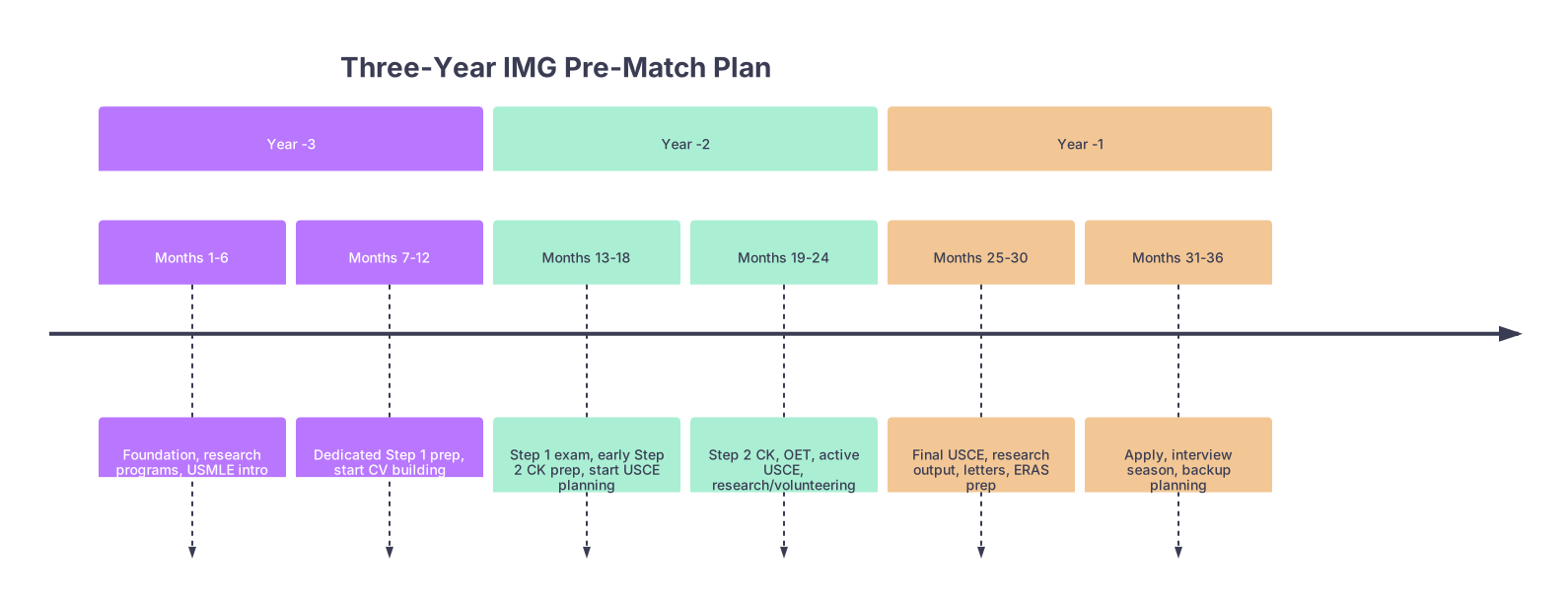
| Period | Event |
|---|---|
| Year -3 - Months 1-6 | Foundation, research programs, USMLE intro |
| Year -3 - Months 7-12 | Dedicated Step 1 prep, start CV building |
| Year -2 - Months 13-18 | Step 1 exam, early Step 2 CK prep, start USCE planning |
| Year -2 - Months 19-24 | Step 2 CK, OET, active USCE, research/volunteering |
| Year -1 - Months 25-30 | Final USCE, research output, letters, ERAS prep |
| Year -1 - Months 31-36 | Apply, interview season, backup planning |
Assume this: “Year ‑3” means three Match cycles before the one you’re targeting. For example:
- If you’re aiming for the March 2028 Match:
- Year ‑3 = March 2025–Feb 2026
- Year ‑2 = March 2026–Feb 2027
- Year ‑1 = March 2027–Match Day March 2028
Adjust the actual calendar, keep the sequence.
Year ‑3: Lay the Foundation (Months 1–12)
At this point, you’re early. Maybe still in med school, or just graduated. Good. This is when you quietly get ahead of 80% of other IMGs who are “still thinking about it.”
Months 1–3: Clarity and Data Collection
At this point you should be:
Choosing your realistic target specialty
- Internal Medicine, Family Medicine, Peds → more IMG‑friendly
- General Surgery, Ortho, Derm, Radiology → far tougher, need higher scores and stronger CV
- Decide now, not “later after Step 1.”
Studying actual match data
- Go to NRMP “Charting Outcomes in the Match” and read the IMG sections.
- Look up:
- Typical Step 1/2 CK scores
- % of IMGs matched vs unmatched
- Importance of US clinical experience (USCE)
Mapping your personal constraints
- Graduation year (old grad status hurts in many programs if >5–7 years out)
- Visa needs (J‑1 vs H‑1B)
- Financial ceiling (USCE and exams are not cheap)
Write this down. Literally. A one‑page plan taped above your desk.
Months 4–6: Build the USMLE Engine
At this point you should be starting real Step 1 prep, not just “looking at resources.”
Core moves:
Lock in your Step 1 resources
- First Aid for USMLE Step 1
- UWorld Step 1 Qbank (non‑negotiable)
- Pathoma / Boards & Beyond / Sketchy (pick, don’t hoard)
Create a weekly study template
- Example:
- 20–40 UWorld questions per day
- 2–3 hours review
- 1–2 hours content consolidation (Anki, notes, diagrams)
- Example:
Diagnose your baseline
- NBME practice test early (even if you suck). You need a starting point.
You’re not aiming for perfection here. You’re aiming for a repeatable study rhythm you can sustain 6–9 months.
Months 7–9: Aggressive Step 1 Prep + Early CV Seeds
At this point you should be in serious Step 1 mode while quietly building a few CV anchors.
Step 1 focus
- Ramp up:
- 40–80 UWorld questions/day
- Weekly self‑testing: mini‑blocks, subject NBMEs
- Goal: Build from “I’m lost” → “I’m consistently getting >60% correct on UWorld.”
- Ramp up:
Start low‑lift CV activities
- Join or start:
- A small research project with a local mentor
- A quality improvement project in your hospital
- A student teaching activity (tutoring juniors, OSCE coaching)
- These do NOT need to be glamorous. They just need to be real and documentable.
- Join or start:
Begin USCE reconnaissance
- Identify:
- Hospitals with IMG‑friendly clerkships/observerships
- Programs known to take IMGs in your specialty
- Start a spreadsheet. You’ll live in it for three years.
- Identify:
| Column | Example Entry |
|---|---|
| Hospital/Program Name | Lincoln Medical Center |
| Type (Elective/Obs) | Observership |
| Specialty | Internal Medicine |
| IMG Friendly? | Yes |
| Visa Support | J-1 only |
| Contact Email | [email protected] |
| Notes | Requires Step 1 pass, CV, fee |
Months 10–12: Step 1 Date & Score Strategy
At this point you should be 3–6 months from your Step 1 exam.
Actions:
Schedule Step 1 window
- If you’re a current student: time it after core basic sciences but before clinicals get insane.
- If you’re a graduate: line it up so you can move into Step 2 CK prep with minimal gap.
Set a non‑negotiable floor for your score
- I’ve seen too many IMGs rush and end up with barely passing scores. That kills competitiveness.
- You want:
- Solid pass on Step 1 (now pass/fail, but programs still care about how comfortably you passed)
- Strong Step 2 CK to carry your application later
NBME checkpoints
- Start taking full‑length NBMEs every 4–6 weeks.
- If your trajectory isn’t rising, change something: hours, resource mix, or environment.
Year ‑2: Exams, USCE, and Real CV Building (Months 13–24)
Now the game is real. This year is where IMGs either set themselves up beautifully—or quietly remove themselves from contention.
Months 13–15: Take Step 1, Flip to CK Mindset
At this point you should be:
Taking Step 1 (or done very soon)
- Do not drag this exam across 18 months. That just delays everything else.
- Clean, focused 6–9 months is usually enough if you’re consistent.
Immediate post‑Step 1 debrief
- The week after:
- List what worked (resources, routines, environments)
- List what failed (too many resources, late nights, distractions)
- You’ll reuse the “worked” side for Step 2 CK.
- The week after:
Transition to Step 2 CK prep
- Core resources:
- UWorld Step 2 CK
- NBME CK forms
- Possibly Online MedEd or similar for weaker systems
- Big mindset shift: Step 2 CK > Step 1 now, for many programs.
- Core resources:
Months 16–18: Step 2 CK Momentum + USCE Applications
At this point you should be layering exam prep + US experience planning.
CK structure
- Daily:
- 40–80 UW CK questions
- Review + notes
- Every 6–8 weeks:
- Full‑length practice (NBME, UWSA)
- Daily:
Apply early for USCE (6–12+ months in advance)
- Strong programs fill fast. You can’t email in July for an August spot.
- Target:
- 8–12 weeks of USCE in your specialty across Year ‑2 and Year ‑1.
- Types:
- Core electives (if still in school)
- Sub‑internships (gold if you can get them)
- Observerships/externships (common for grads)
Start light networking
- When contacting for USCE:
- Use focused emails, not generic “Dear Sir/Madam, I am very interested…” nonsense.
- Mention specific clinic interest, research areas, or mentor’s work.
- When contacting for USCE:
Months 19–21: CK Exam + OET Planning
At this point you should be closing in on Step 2 CK.
-
- Aim to sit CK about 12–15 months before your target Match.
- Why? So your CK score is in hand well before ERAS opens.
Target score
- For many IM specialties, IMGs should be aiming 240+ to be competitive.
- Can people match lower? Sure. But you asked for a planning guide, not lottery odds.
OET / English exam planning (for ECFMG certification)
- Don’t play games here. Schedule it so your ECFMG certification is complete well before ERAS season.
- Many IMGs have been delayed or filtered out because their ECFMG status was “not certified yet.”
Months 22–24: First USCE + Real Research
At this point you should have at least one solid USCE block scheduled or completed.
During USCE
- Show up early. Always.
- Know the EHR basics if possible before starting (Epic, Cerner orientation videos).
- Offer to:
- Present patients
- Prepare short topic talks
- Help with basic chart reviews or literature pulls
This is when future letter writers decide if you’re worth vouching for. They watch your reliability more than your brilliance.
Start or join real research
- Ideal: US‑based attending leads it, you’re actively involved.
- Examples:
- Case reports from your USCE site
- Small retrospective chart reviews
- Quality improvement poster at a local meeting
Track everything in a “CV log” file
- Date started, date ended
- Your specific role
- Supervisor name + contact
- Output: presentation, poster, publication, QI report, etc.
You’ll thank yourself when ERAS asks you to list every activity with dates and hours.
Year ‑1: Application, Letters, and Match Execution (Months 25–36)
This is the application year. Every month matters. Now the timeline gets tighter and more specific.
Months 25–27: Final USCE, Strong Letters, ECFMG Complete
At this point you should be locking down the pillars of your application.
Last major USCE blocks
- Ideally in your target specialty and preferably in:
- Community hospitals that historically take IMGs
- Academic places where at least some IMGs match each year
- Treat every attending as a potential letter writer.
- Ideally in your target specialty and preferably in:
Secure 2–3 strong US LORs
- Ask only if:
- They’ve seen you work for at least 4 weeks
- They can comment on clinical performance, reliability, and communication
- When asking:
- “Do you feel comfortable writing a strong, supportive letter for my US residency applications?”
- If they hesitate, do not push. Move on.
- Ask only if:
Finish ECFMG certification
- By now:
- Step 1: passed
- Step 2 CK: strong score
- OET/English: passed
- ECFMG status should be “Certified” as early as possible in the application season.
- By now:
Months 28–30: ERAS Prep and Program Targeting
At this point you should be working on your application skeleton before the chaos hits.
Program list creation
- Use:
- FREIDA
- Program websites
- Past IMG match lists (from forums, Telegram/WhatsApp groups, alumni)
- Tag programs:
- IMG‑friendly
- Visa‑sponsoring
- Score‑realistic (compare their residents’ profiles to yours)
- Use:
Categorize your programs
- Example for Internal Medicine applicant:
- 20 “reach” programs (more competitive, academic)
- 40–60 “target” programs
- 30–50 “safety” programs (strong IMG history, community‑heavy)
- Example for Internal Medicine applicant:
ERAS personal statement drafts
- You do NOT wait for September to write your personal statement.
- Week‑by‑week:
- Week 1: Brain dump stories and themes (why this specialty, concrete cases, USCE experiences)
- Week 2: Draft 1 → ugly but complete
- Week 3: Revise for clarity and impact
- Week 4: Get it reviewed by at least one US‑trained physician if possible
ERAS activities section
- Use the CV log you kept.
- For each entry:
- Clear role
- Measurable outcomes (“presented to a team of 20 residents,” “abstract submitted to X conference”)
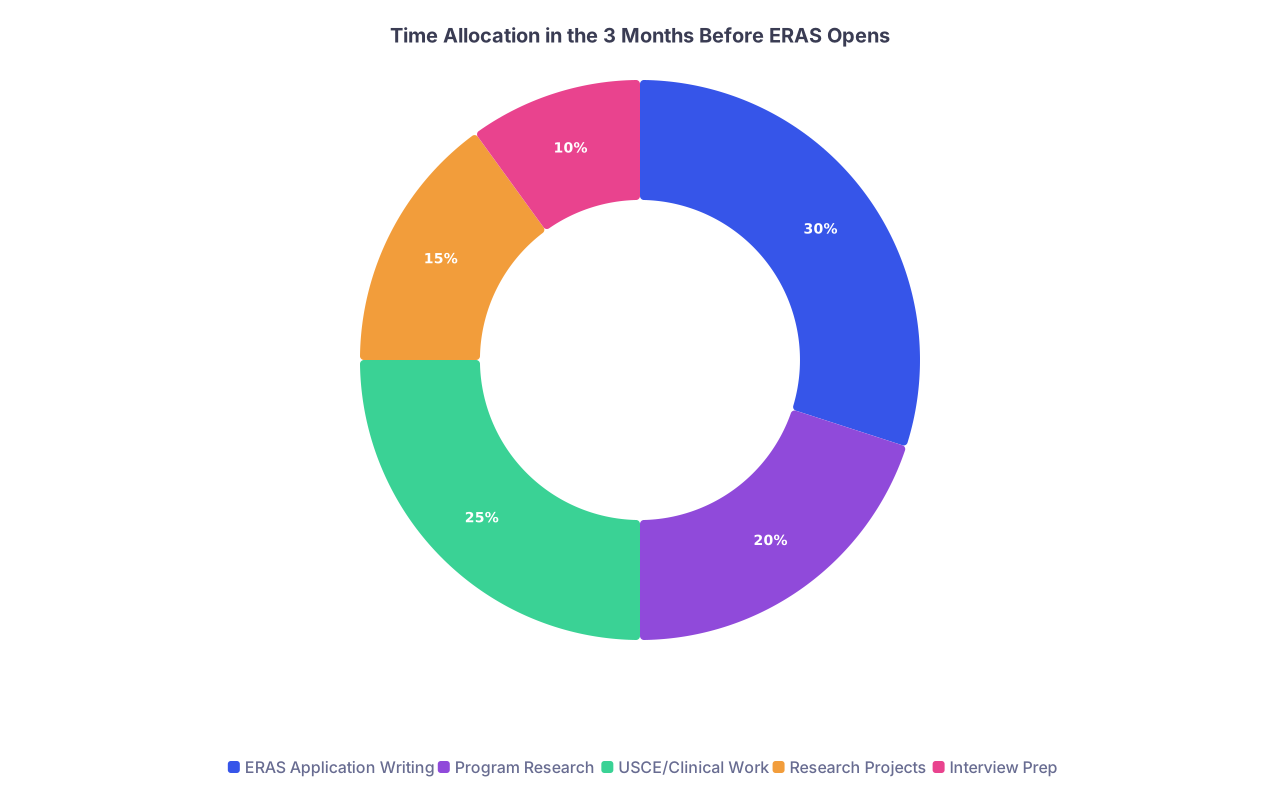
| Category | Value |
|---|---|
| ERAS Application Writing | 30 |
| Program Research | 20 |
| USCE/Clinical Work | 25 |
| Research Projects | 15 |
| Interview Prep | 10 |
Months 31–33: ERAS Submission and Early Interview Prep
This is the high‑leverage window. Tiny mistakes here echo for months.
At this point you should:
-
- Aim for day 1 or the first week applications can be submitted.
- Late apps for IMGs are a quiet self‑sabotage.
Double‑check application details
- No date gaps without explanation
- No activity listed twice
- No obvious spelling in your first sentence (yes, I’ve seen this)
Begin interview prep BEFORE invites
- Structured:
- Practice common questions:
- “Tell me about yourself”
- “Why this specialty?”
- “Tell me about a conflict with a colleague”
- Mock interviews with:
- Friends
- Mentors
- Online services if you can afford it
- Practice common questions:
- Structured:
Clear calendar for interviews
- Keep certain weekdays lighter in the peak interview months (Oct–Jan).
- Have:
- Reliable internet
- Quiet background
- Proper lighting (for virtual interviews)

Months 34–35: Interview Season & Rank List Strategy
Now you’re in it. At this point you should be executing, not improvising.
Handling interview invites
- Respond within hours, not days. Slots disappear.
- Use a simple, consistent system:
- Color‑coded calendar
- Spreadsheet with dates, program type, time zones
During interviews
- You’re an IMG. They’re worried about:
- Communication skills
- Cultural adjustment
- Reliability and visa issues
- Address it calmly:
- Speak clearly, avoid rambling
- Show you understand US training culture (teamwork, hierarchy, documentation)
- Be open and factual about visa needs if asked
- You’re an IMG. They’re worried about:
After each interview
- Same day:
- Jot:
- What you liked/disliked
- How you felt about the residents
- Any red flags
- Jot:
- These notes will save you when building your rank list later.
- Same day:
Prepare a preliminary rank list early
- Don’t wait till deadline week to think about preferences.
- Tie‑breakers:
- Vibe with residents
- Program’s IMG track record
- Location you can actually live in for 3+ years
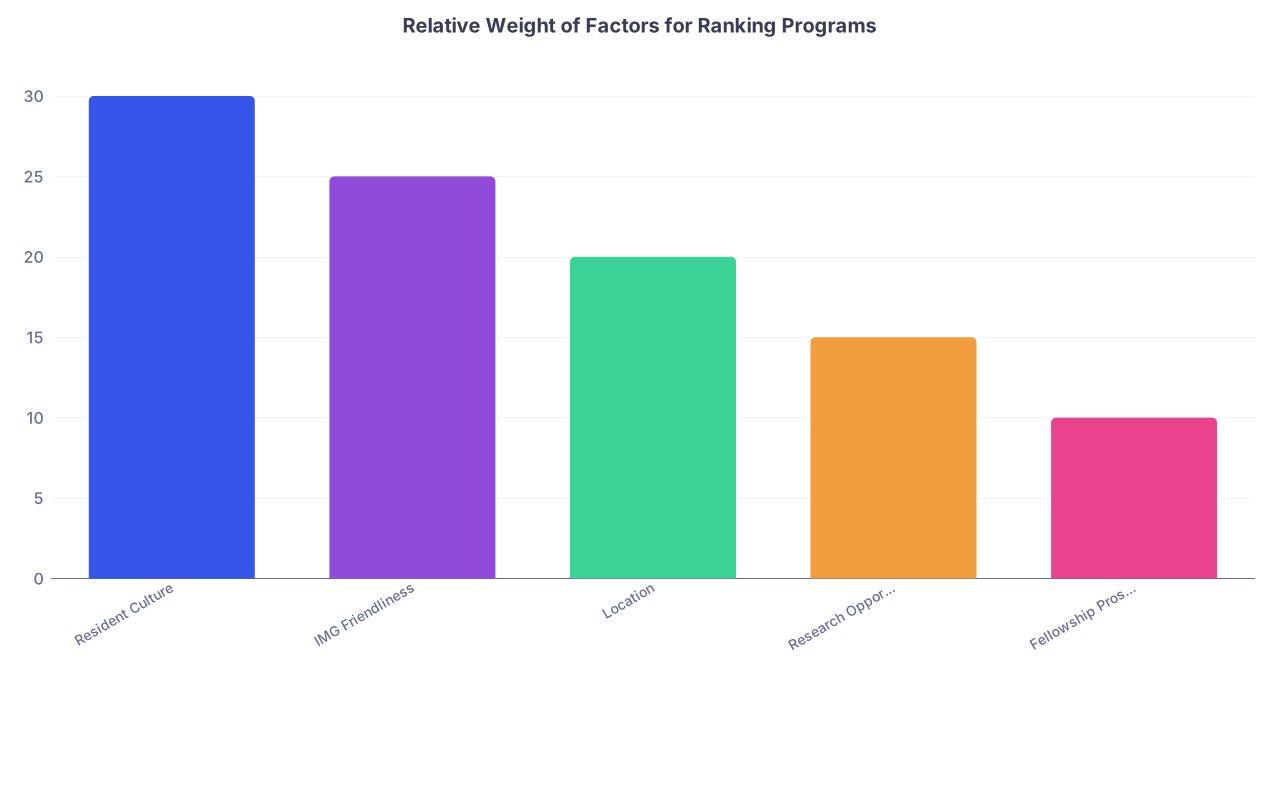
| Category | Value |
|---|---|
| Resident Culture | 30 |
| IMG Friendliness | 25 |
| Location | 20 |
| Research Opportunities | 15 |
| Fellowship Prospects | 10 |
Month 36: Final Rank List, Match Week, Backup Plan
At this point you’re at the end of the three‑year arc.
Finalize NRMP rank list
- Rank by genuine preference, not where you think you’ll match.
- Never play games like putting a “safe” program first just to feel better.
If you get enough interviews
- As a rough heuristic for many IMGs in IM/FM:
- 10–12 interviews → decent match chance
15 → usually quite strong odds
- Still, you rank every program where you’d be willing to train.
- As a rough heuristic for many IMGs in IM/FM:
If interview count is low
- You should already be preparing a re‑application plan:
- Extra USCE
- Second research year
- Another exam attempt only if it’s genuinely likely to improve (e.g., Step 3)
- Don’t wait for an unmatched result to start thinking.
- You should already be preparing a re‑application plan:
Match Week
- If you match:
- Confirm onboarding steps early (licensing documents, visas, background checks).
- If you don’t:
- Scramble/SOAP if eligible
- Same week: sit down and analyze every part of your three years. Brutally honest.
- If you match:

Putting It All Together: Year‑by‑Year Cheat Sheet
| Year | Focus | Non-Negotiables |
|---|---|---|
| Year -3 | Foundation & Step 1 | Decide specialty, start Step 1, early CV |
| Year -2 | Step 2 CK, USCE, Research, ECFMG | Strong CK score, first USCE, OET |
| Year -1 | ERAS, LORs, Applications, Interviews | Early ERAS, solid LORs, timely rank list |
You’re not competing with the IMG who studies “whenever.” You’re competing with the one who started this three‑year clock already and isn’t wasting months wandering.
So do something concrete right now:
Open a blank document and create three headings—“Year ‑3,” “Year ‑2,” “Year ‑1.” Under each, list three milestones you must hit, with actual dates. If you cannot assign dates, your plan is still a wish list, not a strategy.