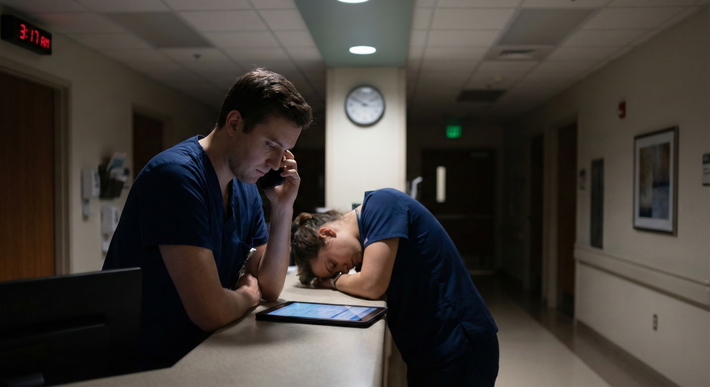
Only 38% of interns get more than 6 hours of sleep before a day on call.
That is not a typo. In one large prospective study, the median intern sleep duration before a 28‑hour call was 5.3 hours, and post‑call it dropped below 3.5. You feel wrecked for a reason. The data backs you up.
Let’s walk through what the numbers actually say about intern sleep patterns, common call schedules, and how all of this translates to performance, errors, and patient outcomes.
What the data shows about intern sleep
Most residents underestimate how bad their sleep actually is.
Across multiple US teaching hospitals, time-stamped sleep diary and actigraphy studies show a consistent pattern:
- Average sleep on non-call days: 6.1–6.5 hours
- Average sleep on call days (during the 24–28 hour shift): 1.5–2.5 hours
- Average sleep on post-call days (24 hours starting at sign-out): 3.0–4.0 hours
Cognitive performance research, including the famous Psychomotor Vigilance Test (PVT), treats anything under 7 hours as partial sleep deprivation. You are starting each week behind.
One multicenter study of PGY‑1 internal medicine residents found:
- 80+ hour weeks: mean total sleep 5.8 hours/night
- 60–70 hour weeks: mean total sleep 6.4 hours/night
A half hour difference per night does not sound like much. Over 6 nights, that is 3 extra hours—almost an entire additional night’s worth of REM and slow-wave combined. That shows up in your reaction times and error rates.
To make this concrete:
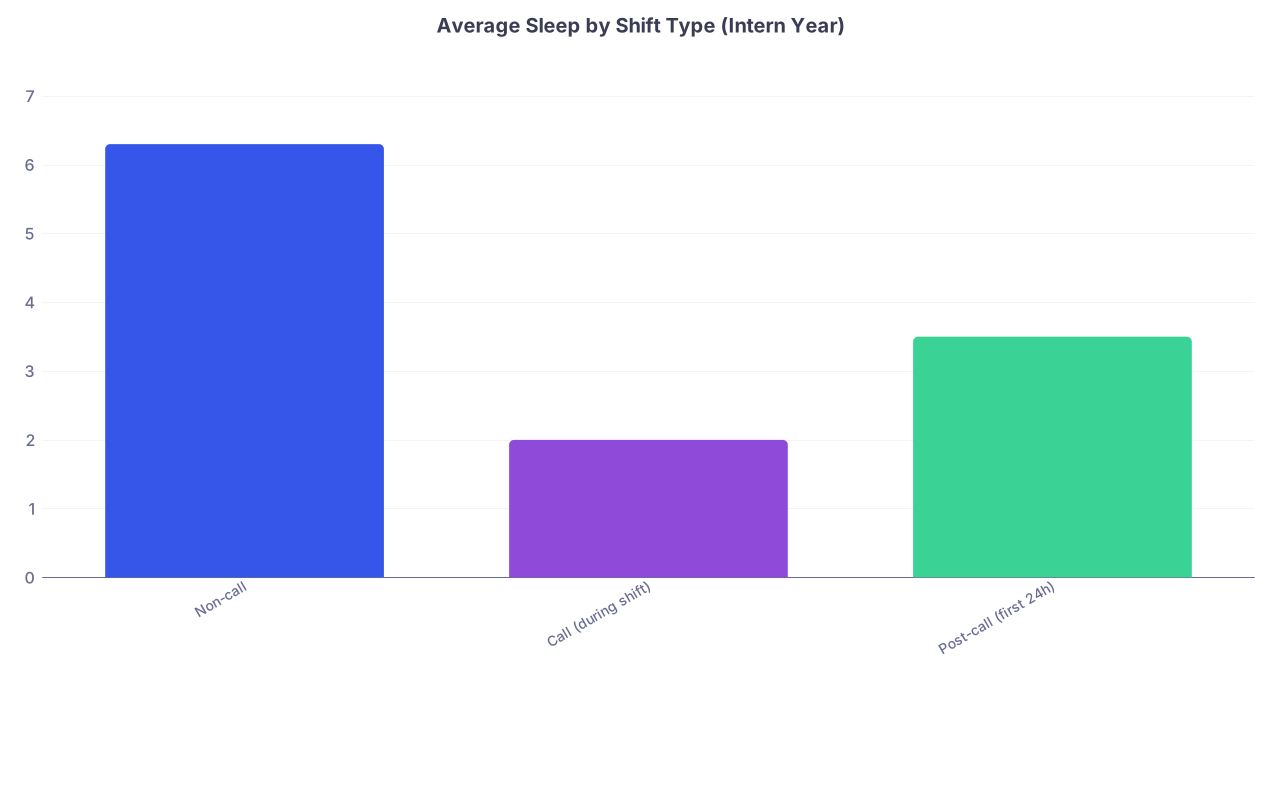
| Category | Value |
|---|---|
| Non-call | 6.3 |
| Call (during shift) | 2 |
| Post-call (first 24h) | 3.5 |
You do not adapt to this. The idea that you “get used to being tired” is mostly bravado. Lab studies show that after 7–10 days of 5–6 hours of sleep, subjective sleepiness plateaus—you feel about the same level of tired—but objective performance keeps degrading linearly. You stop noticing how impaired you are.
I have watched interns insist they are “fine” on 2 hours of fragmented call-room sleep, then take 40 seconds to answer a one‑step medication dosing question. The numbers do not lie.
Common call schedules: how they actually affect sleep
Not all call structures are equally bad. Some are just differently bad. Let’s look at the main patterns.
1. Traditional 24–28 hour call (q4, q5, etc.)
Despite ACGME caps, 24+ hour shifts with 3–4 hours of call-room sleep still exist in many inpatient services (especially surgery, ICU, and some medicine rotations).
Typical pattern for a q4 call system:
- Pre‑call: 10–12 hour day
- Call: 24–28 hours in house
- Post‑call: 4–6 hours of work, then “off” but often with sign-outs, late discharges
- Then two “normal” days… and repeat
Measured sleep per rotation week in internal medicine interns:
- Total weekly sleep on q4 call: about 35–38 hours
- Total weekly sleep on ambulatory weeks (no call): 42–45 hours
That 7–10 hour weekly deficit is equivalent to losing more than a full night of sleep every single week of inpatient.
Under traditional q4 call, actigraphy often shows:
- 60–70% of call nights with ≤2 hours of sleep
- 10–20% of call nights with 0 minutes of recorded sleep
Yes, zero.
2. Night float systems
Night float is usually sold as the humane alternative. Sometimes it is. Sometimes it just shifts your sleep deprivation into a different pattern.
For a typical 6‑night block of 12‑hour nights (e.g., 7 p.m.–7 a.m.):
- Median continuous sleep on “days” (post‑shift): 6–7 hours in a block
- But heavily fragmented by pages, sunlight, roommates, noise
- Social jet lag: your circadian rhythm is pushed 8–12 hours off normal, then snapped back after the block ends
Across multiple programs, data show:
- Night float interns sleep slightly more total hours than those doing 24’s (maybe 0.5–1.0 more hours per 24h)
- But circadian misalignment is greater, which worsens subjective fatigue, mood, and metabolic markers (glucose, blood pressure) even when total sleep time looks decent on paper
You may technically get 7 hours of sleep after a night shift, but that 7 hours from 9 a.m.–4 p.m. does not equal 7 hours from 11 p.m.–6 a.m. Biologically, those are different animals.
3. “Short call” or 16‑hour max shifts
After the 2011 ACGME rules, some intern services moved to 16‑hour caps. Many surgery and ICU programs pushed back and regained 24‑hour allowances in the 2017 revision, but 16‑hour setups still exist, especially on medicine floor rotations.
Performance data for 16‑hour caps is mixed:
- Interns on 16‑hour caps often get 0.5–1.5 more hours of sleep per 24‑hour period than those on 28‑hour shifts
- Objective measures (PVT, memory tasks) improve modestly
- But handoff frequency increases, which leads to more missed information and new types of errors
So you trade individual fatigue-related errors for system-based handoff errors. From a resident’s perspective, 16‑hour shifts feel more humane. From a quality/safety perspective, the data is less clear-cut.
Sleep deprivation and performance: what the numbers actually say
Let us strip out the drama and anecdotes. What happens to performance when your sleep gets cut?
Reaction time and attention
Controlled studies equate extended wakefulness to blood alcohol levels. The classic result:
- 17–19 hours awake ≈ performance like a BAC of 0.05%
- 24 hours awake ≈ performance like a BAC of 0.10% (legally drunk in every US state)
Now map that onto a typical intern call:
- Start work at 6 a.m.
- On call through the day, admissions until midnight or later
- Maybe 1–2 hours of fragmented sleep
- Still writing notes and discharging at 10–11 a.m. next day
By sign‑out, you have been awake and working, with minimal sleep, for 24+ hours. Performance equivalent: working drunk. No attending would accept you showing up with a 0.10% BAC. But the system accepts you at 27 hours awake.
On PVT testing, interns after 24‑hour call have:
- 2–3x more “lapses” (micro-sleeps of reaction time >500 ms)
- Slower mean reaction times by 20–50 ms
- Increased variability—attention is spiky and unpredictable
Those lapses are exactly what you do not want while managing pressors at 5 a.m. in the ICU or cross-covering 60 patients.
Diagnostic accuracy and cognitive bias
Sleep loss does not just make you slow. It makes you overconfident and error-prone.
In simulated diagnostic tasks, physicians after a night of call:
- Take shorter histories
- Order fewer appropriate diagnostic tests
- Jump to initial impressions and stick with them (anchoring bias)
Error rates in interpreting lab results and radiology reports go up. Subtle abnormalities get missed more often. Residents on post‑call rounds are consistently worse at recalling overnight events, medication changes, and pending labs.
I have sat in morning report and watched an intern confidently describe an overnight chest pain admission as “MSK, likely costochondritis,” only to have the attending reveal the troponin was mildly elevated and the EKG had subtle ST‑segment changes that were not recognized at 3 a.m. The intern was not lazy. Just cognitively dulled.
Patient safety: does more sleep actually reduce errors?
The big question: are all these performance decrements just theoretical, or do patients actually get hurt?
Here is where the data gets uncomfortable.
Extended shifts and serious medical errors
One of the most cited resident fatigue studies tracked thousands of intern-months and compared extended-duration shifts (24+ hours) vs shorter shifts.
When interns worked at least one extended (24+ hour) shift in a month:
- Risk of making a serious medical error increased by roughly 20%
- Risk of making a serious diagnostic error increased by ~30%
- Self-reported “near miss” events increased significantly
When interns worked 5 or more extended shifts in a month:
- Risk of having a car crash driving home from work almost doubled
- Risk of a near-miss car crash increased >2x
The correlation is not subtle. Longer continuous wakefulness → more errors. More mistakes. More dangerous commutes.
Another analysis found that residents working 24‑hour shifts every fourth night had:
- 2.3x more attentional failures at night
- Higher rates of needle-stick injuries and accidental exposures late in the shift
Your safety and your patients’ safety degrade together.
Duty hour reforms: mixed clinical outcomes
The story gets more complex when you zoom out to look at hospital-wide outcomes after duty hour reforms (2003 and 2011 ACGME changes).
Multiple large studies using national databases found:
- No major change in inpatient mortality after duty hour limits
- Some small improvements in intern well‑being and self-reported sleep
- But more handoffs led to communication problems and new risks
Translation: improving sleep alone, without fixing system issues and transitions of care, does not magically fix outcomes. Fatigue is one big piece, not the whole puzzle.
Comparing call structures: which schedules are least bad?
Let’s line up some typical structures side-by-side. This is approximate—programs vary—but the pattern is consistent.
| Schedule Type | Avg Sleep / 24h | Extended Wake (≥24h) | Handoff Frequency | Error Risk Pattern |
|---|---|---|---|---|
| q4 24–28h call | 4.5–5.5 h | High | Low–moderate | More fatigue-related errors |
| 6-night night float | 6.0–7.0 h | Moderate (circadian) | Moderate | Fewer lapses, more misalign |
| 16h max shifts | 5.5–6.5 h | Lower | High | Fewer fatigue, more handoff |
If you are ranking pure “biologic kindness,” night float with protected post‑call sleep and stable schedules tends to come out ahead. But only if:
- Daytime sleep is actually protected (no noon mandatory lectures right after a night shift)
- Rotations allow your body to adapt for more than 2–3 nights in a row
In reality, many programs sabotage their own night float benefits with poorly designed schedules, last‑minute changes, or expectations that you “show face” on days you should be asleep.
How interns actually cope: adaptation, hacks, and myths
Let me be blunt: the system is not going to be redesigned around your REM cycles anytime soon. So you are left playing the game with the rules you have.
There is decent evidence for some strategies. Others are basically superstition.
Strategies that actually have data behind them
- Strategic pre‑call napping
A 20–30 minute nap in the late afternoon before a night shift or q4 call:
- Reduces subjective sleepiness for 2–3 hours
- Improves early‑night vigilance (the critical 10 p.m.–2 a.m. window)
You do not need a 2‑hour nap. In fact, long naps often cause sleep inertia and make you feel worse for the first 30–60 minutes afterward. Short and planned works better.
- Caffeine timing, not just caffeine volume
Studies on shift workers (nurses, residents, industrial workers) show:
- Moderate caffeine (100–200 mg) spread over the first 2/3 of the shift improves vigilance
- Heavy late-shift caffeine (after 3–4 a.m.) wrecks post‑shift sleep without meaningfully improving end-of-shift performance
The data supports front‑loading caffeine and tapering, not pounding energy drinks at 5 a.m.
- Light exposure
Controlled light therapy studies in night-shift workers show:
- Bright light during the first half of the night shift + strict light avoidance (sunglasses, blackout curtains) on the commute and at home can partially re‑align circadian rhythms
- Even partial alignment improves reaction time and decreases subjective fatigue
You will not become 100% nocturnal for a short night-float rotation, but keeping your environment consistent helps.
- Protected post‑call sleeping
Interns who manage 3–4 uninterrupted hours of post‑call sleep within 2–3 hours of leaving the hospital perform better on the “second day” (the evening and night post-call) than those who push through, run errands, and collapse later.
The common pattern:
- Post‑call, go home, “just do a few things,” scroll your phone, then sleep 3 fragmented hours from 3–6 p.m.
- Versus: go home, blackout shades, block notifications, sleep a solid 3–4 hours immediately
The second group consistently reports less fatigue for the next day and fewer micro-sleeps.
Myths and bad habits that do not hold up
- “You can train yourself to need less sleep.”
All decent sleep science refutes this. Long-term short sleepers either:
- Are rare genetic outliers (very rare), or
- Are chronically under‑performing vs their biological potential and have no idea how impaired they are
Your brain cannot be “trained” to be fine on 4 hours. It can be trained to stop complaining.
- “I’ll catch up on weekends.”
You can pay off some of the acute debt, but studies show:
- Performance deficits from chronic sleep restriction (5–6 hours per night) accumulate across 1–2 weeks
- A long weekend with 9–10 hours does not fully restore baseline performance
You might feel better, but you are not truly back to zero debt.
- “Alcohol helps me sleep after nights.”
Yes, it shortens sleep onset. It also decreases REM sleep, fragments your sleep, and worsens next‑day performance. You trade quality for speed. The net effect is worse sleep.
Designing a realistic intern sleep strategy
You cannot control the master schedule. You can control how you interact with it. Think in terms of risk reduction, not perfection.
Here is a pragmatic framework that lines up with the data.

| Step | Description |
|---|---|
| Step 1 | Know your call pattern |
| Step 2 | Plan pre call nap 20-40 min |
| Step 3 | Stabilize wake sleep window |
| Step 4 | Front load caffeine early in shift |
| Step 5 | Strict light control post shift |
| Step 6 | 3-4h protected core sleep |
| Step 7 | Short naps only |
| Step 8 | 7-8h full sleep if possible |
| Step 9 | 24h call or nights? |
| Step 10 | Next shift < 24h away? |
The key levers where your behavior matters most:
- Short, scheduled naps, not accidental 2‑hour collapses
- Caffeine earlier, not constantly
- Aggressive environmental control: light, noise, notifications
- Hard boundaries around post-call obligations when possible
The interns who manage to stay functional are not tougher. They are more disciplined about these unglamorous details.
The long-term health cost: not just a bad year
People like to talk about “just surviving intern year.” The body does not file it away neatly as a single tough year.
Extended sleep disruption and circadian misalignment are linked, in physicians and other workers, to:
- Higher rates of hypertension and metabolic syndrome
- Weight gain and worsened glucose control
- Mood disorders—depression, anxiety, burnout
One large study of physicians showed:
- Residents averaging <6 hours of sleep per night had significantly higher rates of burnout and suicidal ideation than those getting ≥7
- The effect was dose‑dependent: every lost hour matters
This is not a character issue. It is literally physiology. Chronic sleep loss shifts your baseline mood, blunts positive affect, and amplifies stress reactivity. You feel more irritable, more hopeless, and less capable of handling the same volume of work.
I have seen excellent interns go from engaged and sharp in July to flat, detached, and error-prone by March, with the only real change being accumulated sleep debt and emotional exhaustion. Then they take a two‑week vacation, sleep normally for the first time in months, and come back almost unrecognizable—in a good way.
What this means for you, concretely
Pulling the data together, a few points are hard to ignore:
, Caffeine use pattern](https://cdn.residencyadvisor.com/images/articles_svg/chart-relative-impact-of-factors-on-intern-performance-9012.svg "Relative Impact of Factors on Intern Performance")
| Category | Value |
|---|---|
| Sleep duration | 90 |
| Circadian alignment | 80 |
| Workload (patients) | 60 |
| [Number of handoffs](https://residencyadvisor.com/resources/intern-year-survival/weekend-call-structures-comparative-outcomes-for-different-models) | 50 |
| Caffeine use pattern | 40 |
Those values are approximate, but they capture the weighting I would assign based on the literature and what I have seen:
- Sleep duration and circadian alignment drive the bulk of your cognitive capacity.
- Workload and handoffs matter, but you tolerate them better when rested.
- Caffeine is a tool, not a solution.
Intern year will not be rested. That is a given. But you can absolutely shift yourself from the “walking disaster” tier (3–4 hours fragmented, unpredictable sleep, constant jet lag) to the “minimally impaired” tier (5.5–6.5 hours when possible, stable patterns, smarter use of naps and light).
The data say that shift is worth it: fewer errors, better mood, and a lower chance of ending the year burnt into the ground.
Three things to remember
- Extended wakefulness on call degrades your performance to drunk‑level impairment. You are not “fine”; you are just unaware of how impaired you are.
- Night float and 16‑hour caps help only if you protect daytime sleep, control light, and avoid fragmented “catch-up” sleep patterns. Structure matters as much as total hours.
- Small, consistent habits—short pre‑call naps, front‑loaded caffeine, strict post‑call sleep protection—measurably improve vigilance and reduce error risk, even in a broken system.