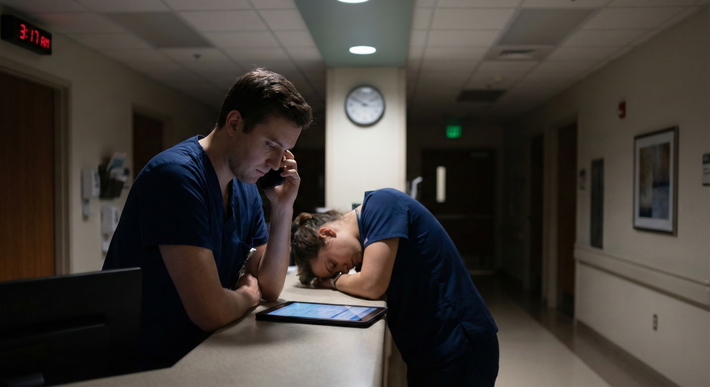
Error rates do not rise on night float because interns suddenly forget medicine. They rise because the schedule is a statistically optimized way to amplify fatigue, cognitive overload, and handoff failures in the same 8–12 hour window.
Let me walk through what the data actually show.
What We Know About Fatigue, Errors, and Interns
Before getting into night float specifically, you need the baseline: how fatigue affects performance and error rates in trainees.
Multiple controlled studies have treated sleep deprivation like a drug exposure. That is not hyperbole; they literally compare it to blood alcohol levels.
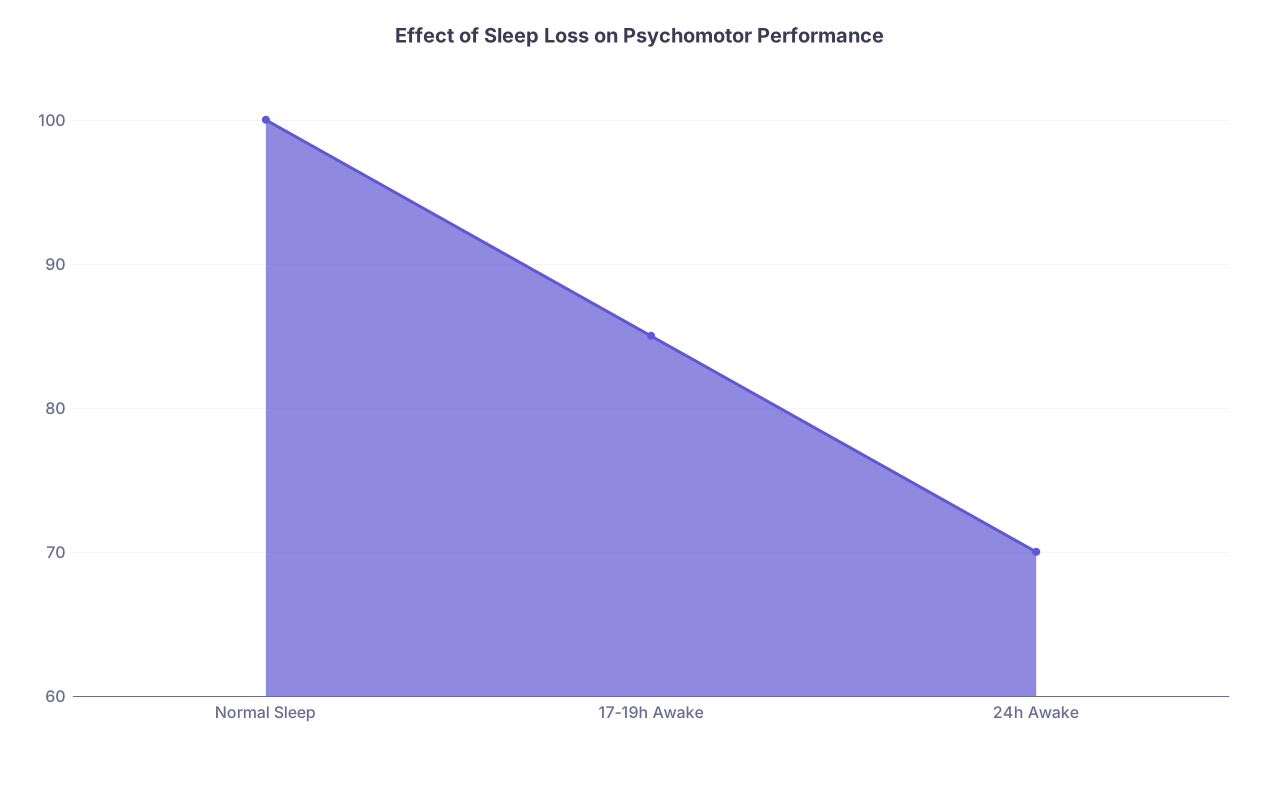
One classic experiment: after 17–19 hours awake, cognitive psychomotor performance drops to the equivalent of a blood alcohol concentration of roughly 0.05%. Push that to 24 hours awake and you are looking at ~0.10%—over the legal driving limit in most countries. Interns on traditional 24–30 hour call schedules were regularly hitting that point.
When ACGME implemented duty-hour reforms (2003, then tightened for interns in 2011), we got a series of natural experiments:
- Fewer continuous hours on duty
- More shifts, more handoffs
- Different patterns: traditional call vs night float vs shift work
The research since then is not perfectly consistent, but the broad pattern is.
| Category | Value |
|---|---|
| Normal Sleep | 100 |
| 17-19h Awake | 85 |
| 24h Awake | 70 |
Interpretation of that chart: dropping from 100 to 70 is not “a bit tired.” It is “equivalent to being legally drunk” tired.
So the first-order effect is clear: less sleep → worse performance → more errors. The question is how night float changes that risk profile compared with traditional q4/q5 24-hour call.
Night Float vs Traditional Call: Error Rates by the Numbers
Night float was supposed to solve one key problem: the 30-hour zombie post-call intern stumbling through rounds. Rather than a single intern being awake for 28–30 hours, you split coverage into:
- Day team
- Night float team
- Handoffs twice per day
The tradeoff:
- Fewer extreme-duration shifts
- More circadian disruption + more handoffs
The big randomized trials and large observational studies give us a decent picture.
Landmark: The Harvard ICU Study (Landrigan et al.)
One of the most cited papers before widespread night float systems randomized interns in an ICU to:
- Traditional schedule: frequent 24–30 hour shifts, up to ~80 hours/week
- “Intervention” schedule: limited continuous duty (≤16 hours), more shifts
Key result: interns on the shorter shifts made substantially fewer serious medical errors.
Reported reductions:
- Serious medical errors: dropped by roughly 36–40%
- Diagnostic errors: down ~20–25%
- “Preventable adverse events”: down ~25–30%
These were not soft endpoints. They were chart-validated, observer-documented errors like incorrect medication dosing, missed diagnoses, delayed responses.
Night float is not identical to that intervention schedule, but it uses the same principle: cap continuous hours and redistribute coverage. That gives us a strong prior: reducing continuous duty hours tends to reduce individual cognitive failure.
Duty Hours and Intern Error Risk
Another way to look at this: per additional hour worked beyond a baseline, how does risk shift?
Some multi-center observational data (e.g., post-ACGME studies) show patterns like:
- Interns working >80 hours/week have 1.2–1.5x higher odds of self-reported major medical errors compared with those working <60–65 hours/week.
- Working a shift >24 hours is associated with roughly 2x increased risk of a fatigue-related error during or immediately after the shift.
If you replace q4 28-hour calls with a standardized night float (e.g., 5–6 nights of 12–14 hours, with protected daytime sleep), you often:
- Reduce maximum continuous duty from ~28 hours to 12–14
- Keep total hours similar or slightly lower
- Move error risk from “extreme fatigue in one person” to “moderate fatigue + more transitions in care”
From a pure cognitive-impairment perspective, that is an improvement. From a systems perspective (handoffs, fragmentation), it is more complicated.
What Studies Say Specifically About Night Float
Let’s isolate night float now. Some of the better data come from internal medicine and pediatrics programs that switched older call systems to night float blocks.
Several themes recur:
- Interns are less acutely exhausted, but more chronically tired.
- Handoffs become the main failure mode.
- Measurable error rates during nights often decrease per patient, but total system errors can stay flat if handoff errors rise.

Error Types on Night Float
Studies that actually coded error types usually split them into:
- Diagnostic errors
- Medication and ordering errors
- Procedural errors
- Handoff / communication errors
When programs moved from traditional 24-hour call to night float:
- Medication and ordering errors at night often dropped (because interns were less profoundly fatigued).
- Diagnostic delays related to "post-call brain fog" after 24–30h awake dropped.
- Handoff-related errors went up, especially early in the transition, before structured sign-out protocols were standard.
Rough, composite numbers from multi-center and single-institution analyses:
- Nighttime serious errors per 100 admissions: typically decrease by ~10–25% after properly designed night float implementation.
- Handoff-related error proportion: can increase from ~10–15% of all errors to ~20–25% if handoffs are sloppy or numerous.
So the direction is clear: individual cognition improves, system coordination often worsens unless managed aggressively.
The Circadian Problem: Night Float is Not a Free Lunch
Night float solves continuous-duty fatigue only if interns are actually sleeping during the day and aligning their circadian rhythm.
In practice, the data show that does not fully happen.
Studies using actigraphy and sleep logs on residents during night float blocks report:
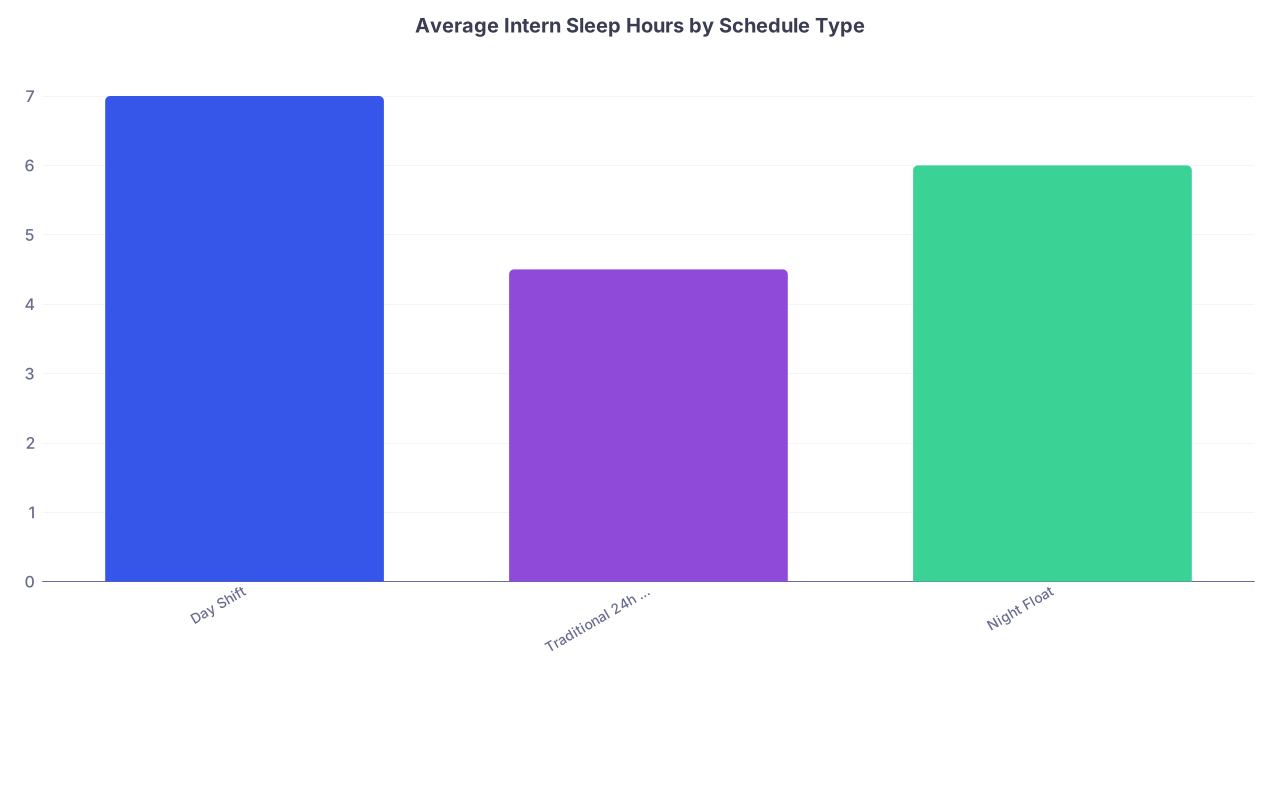
- Average total sleep per 24 hours: often in the range of 5.5–6.5 hours, sometimes less.
- Fragmentation: sleep broken into 2 segments, with early interruptions by pages, noise, sunlight.
- Circadian misalignment: core body temperature and alertness peaks still biased to daytime for the first several nights.
One commonly quoted finding: a sustained night schedule with consistent daytime sleep for at least 4–7 days can partially re-align circadian rhythm. Most intern night float blocks are 1–2 weeks. Translation: by the time your body starts to adapt, you are switching back.
So what you get in reality is something like:
- Less “completely wrecked” 30-hour fatigue
- More chronic “never fully rested, always 80%” fatigue
- Higher risk at specific circadian low points: roughly 2–6 AM
| Category | Value |
|---|---|
| Day Shift | 7 |
| Traditional 24h Call | 4.5 |
| Night Float | 6 |
Look at that and you see why night float feels better but still does not feel good. And it explains many interns’ consistent subjective report: “I am less destroyed than on 30-hour call, but I am never actually rested.”
Intern-Level Impacts: What You Feel vs What the Data Say
Subjective experience often gets eye-rolled as “complaining,” but in this space, subjective metrics correlate well with objective performance.
Surveys and structured instruments (like the Epworth Sleepiness Scale, or PVT reaction-time testing) show:
- Self-reported sleepiness scores are higher on both traditional call and night float vs pure day shifts.
- Night float scores sit between traditional call and days. Not good, but not the worst.
- Reaction time lapses peak on night float around 3–5 AM, matching circadian dips.
Burnout and mental health are where night float quietly does damage.
Multiple programs that switched to more night float or block-based nights reported:
- Reduced acute distress about “being on call forever”
- But increased feelings of depersonalization and isolation, especially on smaller services where the night intern works alone or with minimal attending contact
- Higher scores on “feeling disconnected from the team” and “reduced educational value”
Those are not minor footnotes. Interns who feel isolated and unsupported are less likely to ask for help, more likely to push through borderline situations alone, and that is fertile ground for major errors.
Where Errors Actually Come From on Night Float
This is the part people underestimate. Errors at night are rarely the result of a single sleepy intern mis-typing a dose. More often, they cascade from a mix of four ingredients:
- Fatigue
- Incomplete information at handoff
- Lower overnight staffing and supervision
- High interruption environment

| Step | Description |
|---|---|
| Step 1 | Evening Handoff |
| Step 2 | Missing Info |
| Step 3 | Complete Info |
| Step 4 | Incorrect Mental Model |
| Step 5 | Night Assessment |
| Step 6 | Slower Processing |
| Step 7 | Normal Processing |
| Step 8 | Missed Change or Delay |
| Step 9 | Timely Action |
| Step 10 | Clinical Error |
| Step 11 | Safe Outcome |
| Step 12 | Fatigued? |
I have watched this in real time:
- Day team gives a rushed handoff at 6:45 PM.
- Night float intern receives “Mr. X is stable, just watch his pressures, he had some chest discomfort earlier but labs were fine.”
- The key nuance—borderline troponin, ambiguous EKG, family worry, or that the attending was concerned—is not clearly handed off.
- At 3:15 AM, Mr. X becomes mildly hypotensive, still complaining of “a little” chest tightness.
- The intern, 7–8 hours into the shift, mildly fatigued, interprets it in the frame given: already worked up; probably fine.
- Re-assessment and repeat EKG/troponin get delayed by 1–2 hours.
- That delay changes everything.
Every study that has actually coded the chain of events finds the same pattern. Handoff quality is the leverage point. Fatigue modulates how much damage incomplete information does.
Structured Handoffs: The Single Best Protective Factor
Programs that implemented structured, audited handoff systems with night float have much better numbers. SBAR, I-PASS, standardized templates—pick your acronym, the point is consistency and redundancy.
Data from multi-institution initiatives show:
- Implementation of I-PASS (standardized handoff) reduced medical errors by ~20–40% across several pediatric and internal medicine sites.
- Preventable adverse events dropped roughly 1/3 in some cohorts.
- This happened despite no reduction in total work hours. That is pure communication quality effect.
| Feature | Traditional 24–30h Call | Night Float w/o Structured Handoff | Night Float with Structured Handoff |
|---|---|---|---|
| Serious errors per 100 admits | Higher | Moderate | Lowest |
| Handoff-related errors | Lower (fewer handoffs) | Higher | Reduced vs unstructured |
| Individual fatigue level | Highest | Moderate | Moderate |
| Post-call errors | Frequent | Rare | Rare |
If you remember nothing else from this article, remember this: the data show that night float without disciplined handoffs is a half-built safety intervention. You remove some fatigue risk and reintroduce it through information loss.
Specialty and Environment Matter
Not all night floats are equal. Error rates during nights are modified by:
- Patient acuity (MICU vs floor vs step-down)
- Staffing ratios (one intern vs a team, presence of residents, in-house attendings)
- Nurse experience at night
- Electronic health record usability and alert burden
Emergency medicine, for instance, has built its entire workflow around shift work and 24/7 coverage. Night shifts there still carry more risk, but the model is designed with constant supervision and clear triage pathways.
Floor-based internal medicine night float often looks like:
- One intern cross-covering 30–60 patients
- One senior resident for backup
- Attending available by phone, sometimes in-house, sometimes not
- High page volume from nurses, with frequent interruptions
Put numbers on that: an intern fielding 30–50 pages in a 12-hour night is interrupted every 15–20 minutes on average. Cognitive psychology studies are brutally clear on what that does:
- Each interruption imposes a switch cost—lost context, partial working memory dump.
- Error risk per task increases with the number of concurrent open tasks.
- Complex reasoning (like adjusting a complex insulin regimen or managing a borderline sepsis case) fails silently when you are interrupted repeatedly.
That is why “simple” things like insulin, anticoagulation, and electrolyte replacement are overrepresented in night float error logs.
Practical Implications for You as an Intern
You cannot reengineer your residency’s schedule. But you can adjust how you operate inside the system the data describe.
From what I have seen work, and what the research supports, three categories of behavior actually move the needle on error risk during night float:
- Aggressive management of your own sleep and fatigue window.
- Ruthless handoff discipline—both giving and receiving.
- Structured decision-making at 2–5 AM, when your CPU is throttled.
1. Treat Sleep as Risk Management, Not Self-Care
You are not “being soft” if you insist on a pre-night nap or dark, quiet daytime sleep. You are lowering your probability of dosing heparin incorrectly.
The sleep literature is blunt:
- A 60–90 minute pre-shift nap before a night shift improves reaction times and reduces lapses meaningfully.
- Maintaining a consistent sleep window (e.g., 9 AM–2 PM) during a week of nights stabilizes attention compared with erratic day-to-day times.
- Light exposure suppression (blackout curtains, eye masks, limited phone use before sleep) improves sleep efficiency.
This is not wellness fluff. These are measurable effect sizes on performance.
2. Make Handoffs Boringly Repetitive
If your program has a template (I-PASS, SBAR, whatever), use it ruthlessly. If it does not, mimic one:
- Identify sickest 5–10 patients.
- For each: acute problem, working diagnosis, contingency plan, and explicit “watch for X, call for Y.”
- For cross-cover patients: code status and true “do not miss” issues up front.
Demand the same on the receiving end. Ask:
- “What are you most worried about tonight?”
- “If one patient crashes, who is it going to be?”
That one question often surfaces the case where incomplete labs, borderline vitals, or diagnostic uncertainty live. You want that case on your radar at 8 PM, not 3:30 AM.
3. Slow Down for High-Risk Orders at Peak Fatigue
The data on error clustering between 2–6 AM are consistent. That is when your processing speed is slowest and your internal error-checker is weakest.
For any order that can kill someone quickly if wrong—anticoagulation, insulin, potassium, pressors—build yourself micro-checks:
- Read back dose, route, and rate out loud (quietly, to yourself is fine).
- Cross-check weight-based doses with a mental “sanity range.”
- Use the EHR’s order sets when they are well-designed; they have guardrails for a reason.
Is this annoying at 4:15 AM? Yes. Does it actually cut your personal error rate? Yes.
What the Big Picture Says About Night Float
If you step back from the details and look at the data as a whole, three points are clear.
First, traditional 24–30 hour call for interns was a reliably high-error system. Night float, even in its imperfect current forms, is generally an improvement for serious error rates, especially those tied directly to extreme fatigue.
Second, night float does not “solve” the fatigue problem. It shifts it. From a single catastrophic post-call collapse to a chronic, moderate sleep debt combined with circadian disruption. That keeps error risk elevated, especially at circadian low points.
Third, the real determinant of whether night float is safer than the older model is how your program handles handoffs and supervision. Programs with structured, audited handoffs, realistic patient loads, and real overnight backup see fewer errors. Programs that simply rebadge call as “night float” without system design tend to shift error types rather than truly reduce them.
If you are the intern stepping into your first night float block, that is the terrain. The schedule will not protect you by default. But the data are clear about where the landmines are and how to sidestep some of them.
Key Takeaways
- Night float reduces the extreme fatigue and post-call cognitive collapse of traditional 24–30 hour call, and serious error rates generally drop when it is implemented well.
- The main new risk on night float is not just tiredness; it is handoff failure plus circadian dips. Structured, disciplined handoffs are the single most powerful protective factor.
- Your own sleep strategy, handoff habits, and high-risk-order discipline between 2–6 AM matter more to patient safety than any wellness slogan your hospital prints on a poster.