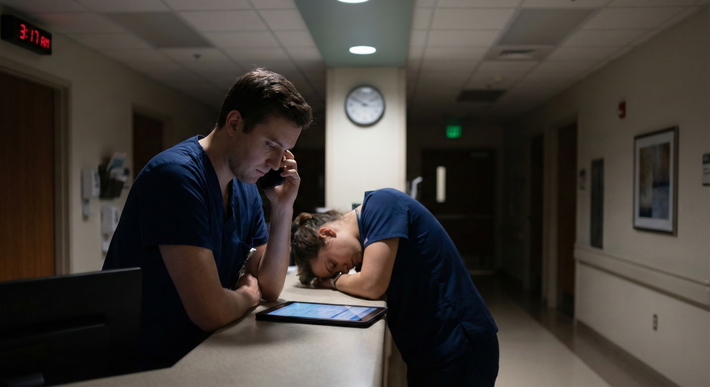
The story interns tell about burnout is emotional. The story the data tells is brutal.
By PGY1, between 35% and 60% of residents already meet criteria for burnout in large cohort studies—often within the first 6–12 months of training. And the strongest, most consistent predictor is not personality, or “resilience,” or some vague wellness construct. It is workload. Measured in hours, patient volume, overnight calls, and documentation burden.
Let me walk through what the numbers actually show, because the patterns are not subtle.
What Large Cohort Studies Actually Measure
When researchers study burnout in residents, they rarely rely on vibes. They use standardized tools and large samples.
The most common burnout instrument: Maslach Burnout Inventory (MBI). It breaks burnout into three domains:
- Emotional exhaustion
- Depersonalization (cynicism toward patients)
- Reduced personal accomplishment
Most large PGY1 studies define “burnout” as high emotional exhaustion and/or high depersonalization on MBI cutoffs. Response rates in well-run cohorts typically sit around 60–80%, which gives decent power to see workload effects.
Prominent datasets you should know:
- iCOMPARE (internal medicine interns, >2,300 residents) – duty hour structures and sleep
- FIRST Trial (surgery residents, ~4,400 residents) – flexible vs standard hours
- Multiple annual national ACGME surveys – 10,000+ residents across specialties
- Program-specific longitudinal cohorts (IM, EM, surgery, anesthesiology, pediatrics) – hundreds to low thousands of PGY1s
These cohorts repeatedly measure:
- Weekly work hours
- Number of inpatients cared for per shift
- Number of overnight calls or night float blocks
- Frequency of 24–28 hour shifts
- Hours of sleep per 24h / per week
- Time spent on documentation / EHR
- Self-reported burnout, depression, suicidal ideation, and leaving-medicine intentions
When you pool this, the signal is very clear: as workload and hours increase, burnout rises in a roughly dose–response fashion.
Baseline: How Common Is PGY1 Burnout?
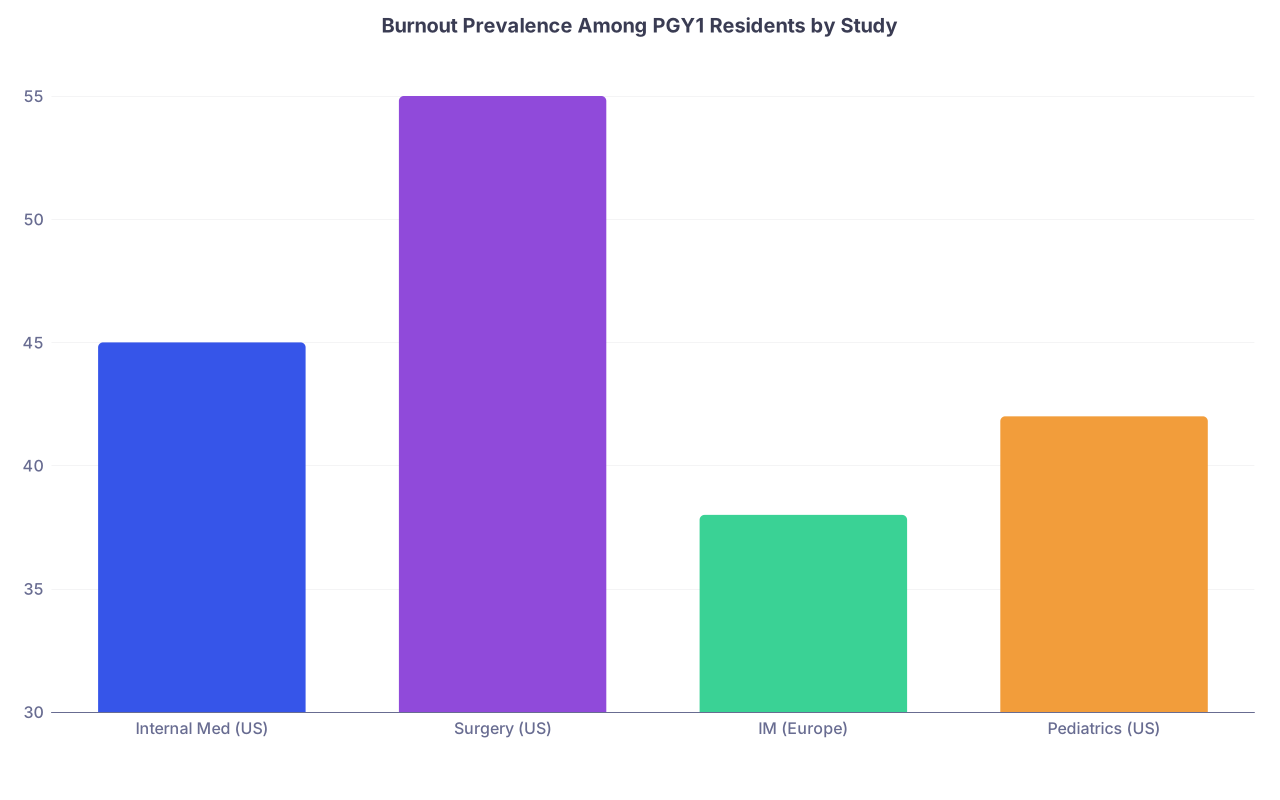
Large cohorts do not agree on the exact percentage, but the range is tight enough to be confident: burnout is common, early, and persistent.
| Category | Value |
|---|---|
| Internal Med (US) | 45 |
| Surgery (US) | 55 |
| IM (Europe) | 38 |
| Pediatrics (US) | 42 |
Most large samples find:
- Internal medicine PGY1: roughly 40–50% meeting burnout criteria at some point in year one
- General surgery PGY1: often 50–60%
- Pediatrics / family medicine: usually 35–45%
- Emergency medicine: around 45–55%, but with wide variation by site
The timing pattern is consistent. Burnout tends to:
- Spike early (3–6 months into PGY1) when workload and steep learning curve collide
- Plateau or slightly improve in late PGY1 as residents adapt and become more efficient
- Persist at non-trivial levels—burnout rarely drops below 25–30% in any group
So if you are PGY1 and feel drained by month 4, the data says you are not an outlier. You are exactly where the distribution says many interns land.
Work Hours: The Clearest Quantitative Driver
Let’s be precise. Workload is not a fuzzy idea. It is measurable.
Across multiple cohorts, each additional 5–10 work hours per week is associated with a significant increase in burnout odds, even after adjusting for age, gender, specialty, and baseline mental health.
Typical hour bands in PGY1 studies:
| Weekly Hours | Typical PGY1 Setting | Approx. Burnout Prevalence |
|---|---|---|
| 50–60 | Lighter ambulatory / psych | 25–35% |
| 60–70 | Many IM / peds programs | 35–45% |
| 70–80 | Busy IM, EM, surgery | 45–60% |
| >80 (violation) | Non-compliant rotns | 60–70%+ |
The association behaves almost linearly up to about 80 hours. Above that, data get sparser (and ACGME prohibits >80 as averaged), but where measured, burnout rates are extremely high.
Specific findings that show how tight this relationship is:
- Interns in the highest quartile of weekly hours (usually
75–80 hours) often have 1.5–2.0 times the odds of burnout compared with those in the lowest quartile (55–60 hours). - In some longitudinal cohorts, reducing average weekly hours by 8–10 is associated with an absolute 10–15 percentage point drop in burnout prevalence.
So when residents say, “It is not just the hours,” they are partially right. But the hours are not negotiable in the model. They are a major term in the equation.
Overnight Call, Shift Length, and Recovery
Next variable: how those hours are distributed. 70 hours in regular day shifts feels different from 70 hours with Q4 overnight 28-hour calls.
Large multicenter studies consistently show that:
- More 24–28 hour call shifts per month → higher burnout, more depression symptoms, more near-miss errors.
- Shorter maximum shift lengths (16–20 hours) combined with adequate day-off structure produce modest but real reductions in emotional exhaustion.
The iCOMPARE and FIRST trials, which compared more flexible duty hours vs stricter limits, did something revealing. They found no catastrophic difference in patient outcomes but did see:
- Flexible hours often came with more long shifts and less predictable time off
- Some subgroups of interns in the more flexible arms showed higher fatigue and worse subjective well-being, even when total weekly hours were similar
In plain language: squeezing the same hours into more brutal configurations punishes PGY1s more than it helps.
Patterns you see across multiple cohorts:
- PGY1s working >3 overnight calls per month have ~1.3–1.5x higher odds of burnout vs those with 0–1 overnights, controlling for total hours.
- Interns with <1 full day off per week on average report substantially worse well-being and higher depersonalization scores.
So the data supports what residents say at 3 a.m. in the call room: the overnight structure and recovery time matter, not just the weekly total.
Patient Volume, Task Load, and EHR Burden
Now to the messy reality: two interns can both work 70 hours, but one is drowning while the other is merely treading water. The difference is task density.
Studies that actually track patient census and task counts show that:
- Caring for more than 10–12 inpatients per intern on a typical day correlates with higher burnout and more reported medical errors.
- Higher “task intensity” (pages, order entries, documentation events per hour) is strongly associated with emotional exhaustion, even when controlling for total hours.
EHR and documentation burden are not side notes. In some surveys:
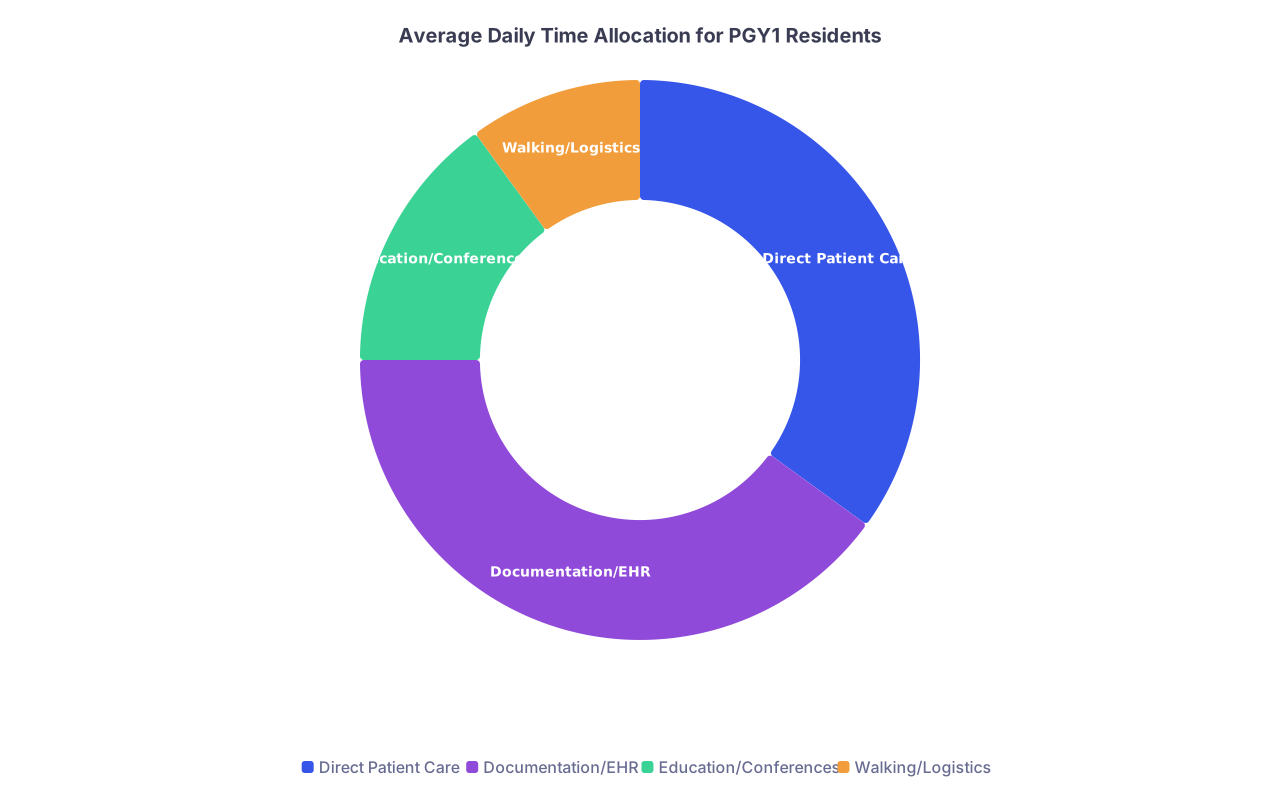
- Residents report 2–4 hours per day on documentation alone.
- Time spent on the computer versus direct patient care commonly hits 40–60% of working time.
| Category | Value |
|---|---|
| Direct Patient Care | 35 |
| Documentation/EHR | 40 |
| Education/Conferences | 15 |
| Walking/Logistics | 10 |
Multiple cohorts show a simple pattern:
- More EHR time per day → higher burnout scores.
- Residents who report EHR as “very inefficient” or “poorly supported” show significantly higher odds of burnout than peers who rate it as “efficient.”
I have seen programs where PGY1s cover 16 patients on day 2 of internship, with 60+ notes to review plus discharge summaries, all ending at 9 p.m. Those interns do not need mindfulness; they need fewer patients and better documentation workflows.
Sleep: The Mediator You Cannot Ignore
Workload translates into burnout via sleep deprivation more than any other single pathway. Large PGY1 cohorts that use actigraphy or validated sleep questionnaires show this repeatedly.
Common numbers:
- Average sleep on on-service inpatient rotations: 5–6 hours per 24h, often fragmented
- Average sleep on nights: 2–4 hours (if they are lucky) during a 24–28 hour call
- Off-service or elective rotations: closer to 7–8 hours
Burnout and sleep map tightly:
- Residents sleeping <6 hours per night on average have ~2x the odds of burnout compared with those getting ≥7 hours.
- Each hour less of sleep is associated with a measurable increase in MBI emotional exhaustion score.
One longitudinal PGY1 cohort tracking sleep changes found:
- As weekly work hours increased by ~15% during intense inpatient blocks, average nightly sleep dropped by about 1 hour
- During those same blocks, burnout scores rose, depressive symptoms increased, and attentional performance declined.
This is not subtle: overwork → sleep loss → burnout, depression, and errors. You can argue about direction or minor confounders, but the overall causal chain is obvious.
Specialty Differences: Not All PGY1 Years Are Built Alike
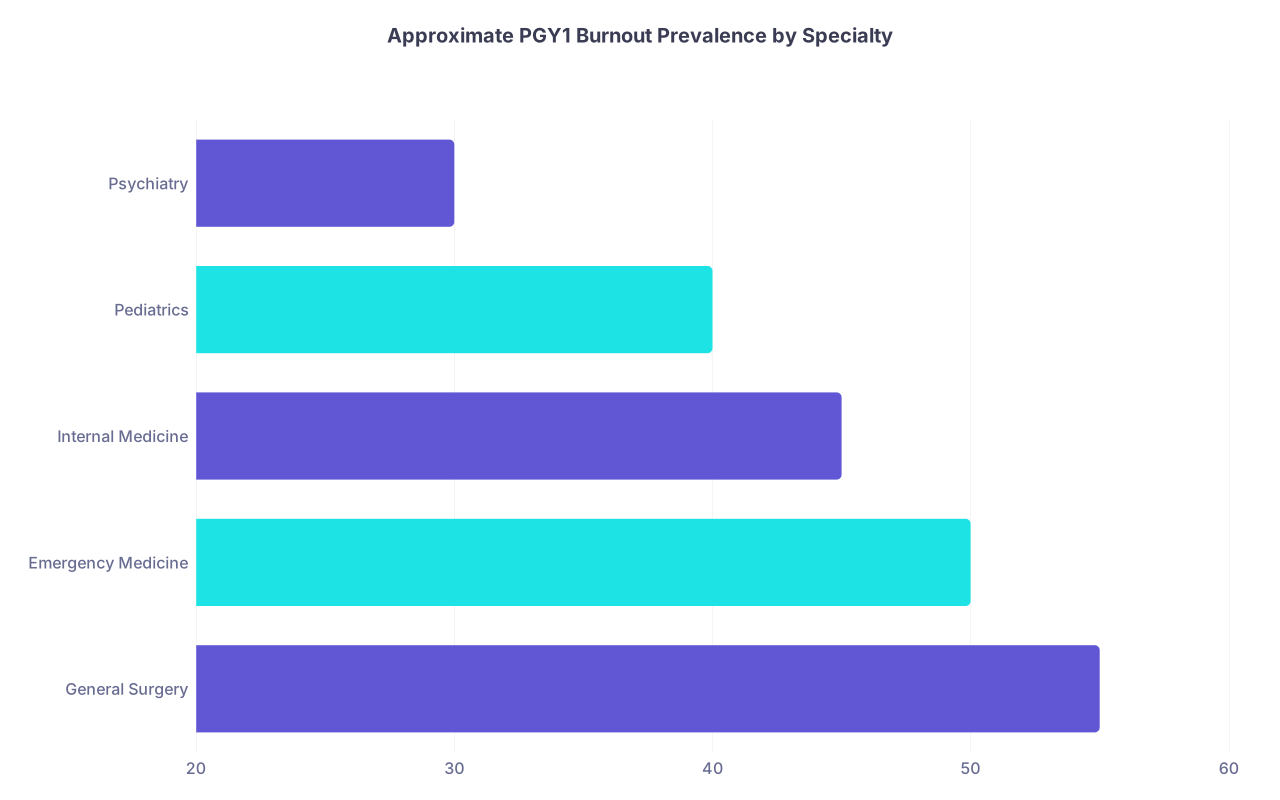
Cross-sectional national surveys let us compare PGY1 burnout rates across specialties, controlling (roughly) for work hours.
Here is the general pattern (numbers vary by study, but the ranking is consistent):
| Category | Value |
|---|---|
| General Surgery | 55 |
| Emergency Medicine | 50 |
| Internal Medicine | 45 |
| Pediatrics | 40 |
| Psychiatry | 30 |
Key observations:
- Surgical fields (general surgery, orthopedics): higher burnout, higher hours, more overnight calls, and more intense “service before self” cultures.
- EM: variable schedules, night work, high acuity and volume, coupled with high documentation demands in many EDs.
- Internal medicine: middle-high burnout driven by inpatient ward workloads, cross-coverage, and consult volume.
- Pediatrics: slightly lower but still substantial rates; often similar hours but somewhat less emotional depersonalization.
- Psychiatry and some lifestyle-heavy subspecialties: consistently lower burnout, partially due to more reasonable hours and less chaotic workflows.
But note: even in supposedly “lighter” specialties, PGY1 burnout rarely drops below 25–30%. The baseline pressure of being PGY1—new responsibility, steep learning curve, evaluation anxiety—keeps rates high.
Culture and Support: Modifiers of the Workload–Burnout Relationship
The data does not let program culture off the hook. Even at similar hour levels, some programs do far better than others.
What shows up repeatedly:
- Perceived institutional support (attendings approachable, program leadership responsive, psychological support accessible) significantly reduces burnout odds at any given workload.
- Residents who report being bullied, humiliated, or disrespected have dramatically higher burnout and depression scores, even after adjusting for hours and call frequency.
- Schedule flexibility (ability to swap calls, protected post-call time, reliable days off) correlates with lower burnout.
In logistic regression models, workload variables usually explain a large share of variance, but culture and support add meaningful independent effects.
I have seen programs running 65–70 hour weeks with decent staffing, reasonable patient caps, and attendings who actively deflect non-educational scut. Their PGY1 burnout rates hover around 30–35%. Another program with similar hours but constant paging, chaotic handoffs, and indifferent leadership sits above 55%. Same hours. Different experience.
Mental Health Outcomes: Burnout Is Not Just “Feeling Tired”
Large PGY1 cohorts do not stop at burnout. They tie workload and burnout to harder outcomes:
- Major depressive symptoms: roughly 20–30% of PGY1s screen positive at some point in the year. Higher among those with greater workload and higher burnout.
- Suicidal ideation: typically 5–10% of residents report having thoughts of self-harm during training, with burnout as a strong predictor.
- Self-reported medical errors: residents with high burnout and severe sleep deprivation report significantly more serious errors and near-misses.
One widely cited PGY1 cohort found:
- Burnout was associated with a 2–3x increase in odds of self-reported major medical errors.
- Work hours and sleep explained part of this; depressive symptoms explained another chunk.
So the idea that burnout is just “complaining” is not supported by data. It is tightly linked with safety, functioning, and risk.
What Actually Reduces PGY1 Burnout (According to Data)
You cannot “self-care” your way out of a 28-hour call every fourth night. Interventions that work quantitatively all change structural variables.
When you pull together experimental trials, quasi-experiments, and strong observational data, the most effective levers look like this:
Reducing average weekly hours
- Dropping from ~75 to ~60–65 hours is repeatedly associated with 10–20 percentage point decreases in burnout prevalence in some cohorts.
- Effect sizes are modest but real; no serious dataset shows that more hours improve well-being.
Limiting consecutive duty and overnight calls
- Capping shifts at 16–20 hours and ensuring ≥1 day off per week improves sleep and slightly reduces burnout.
- Avoiding back-to-back overnight stretches without recovery time reduces acute exhaustion spikes.
Managing patient census and scut load
- Enforcing patient caps per intern and using mid-levels or scribes to offload documentation can meaningfully improve emotional exhaustion.
- Programs that implemented scribe support or intelligent EHR templates report measurable reductions in burnout scores in some before–after studies.
Strengthening supervision and support
- Accessible attendings, low-punitive error cultures, and structured debriefing are consistently linked with lower burnout at any given workload.
- Peer support groups and confidential mental health access show moderate protective effects, but only when residents are granted time to use them.
None of this is magic. It is arithmetic. Less work, more support, saner schedules. Burnout drops. Not to zero, but significantly.
Where This Leaves You as a PGY1
You cannot redesign your residency program single-handedly. But the data gives you leverage and clarity.
At the individual level, hard numbers suggest some practical thresholds:
- If your average week consistently exceeds 75–80 hours, you are in a high-risk band for burnout, depression, and errors. Document it. Bring it up through formal channels. This is not whining; it is a well-demonstrated risk pattern.
- If you are working multiple 24–28 hour calls per month with inadequate post-call rest, understand that your odds of burnout and serious fatigue effects are substantially higher. Planning rest and pushing back on illegal scheduling is not optional; it is safety-critical.
At the program and institutional level, leaders who actually read the literature know:
- PGY1 burnout around 40–50% is common but not inevitable; some programs are lower, and those programs tend to have lower hours, better staffing, and stronger cultures.
- Any “wellness” initiative that ignores workload, hours, sleep, and staffing is mostly cosmetic. The effect sizes for yoga and pizza nights are trivial compared with structural changes.
If you want to push for change, point leadership toward the quantitative levers: weekly hours, overnight frequency, census caps, documentation support, and protected rest. Not another resilience module.
A Simple Mental Model
To make this concrete, here is a rough conceptual model the data supports:
Burnout risk in PGY1 ≈
f(weekly hours, overnight call frequency, sleep hours, patient load, EHR burden, culture/support, baseline vulnerability)
Increase weekly hours → burnout risk rises.
Increase overnight calls without rest → rises more.
Cut sleep below 6 hours/night → spikes.
Dump 16 patients and a broken EHR on an intern → spikes again.
Layer a punitive, unsupportive culture on top → you have a near-perfect burnout factory.
You cannot control all variables, but you can recognize the pattern. And that recognition matters, because it reframes the problem from “I am not tough enough” to “The workload and structure are misaligned with human limits.”
PGY1 will always be hard. The data does not point to a version of internship where burnout drops to 0% and everyone floats home at 4 p.m. But the same data is very clear that how hard it is is not fixed. It shifts with hours, structure, and workload.
You are stepping into, or are already in, a system whose parameters were set long before you arrived. Understanding those parameters through actual numbers is the first step to changing them. Or, at minimum, to refusing to internalize their failures as your weakness.
With that quantitative foundation in place, the next question becomes tactical: how do you use this data—quietly or loudly—to negotiate better schedules, safer staffing, and realistic expectations in your own program? That is the next move in your residency journey, and the one that separates passive endurance from active shaping of your training.