

You are walking out of the hospital at 9:15 pm. Again. You are 40, maybe 42. You have been an attending for a decade. Your W‑2 says you make $350K or $450K. Your bank account does not.
Retirement accounts? A 401(k)/403(b) with maybe $150K. A rollover IRA you barely remember. No taxable investments to speak of. Student loans dragged on longer than they should have. You bought the house, the cars, maybe private school. You feel like everyone else is “ahead” and you are the one who missed the memo.
And now the ugly question pops up: “Am I already behind? Is it too late?”
Short answer: You are behind. It is not too late. But you do not have room for amateur-hour mistakes anymore.
This is the catch‑up strategy I would use for a mid‑career physician starting at 40–45 who wants a realistic shot at financial independence in their late 50s or early 60s.
We are going to be very direct. Numbers, targets, and specific actions. No motivational posters.
Step 1: Get Brutally Clear on Your Starting Point
You cannot fix what you refuse to measure. First step is a hard diagnostic.
A. Build a one-page personal balance sheet
You want assets, debts, and net worth on a single sheet. Tonight.
List:
- Cash: checking, savings, HSA
- Investments:
- Workplace plans (401(k), 403(b), 457(b))
- IRAs, Roth IRAs
- Taxable brokerage accounts
- Any prior employer pensions / cash balance plans
- Real estate:
- Home (conservative market value)
- Investment properties (value and mortgage)
- Other:
- Cash value life insurance (surrender value only, not “face amount”)
- Business equity if you are a partner or practice owner
Then list every liability:
- Student loans (balance, interest rate, repayment plan)
- Mortgage(s)
- Credit cards
- Auto loans
- Personal loans / home equity lines
Give each debt three fields: balance, interest rate, minimum monthly payment.
Now calculate:
- Net worth = Total assets – total liabilities
If you have never done this, it may feel like opening a bad call schedule email. Do it anyway. That number is your baseline. You will track it 2–4 times per year. No obsessing, just trend lines.
B. Calculate your real saving rate now
Not what you “mean to” do. What actually happens.
Take the last 3 months:
- Total after‑tax income (household)
- Total going into:
- Retirement accounts (employee + employer)
- HSA
- Taxable brokerage
- Extra mortgage principal or extra debt paydown (beyond minimums)
Savings rate = (Total savings ÷ Total take‑home) × 100
Most mid‑career doctors who feel “behind” are saving 5–10%. You need to push this into the 20–40% range over the next 12–24 months. That is the lever.
Step 2: Define a Concrete, Non‑Fantasy Target
“Retire comfortably” is meaningless. You need numbers.
A. Back-of-the-envelope “number”
A reasonable rule of thumb:
- Target portfolio = 25× your annual spending in retirement
If you spend $200K/year now (after taxes and saving), assume you will want $150–200K in retirement.
- At $160K/year spending → Target nest egg ≈ $4.0M
- At $200K/year spending → Target nest egg ≈ $5.0M
Could Social Security and any practice buyout offset some of this? Yes. But do not lean on that. Plan to self‑fund most of it. Anything else is gravy.
B. Time horizon and required savings rate
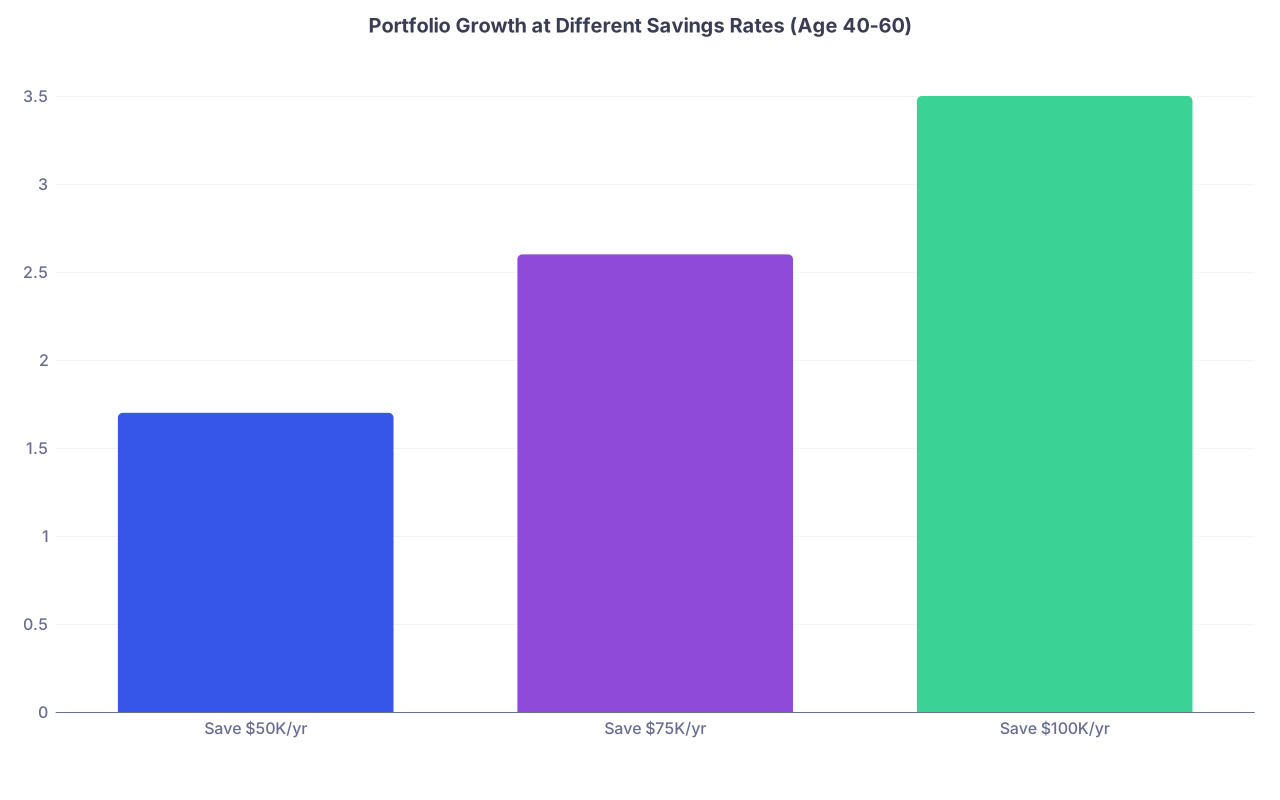
You are 40. You want to be work‑optional at 60 (20 years). Current investable assets: say $200K. Let us run realistic scenarios at 5–7% real return (a reasonable long‑term stock-heavy portfolio assumption, not guaranteed).
Here is what the math roughly looks like:
| Category | Value |
|---|---|
| Save $50K/yr | 1.7 |
| Save $75K/yr | 2.6 |
| Save $100K/yr | 3.5 |
Values are approximate millions at age 60, starting from $200K, assuming 6% annual return.
That means:
- Saving $50K/year→ ~ $1.7M
- Saving $75K/year→ ~ $2.6M
- Saving $100K/year→ ~ $3.5M
If your goal is $4M–5M, you either:
- Extend the timeline (work to 63–65), and/or
- Save more (or earn more), and/or
- Spend less in retirement.
There is no magic. But here is the good news: high income gives you a huge lever if you are willing to use it aggressively in your 40s and early 50s.
Step 3: Build a “Catch‑Up” Cash Flow Plan (Not a Budget)
I do not want you counting almonds. I want you running a practice‑style P&L for your household.
A. Set a mandatory savings “tax” on yourself
Decide on an aggressive but plausible target that ramps over 12–24 months:
- Year 1: 20% of gross income
- Year 2: 25–30%
- Stretch goal: 30–40% if you are serious about catching up
Example: Household gross income $450K.
- 25% savings = $112,500 per year = $9,375 per month
Break that into automated buckets:
Workplace retirement plans (401(k)/403(b)/457(b)):
- Max employee contributions:
- 2025 numbers are not finalized as of my training data; approximate prior pattern:
- 401(k)/403(b): around $23K employee (catch‑up at 50+)
- 2025 numbers are not finalized as of my training data; approximate prior pattern:
- If you have an employer match: capture 100% of it. Non‑negotiable.
- Max employee contributions:
HSA (if eligible):
- Family max around $8K/year. Use it.
-
- $7K per spouse per year (likely around that range). Do it annually.
Taxable brokerage:
- Whatever remains after maxing all tax‑advantaged accounts.
If you are far behind, the taxable account is not optional. It is where your flexibility comes from in your 50s.
B. Cut like an attending, not like a resident
Most advice on “budgeting” is frankly childish for physicians. You do not move the needle with latte bans. You move it with 5–10 big decisions:
Housing:
- Aim for total housing (mortgage, taxes, insurance, utilities, maintenance) ≤ 20–25% of gross income.
- If yours is 35–40%+ and you are behind, consider: refinance, renting out part of the house, or downsizing at your next natural life transition.
Cars:
- No car payments, or at most one modest one. Your household car value should not look like a cardiology device list.
- If you are driving two $80K SUVs, that is a decision, not an accident.
School:
- Private K–12 is a six‑figure lifetime decision per child. If you are behind and insist on this, you need to save more elsewhere. Or work longer.
Travel / lifestyle:
- Cap “luxury” discretionary at a specific monthly number. For example: $3K/month total for eating out, travel, entertainment. Not zero. Just contained.
You are not going back to resident life. You are choosing to trade a small slice of current lifestyle for massive future flexibility. If your spouse is on board, this works. If they are not, fix that misalignment before you tweak spreadsheets.
Step 4: Prioritize Debts Like an Adult, Not Like a Blog Commenter
Physicians love debt debates. “Pay off vs invest” could fuel a decade of physician Facebook threads. I will keep it simple.
A. High interest consumer debt: zero tolerance
If you have:
- Credit cards at 18–25%
- Personal loans > 8–9%
- Auto loans > 7–8%
You treat these like a 2 a.m. airway emergency.
Protocol:
- Stop all non‑matched investing temporarily. Still get employer match.
- Put every extra dollar toward these debts until they are gone.
- Then resume the full investing plan.
Reason: You do not beat a 20% guaranteed negative return in the market consistently. That is delusional.
B. Student loans: treat based on interest rate and program
General guide:
- If effective rate after any tax deduction / PSLF benefit is:
- < 3%: Pay minimums, prioritize investing.
- 3–5%: Mixed zone – do a bit of both but lean toward investing if you are behind.
5–6%: Aggressive payoff is reasonable unless you are on a very clear PSLF path.
If you are eligible for PSLF and already 6–8+ years in, do not sabotage it with bad consolidation or switching employers without counting the cost. PSLF is one of the few big levers doctors actually get.
C. Mortgage: probably not your top priority
If your mortgage rate is:
Under 4–5%: Treat it like a long, boring bond. Make required payments, maybe round up a bit for psychological reasons, but do not dump huge sums here instead of investing if you are behind.
Over 6–7%: Consider refinance if rates allow, or a modestly faster payoff strategy.
Step 5: Use Every Tax‑Advantaged Space You Can Reach
This is where mid‑career physicians either win or bleed unnecessarily.
A. Typical account priority for a W‑2 physician
For most employed doctors, this hierarchy works:
- Grab the full employer match in your 401(k)/403(b).
- Max HSA (if available).
- Max 401(k)/403(b) employee contribution.
- If you have a governmental 457(b), max that too (this is a big one).
- Do backdoor Roth IRA for you (and spouse if eligible).
- Fund taxable brokerage with the rest.
If you are in private practice or a group with a defined benefit or cash balance plan, that can dramatically increase your pre‑tax space. Use it if the plan is well designed and low cost.
B. Governmental vs non‑governmental 457(b)
This one gets missed a lot.
- Governmental 457(b): Generally safe, can often be rolled over when you separate. I like these.
- Non‑governmental 457(b): Assets are technically subject to employer creditors, usually limited distribution options, and not portable in the same way. Use only if:
- Strong employer stability
- Low‑cost investment menu
- Distribution rules that match your likely career path
For many academic physicians, the governmental 457(b) is a powerful catch‑up tool. Another $20K+ per year, pre‑tax.
| Account Type | Typical Annual Limit* | Tax Treatment |
|---|---|---|
| 401(k)/403(b) | ~ $23K employee | Pre-tax or Roth |
| 457(b) | ~ $23K | Pre-tax |
| HSA | ~ $8K family | Triple tax-advantaged |
| IRA/Roth IRA | ~ $7K | Pre-tax or Roth |
| Cash Balance Plan | Varies (often $50K+) | Pre-tax |
*Exact limits adjust yearly; verify for the current tax year.
Step 6: Choose a Simple, Boring, Aggressive Investment Strategy
At 40–50, if you are behind, your enemy is not market volatility. It is under‑saving and over‑complication.
A. Asset allocation that actually gives you a chance
You likely need a high equity allocation for at least the next 10–15 years:
- Age 40–50 and behind on savings:
- 80–100% stocks, 0–20% bonds/cash
- Age 50–60, getting closer:
- 60–80% stocks, 20–40% bonds
International vs US? I like something like:
- 60–70% US stock
- 20–30% international stock
- 10–20% bonds (when you add them)
The key: pick a reasonable stock/bond split and stay with it through ugly markets. You do not have time to chase fads.
B. Use low‑cost index funds, not expensive toys
- US total stock market index (VTI, VTSAX, FSKAX, etc.)
- International total stock index (VXUS, FTIHX, etc.)
- US total bond market index (BND, FXNAX, etc.) if you are adding bonds
- Maybe a small REIT or small‑cap tilt if you care. Not required.
Target‑date retirement funds are fine if:
- They are low cost (expense ratio < 0.20%).
- The stock/bond mix actually matches your needed risk level. Many target‑date funds are too conservative for someone behind.
Do not buy:
- Whole life or variable universal life labeled as “retirement solutions”.
- High‑fee annuities sold as “tax free retirement income”.
- Active funds with 1%+ expenses pushed by “advisors” who are really salespeople.
Every 1% of extra fees over 20 years is like giving up a year or two of your life in the OR. You will not see it day to day. You will feel it at 60.
Step 7: Protect the Plan: Risk Management and Legal Basics
You are not just building assets. You are protecting a future income stream and your family.
A. Insurance you actually need
Term life insurance:
- If you have dependents or a non‑working spouse, get 10–20× your annual income in level term to at least age 60.
- Do not use whole life as a substitute for saving.
Own‑occupation disability insurance:
- If you do not have a strong individual policy, fix this. Group policies are often weak and taxable.
- This is the one policy that actually justifies some complexity, but you want a reputable independent broker, not your colleague’s “guy” who sells everything.
Umbrella liability:
- $2–5M policy, especially if you have non‑qualified assets and a home. Costs a few hundred per year.
B. Basic legal infrastructure
By mid‑career, you should have:
- A will
- Healthcare proxy / advance directive
- Financial power of attorney
- Up‑to‑date beneficiary designations on all retirement accounts and life insurance
If your state allows, and your profession is high‑risk for lawsuits, consider basic asset protection structures coordinated with a real attorney, not a YouTube “expert”.
Step 8: Plan an Exit Ramp, Not a Cliff
You may not want to go from full‑time 1.2 FTE hospitalist to zero at 58. That feels like hitting a wall. Build in gradual options.
A. Build optionality into your finances
Your mid‑50s goal is not “never work again.” It is: “I can walk away from any job I hate.”
To do that:
- Focus on liquid, flexible assets in taxable accounts and Roth accounts, not only pre‑tax buckets with early withdrawal penalties.
- Avoid over‑locking everything into real estate that requires constant management unless you genuinely like being a landlord.
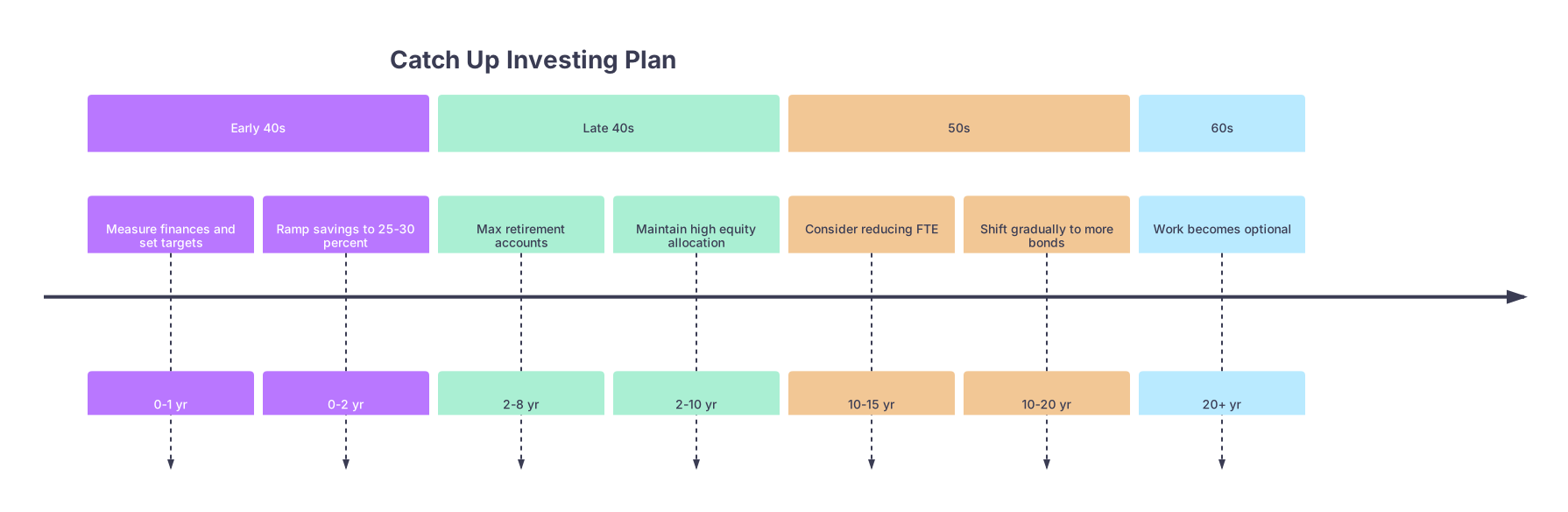
B. Model a realistic glide path
Typical workable pattern I have seen:
Age 40–50:
- Full‑time clinical, aggressive savings (25–40% of gross).
- Kill bad debt, max all tax‑advantaged accounts.
Age 50–55:
- Still mostly full‑time, but may drop nights, call, or procedures.
- Savings still high, but maybe closer to 20–30%.
Age 55–60:
- 0.5–0.7 FTE, heavy focus on work you like: teaching, admin, telemed, consultations.
- Savings may decrease, but portfolio growth plus reduced spending keeps you on track.
Age 60+:
- Work truly optional. You choose what, if any, clinical work remains.
| Period | Event |
|---|---|
| Early 40s - Measure finances and set targets | 0-1 yr |
| Early 40s - Ramp savings to 25-30 percent | 0-2 yr |
| Late 40s - Max retirement accounts | 2-8 yr |
| Late 40s - Maintain high equity allocation | 2-10 yr |
| 50s - Consider reducing FTE | 10-15 yr |
| 50s - Shift gradually to more bonds | 10-20 yr |
| 60s - Work becomes optional | 20+ yr |
When you model your plan, do not assume you go from 1.0 FTE to 0.0 in one year. That is rarely how it plays out for physicians who fix their finances.
Step 9: Common Landmines Mid‑Career Physicians Step On
You are already behind. You cannot afford these mistakes.
Lifestyle creep with every raise or bonus
Annual raise? 50% to savings, 50% to lifestyle. Or 80/20 if you are serious. Not zero/100.House poor choices in your 40s
Moving “up” to the big dream house that eats another $5–8K/month. You will feel that for decades.Confusing income with wealth
I have seen 38‑year‑old cardiologists making $600K with negative net worth and 52‑year‑old pediatricians at $250K with $3M saved. Guess which one sleeps better.Speculative side projects framed as investing
Startups, angel investing, random real estate syndications from friends, crypto gambles. If you have less than $1–2M invested in boring index funds, you have no business “allocating” 20% to speculative plays.Letting a commissioned “advisor” run your life
Anyone who will not show you, in writing, how they are paid, and what your all‑in expense ratio is, does not deserve access to your accounts.
If you want an advisor, pay for advice, not product sales. Flat‑fee or hourly fiduciary, or a low‑cost AUM advisor who actually earns their keep with planning, not just fund selection.
Step 10: Simple 12‑Month Implementation Checklist
You have enough theory. Here is what the first year actually looks like.
Month 1–2
- Create detailed balance sheet and savings rate calculation.
- Set your numeric targets: age, portfolio number, desired annual retirement spending.
- Have the hard conversation with your partner if needed. Shared plan or nothing.
Month 3–4
- Clean up high‑interest debt with a written payoff plan.
- Set new withholding / payroll elections to:
- Capture full 401(k)/403(b) match
- Set path to max by year end
- Open HSA, Roth IRA(s), and taxable brokerage if not already open.
Month 5–6
- Automate monthly transfers to Roth and taxable accounts.
- Choose a simple 2–4 fund portfolio and apply it across all accounts.
- Get term life, individual disability, and umbrella policies in place if missing.
Month 7–9
- Do a deep dive on big‑ticket spending: housing, cars, school, travel.
- Make one significant change that frees up at least $1–2K/month. That alone could be $500K+ at 60.
Month 10–12
- Review portfolio allocation and rebalancing plan (annually or semiannually).
- Recalculate savings rate. Adjust automations to hit or exceed your target.
- Update estate docs and beneficiary designations.
Repeat this cycle annually. Do not reinvent it every three months because of market noise.
One More Reality Check
You are not 25. You do not get the luxury of compounding for 40 years from a clean slate. That is gone. Wishing will not bring it back.
But you do have:
- A high, durable income.
- Probably 15–25 working years left.
- A level of discipline that got you through training and boards.
You can absolutely fix this. The price is a decade of intentional, somewhat aggressive saving and investing, plus a hard limit on lifestyle inflation.
Key Takeaways
You are behind at 40 if you have little saved, but you are not doomed. The combination of a high savings rate (25–35%+ of gross) and a stock‑heavy, low‑cost portfolio can realistically fund a $3–5M nest egg over 20 years.
Use all the tools at your disposal: max workplace plans, HSA, backdoor Roths, and, if available, a solid 457(b) or cash balance plan. Kill high‑interest debt ruthlessly and do not get trapped by housing and lifestyle decisions that lock in massive fixed expenses.
Treat this as a 10–20 year project, not a 6‑month sprint. Automate savings, keep your investments boring, and adjust your clinical career over time so that by your late 50s or early 60s, work is a choice, not a financial necessity.


