
The biggest lie doctors tell themselves is “I’ll start investing later.”
You and I both know what “later” really means in medicine: after residency, after fellowship, after the next promotion, after the loans are under control, after the kids are older. Translation: never.
You’re 35, still in training, watching friends in tech talk about their 401(k) match and their stock options while you’re trying to decide whether you can afford DoorDash tonight. You’re wondering if you already screwed this up. If you missed the compounding window. If starting now is just throwing pebbles at a financial avalanche of debt.
Let me be blunt: no, it’s not too late to start investing. But it is too late to keep lying to yourself that “you’ll figure it out once you’re an attending.”
Because if you don’t build the muscle now, your first attending paycheck will disappear just as fast as your resident one. I’ve seen it. Over and over.
The Ugly Math That’s Freaking You Out (And What It Actually Means)
You’ve probably seen those terrifying charts on Reddit or White Coat Investor where they compare the 25‑year‑old who invests early versus the 35‑year‑old who starts later and ends up with half as much.
Let’s make it worse on purpose, because that’s how our brains work anyway.
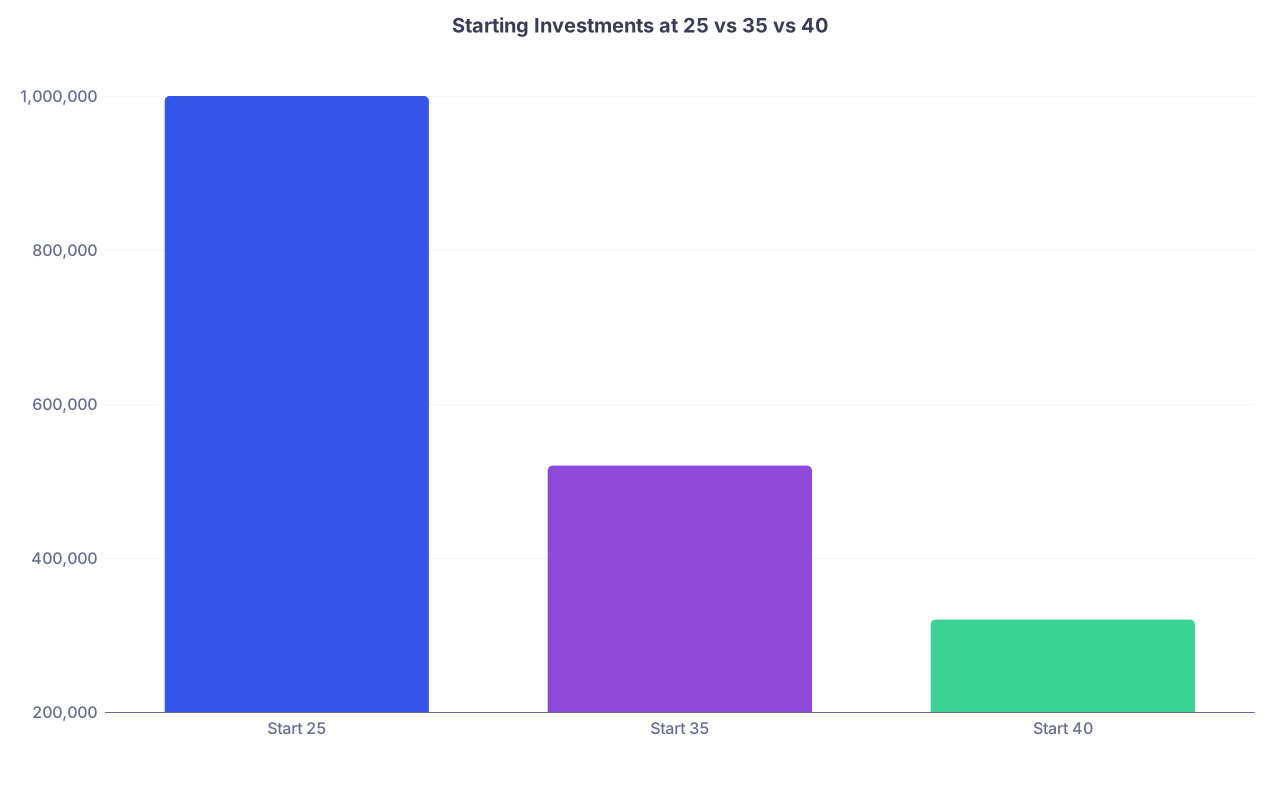
| Category | Value |
|---|---|
| Start 25 | 1000000 |
| Start 35 | 520000 |
| Start 40 | 320000 |
Assumptions:
– $500/month invested
– 7% annual return
– Stop at age 65
25-year-old: about $1,000,000
35-year-old: about $520,000
40-year-old: about $320,000
So your anxious brain says: “Cool, so I blew it. I literally lost half a million dollars by studying for Step 1 instead of doing index funds at 25.”
But here’s what those charts leave out for doctors:
You were never going to be that 25-year-old.
You weren’t some software engineer with a 401(k) match at 23 and no debt. You were grinding through M1, memorizing glycolysis, living on loans. You didn’t have $500/month of real money. You had borrowed money.
And borrowing at 6–7% to invest at maybe 7%? That’s not “being smart with money.” That’s just leverage with training wheels off.
So no, you didn’t blow some perfect fantasy scenario. You’re just starting at the actual doctor timeline: late 20s to mid‑30s, broke, buried in debt, suddenly aware that retirement is a thing and not just something on HR pamphlets.
The real question isn’t: “Did I miss the ideal timeline?”
It’s: “Given this mess, what’s the smartest way forward starting today?”
“I’m 35, In Training, and Broke”: What You’re Actually Up Against
Let’s list the nightmare, because pretending it’s not there doesn’t help.
You might have some or all of this:
- $250–600k in student loans
- High‑interest credit cards from “just surviving” during school
- 55–80 hour work weeks
- Zero emergency fund
- Maybe kids, maybe a partner also in training, maybe aging parents
- No real employer retirement plan in residency/fellowship (or a tiny one you keep ignoring)
And then you see stuff like “max your 401(k)” and you want to scream because you’re just trying to pay rent and not overdraft your account.
Here’s the part that financial bloggers don’t always say clearly:
At 35, in training, your first job isn’t to be a “good investor.”
It’s to stop doing actively dumb financial stuff and to start doing a few consistently smart, boring things.
Not 20 things. Not perfection. Just enough to move the needle.
The Order of Operations: What Comes Before “Real Investing”
Before you go chasing ETFs and trying to time the market between night shifts, there’s a basic sequence that keeps you from blowing yourself up financially.

| Step | Description |
|---|---|
| Step 1 | You at 35 in training |
| Step 2 | Cover basics - budget and cash flow |
| Step 3 | Build mini emergency fund |
| Step 4 | Attack high interest debt |
| Step 5 | Get employer match if available |
| Step 6 | Increase low cost index investing |
| Step 7 | Refine loan strategy and legal planning |
I’m not saying you have to perfect each step before touching the next, but if you’re ignoring the top of this and jumping straight to “which ETF is best?”, you’re doing this backwards.
Let’s walk through it in real-life language.
1. Bare-minimum budget clarity
You need exactly one thing at this stage: to know where your money actually goes.
Not a 12‑tab Excel masterpiece. Just: fixed bills, variable spending, and what’s left. If “what’s left” is negative, that’s your first fire.
2. Mini emergency fund
Not the full 6 months. That’s fantasy during training for many people.
Aim for $1,000–$3,000 parked in a high‑yield savings account. Enough so that a flat tire, broken phone, or last‑minute flight home doesn’t go straight onto a high‑interest card.
This isn’t “investing,” but it’s what protects your investing from constantly getting nuked by emergencies.
3. High-interest consumer debt
If you’re carrying 18–25% credit card debt, pouring money into the market before hitting that hard is like filling a bucket with a hole in the bottom.
Student loans at 4–7%? Different conversation. Those are manageable, long-term, and have specific physician rules and forgiveness paths. High‑interest credit cards? Financial arson.
If all you do this year is build a $2k emergency fund, stop adding to credit card debt, and pay down a chunk of it aggressively, you’ve done more for your long-term net worth than picking the “perfect” mutual fund.
Okay, But When Do I Actually Start Investing?
Here’s the part you’re really asking: when do I stop feeling like I’m too broke to invest?
So I’m going to draw a line in the sand:
You should start investing with some amount as soon as:
- You’re not routinely overdrafting
- You’ve got at least a baby emergency fund
- You’ve stopped taking on new high‑interest debt (you may still be paying it off)
That might mean you start with $25/month in a Roth IRA. Which feels comically small. You’ll think, “this won’t move the needle.”
It will. But not because of the dollar amount. Because of the habit.
You’re not building an investment portfolio in training. You’re building an investment identity.
Future‑attending‑you doesn’t magically wake up one day understanding Roth vs traditional vs taxable. You either start on a small scale now or you try to learn everything while also navigating your first malpractice policy and signing a contract that says “non‑compete” in size 8 font.
Where a 35-Year-Old Trainee Actually Puts Their First Dollars
Let’s say you’ve scraped together $50–$200/month that you can actually invest without going into panic mode.
Where does it go?

Here’s a realistic priority stack for a typical U.S. physician in training:
Employer match (if you have one)
If your hospital offers a 403(b)/401(k) and matches, say, 3–5%, that’s your first stop. Free money beats everything. If they match 100% of the first 3%, that’s a guaranteed 100% return on that piece. You won’t beat that with clever ETF picks.Roth IRA (especially while income is low-ish)
In residency/fellowship, your income is the lowest it will likely ever be as a physician, which means your tax rate is relatively low. That makes Roth contributions very attractive.
Simple version:- Open a Roth IRA at Vanguard, Fidelity, or Schwab
- Put automatic monthly contributions, even if it’s $50/month
- Invest in one boring, broad index fund like a total US stock market fund or a target-date fund
403(b)/401(k) beyond the match (optional in training)
If you still have extra money and you’re not buried by high-interest debt, you can put more into your work retirement plan, especially if the investment options and fees are decent. But I’d rather see you start something consistent than obsess over perfect allocation.Taxable brokerage (later, as an attending)
For now, most trainees don’t need this unless you’re in a very unusual situation. This becomes more relevant once your income explodes and you’re maxing the tax-advantaged accounts.
Here’s a quick comparison of what those actually mean:
| Account Type | Best For | Tax Benefit |
|---|---|---|
| 403(b)/401(k) with Match | First investing dollars | Free employer match + tax deferred |
| Roth IRA | Residents/fellows, lower tax bracket | Tax-free growth and withdrawals in retirement |
| 403(b)/401(k) beyond match | Extra savings once Roth funded | Lowers taxable income now |
| Taxable Brokerage | Higher-income attendings later | No special tax break, but flexible access |
“But I’m 35, Won’t I Never Catch Up?”
This is the fear that sits in your chest at 2 a.m. on call while you’re staring at a blood gas and thinking about your bank account.
So let’s run a more honest comparison. Not fantasy 25‑year-old versus current you, but doctor reality:
Scenario A: You do nothing until you’re 40
You train, become an attending at 37–40, and tell yourself, “I’ll worry about it once I’m making real money.” Translation: your lifestyle expands to match your attending paycheck and retirement is a vague afterthought.
You finally start at 40 and put in $2,000/month until 65 at 7%:
End result ≈ $1.3–1.4 million.
Scenario B: You start tiny now at 35 and ramp up as an attending
35–40 (training years):
$150/month at 7% for 5 years → ~ $10–11k. Which sounds small. But keep going.
40–65 (attending years):
You’re used to investing. It’s automatic. You crank to $2,000/month at 7% for 25 years → ~ $1.3–1.4 million
Plus that earlier 10–11k grows to ~ $50–60k by 65.
So total ≈ $1.35–1.45 million instead of $1.3–1.4M.
That early $150/month didn’t “make you rich,” but here’s the real value:
- You trained your brain that investing is a fixed bill, not an optional extra.
- You learned Roth vs 403(b) while the amounts were small and mistakes weren’t catastrophic.
- You prevented the very common attending trap of “I’ll start later” turning into 5–10 more years of drift.
You’re not trying to beat the imaginary perfect 25‑year‑old. You’re trying to beat doing nothing for another decade.
Legal and Structural Stuff Doctors Ignore Until It Hurts
Since you mentioned “financial and legal aspects,” I’m going to hit the unsexy parts that matter in the long run, even if you don’t care about them yet.
1. Retirement accounts are also asset protection
In many states, money in 401(k)s/403(b)s and sometimes IRAs have strong protection from creditors and lawsuits. You’re entering a high-liability profession. Even if you feel broke now, you’re building future assets that are harder to touch in worst-case scenarios.
That’s not the reason to invest, but it’s a big side benefit doctors often miss.
2. Your student loans are a legal contract, not just “bad vibes”
At 35, especially if you’re still in training, you need to understand two paths:
- PSLF (Public Service Loan Forgiveness) if you’re at a nonprofit institution and plan to stay in that world for 10 qualifying years. In that case, paying too much is actually harmful.
- Aggressive payoff if you’re going private practice or high-income with no forgiveness in sight.
Investing decisions sit on top of this. You don’t have to choose “all loans” or “all investing,” but you can’t ignore the loan side and just hope it works out.
3. Basic legal hygiene: will, POA, and disability
If you have dependents, or even if you don’t but you’re a functioning adult with some assets and a medical license, bare minimum legal documents matter:
- Will (even a simple one)
- Medical and financial power of attorney
- Own-occupation disability insurance as you get close to finishing training
This isn’t about being rich. It’s about not leaving a mess behind and not letting a random court or hospital HR decide things for you.
How to Start When You’re Terrified of Doing It Wrong
Here’s what I’d do if I were 35, in training, broke, and sick of feeling behind but completely overwhelmed:
- Pick one brokerage (Vanguard, Fidelity, Schwab). Don’t overthink it.
- Open a Roth IRA.
- Choose one fund: a total U.S. stock market index fund or a target-date retirement fund.
- Set up automatic monthly contributions, even if it’s $50.
- Walk away. Don’t day-trade between cases. Don’t chase hot tips. Don’t watch CNBC.
Then, separately, look at your employer plan:
- If there’s a match, contribute just enough to get 100% of that match.
- Put that in the broadest, lowest-cost index fund in the plan or a target-date fund.
That’s it. That’s “investing” at 35 as a trainee. Not perfect. But infinitely better than sitting in paralysis for 3 more years while you research the “best” small-cap value tilt.
FAQ (You’re Not the Only One Thinking This Stuff)
1. Should I invest at all if my student loans are huge?
Yes, but with nuance. If you’re on track for PSLF, your required payments are part of the forgiveness game; investing alongside that absolutely makes sense. If you’re not doing forgiveness and your interest rates are high, you may split the difference: some extra to loans, some to retirement accounts, especially if there’s an employer match or you can do a Roth IRA. Completely ignoring investing until the loans are gone can cost you decades of compounding, but ignoring the loans and just investing is also reckless. The middle path usually wins here.
2. What if the market crashes right after I start?
Then congratulations, you’re buying on sale. You’re not putting in a lump sum of your life savings; you’re dollar‑cost averaging small amounts over years. For a 35‑year‑old, a crash isn’t a catastrophe, it’s a discount period. The real risk isn’t that you start and the market drops. It’s that you use fear of a drop as an excuse to never start at all.
3. I feel like I know nothing about investing. How much do I need to know before I begin?
Honestly? Less than you think. You don’t need to understand options, factor tilts, or bond ladders. You need to understand a few basics: what an index fund is, the idea of risk increasing with higher stock percentages, the difference between Roth and pre‑tax. That’s it. You can learn the rest slowly while your small contributions are quietly working for you in the background. Starting small and learning as you go beats waiting until you “fully understand everything,” which never happens.
4. Am I just too late to ever feel financially secure starting in my mid-30s?
No. You’re late compared to Instagram finance influencers who claim they’ll retire at 35 with Airbnbs and crypto. You’re normal for a physician. If you start in your mid‑30s, avoid massive lifestyle creep as an attending, and consistently invest a meaningful chunk of your attending income (20–25% total into retirement and taxable accounts), you can still hit a very comfortable retirement. Maybe it’s 60 instead of 50. Maybe it’s “work optional” instead of billionaire yacht life. But “too late” is more about never changing course than about your age.
Bottom line:
You didn’t ruin your financial life by not investing at 25.
You will ruin it if you use that regret as an excuse to keep doing nothing at 35.
Start tiny, start messy, but start.
Future‑you, exhausted after a 12‑hour clinic day at 55, will be very, very grateful you did.