

It’s March. You just matched into a military residency—Army, Navy, or Air Force. The relief of matching is wearing off, and reality is setting in: you’re now active duty, you’ll have a steady paycheck, and suddenly people are throwing around acronyms like BRS, TSP, CZTE, BAH, BAS, SDP.
You’re thinking: “I want to be smart with money. But military pay and benefits are weird. What rules am I playing under, and what unique advantages do I have as a military doctor?”
Good. This is exactly the moment to get your investment game set up right.
I’ll walk you through, as if you’re about to start PGY-1 at, say, San Antonio Military Medical Center or Walter Reed. You’ve got med school loans (or HPSP/USUHS obligations), a new .mil email, and no bandwidth for vague theory. You need “click here, do this, avoid that.”
Let’s do that.
Step 1: Understand Your Military Money Stack (What’s Actually Coming In)
Before you invest anything, you need to know what’s hitting your bank account and what’s taxable. Military pay isn’t a simple salary.
Here’s your typical stack as a new military physician (numbers are illustrative, not current official tables):
| Component | Taxed? |
|---|---|
| Base Pay | Yes |
| Basic Allowance for Housing (BAH) | No (usually) |
| Basic Allowance for Subsistence (BAS) | No |
| Special Pays (VSP/BCP/etc.) | Yes |
| Incentive Pay (IP/Retention bonuses) | Yes |
The key: a big chunk of what you “make” is non-taxable (BAH, BAS). That massively improves your ability to save and invest compared to a civilian with similar take-home pay.
But most people screw this up in two ways:
- They mentally treat BAH/BAS like “bonus” money and just inflate their lifestyle.
- They ignore how the lower taxable income affects decisions like Roth vs traditional retirement accounts.
You’re not doing that. You’re going to use it.
Step 2: Learn the Big Military Retirement Acronyms (BRS & TSP)
You’re under BRS (Blended Retirement System) unless you’ve been in a long time already. BRS + TSP is the backbone of your long-term wealth.
The Thrift Savings Plan (TSP): Your Military 401(k)
TSP is your government-sponsored retirement account. It’s stupidly good:
- Ultra-low fees (way lower than most civilian 401(k)s).
- Simple investment options (you actually want this simplicity during residency).
- Employer match under BRS.
For 2025, you can put in up to the IRS employee deferral limit (check yearly number, but think ballpark ~$23K). On a resident salary, you probably won’t hit that, but here’s the rule:
Baseline rule as a new military doc:
Set TSP to at least 5% of base pay on Day 1. Non-negotiable.
That 5% unlocks the full BRS match:
- 1% automatic contribution from DoD whether you contribute or not.
- Up to 4% matching if you put in 5%.
You don’t get that match later again. Every month you skip is free money gone.
Traditional vs Roth TSP: Which One for a Military Resident?
This is the first big “unique military” decision.
You have two flavors:
- Traditional TSP: Pre-tax contributions, reduces current taxable income, taxed later.
- Roth TSP: After-tax contributions, tax-free withdrawals in retirement.
As a new military physician, your taxable income is artificially low because:
- BAH and BAS are not taxed.
- You’re in training, so your base pay is relatively modest compared to civilian attendings.
For most residents, Roth is better. For most military residents, Roth is very likely better.
Exception: If you’re already high-income from prior career, spouse makes a lot, or you know you’ll get huge bonuses soon and are already in a high bracket—then traditional might have an argument. But that’s not most interns.
Blunt recommendation:
Set your TSP contributions to Roth as a PGY-1 unless you have a tax advisor telling you otherwise with actual numbers.
Step 3: Understand Combat Zones and Why Roth + Combat Pay Is Wildly Powerful
This is one of the strangest but most powerful military investment opportunities: Combat Zone Tax Exclusion (CZTE).
If you deploy to a designated combat zone:
- Your base pay (and some other pays) can become federal tax-free while you’re there.
- You might still receive BAH, BAS, and you’re getting paid like usual.
- You can contribute this tax-free income into Roth TSP / Roth IRA.
What that means in plain English:
- You earn the money tax-free.
- Then you put it into a Roth account.
- It grows tax-free.
- You withdraw it tax-free.
Triple tax-advantaged. Civilian doctors never see that.
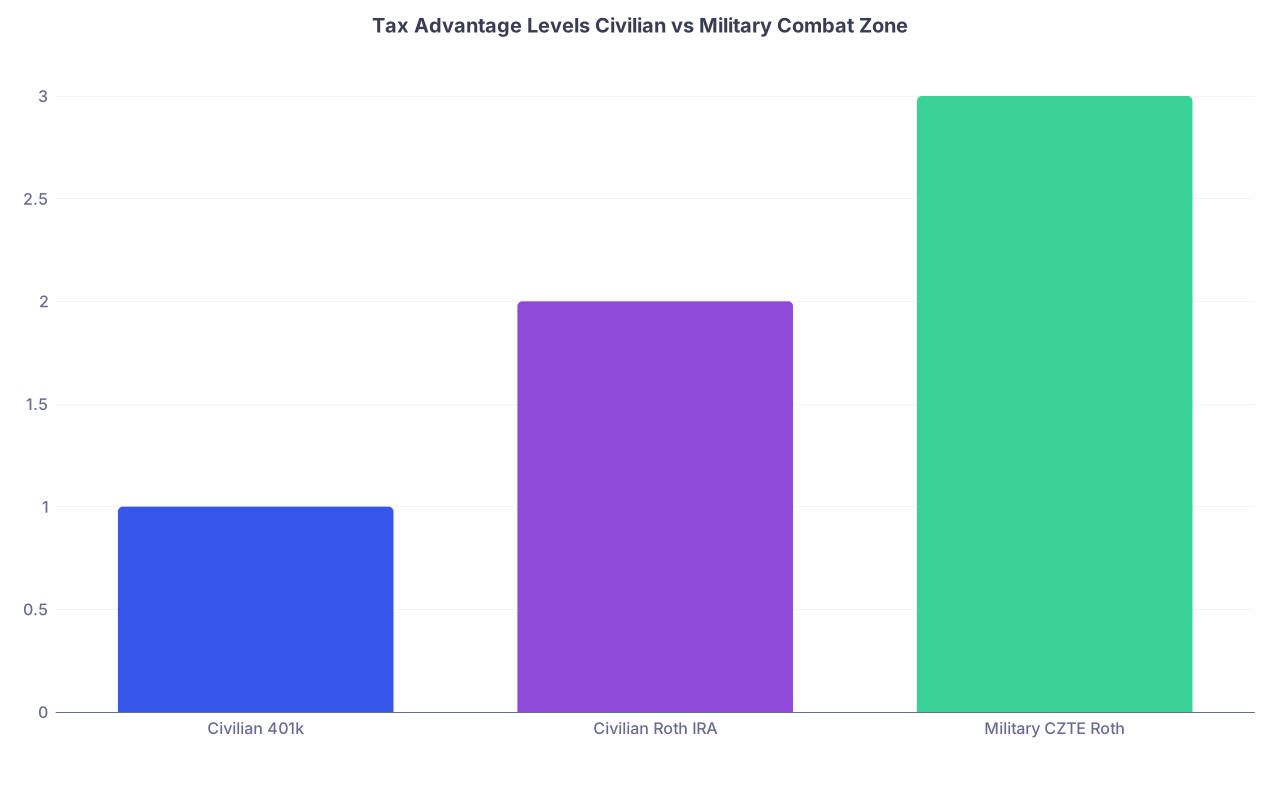
| Category | Value |
|---|---|
| Civilian 401k | 1 |
| Civilian Roth IRA | 2 |
| Military CZTE Roth | 3 |
If you ever end up in a combat zone:
- Max out Roth TSP if you can.
- Then max a Roth IRA on top.
- Treat that year like a once-in-a-career opportunity to turbocharge retirement.
You do not control whether you deploy, especially early in your career, so you don’t plan your whole life around this. But when it happens, you respond aggressively.
Step 4: The Savings Deposit Program (SDP) – The Weird 10% Account
If you deploy to a combat zone for at least 30 days, you may qualify for the Savings Deposit Program (SDP).
SDP:
- Lets you put in up to $10,000.
- Pays 10% annual interest, guaranteed by the U.S. government.
- Stops accruing interest 90 days after you return.
No civilian has access to this. It’s a pure perk for being in a dangerous place.
How to think about it as a doc:
- If you’re in a fairly secure location (Role 3 hospital, big base) and your emergency fund is healthy, SDP is basically a super-savings account.
- It’s not “investment” in the stock market sense, but it absolutely belongs in your financial strategy.
Simple rule:
- If you deploy and you aren’t drowning in high-interest debt, aim to fill SDP to $10K during the deployment.
- Then leave it there earning 10% until that 90-day post-deployment window closes.
Step 5: Military-Specific Legal & Tax Protections You Must Use
You’re not just a doctor; you’re a federal employee in uniform. That triggers special rules. Some of them directly help your investing.
Servicemembers Civil Relief Act (SCRA)
SCRA can:
- Cap pre-service credit card and loan interest at 6% if you incurred them before active duty.
- Pause certain legal and financial proceedings while you’re deployed or otherwise unavailable.
Why this matters for investing:
- If you have old loans with high interest, getting them down to 6% increases your free cash for TSP/IRA.
- It also reduces the pressure to “pay everything off before investing,” because 6% is in a grey zone where investing and paying down debt both make sense.
If you’re HPSP and went straight into active duty:
- Still worth checking all pre-service accounts.
- Some banks overshoot SCRA and give you extra benefits if you just ask.
State Taxes and Residency
Military folks get special state residency rules. You can usually:
- Maintain one state of legal residence even while moving every 2–3 years.
- Potentially pick or maintain a low- or no-income-tax state (Texas, Florida, etc.).
That kinds of thing:
- Reduces your overall tax bill.
- Improves the math on choosing Roth accounts.
- Makes your financial life less messy.
If you’re still listed as a high-tax state (like CA, NY, MA) but stationed in Texas with plans to stay in low/no tax states long-term, talk to JAG or a base legal office about whether changing your home of record makes sense.
Step 6: Roth IRA vs Taxable Brokerage vs More TSP
Once you’ve hit 5% into TSP (for the match), you’ll probably still have room to save.
Order of operations for a typical new military physician:
- TSP to 5% (Roth)
- Build a basic emergency fund (1–3 months of expenses to start)
- Max a Roth IRA (outside TSP)
- Go back and increase TSP beyond 5% as income grows
- Then, and only then, use a taxable brokerage account
Why Roth IRA as step 3?
- You get more investment options than TSP (Vanguard, Fidelity, Schwab, etc.).
- Still tax-free growth and withdrawals if used correctly.
- You can withdraw contributions (not earnings) without penalty in a true emergency. That adds flexibility early in your career.
Still use the TSP though. It’s extremely solid, and you’ll be in it for the long haul.
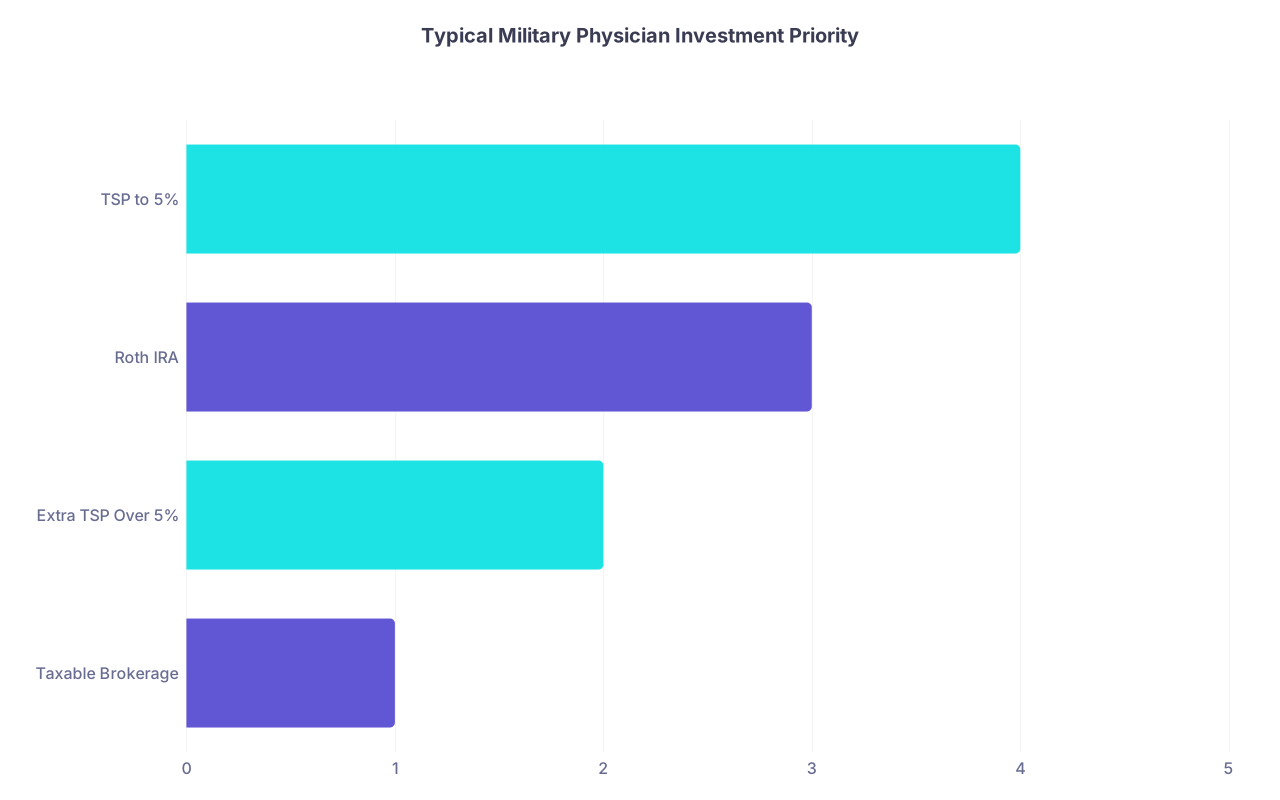
| Category | Value |
|---|---|
| Taxable Brokerage | 1 |
| Extra TSP Over 5% | 2 |
| Roth IRA | 3 |
| TSP to 5% | 4 |
Step 7: Picking Actual Investments (What Funds to Buy)
You don’t have time to become a part-time portfolio manager during intern year. So you make this simple.
Inside TSP
You’ll see:
- G Fund (government securities)
- F Fund (bonds)
- C Fund (large US stocks)
- S Fund (small/mid US stocks)
- I Fund (international stocks)
- L Funds (target date mixes)
For a long-horizon military physician (20–30+ years to retirement):
- Either pick an L Fund that aligns with your planned retirement age (like L 2055 or L 2060).
- Or build your own simple mix—example:
50% C / 20% S / 30% I while young, then add F/G gradually later.
If you don’t want to think:
Pick the age-appropriate L Fund and move on. That’s fine. In fact, that’s often better than overthinking and doing nothing.
Inside Roth IRA / Brokerage
At Vanguard/Fidelity/Schwab:
- Use a total US stock market index fund.
- Add a total international fund if you want some international exposure.
- If you’re lazy (which is not an insult here), pick a target date retirement index fund and call it good.
Your main job is to avoid:
- Stock picking.
- Expensive actively managed funds with high fees.
- “Hot” sector bets or crypto nonsense.
You’re not trying to beat the market. You’re trying to own it cheaply and let time do the work while you practice medicine.
Step 8: Student Loans and Military Service – Where Investing Fits
The military weirdly intersects with student loans.
Scenarios:
You did HPSP or USUHS
- You might have little to no med school debt, but you owe years of service.
- Great. You’ve effectively “prepaid” your education with time.
- That makes it even easier to invest aggressively early—lean into TSP and Roth IRA.
You have federal loans and did NOT use HPSP/USUHS
You might be eligible for:- Public Service Loan Forgiveness (PSLF), since military service counts.
- Military-specific loan repayment programs (depending on branch and specialty).
The strategic angle:
- If you are reasonably likely to qualify for PSLF, it may not make sense to aggressively pay down loans at the expense of investing.
- You’d instead:
- Keep loans in an eligible repayment plan.
- Make required payments.
- Simultaneously invest in TSP/Roth.
- You have private loans at high interest
Here, balance shifts:- Get SCRA applied where possible.
- Attack truly high rates (8–10% plus) more aggressively, even if that means slower investing early.
But do not pause retirement contributions entirely unless you’re in a true emergency. Missing your 20s and early 30s in the market hurts for decades.
Step 9: Big Lifestyle Traps for New Military Docs
You’ve just gone from living like a broke med student to a guaranteed paycheck with housing allowance. It feels rich. It isn’t.
The main traps:
“I deserve it” purchases
New car, fancy apartment off-base, high-end furniture. All at once. Paid mostly with debt.Over-leveraging BAH
Stretching to the maximum rent or buying an expensive house just because the bank will finance it. Remember: you move. A lot.Assuming the military paycheck is forever
You will separate at some point. Could be at ADSO end, could be after 20. But the civilian world doesn’t give you BAH/BAS and Tricare the same way. Plan for that.
A simple sanity check:
- Live on base pay + BAS, and treat BAH as partly for housing, partly for building wealth.
- If you’re saving nothing and have no emergency fund six months into residency, you’re lifestyle drunk.
Step 10: A Minimalist Checklist for a Newly Matched Military Resident
If you want a short “do this now” list, here it is.
Within your first 60 days on active duty:
- Set up TSP to at least 5% of base pay, Roth option.
- Pick an L Fund matching your estimated retirement year and stop fiddling with it.
- Verify SCRA has been applied to all pre-service debts where applicable.
- Start or fund a Roth IRA (even a small monthly amount is fine to begin).
- Build to at least $3–5K emergency fund in a high-yield savings account.
- Do not sign a car loan or house mortgage out of emotion or FOMO in the first month.
Within your first year:
- Increase TSP percentage if cash flow allows.
- Learn your benefits: BRS, CZTE, SDP, Tricare, state residency options.
- Decide a clear student loan plan (PSLF vs payoff vs forgiveness not realistic, etc.).
- Make sure your spouse, if you have one, understands the basics of your benefits and accounts.

| Step | Description |
|---|---|
| Step 1 | Start Active Duty |
| Step 2 | Set TSP to 5 percent Roth |
| Step 3 | Build 3-5K Emergency Fund |
| Step 4 | Open Roth IRA |
| Step 5 | Apply SCRA to Pre Service Debts |
| Step 6 | Learn BRS CZTE SDP Basics |
| Step 7 | Define Student Loan Strategy |
Common Mistakes Military Physicians Make With Investing
I’ve seen the same patterns on every base:
- Only contributing 1–2% to TSP “because resident pay is low,” and missing free match.
- Using traditional TSP during low-income/residency years when Roth would be far better.
- Ignoring Roth IRA entirely because “TSP is enough,” and missing extra tax-free space.
- Treating combat deployments as just extra spending money instead of a time-limited investing opportunity (Roth TSP + SDP).
- Buying expensive cars with 72-month loans at the first whiff of steady income.
You avoid these by having a simple, written plan. Nothing fancy. One page.
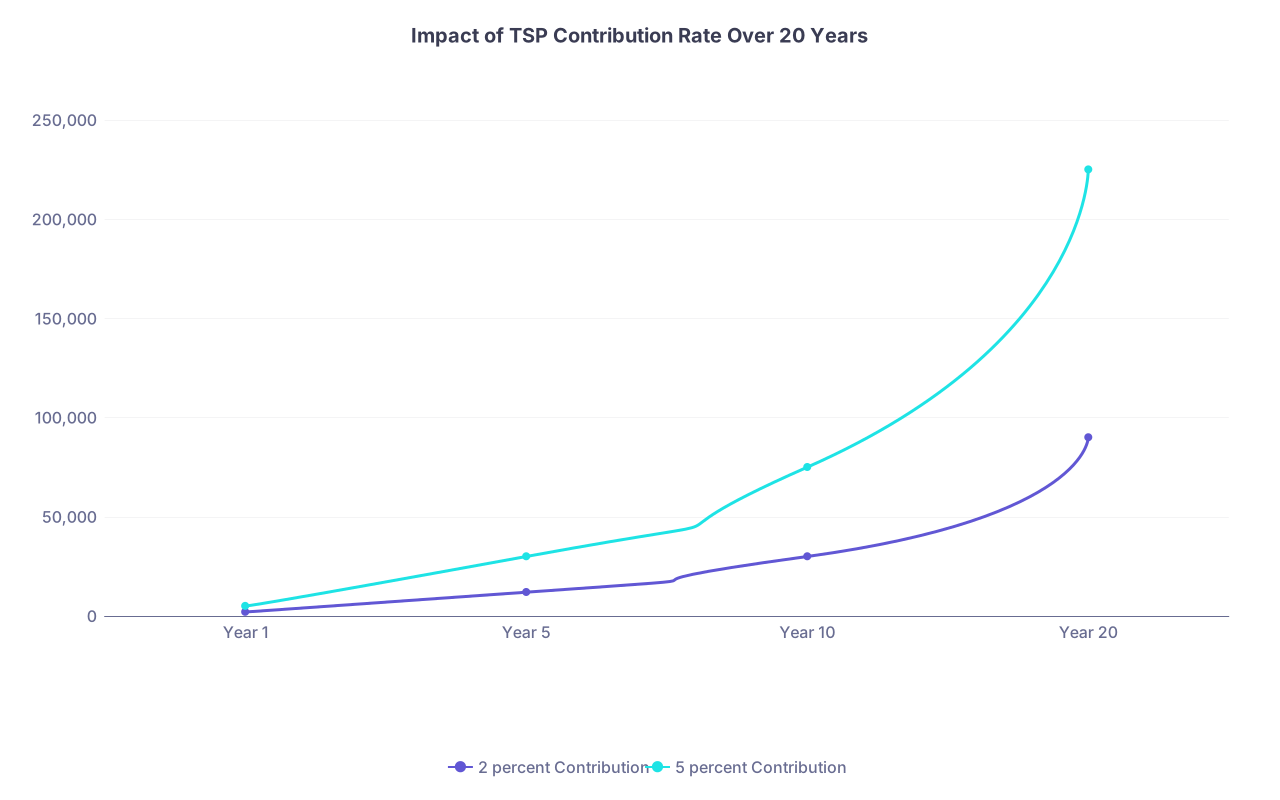
| Category | 2 percent Contribution | 5 percent Contribution |
|---|---|---|
| Year 1 | 2000 | 5000 |
| Year 5 | 12000 | 30000 |
| Year 10 | 30000 | 75000 |
| Year 20 | 90000 | 225000 |
Numbers above are made-up but directionally accurate: small differences in early contribution rates matter later.
FAQs
1. If I can’t afford 5% to TSP right away as a new PGY-1, what should I do?
You’re not the first. Start lower—2–3% is fine to begin—but set a specific date (or promotion) to increase it. When you get your first pay bump or moving allowance, bump TSP straight to 5% before you see the money in your checking account. Do not wait “until things feel less tight.” They never magically do.
2. Should I ever use traditional TSP during residency instead of Roth?
Only if your total taxable household income is already high. For example, your spouse is a well-paid attending or engineer making serious money and you’re filing jointly in a high tax bracket. Then, reducing current taxes with traditional TSP might be smart. But if your effective tax rate is low because of BAH/BAS and modest PGY pay, Roth usually wins.
3. Is it worth paying a financial advisor as a new military physician?
Usually no, not at this stage. Most of what you need—5% Roth TSP, Roth IRA, cheap index funds, loan strategy—is straightforward once you see it laid out. If you do use an advisor, avoid anyone charging a percentage of assets (AUM) for these basic decisions. Look for flat-fee, fiduciary planners who actually understand military benefits. But start with building your own simple plan first.
Key takeaways:
- As a newly matched military physician, your biggest edge is the combination of BRS, TSP, tax-free allowances, and occasional special programs like CZTE and SDP—use them deliberately.
- Hit 5% Roth TSP quickly, add a Roth IRA, keep investments in low-cost index or L Funds, and resist early lifestyle creep.


