
The phrase “easy specialty” is how students talk themselves into red-flag behavior that gets them quietly blacklisted.
If you walk onto a family med, psych, peds, PM&R, or pathology rotation thinking “this one doesn’t really matter,” people can see it from a mile away. And they do not forget. Least competitive on paper does not mean low standards. It just means the bar to get in is lower than the bar to be taken seriously.
This is the trap: students assume competitiveness = only thing that counts. Then they treat “easier” rotations as vacation blocks. The residents and attendings in those fields have seen this movie hundreds of times. They know the look. They know the behaviors. They talk.
Let me walk you through the biggest red flags I’ve seen on so-called “easy” specialties—and how to avoid branding yourself as the lazy, disrespectful, or unreliable student that nobody wants to work with or recommend.
The Core Miscalculation: “This Rotation Doesn’t Count”
The most dangerous thought you can have walking onto a low-competitiveness rotation is:
“I’m going into ortho/derm/rads. This psych/FM/PM&R month isn’t that important.”
Here’s why that mindset is lethal:
- Evaluations follow you. ERAS, MSPE, dean’s letters. That “blow-off” behavior becomes written evidence.
- People in “easy” fields know they’re stereotyped. They’re hypersensitive to condescension.
- Other specialties ask them, “How was this student?” Your rep gets crowdsourced.
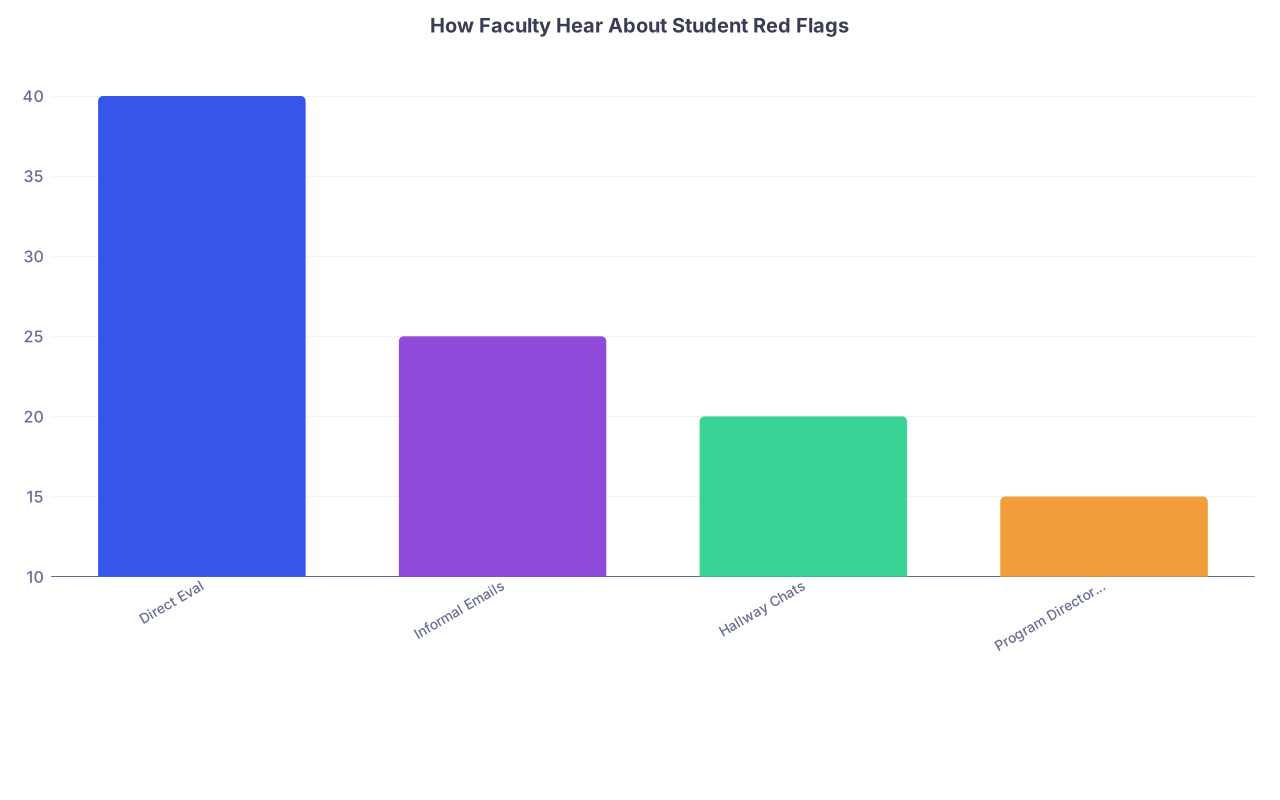
| Category | Value |
|---|---|
| Direct Eval | 40 |
| Informal Emails | 25 |
| Hallway Chats | 20 |
| Program Director Calls | 15 |
You might think only your surgery or medicine grades matter. Then your dean sits down to write your summary and sees:
- “Lacked initiative on family medicine”
- “Uninterested and disengaged on psychiatry”
- “Frequently late and unprepared on pediatrics clinic”
You’ve just signaled: “I only try when I personally care.” That’s a character flaw, not a preference.
Red Flag #1: Acting Like the Work Is Beneath You
This is the biggest, ugliest red flag on “easy” rotations.
You’ll recognize it in phrases like:
- “It’s just clinic.”
- “We’re basically social workers here.”
- “It’s babysitting.”
- “This isn’t real medicine.”
Say any version of that out loud? You’re done.
Even if you never say it, people notice when your behavior screams it.
Specific behaviors that scream disrespect:
- Sitting while everyone else is standing and working, scrolling your phone
- Ignoring nursing staff when they give you tasks or updates
- Refusing simple tasks with a smirk: “Isn’t that more of an MA thing?”
- Rolling your eyes at long social histories, psych interviews, or family meetings
- Visibly zoning out when topics are “soft” (mood, behavior, social determinants, rehab goals)
On outpatient-heavy or “chill” rotations—FM, psych, PM&R—your attitude is the evaluation. They may not have a traumas-per-hour metric, but they absolutely have a “would I trust this person with my patients?” metric.
How to avoid this mistake:
- Treat every task as part of the patient’s care, not your status ranking.
- Ask yourself: “If this were my family member, would I want the student acting like this?”
- When you catch your face going blank or annoyed, reset your posture—sit up, take notes, ask one thoughtful question.
If faculty think you believe their specialty is beneath you, they don’t argue. They just write it down.
Red Flag #2: “Clocking Out” Because the Hours Are Shorter
Least competitive specialties often have more humane schedules on rotations. That’s where students self-sabotage.
The pattern:
- Rounds/clinic are done by 3 PM
- Instead of reading or helping with notes, student disappears
- Shows up right on time or slightly late every day because “we’re not that busy”
- Leaves the second anyone says “We’re mostly done”
On psych, FM, peds clinic, PM&R, outpatient neuro—your reliability is on trial. These fields are continuity-heavy. They care deeply if you’re the sort of person who abandons when things are “easy.”
Red flags attendings notice:
- You consistently stroll in at the exact stroke of start time, never early
- You start packing up 10–15 minutes before the scheduled end
- You say things like, “So… are we done here?” at 2 PM
- You seem surprised/irritated if they ask you to stay an extra 30 minutes for a late add-on
I’ve heard attendings say: “If they cut corners when it’s easy, how bad will it be when it’s hard?”
How to avoid this mistake:
- Arrive 10–15 minutes early. Not 1 minute. Early enough to show intent.
- Don’t be the first to mention leaving. Let them dismiss you.
- If it’s quiet: “Is there anything I can help with? Notes, patient calls, forms?”
- If they say, “You can go early,” say thank you—and go. Don’t argue to stay just to look good. But don’t expect it daily.
Nobody faults you for going home when dismissed. They absolutely fault you for acting like you’re owed an early exit because the census is low.
Red Flag #3: Looking Down on “Non-Procedural” Medicine
On rotations where you’re not doing procedures every day—psych, FM, peds outpatient, PM&R, pathology—students often broadcast boredom.
Bad move.
Danger signs:
- You only perk up when there’s a lumbar puncture, laceration, or joint injection
- You visibly disengage during therapy discussions, medication titration plans, school IEP meetings
- You say things like, “So… we’re just going to talk?” going into a psych intake
- You complain that you’re “not learning anything” if you’re not doing hands-on procedures
Here’s the ugly truth faculty know but don’t always say: students who only value procedures are often the same ones who miss subtle diagnoses, ignore patient narratives, and are a nightmare to collaborate with.
On least competitive rotations, the “soft stuff” is often the whole point:
- On psych: risk assessment, therapeutic alliance, longitudinal management
- On FM: chronic disease coordination, preventive care, trust-building
- On peds: parent dynamics, developmental milestones, behavioral issues
- On PM&R: function, goal setting, multidisciplinary care
- On path: pattern recognition, clinicopath correlation, communication with clinicians
Treating this core content like filler? Red flag.
How to avoid this mistake:
- Explicitly ask to learn what they think is hard in their field:
“What are the things people routinely underestimate in PM&R?” - Take notes during “boring” visits and then ask one synthesis question:
“How did you decide between these two antidepressants for her?” - After clinic/rounds, say: “Can we go over how you approached [X case]?”
If you show that you respect the thinking even when it’s not accompanied by a needle or scalpel, you’ll stand out—for the right reasons.
Red Flag #4: Treating Nurses, Therapists, and Support Staff as Optional
Least competitive specialties are often team-heavy:
- Psych: social workers, therapists, nurses, case managers
- PM&R: PT, OT, speech, nursing, prosthetics
- Peds: child life, RT, school coordinators
- FM: nurses, MAs, care coordinators, pharmacists
Blow these people off? You tank your eval without even seeing it happen.
Common missteps that get reported quietly:
- Ignoring a nurse’s warning about a deteriorating patient because your attending hadn’t seen them yet
- Rolling your eyes when PT asks you to clarify orders “again”
- Talking over a therapist during team meetings
- Treating MAs like personal secretaries rather than colleagues
- Not learning anyone’s name on a small outpatient team
Here’s the part students don’t fully grasp: attendings ask the staff about you. Some even send out formal feedback forms. A single nurse comment like “rude, dismissive, doesn’t listen” can sink an otherwise average evaluation.
How to avoid this mistake:
- Learn names. Use them. Especially on small services.
- Ask staff: “Is there anything I can do that actually helps you during the day?”
- Never contradict or minimize a nurse/therapist in front of a patient. Ever.
- If you screw up (miss a page, forget to follow through), apologize directly and correct it.
Treat allied health as part of the core care team, not background noise. That’s baseline professionalism, and too many students still fail it.
Red Flag #5: Being Unprepared Because “It’s Just Psych/FM/Peds”
Low-competitiveness specialty ≠ low expectations for basic preparation.
You want faculty to think, “This student may not go into my field, but they’re serious.” Instead, too many students show up like this:
- No idea why the patient is admitted/seen today
- Never looked up common meds in the specialty (SSRIs, stimulants, inhaled steroids, DMARDs)
- Can’t do an appropriately focused exam for that clinic (developmental exam in peds, musculoskeletal exam in PM&R, mental status exam in psych)
- Presentations are rambling, unfocused, or copied straight from the chart
That doesn’t read as “not interested in the specialty.” It reads as “doesn’t respect patients enough to prepare.”
Concrete examples that look bad:
- On psych: not knowing the difference between passive vs active suicidal ideation
- On peds: not having any idea about vaccination schedules for a 2-year-old
- On FM: repeatedly asking, “Wait, what’s that med for?” on metformin or lisinopril
- On PM&R: never once looking up ASIA exam or spasticity management despite seeing it daily
How to avoid this mistake:
The bar is not insane. You don’t need to be a mini-fellow. You do need:
- A one-page template for H&P / focused interview relevant to the rotation
- A quick review of top 10 diagnoses and top 10 meds you’ll see in that field
- A plan: “Today I’m going to really understand [one topic]” rather than drifting
Do that, and you’ll look prepared compared to the many students who coast.
Red Flag #6: Over-sharing That You’re “Definitely Not Going Into This”
Being honest about your interests is fine. Treating the rotation like a throwaway because you’re “definitely derm” is not.
Common mistakes:
- On day one, announcing: “I’m going into ortho, so I’m just here to pass.”
- Saying in front of staff: “I just have to get through this month.”
- Refusing opportunities because “it’s not my thing” (e.g., family meetings, therapy sessions, school visits)
- Making jokes with other students about the specialty being “too chill” or “not real medicine”
Faculty in these fields already fight for respect. Hearing that from you doesn’t make them argue; it makes them quietly decide not to help you in the future.
Smarter approach:
- You can say, “I’m currently leaning toward X, but I want to get strong at the outpatient/psychosocial/rehab aspects because that matters in any field.”
- Or just: “I’m keeping an open mind and trying to get as much as I can from each rotation.”
If you truly already matched in another specialty and this is a late 4th year elective, you still don’t say, “This doesn’t matter.” Because the team still has patients, and they still write evaluations.
Red Flag #7: Vanishing on Documentation and Follow-Through
On many “easier” rotations, the work is less about dramatic codes and more about:
- Detailed documentation
- Prior authorizations
- Phone calls to families
- Disability paperwork
- School letters, FMLA forms, rehab plans
Students often vanish when these tasks appear. Huge mistake.
Attendings and residents notice who disappears as soon as the “boring” work shows up.
Red-flag behaviors:
- Never offering to write notes, letters, or call families
- Saying “I’ll help with that” and then never following through
- Writing notes so incomplete that the team can’t actually use them
- Ignoring chart messages or secure texts because “I’m just a student”
How to avoid this mistake:
- Ask: “Can I draft the note/letter/document, and you can edit it?”
- If you say you’ll do something, put it on your own to-do list and confirm when it’s done.
- When you’re unsure how to document something: ask before you write 17 useless paragraphs.
The question faculty are silently answering from your behavior is: “Will this person take care of my patients when I’m not around?” Blowing off paperwork tells them, “No.”
Red Flag #8: Being the “Phone Student”
Shorter hours and lower acuity create long stretches of apparent downtime. And that’s where students hang themselves with their phones.
I’ve seen whole rotations torpedoed by this one thing.
On a psych or FM clinic day, if you’re “just waiting,” temptation hits:
- Check group chat
- Scroll Instagram or TikTok in the corner
- Answer texts during team meetings
- Keep your phone on the desk, face up, lighting up every 30 seconds
Nurses see it. Residents see it. Attendings absolutely see it, even if they don’t comment.
The mental translation they make:
- Phone out constantly = not teachable
- Phone out during patient care = unprofessional
- Phone out when others are working = self-centered
You may tell yourself, “I only looked for a second.” They see the pattern across hours and days.
How to avoid this mistake:
- Put the phone in your bag or coat. Not in your hand, not on the desk.
- If you must use it for a medical app, say out loud: “I’m going to look up X quickly.”
- If there’s genuine dead time, ask: “Is there something I could read or review that would be most helpful here?”
- Worst case, read UpToDate/notes on the workstation computer—not on your phone.
You don’t need to be a monk. You do need not to look addicted in front of people grading your professionalism.
Red Flag #9: Treating Patients as Less “Serious”
On “easy” specialties, pathology may feel less dramatic. No emergent laparotomies. Less crashing. More:
- Depression and anxiety
- ADHD and autism
- Back pain and spasticity
- Obesity, diabetes, hypertension
- Well-child checks and vaccines
Students sometimes slip into a disgusting but common mistake: acting like these problems are minor, or the patients are somehow less worthy of real effort.
Examples that get noticed:
- Dismissing a teenager’s suicidal thoughts as “attention seeking”
- Making jokes about “frequent flyers” or “noncompliant diabetics”
- Downplaying chronic pain because imaging is “normal”
- Acting bored during a parent’s questions on a routine vaccine visit
You’re not just judged on medical knowledge. You’re judged on humanity.
Specialties that see a lot of chronic illness and mental health will especially torch you if you show contempt, irritation, or cruelty.
How to avoid this mistake:
- Assume every patient’s suffering is legitimate, even if you personally don’t “get it.”
- When frustrated, ask seniors how they handle repeated visits or “difficult” families. Learn, don’t mock.
- If you catch yourself making dark jokes to cope, keep them far from patient ears and non-trainee staff. Better yet, process with a mentor instead.
Red Flag Patterns by Specialty
To make this concrete, here’s how certain behaviors look in specific “easier” rotations.
| Specialty | Classic Red Flag Behavior |
|---|---|
| Family Med | Treating chronic disease management as “boring paperwork” and never preparing for common visits |
| Psychiatry | Rolling eyes at long interviews and implying patients are “faking it” or “just attention seeking” |
| Pediatrics | Showing visible annoyance with parents’ questions and never learning developmental basics |
| PM&R | Ignoring therapists’ input and only caring about cool procedures like EMGs or injections |
| Pathology | Skipping sign-out, not learning basic patterns, and acting like you’re on permanent study hall |
You don’t have to be a superstar. You just have to avoid being the obvious problem.
How to Recover If You’ve Already Slipped
Maybe you read this and feel a little sick because you recognize yourself. Good. That means you can fix it.
Here’s a simple reset flow:

| Step | Description |
|---|---|
| Step 1 | Realize you slipped |
| Step 2 | Stop the behavior now |
| Step 3 | Privately acknowledge to yourself what went wrong |
| Step 4 | Ask senior resident for specific feedback |
| Step 5 | Implement 1-2 concrete changes daily |
| Step 6 | Follow up - ask if they noticed improvement |
Practical steps:
- Today: ditch the phone on your next shift. Ask three patients one extra, thoughtful question.
- Tomorrow: show up 15 minutes early and ask the resident, “What would make me actually helpful today?”
- End of week: ask a trusted resident, “I’m trying to step it up—anything I’m doing that reads as checked-out or unprofessional?”
You don’t need to confess every past sin. You do need to demonstrate obvious, consistent improvement.
Bottom Line: Least Competitive ≠ Least Consequential
The biggest mistake students make on “easy” specialties is assuming low competitiveness means low impact on their career. It’s the reverse.
These rotations are often where:
- Your baseline professionalism becomes obvious
- Your attitude toward “less glamorous” medicine is tested
- Staff decide whether to describe you as “solid” or “never again”
You cannot control every grade. You can control whether you get labeled with red flags that follow you into letters, dean’s comments, and quiet hallway conversations.
Today, take one concrete step: open your current (or next) rotation schedule and circle your “easy” block—then write next to it: “This is where my professionalism will be judged.” That one mindset shift will save you from half the mistakes in this article.