
All My Mentors Are Young Faculty: Will Committees Think That’s a Weak Signal?
What if every letter you get screams “low‑level connections” and adcoms read your whole file through that lens?
That’s the fear, right?
Not “Will my letters be good?” but “Will they think I couldn’t get anyone senior to vouch for me, so I must be mediocre?”
You’re not crazy for worrying about this.
I’ve heard this exact question way more times than “How do I ask for a letter?” or “How many letters do I need?”
People whisper this stuff in office hours, or after a premed panel when the room is mostly empty:
“All my mentors are assistant professors. Is that… bad?”
Let me just say the part everyone is too diplomatic to say:
A bland letter from a full professor is worse than a strong, specific letter from a young faculty member.
By a lot.
Committees know this. The problem is we don’t trust they know this, so we spiral.
Let’s go through this properly.
What Committees Actually Care About in Your Letters
They’re not sitting there going, “Hmm, only assistant professors. Weak network.”
They’re asking three much more brutal questions:
- Does this letter actually say anything beyond “hard-working, team player, pleasure to work with”?
- Does this writer know this applicant well enough to take a risk on them?
- Does what they describe match the rest of the application (grades, activities, personal statement)?
Title helps. Sure. But it’s seasoning, not the main dish.
What they really care about is:
- Specific behaviors: “She redesigned our data collection workflow and cut error rates in half.”
- Real comparison: “Among the ~60 undergrads I’ve mentored, he’s in the top 5.”
- Stakes: “I trusted him to speak to visiting faculty solo while I was in clinic.”
- Growth arc: “At first he struggled with X; he responded by doing Y and now does Z independently.”
Young faculty are often way better at this because they:
- Work closely with students in the trenches
- Remember what being evaluated feels like
- Are still building their own mentoring track record, so they actually care how you turn out
I’ve seen letters from “Dr. Chair of the Department” that are literally three paragraphs of “I support this application” with almost zero detail. That does you no favors.
But Won’t They Judge Me for Not Having “Big Names”?
This is the nightmare scenario you’re probably playing in your head:
“They’ll see three letters from assistant professors and think:
Wow, this kid couldn’t even get an associate prof to say something about them. Pass.”
Is that possible? Technically yes.
Is it how most competent committees think? No.
Here’s what they’re more likely to think:
- “All letters are from people who clearly know this student well. That’s useful.”
- “Writers are in relevant fields and can credibly judge performance.”
- “The descriptions are detailed and the comparisons are strong.”
And the quiet part:
They know full professors aren’t the default best mentors anymore. Especially in big research institutions where senior people are running five grants, twelve committees, and don’t even remember the undergrad’s name without a CV attached.
To put some grounding to this:
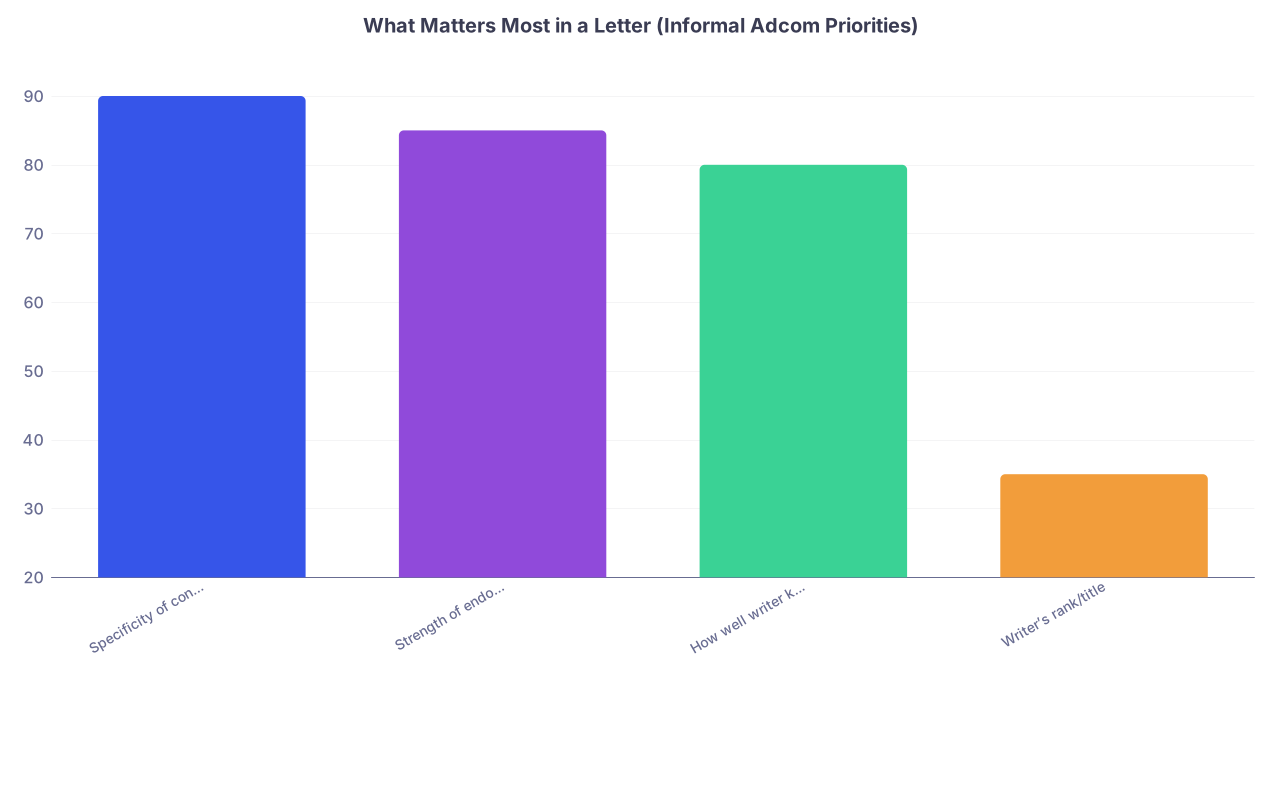
| Category | Value |
|---|---|
| Specificity of content | 90 |
| Strength of endorsement | 85 |
| How well writer knows you | 80 |
| Writer’s rank/title | 35 |
No, those numbers aren’t from a formal study. But if you’ve sat with faculty reading apps, the priorities feel about like that. Title matters, but it’s not driving the bus.
Young Faculty Letters: Hidden Advantages You’re Not Giving Yourself Credit For
Let me flip your anxiety for a second.
Young or junior faculty often:
- Supervised you directly: clinic, bench, small-group teaching, longitudinal project
- Can recall specific stories: that time you stayed late to finish a chart, the miserable experiment that failed ten times and you still came back
- Are still energized: they aren’t phoning it in; they’re crafting their “mentoring” track record
A committee member reading:
“I met Alex as a freshman in my Intro Bio class and have worked with them for three years in my lab and on two outreach projects…”
is going to lean forward. Because that person actually knows you.
Compare that with:
“I have known Alex for one year in my capacity as Division Chief. Alex has participated in our research program and assisted in several projects…”
Totally different level of signal, even though the second writer’s title is fancier.
The risk with only young faculty isn’t that committees think you’re weak.
The risk is if all the letters, regardless of rank, end up vague, generic, or inconsistent with your story.
When Having Only Young Faculty Might Raise Eyebrows
Okay, you probably want the worst-case scenario. Here it is.
There are a few patterns that might give someone pause:
All letters from the same narrow setting
For example, every letter from the same small research lab, all saying almost the same thing. No clinical, no classroom, no community context. That can feel one-dimensional.No letter showing you in a rigorous academic setting
If your best letters are from a postdoc in the lab, but no professor from an upper-level course can say, “This person can handle medical school content,” that’s a gap.All writers junior and peripheral
Think: postdocs, fellows, graduate students—as your only letters. Even if the content is strong, committees start wondering if you couldn’t connect with anyone in a formal teaching or supervising role.
This is where it helps to be a little strategic.
You don’t need a Nobel laureate. But you probably do want:
- At least one letter from someone who taught you a challenging class (ideally science)
- At least one letter from someone who supervised you closely (lab, clinic, job)
- Optional but nice: someone who saw you in a service/leadership role
Title is less important than function and depth of contact. But having all three be assistant professors who started last year and only know you from one semester’s class? That could feel thin.
How to Strengthen a “Young Faculty” Letter Portfolio
If you’re stuck with mostly younger mentors, you can still make this look strong instead of weak. You’re not doomed.
Here’s what you can actually do—today and over the next few months.
1. Choose the strongest relationships over the fanciest titles
If you have a choice between:
- A full professor who kind of recognizes your face and can mention your A in their class
- An assistant professor who’s seen you week after week, watched you struggle, improve, lead, and reflect
Pick the assistant professor. Every time.
If you’re unsure, ask yourself:
- Who could tell a concrete story about me going above and beyond?
- Who could rank me against other students they’ve worked with—honestly and favorably?
- Who has seen me handle adversity, not just success?
Those are your letter writers, regardless of rank.
2. Give your writers ammo so the content is strong
Young faculty, especially, often want to write a good letter but don’t know your full context.
You can help without being annoying by giving them:
- A short updated CV
- A 1–2 page “brag sheet” or bullet points: projects you worked on with them, specific moments you’re proud of, what you learned
- Your personal statement or a rough draft so they understand your narrative
You’re not scripting their letter. You’re reminding them of details they can use to make it specific.
3. Fill obvious gaps with targeted new relationships
If you’re early enough in the process, you can intentionally build one or two relationships that plug holes.
For example, if right now all your potential writers are in research:
- Go to office hours for a challenging upper-level class consistently
- Ask one good question every week, not just “Will this be on the exam?”
- Do the optional problem sets; ask for feedback
- After you’ve shown up for a semester, ask: “Would you feel comfortable writing me a letter when I apply to medical school?”
Is that awkward? Yeah. But what’s more awkward is needing that letter a year later and realizing they barely know your name.
Same idea if you’ve got only academic letters and nothing clinical or service-related. Attach yourself to one attending, one volunteer coordinator, one supervisor who actually sees your work.
Using Titles Strategically Without Selling Your Soul
If you really can get a senior faculty member involved who actually knows you, that’s ideal. The trick is not losing quality in the process.
One option: co-signed letters.
For example, your main research mentor is an assistant professor who knows you well. Above them is a more senior PI or division chief who’s aware of your work.
Sometimes your assistant professor mentor can say:
“Would you like me to have Dr. X co-sign this, since they oversee the program?”
That way you get:
- Detailed content from the person in the trenches with you
- Institutional weight from the senior person’s name and title
But don’t force this or chase it just for ego. A clumsy co-sign from someone who barely knows you is empty signal.
What This Actually Looks Like in a Real Application
Let me sketch two fake-but-realistic applicant setups.
Applicant A – “All Young Faculty, But Strong”
- Letter 1: Assistant professor of biology, taught you in two tough classes, supervised a small honors project, knows your work ethic and intellectual style
- Letter 2: Assistant professor in a clinical department, your direct research mentor, watched you for two years, can describe your growth and independence
- Letter 3: Assistant professor in community health, supervised your long-term volunteering, can speak to your empathy, reliability, and communication
Applicant B – “Big Titles, Thin Content”
- Letter 1: Department chair, met you twice, mentions your A in their class, says “I support this application”
- Letter 2: Program director, vaguely references your “participation” in a summer project, no specifics
- Letter 3: Senior professor, calls you “a pleasure to have in lab,” no concrete comparisons
Applicant B has fancy names. Applicant A has substance.
Applicant A is getting more love in committee.
To help you visualize what a balanced (not prestige-obsessed) letter set can look like:
| Letter Type | Example Writer |
|---|---|
| Science coursework | Assistant/Associate Professor |
| Research mentor | Assistant Professor or PI |
| Clinical/service | Attending, coordinator, or AP |
| Optional 4th letter | PI co-sign or senior faculty |
How Committees Actually Process All This
It might help to see how this plays out when your file hits a conference room table (or, more realistically now, a PDF on a screen).

| Step | Description |
|---|---|
| Step 1 | Read Applicant File |
| Step 2 | Scan Letter Writers |
| Step 3 | Read Content Carefully |
| Step 4 | Look for Context in File |
| Step 5 | Applicant Strengthened |
| Step 6 | Applicant Questioned |
| Step 7 | Any Red Flags? |
| Step 8 | Letters Support Narrative? |
Notice what’s missing from that flowchart?
There’s no: “Are writers full professors? If no, downgrade.”
They’re asking:
- Do these letters match the story in the personal statement and activities?
- Do they corroborate that this person can handle medical school and isn’t a disaster in teams?
- Are there any warning signs—unenthusiastic tone, faint praise, weird inconsistencies?
As long as your young faculty letters are enthusiastic, detailed, and aligned with your story, you’re fine. Better than fine, actually. You’re solid.
What You Can Do Today
Since you probably want something concrete, here’s a simple action you can take right now:
Make a quick list of 5–7 potential letter writers. For each, jot:
- Their role (course, lab, clinic, job, volunteering)
- How well they know you (1–5)
- How much they’ve actually seen your work (1–5)
- Whether they’ve seen you handle difficulty or growth (yes/no)
Don’t even think about titles for this step. Just relationship quality.
Then ask yourself:
- Who are the top 3 based purely on depth and quality of interaction?
- Is there any obvious hole (no rigorous science course? no clinical/service perspective?)
If there’s a hole, make a plan to fill that over the next semester, not to hunt down some random full professor who’s never seen you outside their 200‑person lecture.
That’s the move.
FAQ (Exactly 6 Questions)
1. Will having only assistant professors as letter writers hurt my chances at top schools?
No, not if the letters are strong. Top schools care much more about content and signal than rank. They’d rather see three detailed, enthusiastic letters from assistant professors who know you well than one lukewarm paragraph from a famous full professor who barely remembers you. The “brand name” of your institution and consistency of your story matter more than the seniority of your writers.
2. Should I replace a strong assistant professor letter with a weaker letter from a full professor just to look better?
Don’t. That’s how people quietly torpedo their own applications. A shallow, generic letter from a big name is obvious to reviewers—they know what those look like. If both letters would be strong, then sure, you can lean toward the more senior person. But never trade strength and specificity for title alone.
3. Do I need a department chair or program director letter for medical school?
Generally no, unless a specific program explicitly asks for it (some special programs do). Medical schools usually want: two science faculty, maybe one non-science, plus optional letters from research or clinical supervisors. A chair’s letter is nice if they actually know you, but it’s not some hidden requirement. Don’t chase chairs just because people on Reddit say “it looks good.”
4. Are letters from postdocs, fellows, or grad students acceptable?
They’re fine as supplements, but risky as your main letters. Committees prefer letters from people in formal faculty roles who regularly evaluate students. If a postdoc or fellow knows you best, one workaround is asking if their supervising PI or faculty mentor could co-sign or add a short paragraph. But you still want at least a couple letters clearly from official faculty.
5. How many letters should I get if my writers are all relatively junior?
Aim for quality first, then a bit of redundancy. Most schools are happy with 3–4 strong letters. If yours are all from assistant professors, adding one more letter from a different context (like clinical, service, or another course) can help them see you from multiple angles. But sending 7–8 letters just to compensate for perceived lack of seniority will only annoy readers.
6. What if I already graduated and only have young faculty contacts—am I stuck?
You’re not stuck. Use what you have: former assistant professor mentors, research supervisors, or course instructors who remember you. Then, for future opportunities (postbac, clinical jobs, volunteering), be intentional: pick roles where someone in a stable, evaluative position will see your work frequently. For this cycle, focus on helping your existing writers write the best, most detailed letters they can with a good CV and talking points.
Open a blank document right now and write the names of your likely letter writers, ignoring their titles for a moment. Next to each, write one concrete story or moment they could mention about you. If you’re staring at empty space for someone, that’s your sign: deepen that relationship or pick someone else.