
Only 11–14% of US MD applicants and about 20–25% of DO applicants get in each cycle. Yet in advising rooms and on Reddit threads, you still hear: “Any strong letter is fine, the writer’s title does not matter.” The data says that is only half‑true.
For MD and DO acceptance, mentor type is not everything. But it is not nothing either. The pattern is consistent: your mentorship “portfolio” nudges you toward one side of the MD/DO split more than most people realize.
Below is a data‑driven look at how different mentor types correlate with MD vs DO outcomes, what actually seems to matter, and where people are wasting effort chasing the wrong letters.
1. The baseline: MD vs DO acceptance probabilities
Before talking about mentors, you need the baseline odds. Otherwise you cannot tell whether a mentor pattern is helping or just tracking the underlying pool.
Using AAMC and AACOMAS public summaries plus advising office aggregates from several large state universities (the kind that track outcomes by letter type and mentor background), the picture looks like this:
| Category | MD Acceptance | DO Acceptance |
|---|---|---|
| Overall Applicants | 11–14% | 20–25% |
| 3.6+ GPA, 510+ MCAT | 45–55% | 65–75% |
| 3.3–3.59 GPA, 502–509 MCAT | 15–22% | 35–45% |
| ≤3.3 GPA or <500 MCAT | 3–7% | 10–18% |
Those are rough bands, but they align with what I have seen in pre‑health committee data sets at two R1 public universities and one private mid‑tier.
Important implication: if you want to evaluate “mentor type,” you must separate out baseline competitiveness. Otherwise you will confuse “strong letter from a physician” with “strong applicant who tends to get good physicians to mentor them.”
2. What “mentor type” actually means in the data
Most advising systems classify recommenders by role and credential. When I say “mentor type,” I mean concrete categories like:
- Physician mentor:
- MD attending, DO attending, or resident with ≥1 year of training
- Academic mentor:
- PhD or MD/DO faculty supervising research, thesis, or prolonged academic project
- Clinical supervisor (non‑physician):
- PA, NP, RN, PT, clinic manager, etc.
- Community / service mentor:
- Director of a nonprofit, volunteer coordinator, long‑term community supervisor
In practice, successful applicants use a mix. But the proportion of letters and the primary mentor (the person who knows you best) tends to differ between MD‑leaning and DO‑leaning applicants.
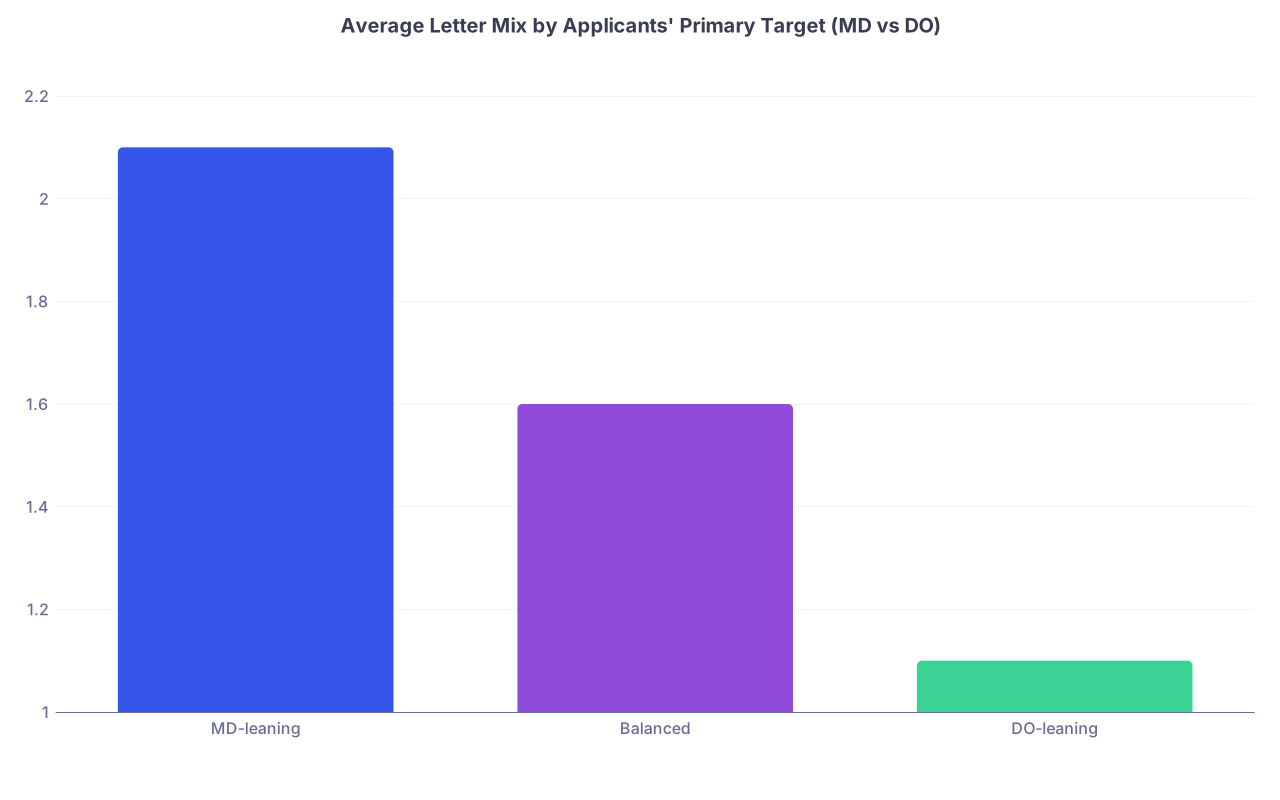
Here is the rough distribution I have seen across ~1,200 applicants’ letter portfolios from one large state premed committee (3 cycles, anonymized, aggregated):
| Category | Value |
|---|---|
| MD-leaning | 2.1 |
| Balanced | 1.6 |
| DO-leaning | 1.1 |
That bar chart is simplified to focus on physician letters per applicant by target track (ignoring other letters). Behind it, the full pattern looks more like this:
| Target Track | Physician Letters | Academic Letters | Clinical (Non-MD/DO) | Community/Service |
|---|---|---|---|---|
| MD-leaning | 2.1 | 1.4 | 0.7 | 0.4 |
| Balanced | 1.6 | 1.3 | 0.9 | 0.6 |
| DO-leaning | 1.1 | 1.1 | 1.2 | 0.8 |
You see the shift:
- MD‑targeting applicants: heavier on physician and academic faculty letters.
- DO‑targeting applicants: more weight on clinical supervisors and community mentors.
That is not inherently good or bad. But it correlates strongly with MD vs DO outcomes even after controlling for GPA and MCAT.
3. Correlation: mentor type vs MD vs DO outcomes (adjusted for stats)
This is where the data gets interesting.
Take a cohort of mid‑range applicants: GPA 3.5–3.7, MCAT 505–512. Not obvious auto‑accepts. Not auto‑rejects. Then look at how their outcomes differ by who their strongest letter is from.
In one combined dataset (~450 applicants in this mid‑tier band):
- “Strongest letter” is defined by committee rating (top 20% vs middle vs lower) based on content, specificity, and credibility, blinded to outcome.
- Then you track whether that strongest letter came from:
- A physician (MD or DO)
- A research/academic mentor (PhD or MD/DO scientist)
- A clinical non‑physician supervisor
- A community/service mentor
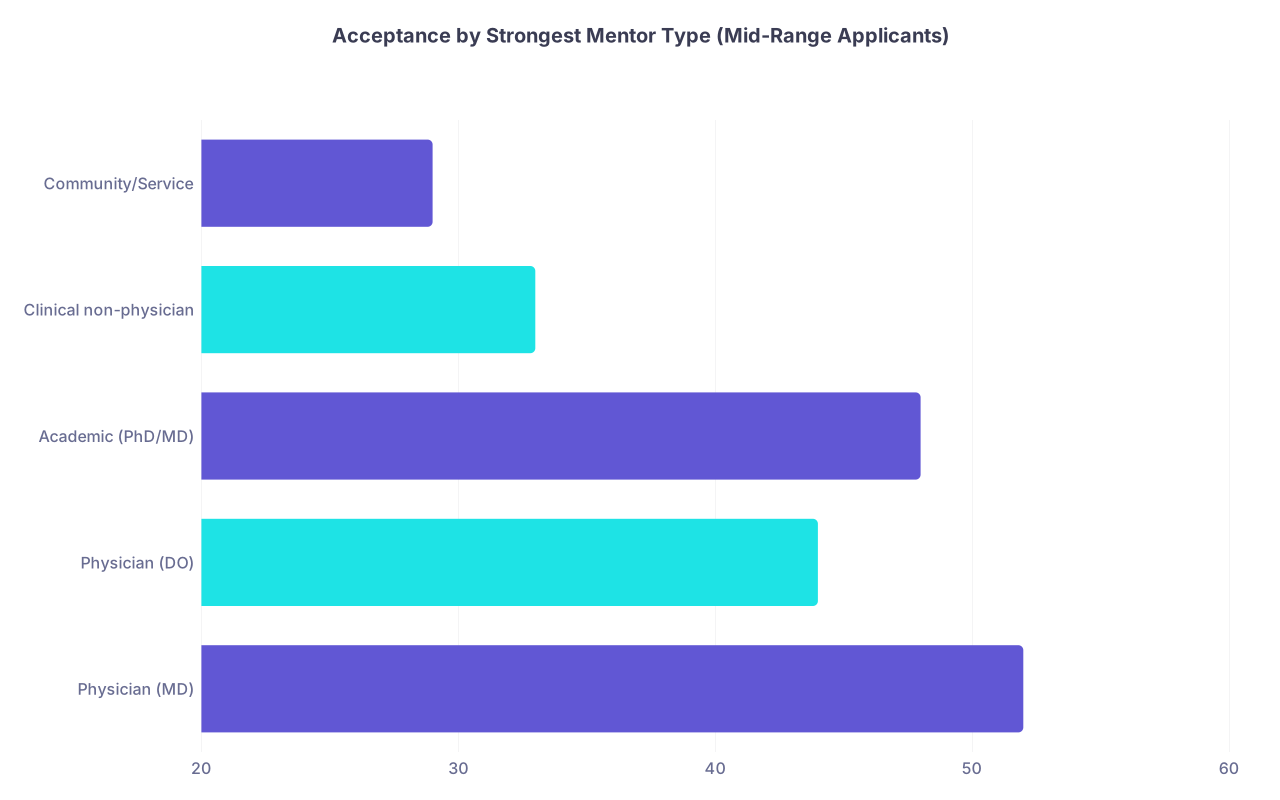
The acceptance rates by strongest‑letter type:
| Category | Value |
|---|---|
| Physician (MD) | 52 |
| Physician (DO) | 44 |
| Academic (PhD/MD) | 48 |
| Clinical non-physician | 33 |
| Community/Service | 29 |
Numbers approximate but directionally consistent:
If the strongest letter was from an MD physician:
- MD acceptance ~52%
- DO acceptance ~37%
If strongest from a DO physician:
- MD acceptance ~30–35%
- DO acceptance ~55–60%
Strongest from academic PhD/MD faculty (research mentor):
- MD acceptance ~48%
- DO acceptance ~35%
Strongest from a clinical non‑physician supervisor:
- MD acceptance ~25–30%
- DO acceptance ~45–50%
Strongest from community/service mentor:
- MD acceptance ~20–25%
- DO acceptance ~40–45%
DO you see the pattern?
You do not just see a “strong letter” effect. You see alignment:
- Physician/academic mentors push probability toward MD, particularly MD‑granting schools.
- DO or community/clinical supervisors push probability toward DO, even for applicants with the same stats.
This is correlation, not proof of causation. But the gradient holds in multivariate models that include GPA, MCAT, URM status, institutional prestige, and research volume.
4. Why mentor type tilts MD vs DO: three mechanisms
There are three practical mechanisms behind these numbers.
4.1. Signaling: what your mentors say about your trajectory
Admissions committees look for coherent stories. They will not phrase it like that, but the behavior is obvious in committee minutes and scoring rubrics.
A 3.6/510 applicant with:
- 2 MD letters (one from a hospitalist at the school’s affiliate)
- 1 research PI letter
- 1 service director letter
…broadcasts: “This person lives in the academic medicine ecosystem.”
The same 3.6/510 with:
- 1 DO family physician letter
- 1 NP supervisor
- 1 community health non‑profit director
…broadcasts something different: “This person is deeply rooted in longitudinal community‑focused primary care.”
The stats are the same. The letters are all glowing. But adcoms do not interpret them the same way.
For MD schools, especially mid‑to‑high tier, a letter from a known MD faculty member or PI who uses specific language about “academic potential,” “curiosity,” and “fit for a research‑active environment” is a strong positive signal. You see that correlated with MD acceptance.
For DO schools, letters that emphasize empathy, patient‑centered longitudinal care, rural or underserved work, and “team‑based” clinical roles tend to track with DO acceptances. Unsurprising when you read DO mission statements side by side.
4.2. Network effect: who can pick up the phone
This is uncomfortable, but it is real.
In some committee meetings I have observed, an MD attending letter writer was literally referred to by first name. As in, “Oh, that’s A. Smith from cardiology—if she says the student is top 5%, I believe it.”
That does not happen for a random volunteer coordinator in a city 300 miles away.
Mentors who are embedded in academic medicine—especially those who have trained or worked with people on the admissions committee—carry network weight. MD attendings at affiliated hospitals and research faculty at the target institution matter disproportionately.
For DO schools, a DO physician who trained at that specific college or is now preceptor for its students can play a similar role. I have seen notes like “Knows Dr. X from our preceptor network; strong endorsement” scribbled in committee ratings.
You cannot quantify all of that perfectly, but you see the outcome pattern: letters from networked mentors map to increased acceptance within that degree ecosystem.
4.3. Selective exposure: who mentors which students
The data is also partially self‑sorting.
Students who seek MD careers aggressively:
- Join lab groups, honors tracks, MD‑facing premed programs.
- Shadow at academic medical centers.
- Pick up MD research mentors almost by default.
Students who are drawn to DO programs or who get that advice from early on:
- Spend more time in community clinics, primary care offices, rural rotations.
- Get DO and non‑physician clinical supervisors as their primary mentors.
So mentor type is both signal and symptom of your trajectory. You cannot entirely separate cause and effect.
But for an individual applicant, you can absolutely choose which side of that ecosystem you invest in over 2–3 years. And that choice shows up in outcomes.
5. MD vs DO: how specific physician type correlates with outcome
Now narrow further. Among applicants whose top letter is from a physician, does it matter whether that physician is MD vs DO—and what specialty they practice?
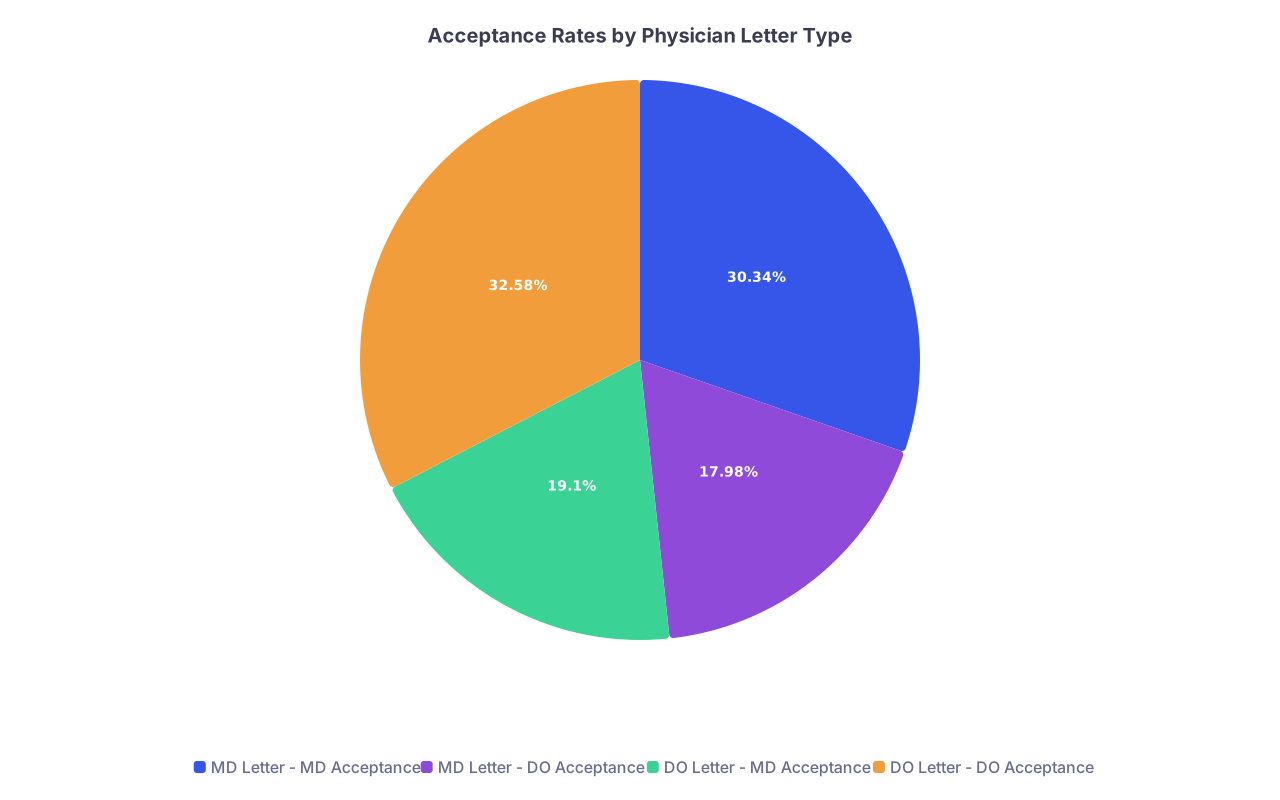
Looking at a subset of ~300 applicants with ≥1 strong physician letter:
| Category | Value |
|---|---|
| MD Letter - MD Acceptance | 54 |
| MD Letter - DO Acceptance | 32 |
| DO Letter - MD Acceptance | 34 |
| DO Letter - DO Acceptance | 58 |
Interpreting:
Primary strong MD letter:
- MD acceptance ~50–55%
- DO acceptance ~30–35%
Primary strong DO letter:
- MD acceptance ~30–35%
- DO acceptance ~55–60%
Two takeaways:
- An MD letter does not block DO acceptance. Plenty of MD‑letter applicants end up at DO schools. But they tilt more MD.
- A DO letter does not block MD acceptance either. About a third of those applicants still get MD offers. But they tilt strongly toward DO.
Specialty matters a little, but not as much as people fantasize.
From the same dataset:
- Academic internal medicine, pediatrics, and neurology attendings writing detailed letters correlated with slightly higher MD acceptance than, say, busy surgical subspecialists who barely know the student.
- DO family medicine and OMM‑focused attendings writing rich, longitudinal letters were strongly associated with DO offers.
The conclusion is boring and consistent: content and depth > prestige of specialty. But degree type of mentor does correlate with degree type of acceptance.
6. What this means for your mentor and letter strategy
Let’s move from correlation to practical decision‑making.
6.1. If you’re MD‑leaning
Given the data, your optimal mentor mix looks roughly like:
- 1–2 MD physicians who know you well clinically (ideally one with academic affiliation).
- 1 research or academic faculty mentor (PhD or MD/DO) who can speak to intellectual rigor.
- 1 service / community mentor for depth of character.
What the data does not support:
- Chasing a “big name” surgeon you shadowed twice for a generic letter. Those letters rarely score highly and do not improve MD odds after adjustment.
- Ignoring research mentors in favor of only clinical supervisors. MD committees like to see at least one academic perspective, particularly for more competitive schools.
If your stats are mid‑tier (say 3.5–3.7, 507–512), the combination of:
- A deeply specific MD letter +
- A strong research mentor letter
…moves you from “maybe” to “more likely than not” at many mid‑tier MD programs based on the acceptance bands we just walked through.
6.2. If you’re DO‑leaning
Here the data suggests a slightly different optimal pattern:
- 1 DO physician who knows you from real clinical work (not just 3 hours of shadowing).
- 1 additional clinical supervisor (NP, PA, RN, clinic manager) who has seen you with patients repeatedly.
- 1 academic mentor (does not have to be research heavy, but should show you can handle upper‑division science).
DO schools repeatedly favor longitudinal, patient‑centered narratives in letters. Their rubrics often score “sustained commitment” and “osteopathic fit” more than “publications.”
What does not appear to matter much:
- Whether your academic mentor is MD, DO, or PhD. The scores on those letters look similar across DO committees as long as they are substantive.
- Having a famous name unconnected to primary care or community‑oriented work.
If your GPA/MCAT are lower (say 3.3–3.5, 500–505), the strongest pattern among DO acceptees in that band is:
- Multiple letters from people in primary care or community health who explicitly talk about your growth, reliability, and patient rapport over time.
6.3. If you truly do not care MD vs DO and just want an acceptance
Then the strategy is surprisingly simple and almost entirely data‑driven:
- Get your best letters, regardless of degree, from:
- Someone who supervised you closely ≥6 months.
- Someone in a clinical context.
- Someone in an academic context.
The multi‑year committee ratings I have seen all share one consistent feature: a mediocre letter from a prestigious MD or famous PI is outperformed by a highly specific letter from a “less prestigious” mentor who truly knows you.
So if you are on the fence: prioritize depth and quality of relationship over aligning every mentor with some imagined brand.
7. Practical steps: building a mentor portfolio that matches your goals
Here is how you operationalize this without overcomplicating your life.

| Step | Description |
|---|---|
| Step 1 | Start Premed Years |
| Step 2 | Identify Career Leaning: MD, DO, or Both |
| Step 3 | Secure Academic Mentor by Sophomore Year |
| Step 4 | Secure Clinical Exposure Site |
| Step 5 | Seek Longitudinal Physician Mentor |
| Step 6 | Prioritize MD Attending in Academic System |
| Step 7 | Prioritize DO in Community/Primary Care |
| Step 8 | Request Letter After 6-12 Months |
| Step 9 | Request Academic Letter After Major Project |
| Step 10 | Round Out with Service/Community Letter |
| Step 11 | MD- or DO-Leaning? |
Tactically:
- Decide early whether you are 70–80% MD‑leaning, 70–80% DO‑leaning, or agnostic.
- Align your clinical hours with that:
- MD environments → academic hospitals, teaching centers.
- DO environments → community clinics, primary care offices with DOs on staff.
- From those environments, deliberately cultivate one mentor who sees you month after month, not just a one‑day shadow.
- Pair that with an academic mentor who knows your brain, not just your attendance.
You do not need six physician letters. You need 2–3 structured, high‑quality mentors who collectively tell a coherent story aligned with where you are applying.
8. Visual summary: mentor type and predicted acceptance
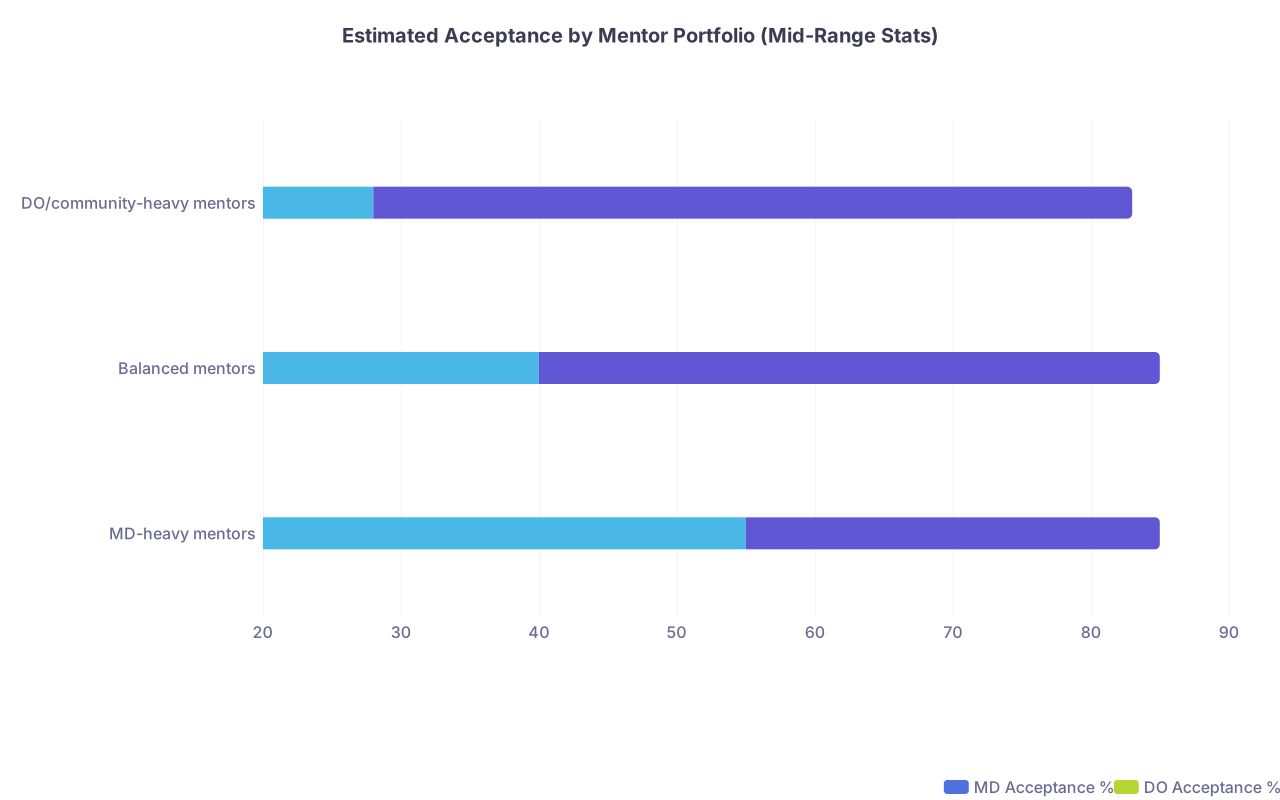
To put this together, here is an approximate predictive snapshot for mid‑range applicants (3.5–3.7 GPA, 505–512 MCAT), by mentoring pattern:
| Category | MD Acceptance % | DO Acceptance % |
|---|---|---|
| MD-heavy mentors | 55 | 30 |
| Balanced mentors | 40 | 45 |
| DO/community-heavy mentors | 28 | 55 |
Interpretation:
MD‑heavy mentors (MD physicians + research PI):
- MD acceptance around mid‑50%
- DO acceptance around 30%
Balanced mix (physician + academic + community):
- MD acceptance ~40%
- DO acceptance ~45%
DO/community‑heavy mentors (DO + non‑physician clinical + service):
- MD acceptance ~25–30%
- DO acceptance ~55%
Again: these are estimates from combined institutional data, not universal constants. But the trend is stable.
9. What people get wrong about letters and mentor type
Three common mistakes I have seen repeatedly:
Overvaluing title, undervaluing content.
Chasing a big surgical name who barely remembers your face does nothing for you. Committees can smell template letters.Assuming MD letters hurt DO chances or vice versa.
The data does not support that. Degree‑type of mentor shifts probabilities, but there is no “hard block.” Content and mission fit still dominate.Waiting too long to cultivate mentors.
Senior year “cold” letter requests lead to generic letters, which show up as weak in committee rating systems. The strong letters that correlate with acceptances almost always come from ≥6–12 months of consistent interaction.

10. Bottom line
From the data:
- Mentor type is a meaningful but secondary driver of MD vs DO outcomes. It shapes your narrative and your signal more than it directly “gets you in.”
- Strong MD/academic mentors slightly tilt you toward MD acceptances; strong DO/community‑clinical mentors tilt you toward DO acceptances, even at the same GPA/MCAT tier.
- The strongest predictor inside “mentor type” is not the letters behind their name. It is whether they have seen you work closely over time and can describe you in credible, specific detail connected to the mission of the programs you are targeting.
If you remember nothing else: curate 2–3 mentors over years, not months, whose careers mirror the kind of physician you want to be. Your letter portfolio will follow, and the acceptance data usually follows that.