
It’s February of your junior year. Your premed file has a scar: an institutional action. Maybe it’s a conduct violation from freshman dorm drama. Maybe it’s a failed course that triggered an academic review. Maybe it’s something more serious.
You’ve accepted that you have to disclose it. You’re already working on your personal statement and IA explanation. But now you hit a subtler landmine:
Who on earth do you ask for letters of recommendation… who can actually help with this, not make it worse?
Your mind is spinning through bad scenarios:
- A professor who barely knows you writes: “X is a good student” and never mentions the IA. Feels fake.
- A PI who likes you but doesn’t know the full story writes something vague: “They’ve had some challenges.” Looks ominous.
- A dean writes a cold, bureaucratic letter full of policy language that screams: RISK.
You do not have the luxury of random letter writers. You need strategic mentors who can both vouch for you and contextualize the IA in a way that adcoms actually trust.
That’s what this is about: if you have an institutional action, how to pick, prep, and use mentors who can meaningfully contextualize it—without turning your file into a disaster.
Step 1: Get Clear On What Needs “Contextualizing”
Before you even think about who, you need to understand what exactly needs framing.
There are three broad IA types I see over and over:
Academic issues
- Probation for low GPA
- Failed/withdrawn courses beyond normal
- Required leave for academic reasons
Conduct / professionalism
- Plagiarism / cheating
- Alcohol or drug violations
- Dorm incidents, fights, harassment complaints
- Unprofessional behavior in class / lab / clinical
Administrative / technical
- Missed required meetings or trainings
- Registration / compliance issues that escalated
- Title IX-related complications where you’re coded into an IA
Each category needs different “context” from mentors.
You need to be able to answer, very bluntly, for yourself:
- What happened? (1–2 clear sentences, no drama)
- What has changed since then?
- Where can someone external realistically say: “I’ve seen the improvement”?
If you can’t map that, your mentors will have nothing concrete to work with. And they’ll default to vague praise, which is poison in this situation.
So write out, for yourself, three bullet points:
- The event (factual, no excuses)
- The consequence (probation, warning, notation)
- The growth (specific changes: grades, behavior, roles, habits)
You’ll use this later when you prep your recommenders.
Step 2: Understand What a Good Contextualizing Mentor Actually Does
A lot of students think “I need a dean’s letter” or “I need someone from the conduct office.” Sometimes that’s true. Often it’s absolutely the wrong move.
A good contextualizing mentor does three specific things:
Acknowledges the IA directly
Not: “They had some challenges.”
Instead: “In sophomore year, X received an institutional action related to [brief description].”Provides temporal distance and trajectory
“Since that time, I have observed…”
“Over the subsequent two years, their performance has…”
This is what adcoms care about: sustained change.Offers concrete, observed evidence of growth
- Improved academic performance under rigor
- Professionalism in sensitive settings
- Reliability and trustworthiness in positions of responsibility
The worst letters in IA cases are:
- Oblivious: never mention the IA at all, when it’s clearly in your file
- Overly defensive: spend half the letter litigating the fairness of the IA
- Vague rehabilitation language: “They’ve learned from this” without proof
You’re looking for mentors who know you after the IA well enough to speak to your current reality, and who are mature enough to talk about it calmly and concretely.
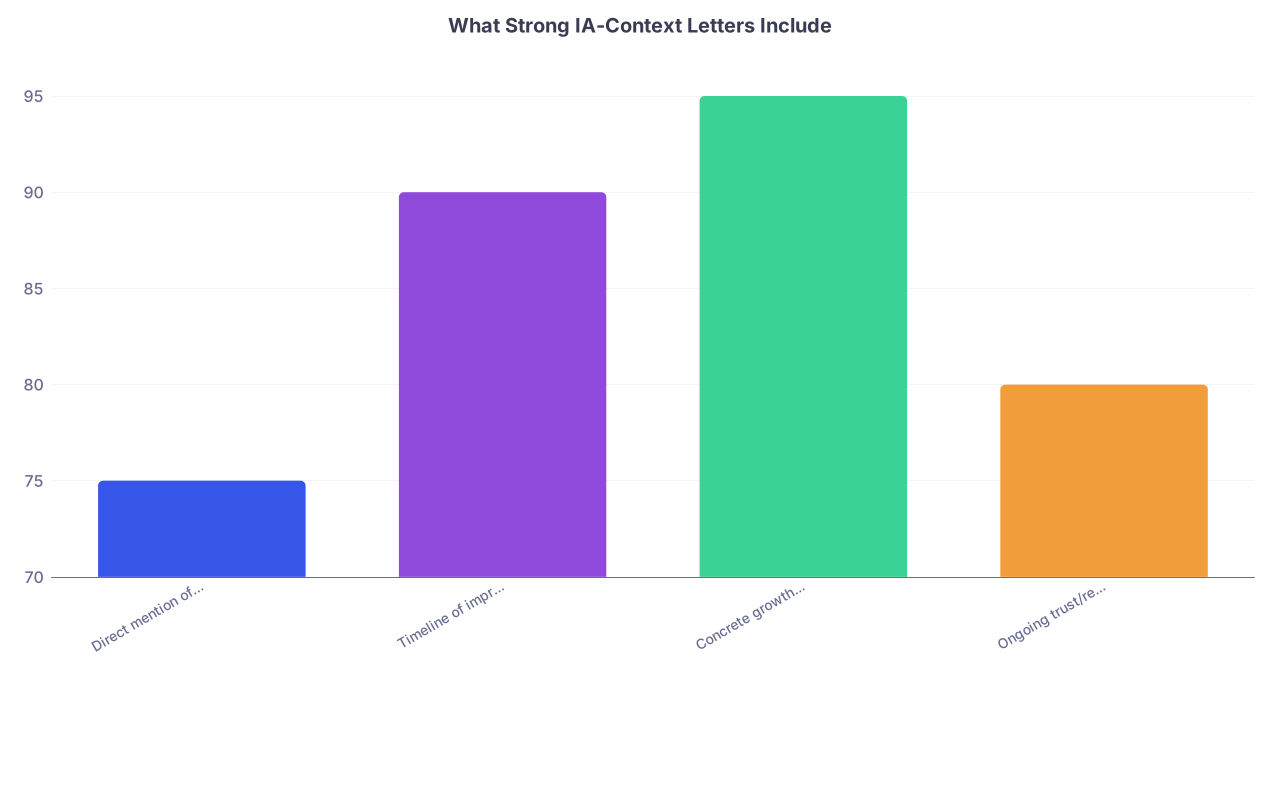
| Category | Value |
|---|---|
| Direct mention of IA | 75 |
| Timeline of improvement | 90 |
| Concrete growth examples | 95 |
| Ongoing trust/responsibility | 80 |
Step 3: Build a Shortlist of Potential Letter Writers
You don’t want twelve options. You want 4–7 realistic possibilities you can evaluate.
Think in categories:
- Academic rigor: Professors from upper-level, demanding courses, ideally after your IA
- Longitudinal mentors: Research PI, advisor, coach, long-term volunteer supervisor
- Professionalism witnesses: Clinical supervisors, work supervisors, people who’ve trusted you with something serious
- Institutional perspective: A dean, conduct officer, or prehealth advisor who actually knows your case and supports you
Now make two actual lists:
- People who know about the IA and still like/trust you
- People who don’t know yet but have a strong, long-term relationship with you
Both categories are usable, but you’ll approach them differently.
The key filter: if they found out about the IA, would they be surprised and disappointed, or “concerned but still supportive”? If someone is going to wobble, you don’t want them.
Step 4: Decide Who Should Explicitly Address the IA (And Who Should Not)
Not all letters need to mention the IA. In fact, they shouldn’t.
You’re aiming for a mix of:
- 1–2 letters that explicitly and constructively address the IA
- 1–3 letters that are purely about excellence and reliability with no drama
Think of it like a portfolio:
- One person says: “Yes, I know about this blot. I’m not worried. Here’s why.”
- Others say: “Here’s how capable and dependable this person has been with me.”
Who should usually be in the “IA-addressing” group?
Good candidates:
- Research PI who has known you for at least a year, ideally post-IA
- Major advisor who has seen your academic recovery and maturity
- Prehealth advisor or dean who understands admissions and believes in you
Weak candidates for IA discussion:
- Random professor from a single semester class, with minimal contact
- Someone clearly out of their depth on admissions norms, who might over-explain
- Anyone who seemed judgmental or conflicted when you disclosed the IA
If your IA was minor and far in the past (e.g., noise violation freshman year), you may not need a letter directly about it. Your own written explanation plus a strong, clean pattern since then can be enough. In that case, prioritize letters that demonstrate responsibility and maturity, without dragging the IA back into the spotlight.
Step 5: How To Approach a Potential Mentor When You Have an IA
This part makes students sweaty. Fair. But avoiding it leads to worse outcomes.
Here’s a structure that works.
Email template skeleton (adjust language to sound like you, not a robot):
- Remind them who you are
- State what you’re applying for and when
- Affirm why you thought of them (specific, not flattery)
- Briefly mention you have an IA that you’ll be disclosing
- Ask if they’d feel comfortable writing a strong, supportive letter
- Offer to meet and share your explanation and materials
Example:
Dear Dr. Alvarez,
I’m applying to medical school this upcoming cycle (submitting primaries in June) and am hoping to assemble a small group of mentors who know my work well. I’ve really valued our work together in the lab over the past year, especially your feedback on my poster and the way you’ve challenged me to think more critically about study design.
I’ll be disclosing an institutional action related to an incident from my sophomore year. I’ve written a formal explanation for my application and would be happy to share that with you, along with my personal statement and CV.
Would you feel comfortable writing a strong letter of recommendation for me, potentially including your perspective on my growth and reliability since that time? If so, I’d appreciate the chance to meet briefly and talk through any questions you might have.
Thank you for considering this,
[Name]
Then you watch their response carefully:
- “Of course, happy to” → Good
- “I can write a letter” with no “strong” → Clarify or walk away
- Hesitation, questions about the IA before agreeing → Probably not your IA-letter person
Step 6: Preparing Mentors So They Don’t Make Things Worse
The worst thing you can do is throw this in their lap with: “Just write something nice.” They won’t know how to calibrate.
You need to guide them—without scripting or controlling.
Bring or send:
- Your CV / activities list
- Draft of your personal statement
- Draft of your IA explanation (the one that will be in AMCAS/AACOMAS/TMDSAS)
- A short bullet summary: “Here are three things that would be helpful if you can honestly comment on them”
For the IA-focused mentor, your bullets might look like:
- “You’ve seen my work in [lab/clinic] over the last 18 months; if accurate, mentioning my reliability and follow-through on commitments would be helpful.”
- “Because my IA involved [academic dishonesty / professionalism], any concrete examples you’ve observed of integrity or professionalism are valuable.”
- “Admissions committees will see that the IA occurred in [semester/year]; if you can reference how I’ve developed since then, that timeline matters.”
Say this out loud, too. I’ve literally said to faculty:
“I’m not asking you to spin this. If you’re not comfortable commenting on improvement, I’d rather you didn’t mention it at all or I’ll ask someone else who can.”
That honesty actually makes them more likely to trust you and help.
Step 7: Special Case – When the IA Is About Dishonesty or Professionalism
Cheating, plagiarism, falsifying hours, harassment, unprofessional conduct in clinical spaces—these hit a different nerve for admissions.
If that’s your situation, you need at least one person who can firmly say, in effect:
“I know what happened. I took that seriously. And based on direct observation over time, I do not see this as an ongoing risk.”
The best people for this:
- PI or supervisor who has given you access to sensitive data, patients, or resources
- Employer who has trusted you with money, confidential information, or leadership
- Clinical supervisor who’s seen your behavior with patients and staff repeatedly
You want them to be able to say things like:
- “I rely on them to handle patient PHI appropriately, and they have always done so.”
- “They’ve been transparent about errors in the lab and quick to take responsibility.”
- “I have no concerns about their professionalism with staff, patients, or peers.”
If your IA was directly under someone (e.g., you cheated in Dr. Smith’s class), don’t use that person for a letter unless your relationship has truly transformed and they have explicitly said they’re willing to advocate for you. Most of the time, choose someone else who knows the story but isn’t the injured party.

Step 8: Coordinating With Your Prehealth Committee (If You Have One)
If your school has a committee letter, you do not get to ignore them. They’re going to see the IA, and many committees write about it explicitly.
Your job is to make them an ally, not a black box.
Do this early:
- Meet with the prehealth advisor months before your committee interview
- Bring your IA write-up, be completely factual, do not downplay
- Ask directly: “How does the committee usually handle IA’s like this in letters?”
- Ask: “Is there anything you need from me, or from my mentors, that would help you contextualize this fairly?”
If the committee is rigid and punitive, you need to know that early so you can:
- Adjust your school list more conservatively
- Make sure your individual letters are very strong and specific
- Possibly supplement with a dean’s letter or advisor letter that counters tone, if appropriate
Some committees are actually very good at this and will coordinate language with your mentors. Use that if you have it.
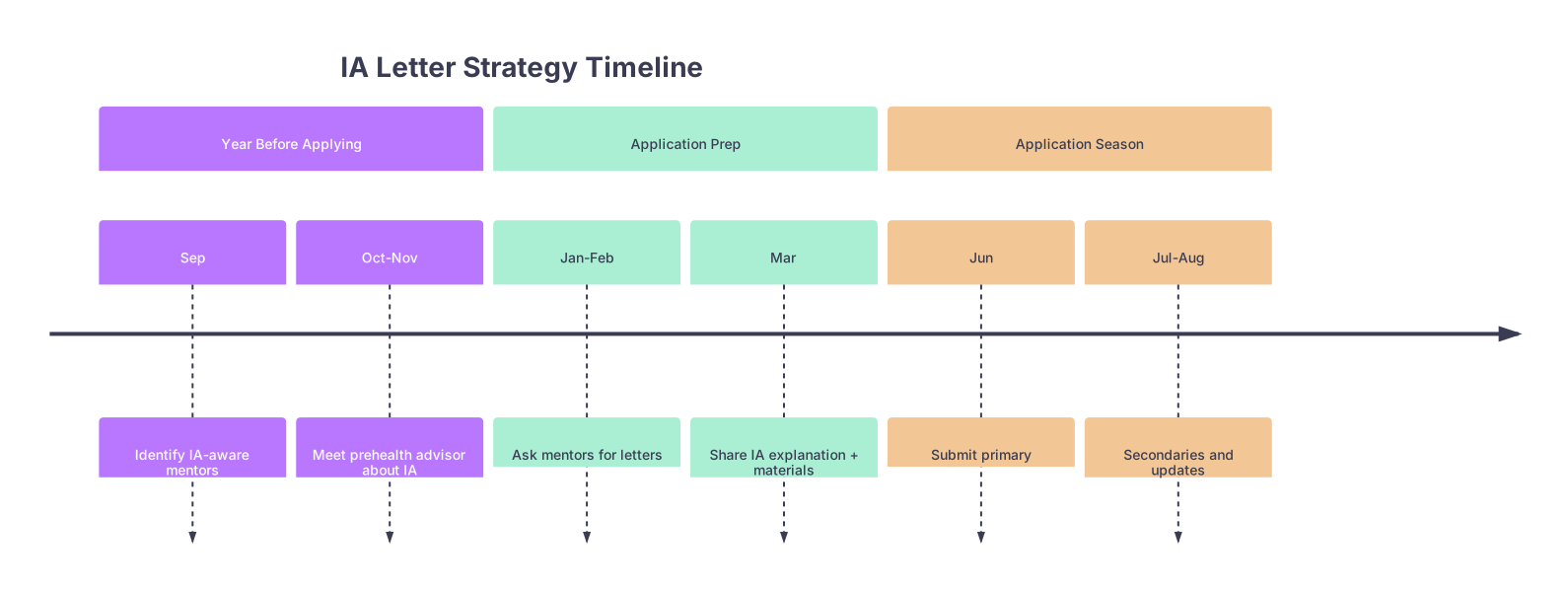
| Period | Event |
|---|---|
| Year Before Applying - Sep | Identify IA-aware mentors |
| Year Before Applying - Oct-Nov | Meet prehealth advisor about IA |
| Application Prep - Jan-Feb | Ask mentors for letters |
| Application Prep - Mar | Share IA explanation + materials |
| Application Season - Jun | Submit primary |
| Application Season - Jul-Aug | Secondaries and updates |
Step 9: When To Use a Dean / Conduct Officer Letter
Sometimes you need the “official” voice. Many times, you really don’t.
Use a dean or conduct officer letter when:
- The IA is complex or bureaucratic, and the raw notation looks worse than reality
- There was a policy change, misunderstanding, or procedural quirk that needs explaining
- The dean has explicitly said, “I’m comfortable stating that you complied with all sanctions and that we support your application”
Do not use them when:
- They sound like lawyers writing a liability memo
- They’re neutral at best: “X fulfilled all requirements of the sanction.” (That’s not helpful.)
- They barely remember you and are just reciting the file
If you’re not sure, meet with them and ask:
“I’m applying to medical school and considering including a letter from you. Do you feel you could write a supportive letter that both explains the IA factually and comments on my standing with the institution now?”
If they hedge, skip it.

Step 10: Common Bad Moves (So You Can Avoid Them)
I’ve watched students with IA’s tank their chances not because of the IA itself, but because of how their letters were handled. Do not do these:
Letting clueless letter writers “discover” your IA on their own
They’ll either ignore it (looks shady) or overreact in their letter.Using only “safe” letters that never mention the IA
Adcoms then think: either no one knows about this, or no one is willing to vouch for them post-incident.Overloading the file with IA talk
You, your committee letter, a dean letter, two mentors… all rehashing the same story. It starts to feel like the core of your identity rather than one past event.Letting someone vaguely “allude” to hardship
“X has overcome significant challenges” without specifying that it’s the IA (which is already disclosed) just triggers curiosity and suspicion.Not checking in on tone
You don’t see the letter, but you can get a sense. If a mentor expresses ongoing concern in conversation, don’t assume their letter will be glowing. Believe them.
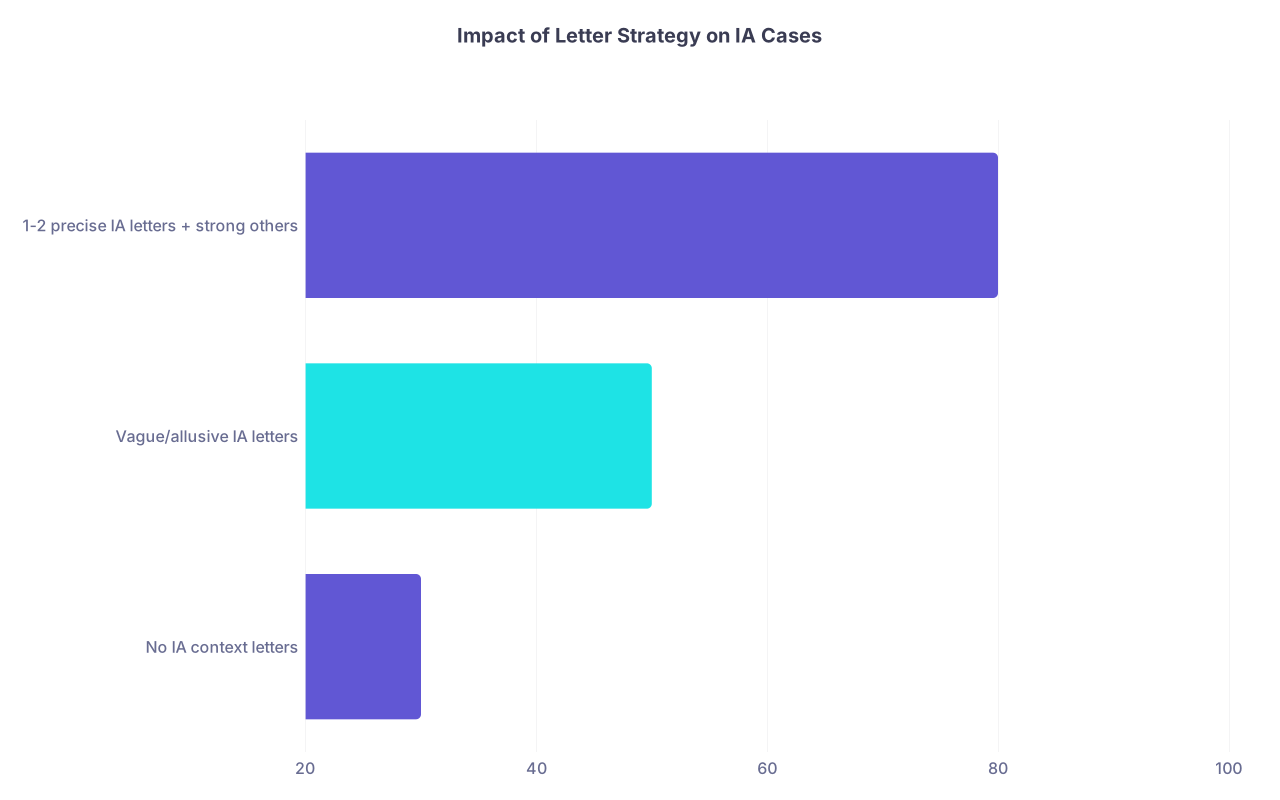
| Category | Value |
|---|---|
| No IA context letters | 30 |
| Vague/allusive IA letters | 50 |
| 1-2 precise IA letters + strong others | 80 |
Quick Example Scenarios
Let me give you three concrete setups.
Scenario 1: Academic Probation, Now High GPA
- IA: Probation sophomore year for GPA 2.3; now 3.7 with strong science grades
- Letters:
- Organic Chem II professor (A, taught after probation) – pure academic strength
- Research PI (knows full IA story) – addresses maturity, consistency over 18 months
- Major advisor – explicitly mentions academic turnaround and probation resolution
- Volunteer clinical supervisor – professionalism and reliability, no IA mention
Here, two letters (PI + advisor) can safely mention the IA and growth. Others stay clean.
Scenario 2: Cheating Incident in Freshman Biology
IA: Caught collaborating on online quiz; academic dishonesty notation; completed sanctions
Now: No further issues, extensive clinical work, leadership roles
Letters:
- Research PI (knows story) – specifically addresses integrity in research setting
- Clinical supervisor – comments on professionalism and trust with patients
- Upper-level physiology professor – academic rigor
- Prehealth advisor / committee letter – official acknowledgement and institutional stance
Here, PI + committee give overt context. Others show who you are now.
Scenario 3: Conduct Violation – Alcohol + Vandalism Freshman Year
IA: Alcohol-related dorm incident with property damage; conduct probation
Now: RA, peer mentor, 3.6 GPA, no further issues
Letters:
- Residence life supervisor – explicitly addresses past incident, your RA performance, trust level
- Upper-level science professor – academic
- Volunteer coordinator – maturity and reliability
- Prehealth advisor – brief mention of IA, completion of sanctions, current standing
Your RA supervisor is gold here; they’re literally in the trust business.

FAQ (Exactly 3 Questions)
1. Should I ever not tell a recommender about my institutional action?
If the IA is already guaranteed to be visible to schools (AMCAS/AACOMAS/TMDSAS requires it) and you’re asking someone for a significant letter, I strongly prefer transparency. That does not mean every letter needs to discuss it, but blindsiding a recommender is risky. The only exceptions are minor, distant IA’s where your explanation is straightforward and the relationship is brief and purely academic; in that case, you can choose someone who just writes about your performance. But your core mentors should know.
2. What if my best academic recommender doesn’t support me because of the IA?
Then they are not your best recommender. I mean that literally. A lukewarm letter from the “famous” or “rigorous” professor who’s ambivalent about your character will hurt you more than a strong letter from a less prestigious but genuinely supportive mentor. If someone hesitates, thanks them, and move on. You’re building a coherent narrative with your letters, not collecting trophies.
3. Do I need more letters than a typical applicant because of my IA?
No. More letters rarely help and often backfire—especially when multiple writers rehash the same IA story. Hit the target number schools want (usually 3–5) and focus on quality and balance: one or two precise, grounded IA-context letters plus strong pure-endorsement letters. If your existing letters are laser-focused, adding extra “just in case” letters usually just dilutes the impact.
Key Takeaways
- You’re not looking for random “strong letters.” You’re building a small team of mentors who can either clearly contextualize your IA or powerfully endorse who you are after it.
- At least one person who knows the full story should explicitly, calmly address the IA and describe your trajectory; the rest should showcase excellence and reliability without drama.
- Be direct, be selective, and prepare your recommenders well. The IA itself isn’t always what sinks applicants—it’s sloppy, inconsistent, or vague letters around it.