
It is late May. Your AMCAS application is almost ready to submit. Your friends are refreshing their inboxes for individual letters… and you are still “waiting on the committee letter.” The pre‑health office has your file, your recommenders submitted weeks ago, and yet you have a dull sense of dread: Did I actually set them up to advocate for me, or did I just dump paperwork on their desk and hope for the best?
If you get this piece wrong, your entire application can feel flat. Or late. Or both.
Pre‑health office letters (committee letters, composite letters, advisor letters) can be a powerful multiplier. Or they can be a bland, late, bureaucratic summary that quietly drags down your file. The difference is almost never the office alone. It is how you interact with them, what you give them, and the mistakes you avoid.
I have watched strong applicants get sandbagged by their own choices here. Not because they were weak, but because they treated the office like a formality instead of a strategic ally.
Let’s walk through the most common, damaging mistakes students make with pre‑health office letters—and how to avoid diluting your own advocates.
Mistake #1: Treating the Pre‑Health Office Like a Transcript Service
The worst mindset: “They just compile my letters and send them; it does not really matter.”
Wrong. Many pre‑health offices do far more than electronically forward PDFs. They:
- Decide whether you receive a full committee letter, a basic cover letter, or nothing at all.
- Assign you an advisor who writes a narrative summary of your candidacy.
- Rate you formally or informally (Highly Recommended / Recommended / Recommended with Reservations).
- Influence how faculty think about you as an applicant over several years.
If you act like they are a vending machine—feed forms in, get letter out—you undercut the one group that could actually orchestrate your advocacy.
The specific behaviors that scream “I do not understand your role”:
- You only show up when you need a letter.
- You ignore pre‑health listserv emails because they look “generic.”
- You do not know the committee letter policy until the cycle you apply.
- You treat staff like clerks instead of people who report back to the committee.
Better approach: from second year onward, know the structure of your pre‑health system. Who runs it? Is there a formal committee? Are there rating tiers? Do they offer mock interviews, file reviews, or feedback? You do not have to live in their office, but you do need to understand how your behavior over multiple semesters will be interpreted when your name hits their spreadsheet.
Mistake #2: Missing (or Misreading) Deadlines and Requirements
This one is brutal because it is avoidable—and it has teeth.
Most pre‑health offices have layered deadlines:
- Intake meeting deadline (often fall or early spring prior to your application year)
- Completion of “file” (transcripts, personal statement draft, CV, sometimes a questionnaire)
- Deadline for external letter writers to submit
- Guarantee deadlines vs. “we will try, but no promises” dates
Students sabotage themselves by:
- Assuming the committee timeline follows AMCAS opening. It often starts months earlier.
- Ignoring the line that says “Committee letter only guaranteed if file complete by X date.”
- Treating “priority deadline” as optional. For some offices, “priority” means “if you miss this, you are in the maybe pile.”
I have seen offices move students from “committee letter” to “advisor letter only” or “no letter” because of missed milestones. Quietly. No drama. Just a smaller voice on your behalf.
You cannot afford this.
Practical safeguards:
- In January of the year you plan to apply, pull your pre‑health office’s current handbook or website. Not last year’s.
- Write down every explicit date and requirement, then build your own earlier internal deadlines.
- If you discover you are late, do not hide. Email or meet with them, take responsibility, and ask what is still possible. Sulking and avoiding them is how you go from “late but salvageable” to “ghosted and downgraded.”
Mistake #3: Handing Them a Sloppy, Generic, or Inconsistent Packet
The pre‑health office often writes its own summary letter based largely on what you give them. If your packet is shallow, disorganized, or contradicts itself, you are training them to see you as shallow, disorganized, and confused.
Common self-inflicted wounds:
- Your CV has different dates or hours than your AMCAS activities.
- You round up hours aggressively in one place and are conservative in another.
- Descriptions of the same experience (e.g., hospice volunteering) change tone so much that they look like two different jobs.
- You provide bullet points instead of clear narratives, so they cannot extract any story.
Committee members are not detectives. They do not cross-examine every line of your application trying to give you the benefit of the doubt. They look for coherence. When they cannot find it, they write blandly or cautiously.
Do not make them guess who you are.
You want your pre‑health file to make it easy for them to talk about you concretely:
- A clean CV with consistent formatting, accurate dates, and honest hour estimates.
- A one-page summary of your key experiences and what you learned from them.
- Clear explanations of any academic dips, withdrawals, or unusual patterns.
If your packet looks like you threw it together at 2 a.m., they will never say that in the letter. But they will write you like a generic applicant. That is the quiet penalty for sloppiness.
Mistake #4: Hiding Weaknesses Instead of Framing Them
The pre‑health office sees your full record. They know about the C– in organic chemistry, the semester you withdrew from two courses, the conduct warning, the leave of absence. Pretending those do not exist does not protect you; it just tells them you are unwilling—or unable—to reflect on your own file.
What happens then? One of two things:
- They avoid mentioning the issue entirely → adcoms see the transcript but no context → they assume the worst.
- They mention it in a vague or oddly phrased way because you never helped them understand what actually happened.
I have literally read committee letters that say, “There was an academic difficulty during sophomore year that the student did not wish to discuss in detail.” That line is a disaster. It screams “unresolved problem” and “poor insight.”
You must do the harder, more mature thing: surface weaknesses before they find them.
That means:
- Bringing up academic issues proactively in your pre‑health interview, with a clear explanation and what you changed afterward.
- Writing a concise, honest paragraph in any office questionnaire about major red flags.
- Being consistent. The story you tell the committee should match the one in your secondaries and interviews.
Handled well, a dip becomes a story of resilience and course correction. Handled badly—or hidden—it becomes a question mark that the committee quietly bakes into their tone.
Mistake #5: Assuming They Know You Because “I Have Been Around”
You worked in a campus lab. You attended the pre‑med club. You went to a couple of info sessions. You figure, “They know who I am.”
They do not. At least, not in the way you think.
Pre‑health advisors often manage hundreds of students per cycle. Faculty committee members read files, not minds. If your only interactions are hallway waves and Zoom squares, do not expect a letter filled with “I have personally observed her growth over three years.”
Instead, you get the dreaded vague language:
- “By all accounts, he is a dedicated student.”
- “Those who have worked with her describe her as…”
- “Faculty report that he…”
That wording tells adcoms exactly what happened: the writer did not know you directly.
You can fix this, but not at the last minute. You need at least some real interactions before they write:
- A proper advising appointment where you talk through your path, challenges, and goals.
- A follow-up meeting after a tough semester, not just when everything is going well.
- Email updates once or twice a year that highlight key changes (“I started working as a medical interpreter this term…”) without being self-congratulatory spam.
You are not trying to become their favorite student. You are giving them actual, lived reasons to write about you as a person, not a file.
Mistake #6: Failing to Align Your Narrative With Their Perspective
Here is a subtle but serious mistake: your personal statement and activities scream one story, but the committee letter tells a different one. Not because anyone is lying, but because you never bothered to connect the dots for them.
For example:
- Your application sells you as “future academic oncologist,” but your pre‑health materials focus mostly on tutoring and music.
- You emphasize primary care and community health, but the committee has only ever seen your shadowing with neurosurgery.
- You frame yourself as “late bloomer who turned things around,” but the advisor remembers your first-year panic and presents you as still shaky.
This creates cognitive dissonance for admissions readers. They sense a mismatch. Even if they cannot pinpoint it, they will trust the office that has seen you longer over your one-year narrative pivot.
You need to pull the pre‑health office into your narrative, not hope they accidentally match it.
That means:
- Sharing a reasonably polished draft of your personal statement with them when you submit your packet.
- Using their questionnaires to reinforce the same themes: the same pivotal experiences, same motivations, same growth arcs.
- If your path has shifted (e.g., from orthopedic surgery or bust to open-minded about specialties), explaining that evolution clearly to them.
You are not scripting their letter. You are aligning your story so they can echo it credibly, with their own observations. When the committee letter and your AMCAS speak the same language, your file feels coherent and intentional. When they do not, you look un-self-aware.
Mistake #7: Micromanaging or Trying to “Edit” the Committee
Another flavor of self-sabotage: you treat the pre‑health office like a ghostwriting service.
I have watched students do this:
- They send multi-page “suggestions” for what should be highlighted.
- They push to see drafts, or they hint they expect to approve anything written about them.
- They complain when advisors mention real weaknesses, even when those weaknesses are already visible in the transcript.
Two problems here.
First, most offices will not let you see the committee letter, and they should not. Confidentiality is part of what gives these letters weight. Pushing that boundary makes you look entitled and unprofessional.
Second, over-directing your advocates backfires. Advisors remember the students who demand a glowing, uncritical narrative. They also remember behavioral red flags and sometimes document them.
You absolutely should provide helpful material: updated CV, context about experiences, explanations for blips. You do not get to dictate tone, erase concerns, or veto honest assessment.
If you want a credible advocate, you have to accept that credibility comes from the freedom to be candid.
Mistake #8: Starving Them of Concrete Evidence and Stories
The strongest letters—pre‑health or otherwise—do not rely on adjectives. They rely on examples.
Adjectives: “hardworking, compassionate, dedicated.”
Examples: “He consistently volunteered for the late Sunday night shift in the ED, when staffing was thin and most undergrads preferred to be anywhere else.”
Your office cannot invent examples. If you do not give them material to work with, they are stuck with empty praise.
Students weaken their own advocacy when they:
- Only describe outcomes (“I did 200 hours of hospice volunteering”) instead of specific situations that changed them.
- Never share patient stories or ethical dilemmas that they handled thoughtfully.
- Avoid reflecting on specific failures or conflicts and what they did differently after.
You do not need to write them a novel. A page or two of well-chosen, specific anecdotes can equip them with vivid ammunition.
Think in terms of 3–5 concrete scenes they could echo:
- A time you went far beyond the minimum.
- A moment you made a hard but principled choice.
- A situation where your communication skills clearly mattered.
- An instance of real growth after criticism.
Feed them substance, or they will be forced to write fluff. Fluff is how your file blends into the pile.
Mistake #9: Ignoring How Their Rating System Actually Works
Some pre‑health offices attach a formal or informal rating to their letters. They may not advertise this loudly, but admissions committees know the code.
A few examples:
- “Strongly Recommend” vs. “Recommend” vs. “Recommend with Reservations.”
- Internal numeric scores that translate into the type of letter you receive.
- Decisions about whether you get a full committee letter or only a basic cover letter.
| Rating Label | How Adcoms Commonly Read It |
|---|---|
| Strongly Recommend | Top tier, clear enthusiasm |
| Recommend | Solid but not exceptional |
| Recommend with Reservations | Concerns; proceed with caution |
| No Committee Letter | Significant issues or weak support |
You dilute your own advocacy when you:
- Never ask what criteria they use for stronger vs. weaker letters.
- Assume “Recommend” is fantastic when, at that school, it actually means “middle of the pack.”
- Ignore early feedback about your readiness (and apply anyway, over their soft objections).
Here is the blunt truth: if your pre‑health office is actively discouraging you from applying this cycle and you do it anyway, many admissions readers will side with them, not you. They have seen you for years; you wrote one essay.
So you need to know where you actually stand. Ask:
- “At our institution, what tends to distinguish a ‘Strongly Recommend’ from a ‘Recommend’?”
- “Are there specific academic or professionalism thresholds that affect the type of letter you can write?”
- “Based on my current record, do you consider me ready to apply this year, or would another year of development change the level of support you can give?”
Listen carefully. You may not love the answers. But they tell you whether you are walking into the cycle with a spotlight or with a quiet asterisk.
Mistake #10: Failing to Coordinate External Letters With the Committee Letter
Another way students sabotage themselves: no strategy for how their individual letters and the committee letter fit together.
Common mess:
- Three clinical letters all saying the same generic things.
- Two research letters describing you as a budding scientist, while your committee letter highlights your passion for primary care.
- A “character” letter from a family friend that undercuts the professional tone of the committee’s advocacy.
Your pre‑health office often asks who is writing for you. They may even store those letters before composing the committee overview. If you pick your writers haphazardly, they are forced to summarize a random assortment of endorsements.
Far better:
- Pick individual letter writers whose perspectives complement each other: one clinical, one research (if relevant), one who has supervised you longitudinally in anything substantial.
- Tell the pre‑health office why each person is writing and what aspects you expect they can speak to.
- Ask the office if there are gaps they see (“We have no academic science letter yet, which some schools require”).
You want the committee letter to synthesize a coherent picture built from distinct but compatible voices. If you feed them noise, they will give you a polished summary of noise.
Mistake #11: Going Dark After the Letter Is Submitted
Students often think, “Once the committee letter is in AMCAS, the pre‑health office is done.” They vanish. Then they:
- Need a quick turnaround for a post‑bac, SMP, or scholarship letter.
- Want advice after a poor cycle, only to realize their last contact was 18 months ago.
- Apply to a linkage or early assurance program that still routes through the same office.
Pre‑health advisors have long memories. They notice who treats them like disposable letter factories and who treats them like long-term mentors. That does not just affect warm fuzzies; it affects how willing they are to go to bat for you again when you need it.
You do not need to send them a fruit basket. But you should:
- Let them know when you get interview invites and where you eventually matriculate.
- Send a simple, sincere thank-you after the cycle, acknowledging their time and advocacy.
- If you do not match or do not get in, meet with them for a post-mortem instead of disappearing in embarrassment.
The next time your name lands in front of them—for a reapplication, an MD–PhD, a scholarship—they will remember you as a professional adult, not a transaction.
Mistake #12: Applying Through the Office When You Really Should Not
This one is uncomfortable but necessary.
Not everyone should seek a committee letter in a given year. Some students:
- Have serious professionalism issues on record.
- Are on academic probation or just emerged from it.
- Have GPAs and MCATs that are so mismatched with their target schools that the office cannot credibly endorse the plan.
- Are visibly applying “because everyone else is,” not because their file is ready.
You can push through. You can insist on your right to apply. But understand the trade-off: a lukewarm or explicitly cautious committee letter can do more harm than no committee letter at all, depending on the school and context.
Sometimes the wiser move is:
- Take an extra year to build a stronger record (post‑bac, SMP, more substantive clinical work).
- Work with the office on a deliberate improvement plan.
- Apply in a future cycle with clearly changed circumstances and, as a result, stronger advocacy.
If your pre‑health office signals that your current committee letter would be restrained or even negative, do not just look for a workaround. Ask yourself whether you are trying to skip the hard work of becoming the applicant you want them to describe.
A Quick Visual: Where Students Most Commonly Undercut Their Advocates
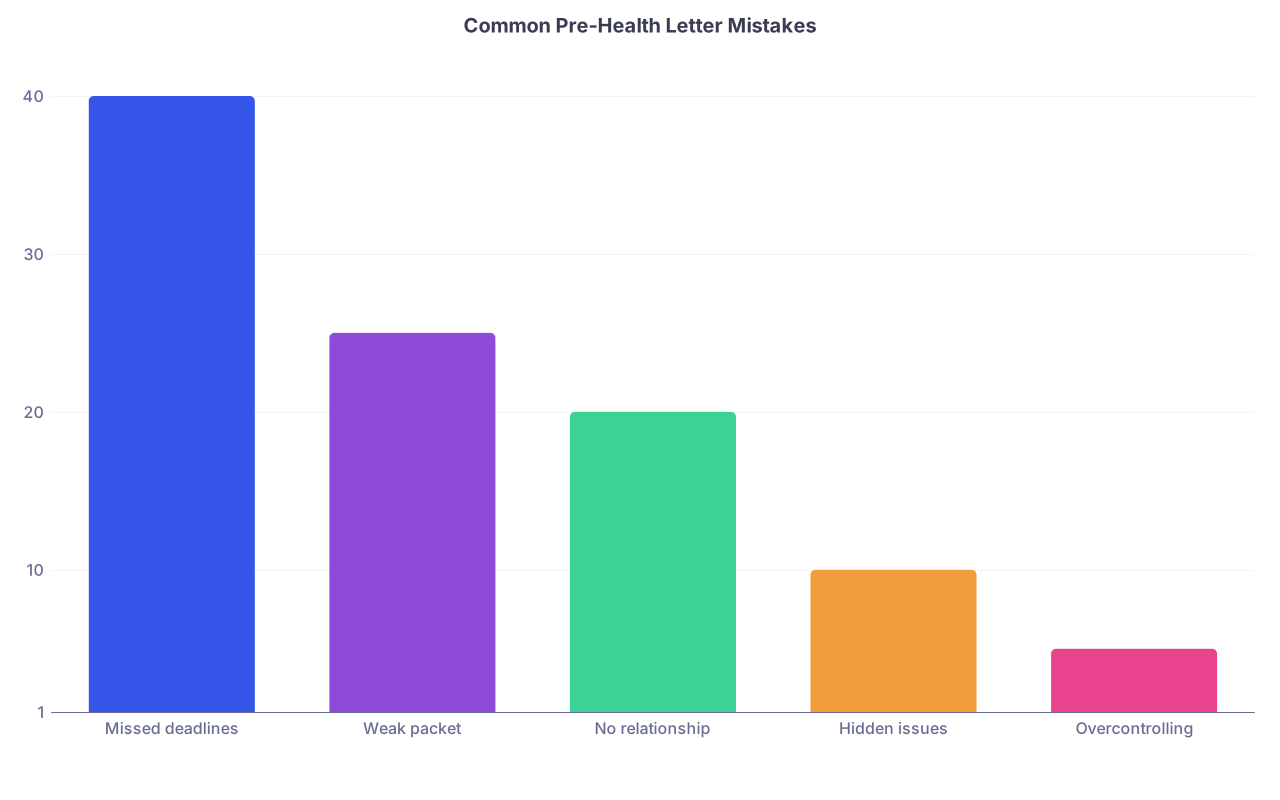
| Category | Value |
|---|---|
| Missed deadlines | 40 |
| Weak packet | 25 |
| No relationship | 20 |
| Hidden issues | 10 |
| Overcontrolling | 5 |
The exact percentages here are illustrative, but the pattern holds: timing and quality of what you provide do most of the damage. Not the office itself.
Don’t Forget: The Process Itself Sends a Message
How you move through the pre‑health letter process tells a story:
- Do you read instructions the first time?
- Do you own your mistakes?
- Can you handle long, slow bureaucratic processes without melting down?
- Are you respectful to staff, not just faculty?
These are not small things. Medicine is paperwork, hierarchy, waiting, and stress. Your behavior with the pre‑health office is an early simulation. They notice.
To see this more clearly, think of the letter process as a mini-clerkship:

| Step | Description |
|---|---|
| Step 1 | Learn Requirements Early |
| Step 2 | Meet Advisor |
| Step 3 | Submit Complete Packet |
| Step 4 | Address Weaknesses Honestly |
| Step 5 | Respect Deadlines & Staff |
| Step 6 | Receive Letter & Apply |
| Step 7 | Update & Thank Office |
Every step is a chance to either reassure them you belong in this profession—or remind them you are not ready.
Final Thoughts: Three Things to Remember
The pre‑health office is not a vending machine. It is a long-term witness to who you are as a student and as a future professional. Treat it that way.
Your packet, behavior, and timing decide whether they can advocate powerfully or are forced to write a safe, forgettable letter. Sloppiness and secrecy are what dilute them.
Alignment matters. Your story, your external letters, and the committee’s perspective must point in the same direction. If they do, you get a coherent, compelling file. If they do not, admissions committees will believe the people who have watched you for years—not the narrative you threw together in a few weeks.