
The worst reapplicant mistake is this: submitting the exact same letters and expecting a different result.
If you’re reapplying, your letters of recommendation have to tell a new story about a stronger applicant. Not a replay of last cycle. That means you need a structured, month‑by‑month plan for both new and updated letters—not last‑minute emails in August that start with, “Hi Dr. Smith, hope you’re well, I’m reapplying…”
Here’s the roadmap you should follow.
Big Picture: Your Reapplicant Letter Strategy
At this point you should be brutally honest about last cycle.
There are three questions that matter:
- Were your prior letters strong, specific, and recent?
- Are your experiences and stats meaningfully better this year?
- Do you have at least one new perspective on you (new supervisor, PI, physician, course instructor)?
If you can’t answer “yes” to at least two of those, you’re not ready to reapply. Fix that first.
Ideal reapplicant letter mix
By the time you submit your next primary, you want:
- 1–2 returning letter writers who can update and say “stronger this year because…”
- 1–2 new letter writers who’ve seen your growth since the last cycle
- Coverage of:
- Academic ability
- Clinical exposure
- Character / reliability
- (Optional but powerful) Research or long‑term service
| Letter Type | Count | Priority |
|---|---|---|
| Updated Academic | 1–2 | High |
| Updated Clinical | 1 | High |
| New Supervisor/PI | 1 | Medium |
| Long-term Service/EC | 0–1 | Medium |
You’re not collecting letters for a scrapbook. Each one needs a job.
Month‑by‑Month Roadmap (Assuming June Reapplication)
Let’s assume you’re planning to reapply in June of the upcoming cycle. I’ll walk you from August–September of the year before through post‑submission. Shift dates if needed, but keep the sequence.
August–September (Year Before Reapplying): Autopsy and Targets
At this point you should dissect last cycle and decide what your letters must fix or highlight.
Step 1: Analyze last cycle
- Pull up:
- Old school list
- Any feedback from advisors, committees, or schools (if you got any)
- Your AMCAS/AACOMAS and old personal statement
- Identify:
- Were you missing science faculty letters?
- Did you rely heavily on generic shadowing letters (“pleasant to work with”)?
- Did you have a committee letter that was lukewarm?
If you never saw your letters, assume at least one was mediocre. That’s reality.
Step 2: Choose your improvement arenas
By end of September, you should have decided:
- Which experiences to deepen this year:
- More clinical hours?
- More responsibility in your job or lab?
- Leadership role in a service org?
- Where potential new letter writers will come from:
- New upper‑level science course
- New job or promotion
- New volunteer or clinical supervisor
You’re not just reapplying. You’re rebuilding your narrative—and that starts now.

| Step | Description |
|---|---|
| Step 1 | Review Last Cycle |
| Step 2 | Plan new science courses |
| Step 3 | Increase clinical hours |
| Step 4 | Find new roles |
| Step 5 | Potential new prof letter |
| Step 6 | New clinical supervisor letter |
| Step 7 | New leadership or PI letter |
| Step 8 | Identify Gaps |
October–December: Position Yourself for Strong New Letters
At this point you should be earning future letters, not asking yet.
Academics
If you’re in school or post‑bacc:
- Choose rigorous, upper‑level science courses with:
- Smaller class sizes
- Discussion sections or labs where you can stand out
- By November, you should:
- Sit near the front
- Ask thoughtful (not performative) questions
- Go to office hours a few times and talk about:
- What you’re learning
- Your trajectory as a reapplicant
- How you’re improving since last cycle
You’re not brown‑nosing. You’re making it possible for them to actually know you.
Clinical and work settings
If you’re an MA, scribe, EMT, CNA, or volunteer:
- By December, aim to:
- Take on more responsibility or train new hires/volunteers
- Ask for feedback from supervisors
- Make sure at least one MD/DO, RN, PA, or clinical manager knows you by name and story
Clinical letters are often weak because the writer barely knows the applicant. Fix that now.
Research / Long‑term EC
If you’re in a lab or major project:
- By December:
- Present at least on a poster, lab meeting, or internal conference if possible
- Take ownership of a protocol, analysis, or sub‑project
- Meet with your PI to talk about your career goals and the reapplication plan
You’re building material they can reference later: concrete contributions, not “hard worker in the lab.”
January–February: Decide Who Writes and Start the Soft Ask
At this point you should lock in your target letter writer list.
Step 1: Draft your letter map
By end of January, write down:
- Returning writers (from last cycle) you might ask to update:
- Example: Orgo professor, lab PI, clinical supervisor
- New writers:
- New upper‑level science prof
- New job supervisor
- Physician who’s seen you clinically this year
Make sure you cover:
- At least 2 academic letters (ideally science)
- At least 1 clinical or patient‑facing letter
- Optional: 1 research or service letter if it adds a new dimension
Step 2: The “preview” conversation
February is when you start planting the seed.
For each potential writer, in person or via email:
“I’m planning to reapply to medical school this coming cycle. I’ve spent the last year improving [classes/clinical hours/research], and I’d really value your perspective on my growth. If, as we continue working together, you feel you can write a strong letter for me, I’d be grateful to ask closer to application time.”
You’re doing two things here:
- Giving them an easy out if they can’t be strong
- Starting the mental file in their head: “This student is reapplying and improving.”
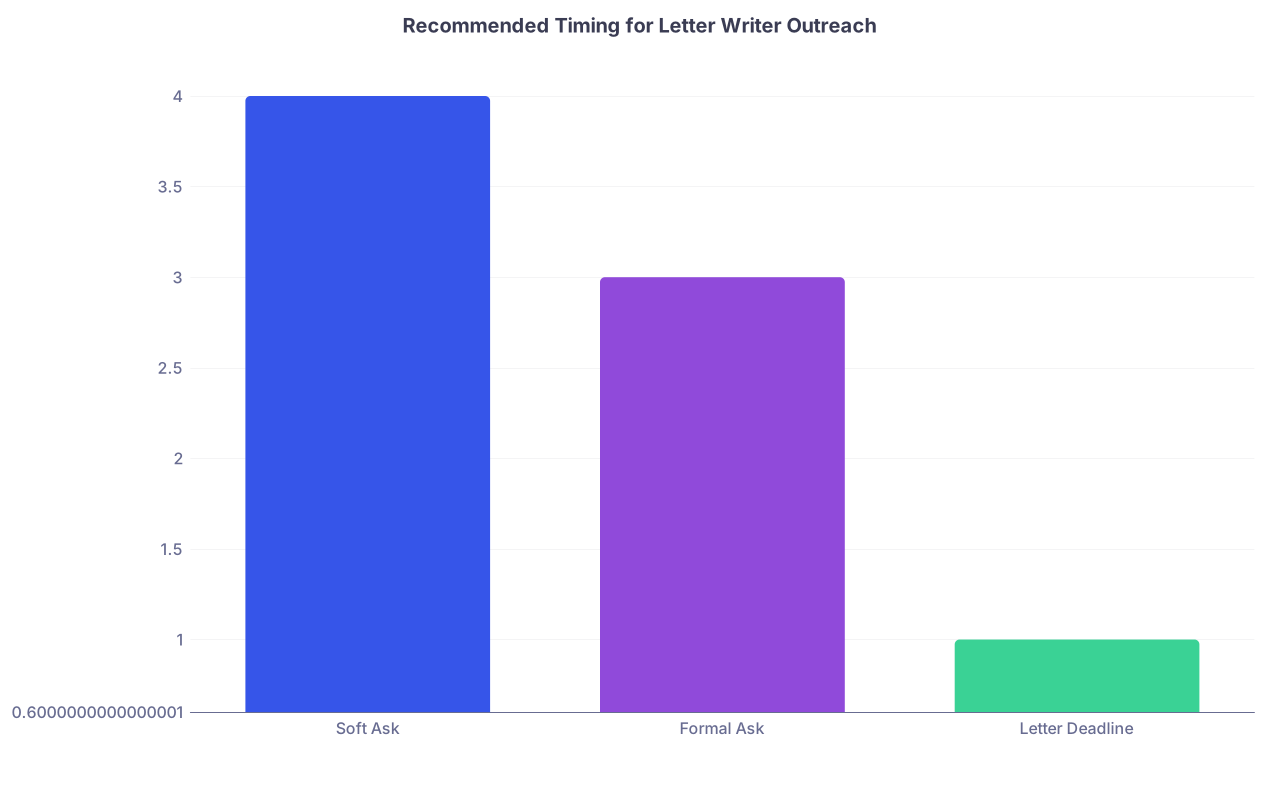
| Category | Value |
|---|---|
| Soft Ask | 4 |
| Formal Ask | 3 |
| Letter Deadline | 1 |
(Values here = months before primary submission.)
March: Formal Ask for Key Writers
At this point you should officially request letters from your most important writers.
How to decide who to ask in March
Ask now if:
- You’ve worked with them at least 3–4 months
- They’ve seen you in multiple contexts (class + office hours, clinic + staff meetings, etc.)
- They reacted positively to your earlier “preview” conversation
The actual ask (email template you can adapt)
Subject: Request for strong letter of recommendation for medical school reapplication
Body (short version):
Dear Dr. Lopez,
I’m reapplying to medical school this June and wanted to ask if you’d feel comfortable writing a strong letter of recommendation on my behalf.
Since last cycle, I’ve [brief bullet list of improvements: completed advanced physiology with an A, taken on lead scribe responsibilities, and increased my clinical hours from 300 to 800]. Your perspective on my academic growth and preparation for medical training would be especially meaningful.
If you’re able, I’d plan to submit primaries in June and would need your letter by late May. I’m happy to provide my updated CV, personal statement draft, and a brief summary of my work in your course.
Thank you for considering this,
[Name]
If they hesitate. Or say “sure, send me something and I’ll see what I can do.” That’s a yellow flag. Consider another writer.
April: Feed Them Material and Clarify “Updated” vs “New”
At this point you should be making their job easy.
For all letter writers (new and returning), give them:
By mid‑April, send each confirmed writer:
- Updated CV/resume
- Draft of your new personal statement (or at least your core narrative outline)
- Bullet list: “Key points you might highlight, based on what you’ve seen”
- Reminder of:
- How you’ve changed since last year
- What you’re hoping they can emphasize
Handling returning writers (who wrote last cycle)
You need to explicitly ask for an updated letter that shows growth.
What to say:
“Thank you again for your letter from last cycle. Since then, I’ve [specific growth]. If you’re willing to write an updated letter, it would help a lot if the new version could comment on these changes and how you’ve seen me develop over time.”
Do not let them just “reuse last year’s letter.” That kills your reapplicant story.
May: Deadlines, Reminders, and Damage Control
At this point you should be chasing, not starting letters.
Early May (3–4 weeks before primary submission)
- Send a polite reminder:
- Confirm application timeline
- Re‑include links or instructions for uploading to AMCAS/AACOMAS/Interfolio
- Offer to answer questions
- Check your portal or Interfolio to see:
- Who has actually submitted
- Who’s outstanding
Late May: Backup plans
If someone is non‑responsive or admits they can’t do it:
- Immediately pivot to:
- Another professor who knows you reasonably well
- Another supervisor who’s seen your growth
- It’s better to have a slightly newer but enthusiastic letter than a late, reluctant one.
June–July: Primary Submitted, Now What About Secondaries?
At this point you should have all core letters in or very close.
Keep writers in the loop
Once you submit primaries:
- Email your writers:
- Thank them again
- Let them know you’ve submitted
- Mention any key themes you emphasized in your personal statement and activity descriptions (so they’re aligned if they think of more to say later, e.g., for a school‑specific portal).
School‑specific letter quirks
Some schools:
- Limit number of letters (e.g., maximum 3–4)
- Allow optional additional letters
Strategy as a reapplicant:
- Prioritize:
- 1 updated academic
- 1 updated clinical
- 1 new writer showing this year’s growth
- Use optional letters only if:
- They add a truly different angle
- They aren’t generic (“hard worker, shows up on time”)
August–September: Interview Season Letters and Updates
At this point you should be reinforcing your story, not scrambling.
If you start a new role around now
You might:
- Start a new full‑time job
- Take on a major leadership or service role
Can you get a letter this late? Sometimes, but only if:
- You’ll have at least 3 months with them before they write
- They see you frequently and directly (not a distant manager)
More realistic: use them for update letters to schools rather than your core recommendation set.
Targeted updates to schools
Once you start getting interview invites (or if things are quiet by late fall):
- Ask a trusted supervisor/prof you’re currently working with to write:
- A short update letter you can send directly to schools that accept them
- Focused on: your ongoing improvement, new responsibilities, and continued commitment
October–March: Late Cycle and Next‑Cycle Insurance
At this point you should be playing two games at once:
- Maximizing your current reapplication
- Protecting yourself if you have to reapply again (hopefully not, but plan like you might)
If you’re getting interviews
- Update your writers:
- Tell them where you’re interviewing
- Thank them again—yes, again
- If a school specifically asks for an additional letter (some do post‑interview):
- Choose the writer who can best address any perceived gap:
- Professionalism
- Teamwork
- Handling stress
- Choose the writer who can best address any perceived gap:
If you’re not getting interviews
By November–December, if silence is the theme:
- Have a frank meeting with:
- A premed advisor
- A trusted faculty mentor
- Review:
- Whether your letters might still be weak
- Whether you need completely new voices next year (new post‑bacc, SMP, new job)
Do not wait until April again to face this. That’s how people become three‑time applicants.
Common Reapplicant Letter Pitfalls (And When They Happen)
You’re trying to avoid these landmines:

- February–March: Asking writers who barely know you “for a favor,” instead of systematically building relationships since fall.
- April: Failing to specify that you need an updated letter, so they recycle last year’s generic paragraph.
- May–June: Not checking whether letters actually arrive, then panicking when a school flags your file as incomplete.
- July–August: Throwing in random extra letters “just because I have them,” muddying your overall message.
Stay ahead of the calendar, and half your competition disappears.
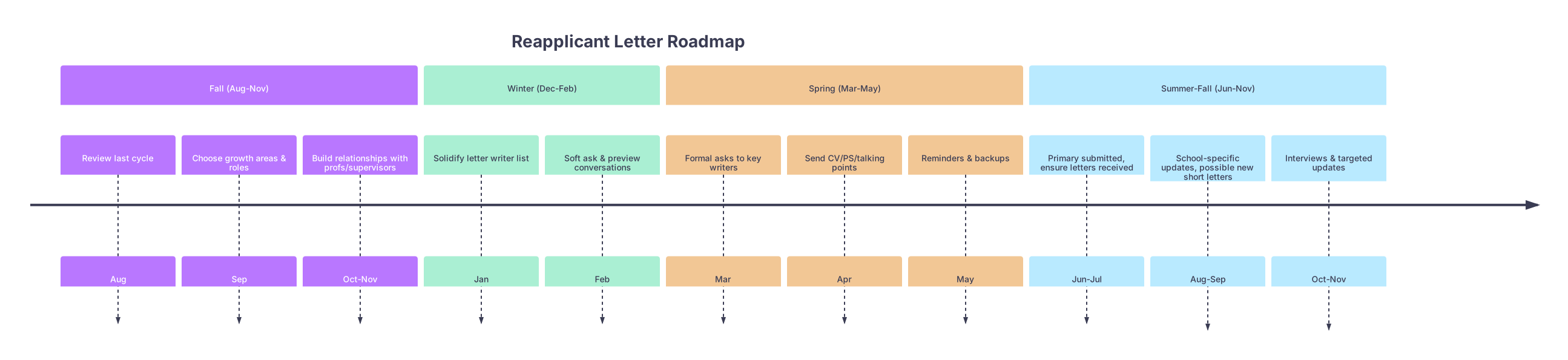
Sample Micro‑Timeline (Condensed)
If you want a pure timeline snapshot, here’s the skeleton.
| Period | Event |
|---|---|
| Fall (Aug-Nov) - Review last cycle | Aug |
| Fall (Aug-Nov) - Choose growth areas & roles | Sep |
| Fall (Aug-Nov) - Build relationships with profs/supervisors | Oct-Nov |
| Winter (Dec-Feb) - Solidify letter writer list | Jan |
| Winter (Dec-Feb) - Soft ask & preview conversations | Feb |
| Spring (Mar-May) - Formal asks to key writers | Mar |
| Spring (Mar-May) - Send CV/PS/talking points | Apr |
| Spring (Mar-May) - Reminders & backups | May |
| Summer-Fall (Jun-Nov) - Primary submitted, ensure letters received | Jun-Jul |
| Summer-Fall (Jun-Nov) - School-specific updates, possible new short letters | Aug-Sep |
| Summer-Fall (Jun-Nov) - Interviews & targeted updates | Oct-Nov |
FAQ (Exactly 2 Questions)
Q1: Should I reuse any of my old letters as a reapplicant, or start completely fresh?
If one of your previous letters was from someone who knows you well and genuinely believed in you—keep them, but updated, not copy‑pasted. An ideal scenario: a professor or PI who can now say, “I wrote for this applicant last cycle, and since then I’ve seen them take on X, grow in Y, and they’re a significantly stronger candidate.” That continuity actually helps. What you shouldn’t do is reuse shallow, generic letters from shadowing or one‑semester acquaintances. If you’re not sure a letter was strong, assume it wasn’t and replace it with someone newer who can speak in detail about the last 12–18 months.
Q2: How late is too late to ask for a new letter if I decide to reapply last‑minute?
If you “decide” to reapply in May for a June submission and have no recent contacts, you’re basically asking for weak letters. As a rule, you need at least 2–3 months of consistent interaction with someone before asking them to recommend you for medical school. Anything less usually produces a generic “they were pleasant” letter. If you’re in that last‑minute scenario anyway, prioritize people who: (1) see you often (daily/weekly), and (2) have supervised you in real responsibility. Then delay your reapplication by a cycle if you must. A late but well‑prepared reapplicant with strong letters will do better than a rushed one repeating the same mistakes.
Open a blank document right now and list your target reapplication month and 5 potential letter writers. Next to each name, write the month you’ll: (1) start deepening the relationship, and (2) make the formal ask. If those months are the same, you’re already behind—shift your behavior starting this week.