
It’s late May. You’re wedged into a windowless conference room with three “faculty mentors” who’ve been “following your progress” since freshman year. Someone just said the line that’s supposed to reassure you:
“We all know you so well. It makes more sense if we just write one committee letter together.”
You nod. You’ve been told this is a huge advantage. A whole committee vouching for you. What could go wrong?
A lot.
If you’re premed or early in med school and you’re leaning hard on group mentors, advising committees, or “we all know you” programs to carry your letters of recommendation, you are inches from one of the most common, quiet, damaging mistakes in this entire process.
Let me walk you through the landmines so you don’t step on them.
The Core Problem: Diffused Responsibility = Weak Letters
Group mentorship sounds great on paper. Multiple perspectives. A “holistic” view. Everyone “knows” you.
But here’s the trap: when everyone is responsible for your advocacy, no one actually is.
I’ve watched this play out over and over:
- A premed committee says, “We’ll coordinate your recommendation.”
- Three or four faculty each contribute a few vague lines.
- No one person feels truly accountable for going to bat for you.
- You end up with a bland, generic, “solid citizen” letter that quietly kills your application.
Med schools are not impressed by the sentence “We’ve all worked with this student.” They’re impressed by the sentence “I personally supervised this student for 18 months and here is exactly what they did.”
If your entire plan is “my group mentors will write my main letter,” you’re already behind.
Why “We All Know You” Is Often a Red Flag
That phrase sounds comforting. It often means the opposite of what you think.
What it often really means:
- “We know you casually from meetings and email, not from real work.”
- “We’ve seen your name enough to recognize it, but we could not describe a single concrete thing you did.”
- “We like you as a person, but have no basis to rate your clinical skills, research ability, or work ethic.”
Admissions committees can smell this a mile away. They read thousands of letters. They know when the writer actually knows you, versus when they’re covering for thin contact with collective language.
Look at these two kinds of letters:
| Type of Letter | Typical Phrase |
|---|---|
| Strong, individual | "I directly supervised her in my lab for 2 years, during which she led a project on X." |
| Weak, group-based | "As a committee, we have observed the applicant's growth and participation in the department." |
| Strong, individual | "He took ownership of Y task and stayed late repeatedly to finish it." |
| Weak, group-based | "We have all found her to be pleasant, motivated, and professional." |
| Strong, individual | "I would rank him in the top 5% of students I’ve worked with in 15 years." |
| Weak, group-based | "Collectively, we believe she will be a fine addition to your medical school." |
You do not want your main letters full of “we,” “as a committee,” and “we have all found.” That language screams: no one had enough direct interaction to stand alone.
The Hidden Structural Risks of Group Mentors and Committees
There are several structural problems baked into group-based mentorship setups that students underestimate.
1. Lowest-Common-Denominator Content
When three or four people have to agree on what to say about you, the content gets watered down.
I’ve seen this exact conversation in faculty meetings:
- Faculty A: “I’m comfortable calling her ‘top 5%’—she was outstanding in my seminar.”
- Faculty B: “Well, I can’t personally verify that. I only saw her twice a semester. Could we say ‘top third’ instead?”
- Faculty C: “Let’s just remove percentages. We don’t want to overstate.”
The result: your strongest advocate gets sanded down by people who barely know you.
In contrast, your individual PI who supervised you 20 hours a week can confidently say “top 5%” without asking anyone’s permission.
2. Mixed Impressions Get Smoothed, Not Solved
If one person had a mediocre impression of you during a group project three years ago, guess what happens when the committee letter is drafted?
You do not get a chance to have that addressed directly. You get vague, hedged language that “averages” the impressions:
“While there have been areas of growth, overall we have seen consistent improvement…”
That is code. Admissions people read that as: “Somebody on this committee had reservations and they compromised on this sentence.”
A single strong, independent letter from someone who knows your work can drown out one random mediocre impression. A committee trying to speak with “one voice” cannot.
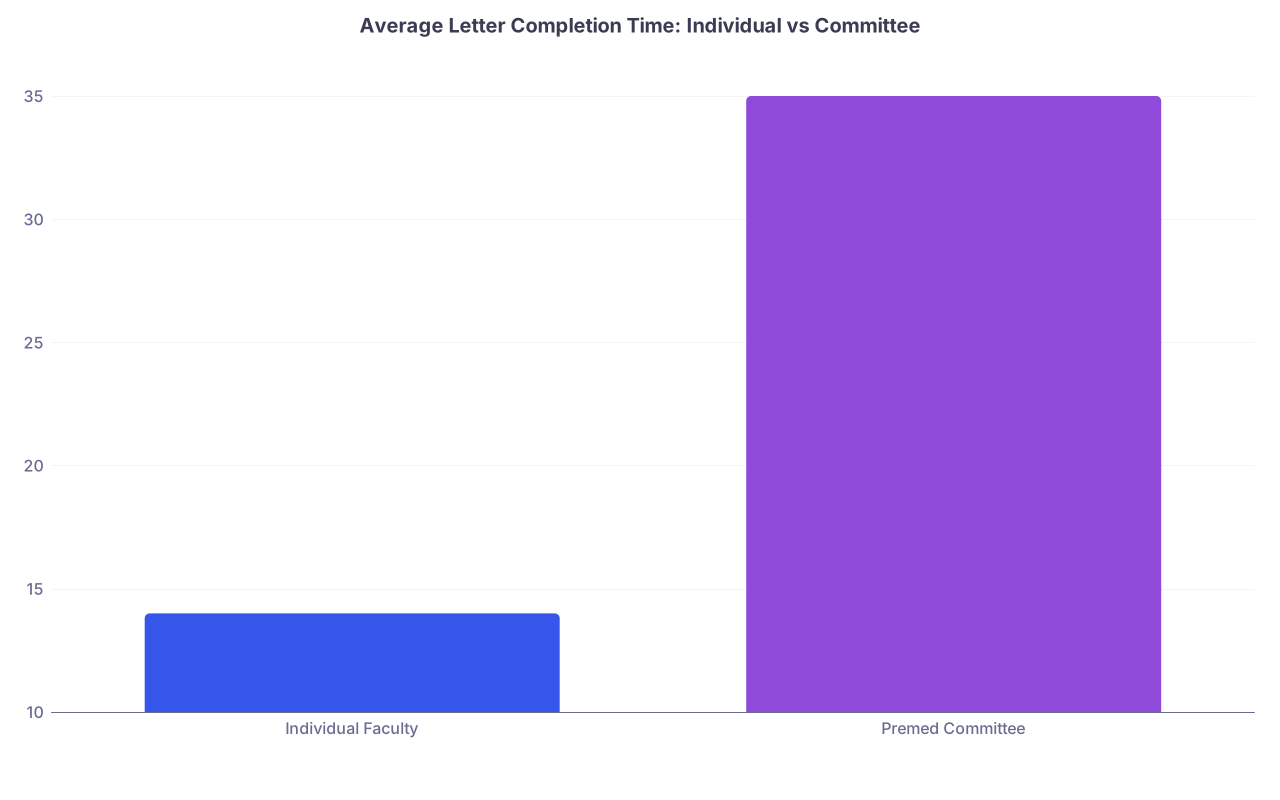
3. Calendar Risk and Timing Bottlenecks
Another thing students miss: group letters are logistically fragile.
One person gets sick. One person goes on sabbatical. One person doesn’t answer emails for weeks.
You get delayed.
| Category | Value |
|---|---|
| Individual Faculty | 14 |
| Premed Committee | 35 |
Those numbers are realistic. Individual faculty often turn letters around in 2–3 weeks when they know you well. Committees? I’ve seen them miss internal deadlines, ignore your panicked emails, and finally submit a generic letter right before your first school’s deadline—after your application sat incomplete for a month.
And no, the admissions office does not care that “the committee was behind this year.”
The Emotional Trap: Feeling “Seen” vs Being Strongly Advocated For
I get why you like your group mentors. The meetings feel supportive. They remember your MCAT date. They ask about your classes. They know your face.
That’s emotional knowing. Not evaluative knowing.
Admissions committees need the second kind.
Do not confuse:
- “They know I’m stressed and working hard”
with - “They’ve actually seen me perform in a demanding, graded, or high-stakes environment and can describe it.”
Your committee might be the best emotional support network on campus. That does not automatically make them your best letter writers.
The mistake: assuming that people who make you feel known are the same people who can write the most powerful, specific, credible letters.
They’re not always.
Concrete Ways Group Mentors Quietly Weaken Your Application
Let’s be very specific. Here’s how “we all know you” routinely backfires.
Vague Language that Screams “Generic”
Common phrases in weak committee-style letters:
- “We have watched her grow and mature over her college career.”
- “He has been involved in a range of activities on campus.”
- “She is well-liked by her peers and faculty alike.”
- “He has demonstrated a commitment to service and learning.”
None of this differentiates you from the 5,000 other applicants with similar phrases. It’s filler.
Strong letters use:
- Concrete episodes
- Measurable achievements
- Comparative statements (“top 10 of 500 students”)
- Direct supervision descriptions
Group mentors often can’t provide that, so they default to safe platitudes.
Over-Emphasis on “Holistic” View Instead of Actual Work
Committee mentors love to highlight that they’ve seen:
- Your personal challenges
- Your family background
- Your “journey”
This is fine in your personal statement. It’s much weaker as the core of a letter of recommendation unless it’s paired with serious, concrete, performance-based praise.
A letter that says “despite significant hardship, she persisted” but never talks about how well you actually did in demanding settings will get you sympathy, not an acceptance.
You want the letter that says: “Despite working 30 hours a week, he still ranked in the top 10% on my most challenging exam and was the only student to voluntarily stay after lab to help troubleshoot others’ experiments.”
That cannot be written by someone who’s only seen you in a quarterly check-in or group lunch.
When a Committee or Group Letter Is Useful — and When It’s Not
I’m not saying all committee letters are garbage. Some schools require them. Some are actually well done. But you need to understand their proper role.
Here’s the rule of thumb:
- Committee letter = supplemental, contextual overview
- Individual letters = evidence of performance and excellence
You get in trouble when you treat the committee letter as your main, or only, serious piece of advocacy.

Use a committee letter for:
- Providing institutional context (grading rigor, school policies, obstacles)
- Summarizing your broad engagement (clubs, leadership, research, service)
- Satisfying a school’s requirement that “a committee letter be submitted”
Use individual letters for:
- Your PI or research mentor (long-term, detailed work)
- A clinical supervisor who saw you with patients regularly
- A professor in a challenging upper-level class who can rank you against peers
- A physician who directly watched you interact with patients and staff
If a school allows both, the committee letter should not be the star of the show. It should be the wrapper. The evidence is in the individual letters.
Specific Mistakes to Avoid with Group Mentors
Let’s get very blunt. If you’re doing any of these, fix it now.
Mistake 1: Letting the Committee Be the Only People Who Really Know Your Plans
Too many students think, “I already have to meet with the committee; they’ll take care of the rest.” Then they:
- Skip deeper involvement in any single lab or clinic
- Spread themselves thin across 6–7 shallow activities
- Never build a relationship where someone sees them week after week
Then, when it’s time for letters, the only people who can say anything about them are… the committee. Who has never seen them do real work.
Your priority should be at least 2–3 anchor relationships where:
- You show up consistently
- You take on responsibility
- Someone notices when you’re not there
Because those are your future letter writers.
Mistake 2: Accepting “We’ll Just Do a Group Letter” Without Question
If your program tells you, “We’ll just submit a single committee letter for you,” your response should not be blind agreement. Your response should be questions:
- “Will I also be able to submit individual letters from research and clinical supervisors?”
- “Do medical schools see the individual comments, or only the compiled version?”
- “What’s your typical timeline for completing the committee letter?”
- “Can I see the letter or at least know the general structure and who is contributing?”
If they resist all of this, that’s a warning.

| Step | Description |
|---|---|
| Step 1 | Committee offers group letter |
| Step 2 | Use it as required letter |
| Step 3 | Optional: Treat as supplement |
| Step 4 | Secure strong individual letters |
| Step 5 | Lean heavily on non-committee mentors before apps |
| Step 6 | School requires committee letter? |
| Step 7 | Can you also add individual letters? |
Mistake 3: Letting the Nicest Person Be in Charge, Not the Person Who Knows You Best
In committee settings, the most organized, friendly, administrative-minded person often drafts the letter. That might not be the person who’s actually seen the best version of you.
I’ve seen letters clearly written by:
- The premed advisor who never taught or supervised the student
- The faculty member who coordinates schedules, not the one who ran the lab
- The “student success” person who knows every applicant by first name but has never graded anything
You want your most substantive mentor, not your warmest, to be your primary voice.
You can prevent this by:
- Directly asking: “Who will be drafting the initial version of my letter?”
- Following up with your strongest mentor: “Would you be comfortable writing a separate individual letter that highlights my work in your setting?”
How to Protect Yourself While Still Using Group Mentors
You don’t need to blow up your committee or avoid them completely. You just need to be strategic and a little less trusting.
Here’s your survival plan.
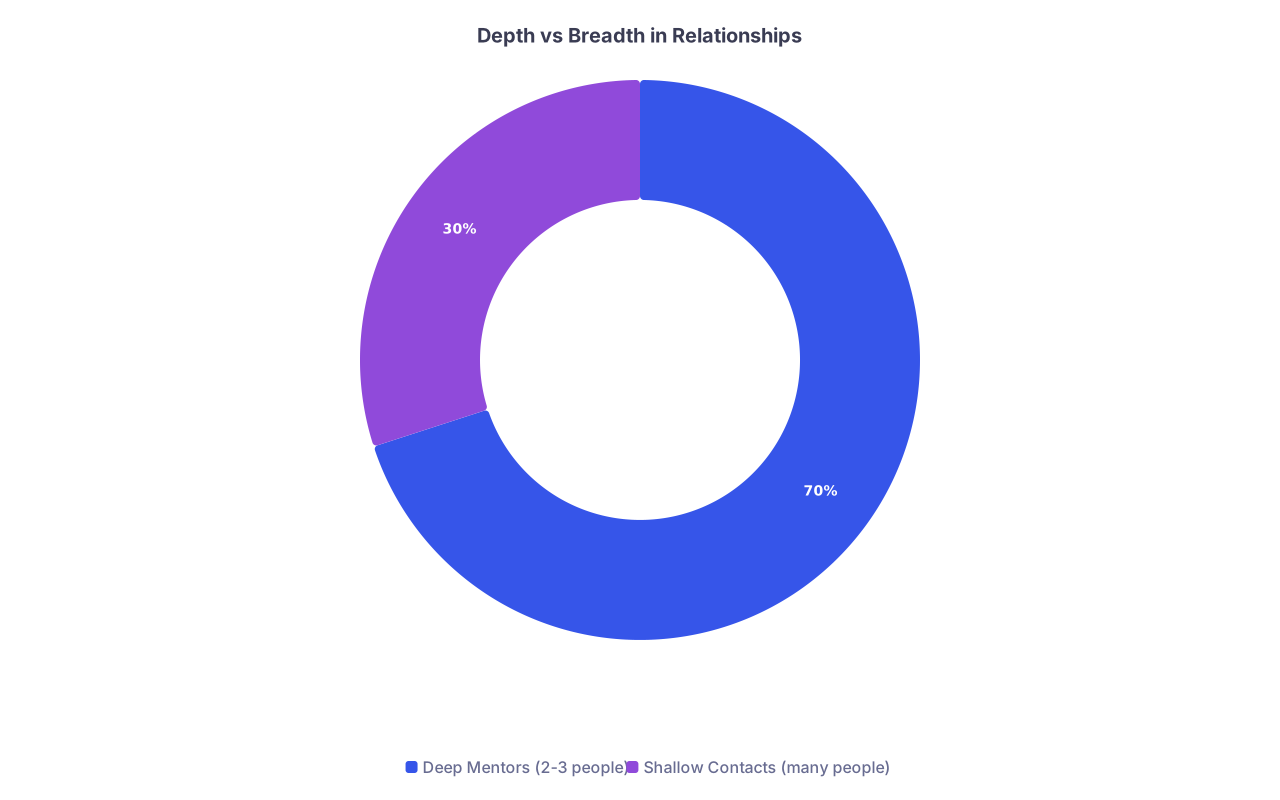
1. Prioritize Deep Work with 2–3 People Outside the Group
This is non-negotiable. I do not care how strong your committee program claims to be.
Identify 2–3 individuals who can eventually say:
- How long they’ve known you
- In what capacity
- What you actually did
- How you compared to others they’ve worked with
- One or two specific moments where you impressed them
That usually means:
- Staying in one research lab for more than a year
- Showing up consistently to one clinic, not five different ones for 10 hours each
- Taking multiple classes or projects with the same professor or supervisor
| Category | Value |
|---|---|
| Deep Mentors (2-3 people) | 70 |
| Shallow Contacts (many people) | 30 |
Be more afraid of having no deep mentors than of saying “no” to one extra shallow activity.
2. Ask Early What the Committee Letter Actually Looks Like
Do this by the end of sophomore year if possible.
Questions to ask:
- Is it standardized or customized?
- Do individual faculty write separate statements, or is it synthesized into one bland essay?
- Are students ranked, and if so, how?
- How do they handle situations where faculty disagree?
You’re not being annoying. You’re deciding how much weight to put on this letter in your application strategy.
If what you hear sounds like: “We mostly write a general narrative about your time here,” assume that letter will not be the strongest part of your file. Plan accordingly.
Red Flags You Should Not Ignore
Here are things I’ve seen that should make you immediately re-evaluate relying on your group mentors.
- They cannot name a single student who got into a top program and credits the committee letter as a clear strength.
- They say “we don’t have time to write highly detailed letters for each student.”
- Their internal deadline for letter info is weirdly late (e.g., August, after you should already be complete).
- They discourage you from asking other faculty or supervisors for individual letters.
- They insist they “know what med schools want” but cannot explain how their letters are received.
If you see two or more of these, treat the committee as a bureaucratic requirement, not a pillar of your application.

What Strong Use of Group Mentors Actually Looks Like
When this system works well, it looks like this:
- You meet with the committee for high-level planning and feedback.
- You use them to identify opportunities: specific labs, doctors, courses.
- You then build deep relationships in those settings that lead to individual letters.
- The committee letter ends up being a polished, contextual summary that sits on top of 3–4 powerful, detailed letters.
The mistake is flipping that order: using the committee as your primary voice and treating real mentors as optional extras.
Don’t do that to yourself.
FAQ (Read These Before You Hand Over Control)
1. My school requires a committee letter. Am I screwed?
No. You’re only in real danger if you let that required letter be your only strong source of advocacy. Many schools that require committee letters also allow additional individual letters. Use those. Build long-term relationships with a PI, a clinical supervisor, and at least one professor in a rigorous course. Let the committee handle context; let your real mentors handle praise.
2. Should I ever decline to let the committee write my letter if it’s optional?
If it’s optional and your committee has a reputation for generic, slow, or weak letters, then yes—consider skipping it. You’re better off with 3–5 excellent individual letters than padding your file with a lukewarm, redundant “overview.” If you’re unsure, quietly ask recent alumni how useful they thought the committee letter was.
3. What if I feel closer to my advisors than to my PI or professors?
That’s normal emotionally, but dangerous strategically. You may chat more openly with advisors, but med schools care more about people who’ve seen you handle responsibility, stress, and complex tasks. You don’t need to “feel” close to a PI for them to write a superb letter; you need to have done real work with them over time. Use your advisors for support and planning. Use your supervisors for letters.
4. How early should I start building relationships beyond the committee?
By the middle of sophomore year at the latest. Earlier if you can. You want at least 12–18 months of sustained work with at least one mentor before they write. If you’re already a junior or early senior, stop spreading yourself across five new activities. Double down on the 1–2 places where someone already knows you and ask for more responsibility there.
Open your list of “mentors” right now. Next to each name, write one sentence: exactly how they’ve seen you work and for how long. If you can’t fill that in with concrete detail for at least two people, your “we all know you” safety net is thinner than you think—and it’s time to fix that before your letters lock in.