

The biggest misunderstanding about geriatrics is simple: people think it is “just primary care for old people.” That misconception will wreck your expectations on training, pay, workload, and career satisfaction if you do not correct it early.
Geriatrics is its own animal. Different physiology, different priorities, different system pressures. And yes—different pay ceiling.
Let me walk you through what this specialty really looks like, from training path to compensation to the less obvious nuances that you only pick up from seeing how geriatricians actually live their careers.
1. What Geriatrics Actually Is (and Is Not)
Geriatrics is not “internal medicine plus age.” It is a subspecialty defined by complexity, not organ system.
You live in the world of:
- Frailty, falls, and functional decline
- Cognitive impairment and dementia
- Polypharmacy and deprescribing
- Goals of care, advance care planning, and code status conversations
- Multimorbidity where no guideline cleanly applies
On paper, geriatrics is a subspecialty of internal medicine or family medicine. In real life, it often functions as:
- The person of last resort when everyone else bails: “Cardiology, nephrology, ortho, neurology have all signed off. Can geriatrics see?”
- The referee when treatments conflict: “If we treat the heart aggressively, we break the kidneys and the brain. What is the least bad option for this specific 88‑year‑old?”
- The translator between medical reality and family expectations
You are not “fixing” things in the classic surgical or ICU sense. You are trading risks, optimizing function, and often saying, “No, we should not do that,” in a system culturally wired to do more.
That alone already shapes training and career trajectory.
2. Training Path: How You Actually Become a Geriatrician
The path is relatively standardized in the United States, but the flavor differs depending on whether you come from internal medicine or family medicine.
2.1 Standard U.S. Training Path
Medical School (4 years)
Nothing special required beyond normal graduation. You do not need a geriatrics-heavy CV to match geriatrics eventually (though it helps).Residency (3 years)
Two main feeder routes:- Internal Medicine (categorical IM, 3 years)
- Family Medicine (FM, 3 years)
Geriatrics fellowships accept both. Some hospitals lean heavily IM (academic centers), others are FM-heavy (community-based programs).
Geriatric Medicine Fellowship (1 year, usually)
- ACGME-accredited, often 1 year in the U.S.
- Some programs offer 2-year tracks if combined with research, palliative care, or clinician-educator training.
- You are eligible after board-eligibility/board-certification in IM or FM.
So you are usually 8 years post-college when fully trained: 4 med school + 3 residency + 1 fellowship (minimum).

| Step | Description |
|---|---|
| Step 1 | Medical School 4 yrs |
| Step 2 | IM Graduate |
| Step 3 | FM Graduate |
| Step 4 | Geriatrics Fellowship 1 yr |
| Step 5 | Board Certified Geriatrician |
| Step 6 | Residency Type |
2.2 Competitiveness: Matching and Fellowship Reality
Geriatrics is not competitive in the traditional sense. Programs struggle to fill spots.
This is not because geriatrics is unimportant; it is because:
- Pay is low relative to cognitive load and time spent
- Work is emotionally and logistically demanding
- There is minimal procedure revenue
- Lifestyle is decent but not “dermatology-level,” and the money is nowhere close
From the applicant standpoint:
- You do not need top decile board scores.
- A solid IM or FM record, decent letters, and clear interest in older adults will usually get you a fellowship spot.
- If you want academics at a big name (e.g., UCSF, Hopkins, Mount Sinai), strong evaluations, some research/QI, and teaching involvement help.
If you are the type of person chasing competitiveness itself as a badge, geriatrics will feel “too easy” to get into. That is the wrong lens. The fact it is not competitive is a systems failure, not a reflection of the complexity or value of the work.
3. What Geriatrics Training Actually Teaches You
Let me be specific. You will not just “see old people.” You are trained to manage a completely different decision framework.
3.1 Core Clinical Content
Common curriculum pillars:
Comprehensive Geriatric Assessment (CGA)
Structured evaluation of:- Physical function (ADLs, IADLs, gait, balance)
- Cognitive status (MMSE, MoCA, more nuanced tools)
- Mood, nutrition, social supports, caregiver burden
- Polypharmacy, sensory impairment, fall risk
Syndromes more than diseases
- Delirium vs dementia vs depression
- Failure to thrive, weight loss, incontinence
- Recurrent falls and syncope with normal heart and neuro workups
Polypharmacy and deprescribing
- Using Beers Criteria, STOPP/START, but more importantly: You learn that the “right” answer is often to stop 5–10 meds, not add more.
- Managing anticoagulation, dual antiplatelets, diabetes meds, and psych meds in 90‑year‑olds with declining kidneys and cognition.
Advanced care planning and goals of care
- You get comfortable with “We can do X, Y, or Z. Here is what they each mean for function, suffering, and survival.”
- Serious illness conversations, code status, POLST, transitions to hospice.
3.2 Practice Settings in Training
You will rotate broadly across:
- Outpatient geriatrics clinic (complex, multiple comorbidities, long visits)
- Nursing homes / skilled nursing facilities (SNFs)
- Home visits / house calls (in some programs)
- Inpatient consult service (delirium, falls, goals of care, complex discharges)
- Memory clinics (if linked with neurology/psychiatry)
- Palliative care (often cross-trained or at least strongly overlapping)
If you dislike ambiguity and gray zones, these rotations will feel frustrating. If you like nuance and trade-offs, you will thrive.
4. Compensation: Pay Floor, Pay Ceiling, and Why Geriatrics Is Low Paid
Let me be blunt. Compared to other subspecialties, geriatrics is a bottom-tier earner. And that is not because the work is simple or “easy.”
4.1 Typical Income Ranges
Broad U.S. ballpark numbers (these vary by region, employer, and practice structure, but the order of magnitude is consistent):
| Specialty Type | Typical Range (USD) |
|---|---|
| General Internal Med (PCP) | $220k–$280k |
| Geriatric Medicine | $200k–$260k |
| Hospitalist (IM) | $260k–$350k |
| Cardiology (non-interv) | $450k–$650k |
| GI / Pulm / Heme-Onc | $400k–$650k |
Many geriatricians sit around $210k–$250k in academic or large system jobs. Higher if:
- Heavy administration or leadership roles
- High-volume SNF work with productivity incentives
- Blended roles (hospitalist + geriatrics, or palliative + geriatrics)
There is a ceiling. You are almost never going to cross $300k in a purely clinical, pure geriatrics role unless you have a very aggressive SNF/ALF (assisted living facility) practice or you bolt on other roles.
4.2 Why the Pay Is Low
The payment system rewards procedures and volume. Geriatrics is the opposite:
- Longer visits (30–60 minutes)
- Intensive cognitive work, counseling, coordination
- Minimal procedures
- Patients who often cannot be “turned over” quickly due to complexity, mobility, or cognition
Imagine:
- A 25-minute cardiology new consult may involve an echo, stress test, future cath. Those tests and procedures drive huge chunks of revenue.
- A 60-minute geriatrics new consult: med reconciliation, family meeting, frailty assessment, goals of care. High value intellectually, minimal billable procedures.
RVU-based compensation punishes that structure.
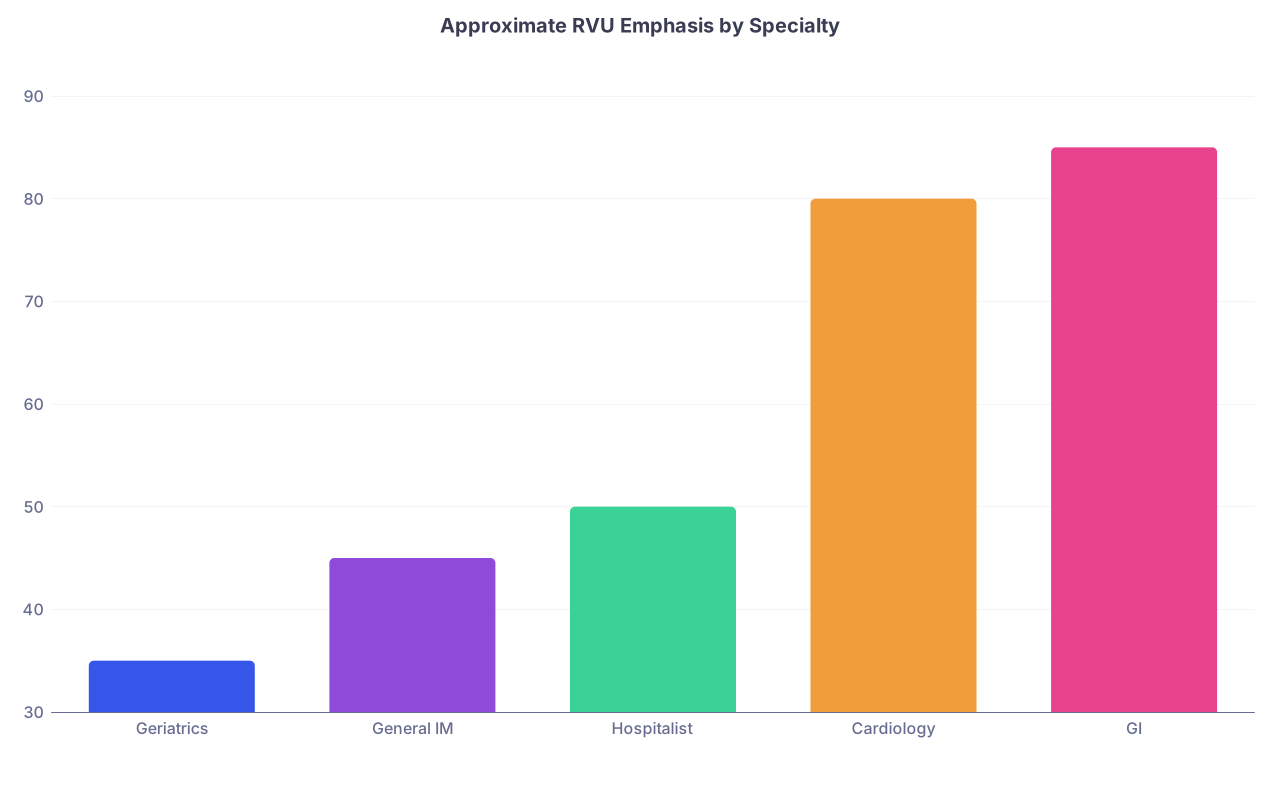
| Category | Value |
|---|---|
| Geriatrics | 35 |
| General IM | 45 |
| Hospitalist | 50 |
| Cardiology | 80 |
| GI | 85 |
You can see the pattern: the more procedure-driven the specialty, the higher the typical compensation. Geriatrics is at the cognitive-care extreme.
4.3 Academic vs Community vs SNF-Focused Pay
Academic centers
- Lower pay, often $190k–$240k for early faculty.
- Upside: protected time, teaching, research, less volume pressure.
- Downside: compensation lag and bureaucracy.
Health-system employed outpatient geriatrics
- ~ $210k–$260k.
- Benefits often good, but productivity expectations vary.
SNF / Post-acute heavy practice
- Sometimes higher total comp ($250k–$320k) if you:
- Cover multiple facilities
- Accept high census
- Bill transitional care, chronic care management codes, etc.
- But: travel between facilities, heavy paperwork, family calls, nursing staff demands, survey pressure. Emotional burnout is a very real risk.
- Sometimes higher total comp ($250k–$320k) if you:
5. Day-to-Day Work: What Your Job Actually Looks Like
This is where many physicians misjudge geriatrics. They hear “clinic-based, older patients” and think “easy lifestyle primary care”. That is naive.
5.1 Core Practice Models
Outpatient Geriatric Clinic
- 8–12 patients per day if visits are long and complex.
- Mix of new consults (falls, cognitive issues, polypharmacy) and follow-ups.
- Lots of coordination: PT, OT, social work, home health, DME, caregiver support.
SNF / Nursing Home Rounds
- You cover a census of 40–150 residents depending on time allocation.
- You are on-site several times per week, plus calls and paperwork.
- Heavy interaction with nursing staff, families, and administrators.
Inpatient Geriatric Consult Service
- Consults for delirium, falls, frailty, complicated discharges, code status confusion.
- You are the “sanity check” for multi-morbid older adults receiving maximalist interventions.
Home-Based Primary Care / House Calls
- Growing niche, especially in large systems and VA.
- Lower daily volume (travel time) but incredibly high relational depth.
- Often strong patient and family satisfaction—if you like going into patients’ environments, this is rewarding.
Many geriatricians mix these. Example: three clinic days, one SNF day, one inpatient consult day.
5.2 A Realistic Clinic Day Scenario
You walk in and here is your schedule:
- 9:00 – New patient, 82‑year‑old, 15 meds, 3 hospitalizations in 6 months, frequent falls, daughter convinced “something is wrong with her memory”
- 10:00 – Follow-up on 88‑year‑old with advanced dementia, previously aggressive in facility, now sedated on three psych meds—staff wants more meds, family wants fewer
- 11:00 – Goals of care visit after a new cancer diagnosis in a 90‑year‑old with severe heart failure
- 1:00 – Telehealth check-in with son calling from another state, worried SNF is “not doing enough” for his father
- 2:00 – Post-discharge visit: discussion of whether to restart anticoagulation after a major GI bleed in an 87‑year‑old who already fell twice this year
- 3:00 – Family meeting for a 79‑year‑old with Lewy body dementia and hallucinations; conflict between siblings about whether to move to memory care
None of that bills like a cath. Yet every single one is ethically and cognitively demanding.
6. Career Nuances You Only Notice Up Close
This is where things get interesting. The stuff you will not see on program brochures.
6.1 Emotional Load and Moral Distress
Geriatrics is emotionally heavy in a very particular way:
- You constantly manage decline—physical, cognitive, social.
- You routinely see older adults pulled through brutal interventions that do not match their values.
- Families are often in denial, fractured, or burned out.
You will experience moral distress:
- When the system incentivizes sending a frail 92‑year‑old with end-stage dementia back to the hospital for “potentially reversible” pneumonia because the SNF fears liability.
- When families insist on full code for a bed-bound, non-communicative patient with terminal cancer and end-stage heart failure—because “we are not ready to give up.”
If you cannot handle repeated, nuanced conversations about suffering, meaning, and limits of medicine, geriatrics will grind you down.
6.2 Interdisciplinary Teamwork
This is not a solo hero specialty. Your best days depends on:
- Strong social work
- Dedicated nursing
- Physical and occupational therapy
- Pharmacy support
- Often palliative care, psychiatry, neurology, surgery, and primary care partners
The geriatrician often acts as the integrator:
- “No, the 80‑year‑old who fractured her hip and has moderate dementia should not go straight home with no services because her son ‘works from home.’ He is on Zoom all day and not trained to do transfers.”
Good teams make the job doable. Weak teams push impossible work onto you.
6.3 Academic and Policy Leverage
This is where savvy geriatricians quietly punch above their weight.
Common leverage points:
- Hospital committees on falls, delirium prevention, high-risk readmissions
- System redesign for care transitions, post-discharge follow-up, SNF partnerships
- Value-based care models (ACOs, bundled payments) that reward reduced hospitalizations and ED visits
If you pair geriatrics with health services research, quality improvement, or leadership, you can end up shaping system policy. And that carries both job security and influence that is not captured by salary alone.
6.4 Burnout Patterns
You will not be sprinting through 30 patients a day like some PCPs. But burnout still happens:
- Chronic moral distress about futile care
- Administrative overload (forms, documentation, SNF regulations)
- Emotional exhaustion from constant family conflict mediation
People who last in geriatrics long term usually do one or more of these:
- Shift part of their time into teaching or administration
- Develop a niche (memory clinic, falls clinic, VA home-based care, frailty consults for surgery)
- Work in systems that value longer visits and team-based care rather than pure RVU grind
7. Strategic Ways to Use Geriatrics Training
If you are worried about the “low pay” label—and you should at least be aware of it—there are ways to shape your career intelligently.
7.1 Combine Geriatrics with Hospital Medicine
A common and sensible blend:
- Half or part-time hospitalist work (higher pay)
- Half geriatrics consults / outpatient clinic
Upsides:
- More income than pure geriatrics
- Marketability: hospitals like a hospitalist who understands frailty and discharge planning for complex elders
- Job flexibility across institutions
Downside: You may be effectively doing two jobs.
7.2 Pair Geriatrics with Palliative Care
Highly synergistic:
- Training overlaps in communication, goals of care, prognostication.
- Many programs offer combined fellowships or sequential 1+1 years.
Benefits:
- Broader clinical footprint: inpatient palliative consults, outpatient symptom management, hospice medical director roles.
- Slightly higher average pay, especially if you take on leadership roles in palliative/hospice programs.
7.3 Leadership, QI, and System Design
Geriatricians who lean into leadership can carve out roles:
- Director of Geriatric Services
- Chief of Post-Acute Care
- Medical Director for ACO / Value-based Care programs
- Medical Director for SNFs, assisted living, or nursing home chains
These roles can bump income and influence. You will spend more time in meetings and less time in clinic, but you will actually change how older adults are treated at scale.
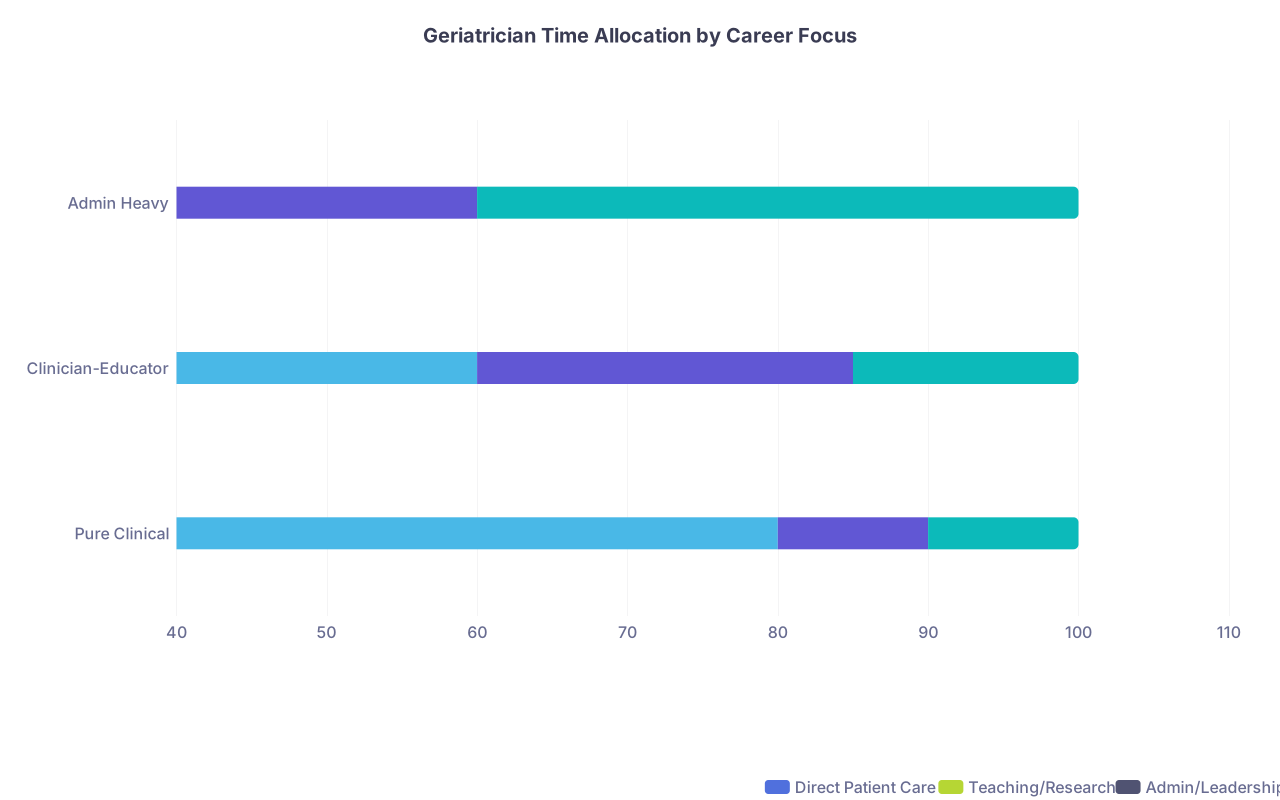
| Category | Direct Patient Care | Teaching/Research | Admin/Leadership |
|---|---|---|---|
| Pure Clinical | 80 | 10 | 10 |
| Clinician-Educator | 60 | 25 | 15 |
| Admin Heavy | 40 | 20 | 40 |
7.4 VA and Government Systems
VA geriatrics is its own universe:
- Robust home-based primary care programs
- Interdisciplinary teams that often function better than in many private systems
- Federal benefits, pensions, and more predictable schedules
The salary may not be dazzling, but job stability and retirement structure can make lifetime financial outcomes more favorable than they look on a simple annual-comp chart.
8. Who Actually Thrives in Geriatrics (and Who Should Stay Away)
You will do well in geriatrics if:
- Ambiguity and gray zones do not scare you; they interest you.
- You derive satisfaction from improving function, comfort, and dignity—not just survival curves.
- You are willing to have hard conversations again and again.
- You enjoy interdisciplinary work and can manage competing viewpoints.
- You care more about meaning and alignment of care with values than about cutting-edge procedures.
You will be miserable in geriatrics if:
- You need rapid, visible “fixes” to feel accomplished.
- You are deeply averse to recurrent conversations about death, decline, and limitations.
- You want high six-figure income and are unwilling to trade money for mission.
- You get easily frustrated by family dynamics and slow decision-making.
9. Bottom Line on Geriatrics: Training, Pay, and Long-Game Realities
Let me be clear:
- Training is relatively straightforward structurally (IM or FM → 1 year geri fellowship) but cognitively demanding.
- Pay is objectively low compared with other subspecialties and even some generalist roles. You are not missing some secret; this is how the system is currently built.
- The work is incredibly high-yield for patients and systems, but that value is not translated into compensation under current RVU/procedure-centered models.
If you choose geriatrics, do it with eyes open:
- Plan how you will balance meaning, emotional load, and financial reality.
- Think strategically about blended roles—hospitalist, palliative, leadership, VA.
- Accept that your professional currency will be impact and influence more than raw salary.
FAQs
1. Is geriatrics fellowship “worth it” financially compared to just doing hospitalist or primary care?
Purely on short-term dollars, no. One extra year of training plus a lower long-term salary compared with a typical hospitalist is a financial negative. Where it can become “worth it” is if you leverage geriatrics into leadership, palliative care, VA roles, or system redesign jobs that expand your influence and sometimes your compensation. If your primary goal is maximum income, hospitalist or certain subspecialties will beat geriatrics nearly every time.
2. Do I need strong research experience to match a geriatrics fellowship?
For most programs, no. Geriatrics fellowships are not hyper-competitive; solid clinical performance, good letters, and clear interest in older adults are enough. For top academic centers where you want a research-heavy career, some scholarly work—QIs, retrospective charts, or small studies—will help. But you are not playing at the same “must have 5+ publications” level as, say, cardiology or GI applicants.
3. Can I do geriatrics without a fellowship if I am a PCP who likes older adults?
You can absolutely see large numbers of older adults as a general internist or family physician. Many do. But fellowship gives you deeper training in geriatrics syndromes, interdisciplinary care, post-acute care, and complex decision-making. You also gain credibility for certain leadership roles (e.g., Director of Geriatric Services, memory clinic lead) and for academic positions focused on aging.
4. How does geriatrics compare to palliative care in terms of lifestyle and pay?
They are cousins. Both focus on complex, high-stakes conversations and symptom management. Palliative care often has:
- Slightly higher average compensation
- More inpatient consult work (depends on job)
- Strong overlap around goals of care and end-of-life issues
Geriatrics has broader scope across the whole aging spectrum—functional status, falls, cognition, frailty—not just serious illness and end of life. Many people do both and split their time, which can be a very coherent career.
5. Is there any way to make $300k+ as a geriatrician?
It is possible but not typical. Paths that sometimes reach that level:
- High-volume SNF/post-acute practices with multiple facilities
- Blended roles where you are, for example, a hospitalist 50–60% and geriatrician the rest
- Senior leadership positions (system-level director roles) that come with higher administrative pay
You will not see $500k geriatrics jobs. If that is your absolute non-negotiable, you are in the wrong neighborhood.
6. Will AI and tech reduce the need for geriatricians in the future?
Unlikely. Templates, predictive models, and decision aids may help with medication reconciliation, risk scoring, and flagging problems. They do not replace nuanced value-laden conversations about trade-offs in frail, cognitively impaired, socially complex older adults with family conflict. If anything, as the population ages and multimorbidity grows, the need for physicians who can integrate all of that human context will increase. The bottleneck is not data; it is judgment and communication. That is geriatrics’ core territory.
Key takeaways:
- Geriatrics offers high intellectual and ethical complexity with structurally low pay—do not pretend otherwise.
- The training path is straightforward but the real “work” is in managing ambiguity, family dynamics, and system failures.
- The smartest geriatrics careers are hybrid: pairing clinical work with leadership, palliative care, hospital medicine, or VA roles to balance meaning, impact, and financial reality.


