

The myth that “palliative care is just talking and holding hands” is not only wrong, it is dangerously ignorant.
If you are seriously considering palliative care as a career, you need a clear-eyed view: the workflow, the emotional cost, and the salary reality. No romance, no doom. Just how the job actually looks week to week when you are the one being called to the bedside at 4:30 p.m. for a “quick goals-of-care” that is anything but quick.
Let me break this down specifically.
1. What Palliative Care Actually Is (And Is Not)
Palliative care is not “hospice only,” and it is not “giving up.”
Think of it as three overlapping practice arenas:
Inpatient palliative consult service
Acute care hospitals, big academic centers, community hospitals. You are the team people call when patients are:- Symptom-disaster: pain, dyspnea, delirium, nausea that the primary team cannot control
- Decision gridlock: family conflict, unrealistic expectations, no clarity on goals
- Transition questions: “Is it time for hospice? Can they go home with support?”
Outpatient palliative clinic
Advanced cancer, end-stage organ failure (CHF, COPD, cirrhosis), neurodegenerative disease. These are people who still see their oncologist, cardiologist, pulmonologist. You follow them longitudinally for:- Complex symptom management
- Advance care planning
- Support around big treatment decisions (clinical trials vs comfort, LVAD vs no LVAD, etc.)
Hospice medical direction & home visits (varies by job)
Some palliative docs serve as hospice medical directors, do home or SNF visits, or supervise nurse practitioners who do. Others stay hospital-based and touch hospice mostly through referrals and IDG meetings.
You can practice palliative care via several training paths:
- Internal medicine → hospice and palliative medicine (HPM) fellowship
- Family medicine → HPM fellowship
- Pediatrics → HPM fellowship
- Neurology, EM, anesthesia, psych → HPM fellowship (less common, but real)
You are not “just a consultant who talks.” You are a symptom specialist, a communication specialist, and frankly, the only person in many rooms who seems willing to say out loud that the cancer is not responding, the vent is not a bridge to recovery, and the patient is dying.
That has consequences. On your schedule. On your psyche. And yes, on your paycheck.
2. Daily Workflow: Inpatient vs Outpatient vs Hospice
The workflow in palliative care changes dramatically by setting. Let us separate them cleanly.
A. Inpatient Palliative Care – What Your Days Actually Look Like
Hospital-based palliative is the backbone of many HPM careers.
A typical week (academic or large community hospital):
Schedule:
- 5 days a week, usually 8 a.m. – 5 or 6 p.m. on paper
- Realistically, a lot of notes spill past 6 p.m.
- Call: often phone-only, one week out of every 3–6, but this varies
Morning (8–11 a.m.):
- Brief huddle: review new consults, follow-ups, discharges
- Triage consults:
- High priority: uncontrolled pain, agitation, ventilated patient with family conflict, “comfort care” transition
- Lower priority: POLST updates, more routine advance care planning
- Start with the worst train wreck: ICU family meeting, for example
Midday (11 a.m. – 2 p.m.):
- Long family meetings:
- You, maybe an NP, the primary team, bedside nurse, sometimes chaplain or social worker
- 45–90 minutes is not unusual
- Bedside symptom assessments:
- Adjust opioids, sedatives, antiemetics, bowel regimens
- Work through complicated pain (renal failure, high opioid requirements, delirium risk)
- Long family meetings:
Afternoon (2–5:30 p.m.):
- More consults, follow-ups
- Documentation:
- Your notes are long. Complex decision-making, goals-of-care summaries.
- Phone calls:
- Update an out-of-town daughter
- Debrief with ICU attending who disagrees with the outcome of a meeting
End of day (the part nobody advertises):
- The “quick” consult at 4:30 p.m.:
- Intubated septic shock patient on three pressors
- Family has “never heard that they might die” despite a 3-month ICU stay
- You are supposed to fix this in 30 minutes before sign-out
- The “quick” consult at 4:30 p.m.:
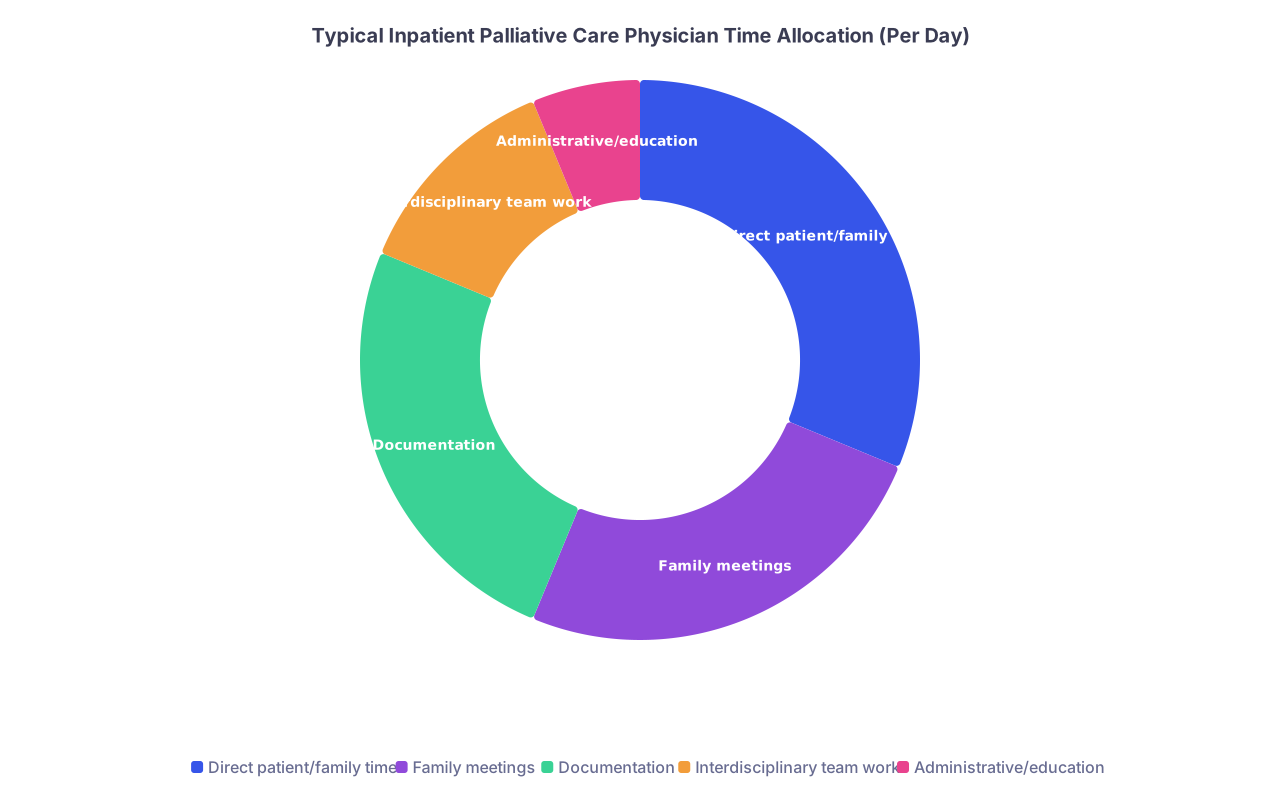
| Category | Value |
|---|---|
| Direct patient/family time | 150 |
| Family meetings | 120 |
| Documentation | 120 |
| Interdisciplinary team work | 60 |
| Administrative/education | 30 |
Notice what is missing: procedures, OR time, “quick” 15-minute follow-ups. Your day is cognitively and emotionally dense, not task-dense.
B. Outpatient Palliative Clinic – Slower Pace, Different Load
Outpatient palliative is where people often go to preserve some balance and continuity.
Typical structure:
Clinic days:
- 8–10 patients per full day (sometimes fewer)
- 40–60 minute new visits, 30-minute follow-ups
- Mixed: in-person, telehealth, maybe a few home visits depending on the practice
Patients:
- Metastatic cancer on second-line chemo
- Severe COPD with repeated hospitalizations, now on home O2
- ALS patient with progressive weakness and PEG discussion looming
- End-stage CHF with recurrent decompensations
What you do in each visit:
- Pain and symptom adjustments
- Elicit values, hopes, fears
- Frame next decisions: “Chemo vs no chemo,” “Intubation vs DNR,” “Hospital if worse vs treatment at home”
You work inside a system of other specialists. You are constantly translating:
- Oncologist: “There is still treatment we can try.”
- Patient hears: “There is still a chance I beat this.”
- You: “Given what we know about this treatment and where your body is today, let us talk about what ‘helpful’ actually looks like.”
It is slower paced than inpatient, usually more predictable hours, fewer crises—but emotionally not lighter. You watch people decline over time. You see how decisions play out.
C. Hospice Role – Medical Director and Home-Based Care
Hospice-heavy jobs vary a lot, but the core structure:
Medical director work:
- IDG (interdisciplinary group) meetings weekly or biweekly
- Signing certifications and recertifications
- Reviewing complex symptom plans
- Supporting NP/RN staff
Home visits / SNF visits:
- Either you or NPs travel to see patients
- Assessment, symptom titration, psychosocial support
This can be:
- Very flexible, often family-friendly schedule
- High burnout if the program is understaffed or poorly managed
- More “hands-off” in terms of daily minute-to-minute crises, but you own the responsibility if care quality is poor or regulations are ignored
3. Emotional Load: Where It Hits You And How
Let us be blunt: if you are emotionally avoidant, you will not last in palliative care.
But the stereotype that “palliative care is emotionally crushing” is half-true at best. The emotional load is specific. It is not just “sad.”
A. Recurrent Themes You Will Live Inside
You will hear, several times a week:
- “We are fighters. We are not ready to give up.”
- “No one ever told us the cancer was this bad.”
- “She would not want to live like this, but I cannot be the one to say stop.”
- “Is there really nothing else you can do?”
You sit with:
- Grief that is raw and unprocessed
- Families fighting each other at the bedside
- Moral distress of nurses who have been caring for a dying patient through yet another “full code”
You are the one who has to:
- Put the medical reality in plain language
- Validate hope without lying
- Acknowledge when continuing aggressive treatment is more about the family’s readiness than the patient’s benefit
B. Moral Distress and “Futile” Care
The hardest part for many palliative clinicians is not the dying itself. It is watching prolonged, aggressive, often non-beneficial treatment.
Scenarios you will know intimately:
- 36-year-old with widely metastatic cancer, ventilated, vasopressors, dialysis. Code status: Full. No realistic path to discharge.
- Advanced dementia patient with recurrent sepsis, PEG tube, non-verbal, bedbound. Repeated ICU admissions at family insistence.
You are called in late:
- “Family is unrealistic.”
- “Please help them understand the prognosis.”
You inherit years of poorly framed conversations. Or no conversations. And you get one family meeting to fix it.
This produces:
- Moral distress: You know what medically makes sense, but you cannot impose it
- Anger, quietly, at systems that incentivize volume over clarity
- Resentment when colleagues dodge difficult conversations and drop them on you
C. Vicarious Trauma vs Meaning
Here is the paradox: palliative clinicians, when appropriately supported, often have higher professional meaning scores than many higher-paid procedural specialties.
Why?
- You see the immediate impact of your work: suffering eased that same day
- Families write you letters. Years later.
- You watch good deaths, not just bad ones
But if your team is small, your hospital does not understand boundaries, and you become the “dumping ground” for every conflict and every unfixable situation? That is where burnout spikes.
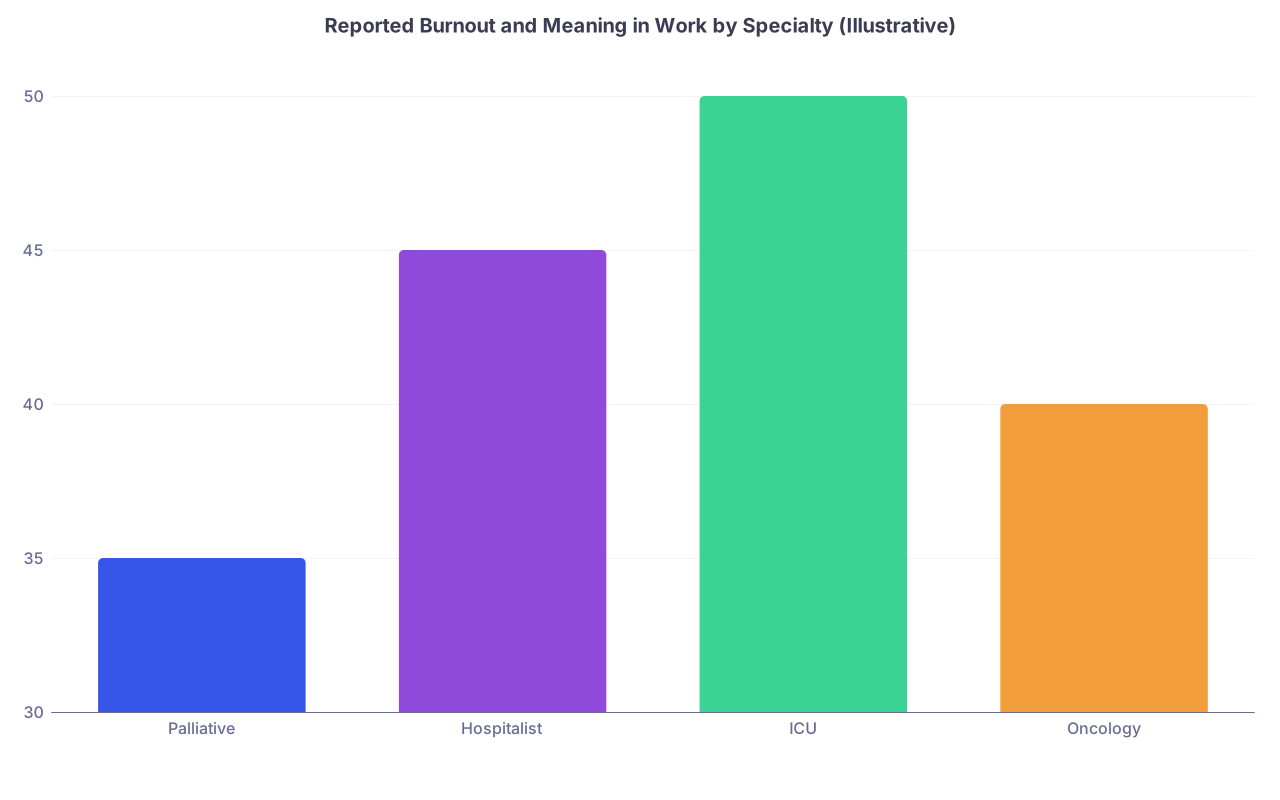
| Category | Value |
|---|---|
| Palliative | 35 |
| Hospitalist | 45 |
| ICU | 50 |
| Oncology | 40 |
(Think of these numbers as “burnout percentage”; palliative tends to be mid-range—high risk, but not automatically the worst.)
D. How Palliative Clinicians Actually Cope
The ones who last 10+ years almost always:
- Work in teams: chaplain, social worker, NP, RN, not solo
- Have some structural boundaries:
- No routine 2 a.m. family meetings
- Clear handoffs, limits on daily consult load
- Do their own processing:
- Debrief after the traumatic cases
- Therapy or peer support, not just “I am fine”
If your temperament needs emotional distance and you hate being in messy family systems: palliative will grind you down. If you derive meaning from being the one who can “step into the room when everyone else steps back,” the emotional difficulty is real but not purely destructive.
4. Salary Reality: Where Palliative Care Actually Lands
Now the part everyone whispers about: money.
Palliative care sits firmly in the lowest paid specialties cluster, especially compared with procedure-heavy or diagnostic fields.
Let us anchor this with realistic, broad figures (US, full-time, 2024-ish ballpark; geographic and institutional variation is huge):
| Role / Specialty | Typical Annual Compensation (USD) |
|---|---|
| Academic inpatient palliative (MD) | $190,000 – $230,000 |
| Community hospital palliative (MD) | $220,000 – $260,000 |
| Outpatient clinic-focused palliative (MD) | $200,000 – $250,000 |
| Mixed palliative + hospice director (MD) | $220,000 – $280,000 |
| General IM hospitalist | $260,000 – $320,000 |
| Hem/Onc | $400,000 – $600,000+ |
Even if you hit the upper end (large system, leadership roles, some administrative stipend), you are still significantly below:
- Cardiology, GI, pulmonary/critical care, anesthesiology, EM, radiology, ortho, etc.
You are often closer to:
- General internal medicine hospitalist
- Outpatient general IM/FM
Sometimes slightly lower.
Why is palliative care paid less?
Because the US system pays for procedures and “things done to people,” not for:
- Advanced communication
- Time-intensive family meetings
- Symptom management planning
Your work:
- Is heavily cognitive and relational
- Generates less billable RVU compared with procedures
- Is often co-billed with hospitalist or oncologist visits
You can improve income by:
- Taking medical director roles (hospice, palliative program)
- Working in high-paying markets or health systems with good value-based contracts
- Combining palliative with another role (e.g., 0.5 FTE palliative, 0.5 hospitalist)
But this is not a “quietly high-paying” niche. If someone tells you that, they are either in a unicorn private setup or they are selling you something.
5. The Tradeoffs: Workflow vs Emotional Load vs Salary
Here is where we have to be brutally specific. You need to know what you are trading.
A. Compared with Hospitalist Medicine
Hospitalist:
- Workflow:
- 14–18 shifts per month, 12-hour days
- Volume pressure, throughput obsession
- Nights, weekends, holidays
- Emotional load:
- Fragmented relationships, but fewer protracted end-of-life meetings (still plenty of death, though)
- Burnout from pace and volume more than from grief
- Salary:
- Often $260,000–$320,000+, more with nocturnist roles
Palliative:
- Workflow:
- More standard weekdays in many jobs, fewer nights
- Longer, deeper encounters; less volume throughput pressure
- Fewer “codes at 2 a.m.” but more “this family meeting is emotionally draining”
- Emotional load:
- Concentrated around serious illness, conflict, and death
- More meaning, more moral distress
- Salary:
- Typically $50,000–$100,000 less per year than a similar-market hospitalist role
The trade: less chaos, more depth, significantly more emotional intensity, for less pay.
B. Compared with Oncology
Oncology:
- Workflow:
- Full clinic days, infusion center responsibility, call
- Lots of lab/imaging review, protocol juggling
- Emotional load:
- Death and suffering, yes—but within a traditional “treatment” framework
- Identity as “the doctor who fights the cancer”
- Salary:
- Often double or more palliative compensation
Palliative:
- You see many of the same patients.
- You are the one who reframes “fighting” into “comfort, time at home, dignity.”
- You share the emotional load, with less prestige and less pay.
Is that unfair? Yes. It is also reality.
C. Hidden Non-Financial Upsides
Let me be fair. There are real upsides that do not show up in the salary number:
- Less malpractice exposure:
- You are not doing high-risk procedures.
- You are usually aligned with patient preferences.
- Schedule flexibility, especially in outpatient/hospice blends:
- More predictable days
- Easier to negotiate 0.8 FTE / 4-day weeks in some systems
- Professional identity:
- You become the go-to person for the hardest conversations in your hospital
- You get a seat at tables around ethics, quality, end-of-life care systems
If your primary career driver is maximized income, palliative will never beat cardiology or GI. If you care more about meaningful patient interaction and some control over your life outside the hospital, the calculus shifts.
6. Who Actually Thrives in Palliative Care (And Who Should Walk Away)
After watching multiple residents and fellows swing toward and away from palliative, patterns are obvious.
You are likely a good fit if:
- You can sit in discomfort without rushing to fix it:
- You can say, “I do not have a way to make this okay, but I will not abandon you,” and mean it.
- You are not afraid of tears:
- Your own or others’. You stay functional but not cold.
- You have internal structure:
- You can emotionally separate your life from the patient’s tragedy by the time you drive home.
- You are okay with slower gratification:
- No amazement at your surgical skill, no “we saved him and he walked out of the ICU.”
- You get quiet, private gratitude. Sometimes delayed by months or years.
You should be cautious if:
- You are heavily income-motivated:
- Student loans north of $400k + desire for high-cost city living + palliative = financial squeeze.
- You hate meetings:
- Family meetings are the currency of the job. No way around that.
- You are conflict avoidant:
- You will stand in the middle of family vs family, family vs team, team vs team.
- Deferring conflict simply dumps it later, worse.
- You need clear-cut wins:
- Palliative care is often about “less suffering,” not “cure.”
- If that does not feel like a win to you, you will struggle.
7. Training and Early-Career Strategy if You Are Interested
Let us talk practical moves if you are a resident or early career physician leaning toward this path.
A. Best Foundations
Strong backgrounds for palliative:
- Internal medicine or family medicine:
- Breadth across organ systems
- Comfort with complex medical histories
- Pediatrics for pediatric palliative:
- Extremely niche, high emotional complexity, but desperately needed
You can absolutely come from other paths (EM, anesthesia, neurology, psych), but you will need to be intentional about rounding out generalist skills.
B. Fellowship Realities
Hospice and Palliative Medicine fellowships:
- Typically 1 year
- Mix of:
- Inpatient palliative consult
- Outpatient clinic
- Hospice rotations (home hospice, inpatient units, SNFs)
- Pediatric or subspecialty palliative in some programs
Look for programs that:
- Support well-being in real, structural ways:
- Reasonable call
- Access to supervision/debrief
- Have interdisciplinary depth:
- Dedicated chaplain, social work
- Nursing staff integrated into team, not afterthoughts
C. Career Positioning
If you are worried about salary or burnout:
- Consider hybrid roles:
- 0.5 FTE hospitalist, 0.5 FTE palliative
- 0.8 FTE palliative + hospice medical directorship
- Acquire leadership skills:
- QI work around end-of-life care
- Committee work on ethics, serious illness communication
That is where you gain leverage to build reasonable schedules, better staffing ratios, and slightly better pay.
8. The Bottom Line: Is the Tradeoff Worth It?
Palliative care is one of the lowest paid specialties in medicine relative to training length and emotional complexity. That is objectively true.
But it is also one of the few fields where:
- Your primary job is to align care with what actually matters to patients
- You are allowed—expected—to name reality when everyone else is dancing around it
- You see how medicine ends, over and over, and you can make that ending less brutal
So here is the real decision you are making:
- You are trading income and some professional status for:
- More control of your time (in many jobs)
- Deep, high-stakes human connection
- A front-row seat to what people value when everything is stripped away
Some people read that and think, “Absolutely not.”
Others read it and think, “That is exactly what I went into medicine for.”
If you are the latter, the combination of intense workflow, emotional load, and modest salary is not a bug. It is the cost of admission to a very particular kind of medicine.
With that clarity, your next step is simple: go find a strong palliative team at your institution, spend real time with them, and watch how they work, not just what they say. The specialty will either resonate in your bones—or it will not. And that answer is far more valuable than any salary survey.


