

The myth that “low-paid specialties are easy to match into” is wrong. The data shows a handful of so‑called “low pay” fields are still brutally competitive—sometimes more so than better‑paid specialties.
You cannot just look at the salary column and assume the match will be gentle. Program spots, applicant volume, lifestyle, and fellowship pathways all distort the supply–demand balance. Some of the lowest-earning core specialties still run hot in the Match.
Let me walk through where the numbers actually are, not where the stereotypes live.
The Baseline: What Counts as “Low Pay” and “Competitive”?
First, definitions. We need objective cutoffs or this turns into vibes.
Using recent MGMA / AAMC / Medscape data (ranges vary by source and year, but the rank order is consistent), the lower‑paid end of physician compensation for core specialties (not including training-only categories) typically includes:
- Pediatrics (general)
- Family Medicine
- Internal Medicine (general)
- Psychiatry
- Geriatrics (via IM/FM)
- Endocrinology
- Infectious Disease
- Rheumatology
- Hospital Medicine (depending on practice model)
- Med–Peds
Most of these cluster in the roughly $230k–$320k median attending range, versus surgical and procedural fields that routinely push $450k–$700k+.
Now, “competitive” in a data sense usually means some combination of:
- High unmatched rate for U.S. MD seniors
- High Step/COMLEX scores among matched applicants
- Large number of applications per applicant (signal of perceived competitiveness)
- Limited PGY‑1 positions relative to applicant pool
- High proportion of U.S. MDs vs IMGs (many IMGs = often less competitive; heavy U.S. MD dominance = often more competitive)
Let’s quantify some of that.
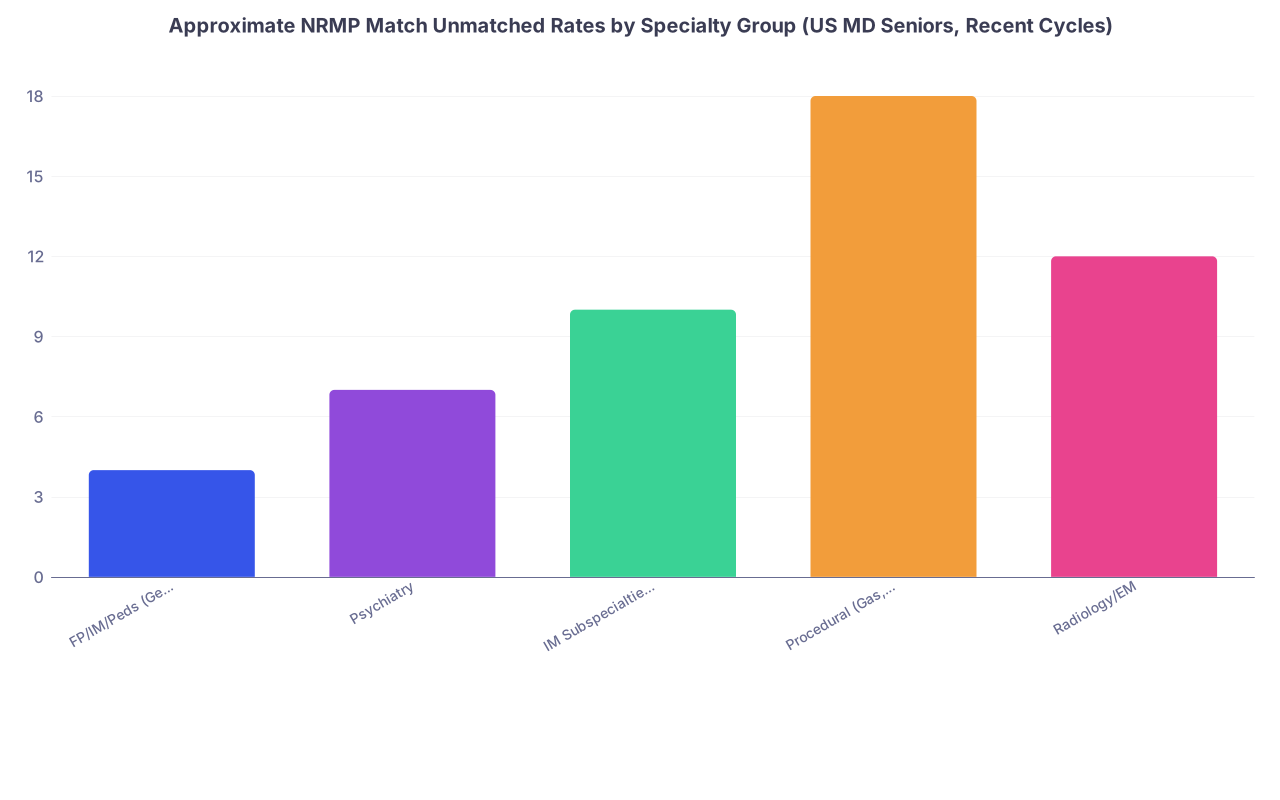
| Category | Value |
|---|---|
| FP/IM/Peds (General) | 4 |
| Psychiatry | 7 |
| IM Subspecialties (fellowships) | 10 |
| Procedural (Gas, Derm, Ortho, ENT) | 18 |
| Radiology/EM | 12 |
The precise percentages move year to year, but the relative structure holds:
- General FM/IM/Peds remain low unmatched rate for U.S. MD seniors.
- Psychiatry has crept up from “easy” toward “moderately tight.”
- Many IM fellowships (especially GI, cards) are competitive, even if the parent specialty (IM) is not.
- Procedural and lifestyle‑luxury fields stay at the top.
The interesting question is: among the lower‑paid group, which specialties’ competitiveness metrics look more like “hot” fields than their salary would suggest?
Big Picture: Low Pay vs Match Heat
Here is a simplified comparison to frame the rest of the discussion. Salary numbers are ballpark medians; competitiveness is relative based on NRMP data, board score patterns, and applicant per position ratios.
| Specialty | Typical Median Salary (USD) | Competitiveness (US MD) | Notes |
|---|---|---|---|
| Family Medicine | 240k–260k | Low | High fill, low unmatched |
| Internal Med | 250k–280k | Low–Moderate | Driven by fellowship ambitions |
| Pediatrics | 230k–250k | Low–Moderate | Small field, stable demand |
| Psychiatry | 280k–320k | Moderate–High | Rising demand, few spots growth |
| Med–Peds | 260k–300k | Moderate | Niche, small n programs |
| Geriatrics* | 230k–260k | Moderate (fellowship) | Undersupply, but low applicant n |
| Endocrinology* | 240k–280k | Moderate–High (fellow) | Few spots, lifestyle draw |
| Infectious Dz* | 230k–260k | Historically Low, rising | COVID interest spike then ebb |
| Rheumatology* | 260k–300k | Moderate–High (fellow) | Lifestyle–procedure hybrid |
* Fellowship-level after IM/FM/Peds.
Headline: Psychiatry, Med–Peds, and several low‑paid IM subspecialties run significantly hotter than their compensation would predict.
Let’s drill down.
Psychiatry: “Low-ish Pay,” High Heat
Psychiatry is the clearest example of a “not top pay” specialty that now behaves like a competitive field.
Data trends over roughly the last decade:
- U.S. MD senior unmatched rate in Psychiatry has roughly doubled compared with earlier cycles, now sitting in the high single digits in some years.
- The proportion of U.S. MDs filling PGY‑1 psychiatry spots has increased, squeezing IMGs.
- Step 1 going pass/fail shifted more applicants toward lifestyle fields—psych benefitted heavily.
You see it on the ground. I have watched mid‑tier schools where psych was once the “safety” away rotation now field triple the number of home students wanting letters. Residents casually mention getting 15–20 interview invites; attendings joke that “psych is the new derm, minus the money.”
Why the heat?
Quantitatively, three variables matter most:
Demand shock
- Mental health utilization has climbed sharply. The percentage of adults receiving mental health treatment in the U.S. increased substantially over the last decade.
- More psychiatrists are in outpatient, part-time, or telehealth roles, reducing full‑time FTE supply.
Training slot inertia
- Hospital systems and GME funding move slowly. Psychiatry residency positions have expanded, but nowhere near enough to match demand growth.
- Result: applicant per position ratio climbs.
-
- Call burden, procedures, and malpractice risk are relatively low.
- Even if median reported salary is ~$300k, actual take-home in certain markets (especially cash/concierge or telepsych) can push higher, and flexibility is a huge non‑monetary “comp.”
In data terms, psychiatry is a mismatch problem: demand + lifestyle > salary drag. The salary number alone underestimates the real utility value to applicants.
Med–Peds: Modest Pay, Quietly Competitive
Med–Peds does not get the Twitter hype of derm, but the numbers show it is not a pushover.
Key data features:
- Med–Peds positions are a small fraction of total categorical IM or categorical peds spots.
- Many programs only take 2–4 residents per year; a single strong med school’s students can saturate those positions.
- U.S. MD fill rates are high; IMGs have more limited access compared with pure IM.
Despite median pay that roughly parallels general IM or Peds (and often ends up similar to hospitalist or outpatient primary care salaries), Med–Peds has:
- Higher Step score averages than pure Peds.
- Applicants often with stronger academic / research profiles (they are self‑selecting for complexity and often hope for subspecialty or academic careers).
Why it runs hot despite “meh” pay:
- Flexibility value. Med–Peds buys optionality: ICU, hospitalist, outpatient, complex care, transitions of care, adult congenital heart, etc. You get 2 boards, lots of exit ramps.
- Fellowship pipeline. A sizable fraction go to competitive fellowships (cards, ID, pulm/crit, endocrine). The long‑term compensation can be substantially higher than the Med–Peds “base.”
- Identity. This is a niche identity-driven field. Applicants who want complex lifetime care across age groups are willing to take lower immediate pay for job satisfaction and intellectual complexity.
The specialty is not “derm‑level” competitive, but for its salary tier, Med–Peds runs hotter than you would expect by pay alone.
General Pediatrics: Low Pay, Not As Easy As The Stereotype
Pediatrics sits at or near the bottom of the salary rankings among major core specialties. General peds outpatient salaries around $230k–$250k are common. That should, in theory, make it soft.
Reality is more nuanced.
Match data:
- U.S. MD unmatched rates remain low, but not trivial. Especially for applicants with weaker scores or red flags, peds is no longer a guaranteed soft landing.
- U.S. MD fill rates are robust. Many solid mid‑tier peds programs fill heavily with U.S. MDs and DOs; IMGs get more of the community and lower‑tier positions.
The tension:
- Low salary and often high workload (clinic volume, calls from parents, admin tasks).
- But strong lifestyle alignment for a specific personality type: long-term relationships, child‑centered care, lower malpractice risk, comparatively humane inpatient call in many programs.
What keeps pediatrics “warmer” than the pay rank suggests:
Limited total pipeline
- Far fewer pediatric slots than IM slots. The raw number matters: even if some spots go unfilled, the most desirable programs still see multiple strong applicants per position.
Subspecialty buffering
- Neonatology, pediatric cardiology, heme/onc, PICU, etc. open doors to higher pay or more procedure‑heavy roles.
- So the general peds salary is not the entire economic story for many applicants.
Mission-driven applicants
- A non-trivial portion of peds applicants are intrinsically motivated. They care far more about working with kids than about hitting $500k. That shifts the salary–heat relationship.
Conclusion: Pediatrics is still on the more “accessible” side of the Match, but within the low-pay cluster it is less of a pushover than, say, community FM.
Internal Medicine and the Fellowship Game
If you only look at general internal medicine salary—outpatient primary care around $250k—it looks like a low‑paid, low‑competitiveness field. The match numbers for categorical IM support that: U.S. MD unmatched rates are low, and many IM programs fill with a mix of IMGs and DOs.
But the data pivot is this: for a large share of IM residents, “internal medicine” is not the destination. It is the gate.
IM is the funnel to both highly paid and comparatively lower‑paid but competitive subspecialties. Some of those subspecialty salaries are not impressive on paper yet remain fiercely fought over.
Look at a simplified comparison:
| Fellowship | Typical Salary Range | Fellowship Competitiveness | Lifestyle/Draw |
|---|---|---|---|
| Cardiology | 500k–700k+ | Very High | Procedures, high pay |
| GI | 550k–750k+ | Very High | Procedures, high pay |
| Endocrinology | 240k–280k | Moderate–High | Lifestyle, outpatient focus |
| Rheumatology | 260k–320k | Moderate–High | Mix of procedures, lifestyle |
| Infectious Dz | 230k–260k | Historically Low–Mod | Academic interest, variable pay |
| Geriatrics | 230k–260k | Moderate | Aging population, policy focus |
The interesting cluster for this discussion is endocrine, rheum, geriatrics, and sometimes ID. These pay on the low side compared with GI/cards, yet some of them are not easy fellowships to secure.
Why?
Small fellowship class sizes
- Endocrinology and rheumatology often have 1–3 fellows per year per program. A single strong home program can generate more applicants than it has spots.
- Even with a modest national applicant pool, the small denominator makes the acceptance rate non‑trivial.
Lifestyle premium
- Endocrinology and rheumatology in many settings have:
- Primarily outpatient practice
- Predictable hours
- Limited or no night/weekend call
- Applicants are effectively trading salary for schedule. When you weight compensation by hours worked and stress, their “effective rate” is higher than the raw $250k suggests.
- Endocrinology and rheumatology in many settings have:
Academic and intellectual draw
- Complex physiology (endocrine) and immunology (rheum) attract residents who value intellectual depth over RVU churn. They are not primarily pay‑maximizers.
- Academic centers drive much of the fellowship market, and academic salaries are lower across the board, which depresses reported medians.
In data terms, fellowship competitiveness in these fields is driven more by limited supply of positions and non‑salary utility than by gross pay levels. So yes, some “low‑pay” IM fellowships still run hot.
Family Medicine: Low Pay and (Mostly) Low Heat
Let us be honest. Family medicine is the closest match to the stereotype: lower pay, and overall, easier access.
Core numbers:
- Median outpatient FM salary often sits around $240k–$260k, with a lot of regional variation.
- U.S. MD unmatched rates are low; many FM spots fill with DOs and IMGs.
- Program expansion has been aggressive over the last decade; supply of positions is large.
The data shows:
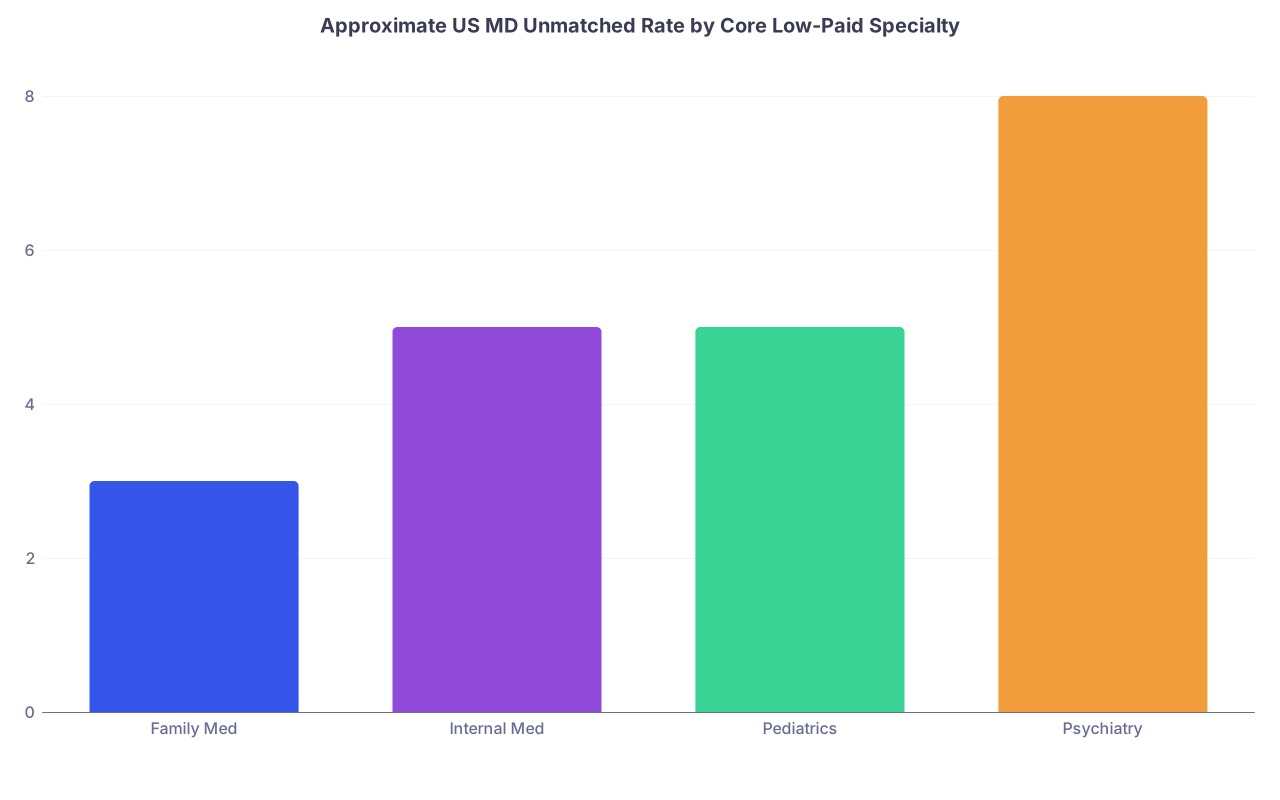
| Category | Value |
|---|---|
| Family Med | 3 |
| Internal Med | 5 |
| Pediatrics | 5 |
| Psychiatry | 8 |
Again, numbers are approximations, but the ordering is robust:
- Family medicine sits at or near the bottom for unmatched rate.
- Psychiatry is the hottest among these.
- IM and Peds in the middle.
Where it gets interesting is that not all FM is equal:
- Top academic FM programs (think UW, UNC, Colorado, UCSF) attract applicants interested in academic medicine, global health, and sports med. Those individual programs are more selective than the average FM community program.
- Rural and community programs in less desirable locations sometimes have unfilled spots and will rank a wide range of candidates.
So at the macro level, FM is low‑pay, lower‑heat. At the micro level, specific programs can still be quite selective, particularly those with strong OB, procedures, or sports medicine pipelines.
But if you are mapping salary to competitiveness, family medicine is the one field where the cliché “lower pay, less competitive” mostly holds true.
Where the Salary–Competitiveness Correlation Breaks
If you try to treat salary and match competitiveness as a simple correlation, you will misread the market. There are clear breakpoints where the relationship collapses.
Here’s the conceptual model I would use, based on the data and how applicants behave:
Competitiveness ≈ f(
Salary potential (base + fellowship options),
Lifestyle (hours, call, geographic flexibility),
Prestige / identity,
Number of training spots,
Applicant volume & self‑selection,
)
Salary is just one term. And not the dominant one in every low-pay field.
Look at specific examples where the correlation breaks:
Psychiatry vs Radiology
- Psych median salary is often lower than radiology.
- Yet psych has moved into a similar “moderate‑high” competitiveness band because of lifestyle and demand, whereas radiology had a softer period post‑2010 before rebounding.
Endocrinology vs Hospitalist IM
- Many hospitalists can make more than outpatient endocrinologists, especially with nights and extra shifts.
- Yet endocrine fellowships are still consistently sought after, because the lifestyle and intellectual nature of the work appeal strongly to a specific subset.
Med–Peds vs General IM
- Med–Peds attendings do not clearly out‑earn general IM on average.
- But the training slots are fewer, and the subspecialty/flexibility potential is higher, so Med–Peds recruits a self‑selected, competitive subset.
The common pattern: specialties with strong lifestyle and/or identity appeal, combined with constrained training capacity, remain hot even when their nominal salary is mediocre.
Practical Implications If You Are Choosing a “Low Pay” Field
You are probably not reading this just for trivia. You are trying to line up your preferences, your competitiveness, and your risk tolerance.
Here is what the data implies in practical terms:
Do not treat all “low-pay” specialties as backup plans.
- Psychiatry and Med–Peds in particular can absolutely burn you if you treat them like guaranteed safeties.
- You need solid letters, convincing specialty commitment, and a rational list.
Differentiate between field competitiveness and program competitiveness.
- Family medicine as a whole may be easier, but top academic FM programs can be choosy.
- Similarly, pediatrics at CHOP or Boston Children’s is not the same game as a small community peds program.
Factor fellowship strategy into your calculation.
- If you plan on endocrine, rheum, or peds subspecialty, realize that you are signing up for:
- A second competitive selection filter.
- A final salary that is still not in the top quartile of physician pay.
- If your priority is financial maximization, this is a poor optimization path on paper.
- If you plan on endocrine, rheum, or peds subspecialty, realize that you are signing up for:
Use data, not folklore, to calibrate risk.
- Look at recent NRMP data for unmatched rates, fill rates by applicant type, and number of positions.
- Talk to current residents and PDs about how many applications they see and what kind of profiles are getting interviews.
Fields to Watch: Where Heat May Keep Rising
If you want to be slightly ahead of the curve, a few “low-pay” domains are likely to stay competitive or get hotter:
- Psychiatry: Continued mental health demand, telepsych growth, limited training expansion.
- Endocrinology: Obesity, diabetes, and metabolic syndrome are not going away; outpatient lifestyle remains attractive.
- Rheumatology: Aging population with autoimmune and degenerative disease; biologics and procedures, manageable hours.
- Geriatrics: Massive demographic wave. Historically under‑applied, but policy and societal focus on aging could slowly push prestige and interest upward.
All of these sit below many surgical/procedural fields in raw dollars, yet each has structural reasons to be more competitive than their pay ranking alone would justify.
Key Takeaways
Salary is a weak predictor of competitiveness in the low‑pay cluster. Psychiatry, Med–Peds, and several IM subspecialties are clearly hotter than their compensation suggests.
Training slot scarcity and lifestyle value drive a lot of the mismatch. Small fellowships and outpatient-friendly fields can be surprisingly competitive even when median salaries hover around $250k.
If you aim for a “low pay” specialty, do not assume it is a safety. Use actual match data, not hearsay, to set your application strategy and risk profile.


