

What do you actually do when you’re an anesthesiology PGY-2 staring at an offer to switch into psychiatry... knowing full well you’re walking away from hundreds of thousands of dollars over your career?
This is not hypothetical. I’ve seen it play out with anesthesia → psych, ortho → peds, EM → FM, radiology → IM. The money gap is real. The sunk cost is real. The regret risk is real.
Let’s walk through this like we’re sitting in a call room at 1:30 a.m. and you just said, “I think I picked the wrong specialty.”
Step 1: Get Bluntly Clear on Why You Want to Jump
Not “why in theory.” Why today, after an actual month on service.
If you are in a high-paid specialty now (ortho, plastics, derm, radiology, anesthesia, gas-heavy EM job potential) and considering a low-paid one (pediatrics, family medicine, psychiatry, geriatrics, general internal medicine, some hospitalist tracks), you have to separate three things:
- Burnout from current rotation
- Normal PGY-1/2 misery
- True specialty misfit
Here’s how I’d test it.
Ask yourself, on your best day in this specialty, doing the best-case version of the job… do you actually want that life?
- Ortho: Full OR day, big cases, great attending, stuff goes well. Are you energized or counting down the minutes?
- Anesthesia: Smooth cases, minimal pager chaos, good CRNA partners. Do you like the physiology puzzle or does it feel like babysitting monitors?
- Radiology: Quiet reading room, interesting studies, no malignant personalities. Does spending most of the day at a workstation appeal to you long-term?
Then flip it: imagine the low-paid specialty in its best-case version.
- FM: Continuity clinic with patients who trust you, wide variety, long-term relationships.
- Peds: Sick kids, yes, but cooperative team, family meetings where you actually help.
- Psych: Real time to talk, medication management that clearly changes people’s lives.
If the best day in your current specialty still feels worse than the average day you imagine in the new one, you’re not just tired. You’re in the wrong place.
If you’re mostly hating:
- Call schedules
- Specific attendings
- One toxic rotation
…but you’ve had flashes of “this is cool” in your field? Be careful. You might be about to burn down a solid career over a bad six months.
Step 2: Know the Money Gap in Real Numbers, Not Vibes
You already know the headlines: ortho vs peds, derm vs FM, anesthesia vs psych. Sometimes the gap is $200–$400k per year at attending levels.
You need real numbers, not social media bitterness.
| Specialty | Approx Median Salary (USD) |
|---|---|
| Orthopedic Surg | $600,000–$700,000 |
| Anesthesiology | $450,000–$550,000 |
| Radiology | $450,000–$550,000 |
| Psychiatry | $260,000–$320,000 |
| Family Medicine | $230,000–$270,000 |
| Pediatrics | $220,000–$260,000 |
You are not choosing between “rich” and “poor.” You’re choosing between:
- “I will probably have to think about money but won’t starve”
and - “I can screw up financially for a decade and still be okay.”
To make a grown-up decision, do this:
- Look up your student loan balance and actual interest rate.
- Choose 3 specialties: your current one, your target low-paid one, and a midpoint (e.g., IM hospitalist) as a sanity check.
- Use a basic loan calculator + salary estimates from MGMA/Medscape or job postings.
Then sketch something like:
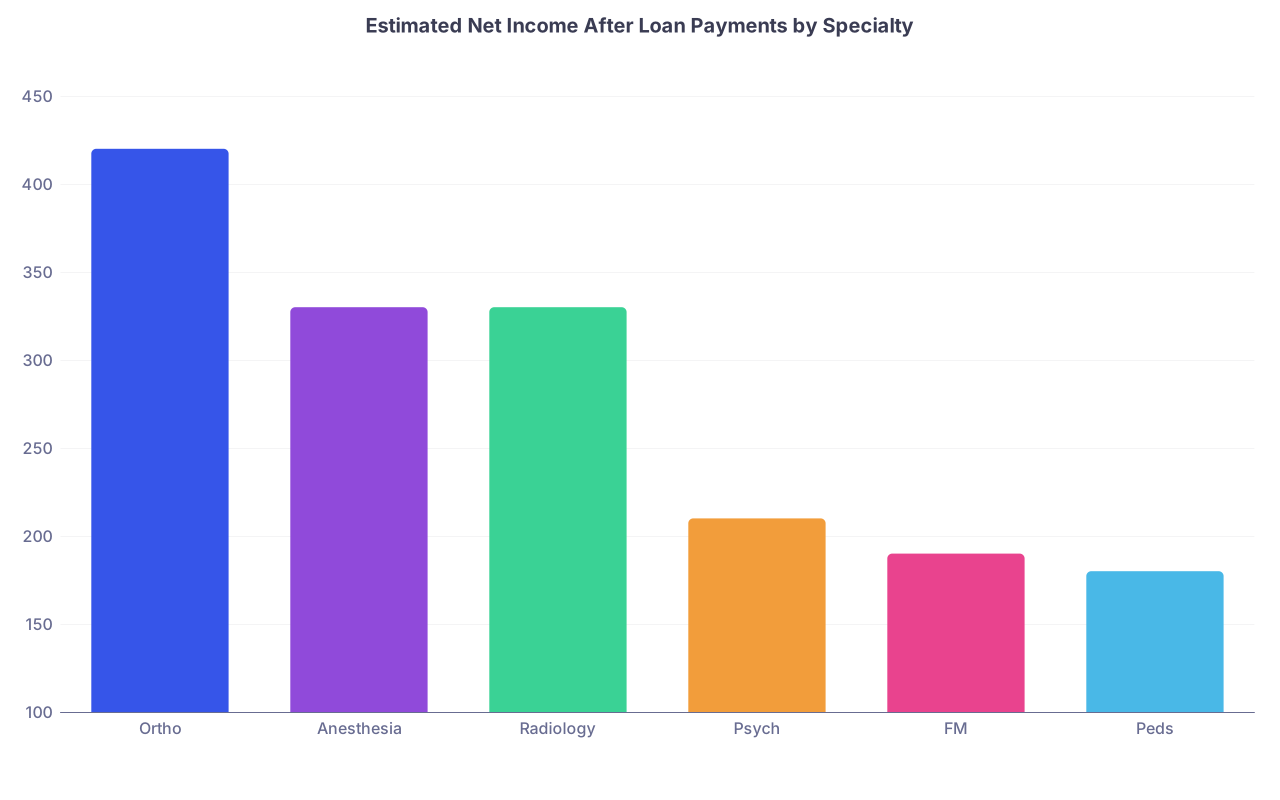
| Category | Value |
|---|---|
| Ortho | 420 |
| Anesthesia | 330 |
| Radiology | 330 |
| Psych | 210 |
| FM | 190 |
| Peds | 180 |
(Values here = very rough “take-home after taxes and an aggressive loan payment,” in thousands, just to visualize the difference.)
If those bars don’t scare you at least a little, you’re not thinking clearly. If they scare you so much you’d sell your soul to avoid the bottom of the chart, you’re also not thinking clearly.
You’re going to be in the top few percent of income in the country almost regardless. The real question is:
- Are you okay saying no to the $600k lifestyle to have work you actually like?
- Or are you okay enduring work that’s fine/neutral/occasionally miserable to buy more financial margin?
There is no moral high ground here. There’s just preference plus consequence.
Step 3: Map Out the Training Hit and Life Delay
Switching mid-residency doesn’t just change your salary. It resets the clock.
You must know:
- How many years you’ve already done
- How many of those can transfer (often 0–1)
- How long the new residency is
That’s your delay cost: extra years on resident salary plus extra years before attending money starts.
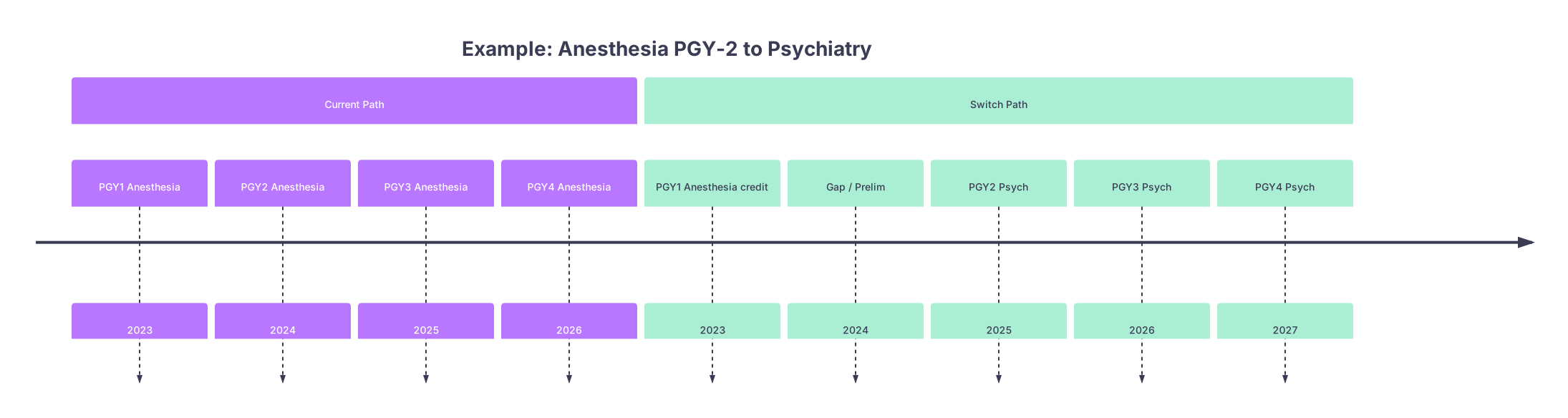
| Period | Event |
|---|---|
| title Example | Anesthesia PGY-2 to Psychiatry |
| Current Path - PGY1 Anesthesia | 2023 |
| Current Path - PGY2 Anesthesia | 2024 |
| Current Path - PGY3 Anesthesia | 2025 |
| Current Path - PGY4 Anesthesia | 2026 |
| Switch Path - PGY1 Anesthesia credit | 2023 |
| Switch Path - Gap / Prelim | 2024 |
| Switch Path - PGY2 Psych | 2025 |
| Switch Path - PGY3 Psych | 2026 |
| Switch Path - PGY4 Psych | 2027 |
In some cases, you might:
- Repeat an intern year
- Lose seniority
- Lose a chief shot
- Move your board eligibility back by 2–3+ years
Ask explicitly when you talk to programs:
- “Will any of my completed years count toward the new specialty?”
- “Will I match as a PGY-2 or have to start over as PGY-1?”
- “Do you have experience taking switchers from ___?”
Do not assume “they can probably count my PGY-1.” Some will. Some won’t. And ACGME rules can be rigid depending on field.
Step 4: Quietly Test the New Specialty Before You Jump
You do not blow up your current training based on vibes alone. You get data.
Ways to test-drive without detonating your life:
Electives:
- Ask your program director for outpatient or consult electives in the target field.
- Phrase it as “I’m exploring my long-term fit and would like more exposure to X in case I integrate it into my current specialty.”
Moonlighting / per diem:
- Harder in training, but some psych, FM, or urgent care settings let senior residents moonlight under supervision.
- You at least see the workflow and pace.
Shadow on off days:
- Show up for a Saturday inpatient psych round.
- Sit in with an FM doc doing back-to-back 15-minute visits.
- Watch what annoys them. That will be your daily reality.
Talk to mid-career docs in that field. Not the starry-eyed new grads. The 45-year-old pediatrician with 3 kids and aging parents. Ask:
- “If your kid wanted to go into your specialty, would you encourage it?”
- “What’s the part of your day that you secretly hate?”
- “What did you underestimate about the money or lifestyle?”

If after that you still feel pulled toward the lower paid specialty, that’s a signal you may actually belong there.
Step 5: Strategy for Talking to Your Current Program (Without Nuking Everything)
Here’s where people mess up: they panic, blurt out “I hate it here, I want to switch,” and instantly become “the problem resident.”
Do not do that.
Your goals talking to your PD:
- Stay in good standing
- Preserve a strong letter
- Maybe even get help opening doors to the new specialty
Before the meeting, prepare:
- 3–4 specific reasons this specialty isn’t the right long-term fit, framed professionally:
- “My interests are more chronic, relationship-based care than procedural/OR.”
- “I’ve realized I’m more engaged by longitudinal management than acute crises.”
- Evidence you’re not a mess:
- Decent evaluations
- Examples of showing up, being reliable, doing the work
- A calm, non-accusatory tone:
- You’re not attacking their program. You’re describing your fit.
The script sounds something like:
“Dr. X, I’ve been doing a lot of thinking over the last six months. I’ve worked hard and I think my performance has been solid, but I’m realizing that my interests and temperament align more with [new specialty] than with [current specialty] long term. I didn’t fully understand that as a med student.
I want to finish this year as strongly as I can, but I also don’t want to ignore this and end up burned out and resentful five years from now. I’d really value your honest take on whether you’ve seen residents in my position successfully transition, and what would be the most professional way to approach this.”
Then shut up and listen.
Even if your PD is annoyed, most have seen this before. Some will even say, “Honestly, I wondered if this was the right field for you.”
Do not:
- Say you’re “miserable” or “hate everything.”
- Trash attendings, co-residents, or call schedules.
- Threaten to quit if you can’t switch.
You’re trying to graduate your reputation from “disgruntled” to “self-aware and professional.”
Step 6: Reality Check — What Actually Changes Day to Day?
People imagine switching from high-paid to low-paid like it’s going from prison to beach resort. It’s not.
Be brutally specific about what improves and what just… changes flavor.
Procedures:
- Ortho → Peds? Massive drop in OR time. That has to genuinely relieve you, not just be “less scary.”
- Anesthesia → Psych? No more intubations, but way more documentation and family meetings.
Hours:
- Some low-paid fields still have brutal call (inpatient peds, some FM with OB, inpatient psych in under-resourced systems).
- Don’t assume 9–5 clinic with a latte.
Emotional weight:
- Lots of low-paid fields trade procedural intensity for emotional intensity.
- You need to be okay with chronic suicidality, CPS calls, generational poverty, multi-morbidity, non-adherence.
Autonomy & cognitive load:
- Less “big money” usually doesn’t mean less responsibility.
- FM/IM/hospitalists own a patient in a way some procedural subspecialties don’t.

You’re swapping one kind of stress for another. The key question is: which set of problems do you actually want to solve at 3 p.m. on a Wednesday… for decades?
Step 7: Plan the Actual Switch — Logistics, Not Fantasy
Once you’re serious, treat this like a second mini-application cycle.
You’ll need:
An updated CV that doesn’t look like you’re fleeing a disaster.
A personal statement that clearly but concisely explains:
- Why this new field
- What you learned from your original choice
- How your current training is an asset, not a mistake
Letters from:
- At least one person in the new specialty who can say, “I’ve seen this resident on our service and they’re excellent.”
- At least one from your current PD or core attending saying you’re competent and professional.
Reach out quietly to programs in the new specialty and ask specific questions:
- “Do you consider applicants already in another residency?”
- “Would I apply through ERAS or directly for an off-cycle PGY-2 spot?”
- “How many switchers have you taken in the last 5 years, and how did that go?”
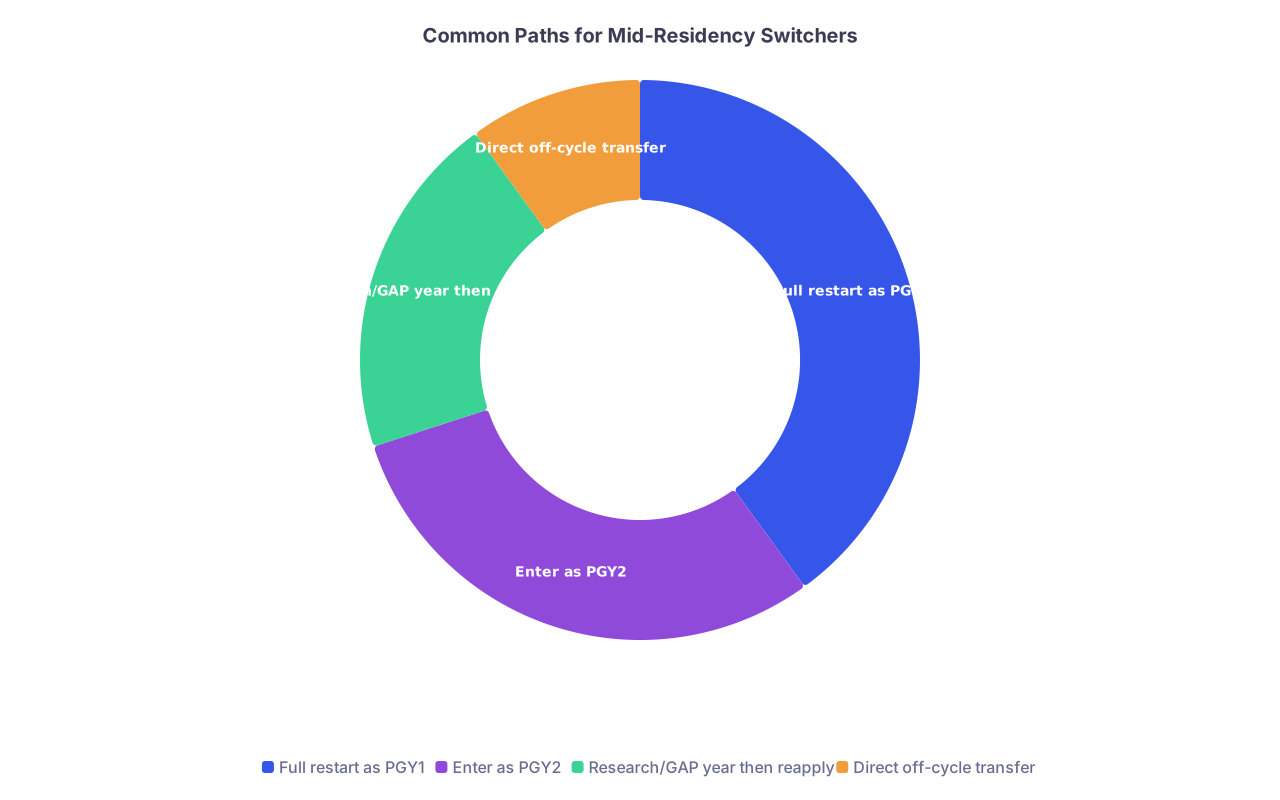
| Category | Value |
|---|---|
| Full restart as PGY1 | 40 |
| Enter as PGY2 | 30 |
| Research/GAP year then reapply | 20 |
| Direct off-cycle transfer | 10 |
You may discover:
- You need to stay another year where you are while you apply.
- Or you can jump directly into an open PGY-2 in July.
- Or you need a research or prelim year to bridge.
Messy. But survivable.
Step 8: Fix Your Personal Money Situation Now, Before You Jump
If you’re walking away from a $500k field to a $250k field, your only safety net is not being financially reckless.
I’d do three things immediately, even before you formally switch:
-
- If you just leased the luxury apartment because “future attending money,” reconsider.
- Avoid new car payments, fancy vacations, or lifestyle creep.
Decide your loan strategy:
- If you’re going into FM/peds/psych and plan academic or nonprofit work, PSLF (Public Service Loan Forgiveness) becomes much more likely. That changes everything.
- If you’re going into private practice psych/FM, you may be better off refinancing later and attacking loans aggressively.
Educate yourself on actual cost of living for your dream lifestyle:
- That might mean two incomes, a smaller house, fewer toys.
- Fine. You picked meaning over money; now make that sustainable.

The worst version of this story is: switch to a low-paid specialty for “happiness,” then live in chronic financial stress because you refuse to right-size your lifestyle. Do not do that to yourself.
Step 9: The Psychological Fallout — What to Expect in Your Head
Everyone talks about logistics. Not enough people talk about shame, ego, and family expectations.
Things you will probably feel:
- Embarrassment telling people you “stepped down” from the flashy specialty.
- Annoyance when classmates start cashing $600k checks while you’re a PGY-3 again.
- Anxiety seeing your debt number not moving as fast as their Instagram vacations.
- Relief on random Tuesday afternoons when you realize you’re actually enjoying your work.
Family might say:
- “But you were going to be a surgeon!”
- “Are you sure… that’s less money, right?”
- “Can’t you just finish this and then do something you like later?” (No. That’s not how any of this works.)
You need a simple, boring script you can repeat:
“I realized early enough that my original specialty wasn’t the right long-term fit. I’d rather take a short-term hit and build a sustainable 30-year career in something that matches how I actually like to work.”
Say it enough and it becomes your own internal narrative, not just PR.
When You Probably Shouldn’t Switch
Let me be very direct: there are bad reasons to jump.
I’d be cautious if:
- You’re in the worst rotation of intern year and have not seen the full specialty.
- You’re clinically struggling and hoping an “easier” field will fix performance issues.
- You’re running from one malignant PD to another unknown environment without doing your homework.
- Your main driver is “lifestyle” and you haven’t actually seen that lifestyle in real life, only on Reddit.
And I’d push pause if:
- You haven’t done at least a couple weeks embedded in the new specialty, with honest attendings giving you feedback.
When It’s Absolutely Worth It
On the other hand, I’ve seen residents switch from:
- Ortho → Peds
- Anesthesia → Psych
- Radiology → FM
- EM → IM
And years later they say the same thing: “I’d be rich and miserable if I’d stayed. Now I’m comfortable and fine.”
The big pattern?
- They liked the day-to-day of the new work, not just the idea of it.
- They were willing to right-size their lifestyle.
- They didn’t burn bridges on the way out.
- They accepted being “behind” for a while.

Bottom Line
If you’re mid-residency in a high-paying specialty and seriously considering jumping to a lower-paid one:
- Test reality, not fantasy. See the new specialty up close, run actual numbers, and be specific about what will improve and what will just change flavor.
- Switch like a professional, not like a runaway. Protect your reputation, gather strong letters, and map out the logistical hit to your training and finances.
- Accept the trade: less money, more fit. If the best day in the new field clearly beats the best day in your current one—and you’re willing to adjust your lifestyle—then yes, the switch can absolutely be worth it.


