
The biggest financial mistake mid‑career physicians make when changing specialties is screwing up their malpractice coverage.
They focus on fellowship logistics, credentialing, new hospital bylaws. Meanwhile, one small box on one malpractice form gets checked wrong, and three years later they’re writing a $200,000 check for tail coverage they could have had their old group pay for.
Let’s not have that be you.
You’re changing specialties. That’s the career decision. Now you have a very specific, very fixable problem: how to restructure your malpractice coverage so you’re protected, compliant, and not paying for things you shouldn’t.
Below is the playbook I’d walk you through if we were on the phone and you said, “I’m leaving EM for outpatient psych,” or “I’m dropping OB and going GYN‑only,” or “I’m done with surgery, moving into wound care.”
Step 1: Get Clear on What’s Actually Changing
Forget the generic “I’m changing specialties” story. Malpractice carriers care about details. You need a simple, concrete statement that answers three things:
- What you are stopping
- What you are starting
- When the risk profile changes
Example translations into “insurance language”:
- “I’m leaving hospital‑based emergency medicine and moving to outpatient urgent care with no trauma coverage and no procedures beyond basic laceration repair and splinting, starting August 1.”
- “I’m stopping obstetrics entirely (no deliveries, no intrapartum management, no VBAC consults) and will practice only office‑based gynecology starting January 1.”
- “I’m leaving orthopedic surgery (including spine) and transitioning to non‑interventional sports medicine and EMG only, starting July 15.”
Why this matters: your carrier will classify you into a rating category based on procedures, setting, and call. That rating drives your premium. If you sound vague (“I’m doing more outpatient stuff”), they’ll default to the higher‑risk interpretation.
Write down your “insurance language” version. You’ll reuse that sentence with:
- Your current malpractice carrier
- Your new employer or group
- Credentialing offices
- Any broker you work with
Step 2: Identify Your Current Coverage Type (Occurrence vs Claims‑Made)
If you do not know this yet, stop everything and find out. It determines almost every decision you make.
Pull your declarations page (dec page). If you do not have it, email the practice manager, hospital med staff office, or your broker and ask:
“Can you please send me the latest declarations page for my malpractice policy and confirm whether my coverage is occurrence or claims‑made, and who is responsible for tail if I leave?”
Then look for these words:
- Occurrence – every year stands on its own. An incident that happened while the policy was active is covered forever, even if the claim is filed years later. No tail needed when you leave.
- Claims‑Made – the policy covers claims that are filed while the policy is active (and after the retro date), regardless of when the incident occurred. When you stop the policy, you usually need tail coverage to extend the reporting period.
Most private practice and hospital policies these days are claims‑made. Many academic and some hospital systems use occurrence. Do not assume. Confirm.
Here’s the quick comparison so you see what’s at stake:
| Feature | Occurrence | Claims-Made |
|---|---|---|
| Tail needed when you leave? | No | Usually yes |
| Premium early in career | Higher | Lower initially, then increases |
| Coverage trigger | When event occurred | When claim is reported |
| Switching employers hassle | Lower | Higher (tail/retro issues) |
If you have occurrence coverage now, your past specialty exposure is simple: you’re done once the policy ends. If you have claims‑made, we need to talk tail and retro dates.
Step 3: Map Your Risk Timeline (Old vs New Specialty)
You’re juggling two risk timelines:
- Your past work in your old specialty
- Your future work in your new specialty
They’re separate buckets in the eyes of malpractice carriers, even if a single policy covers them.
You want answers to two questions:
- Who covers patients I saw in my old specialty, if they sue me 3 years from now?
- Who covers patients I see in my new specialty, starting on [date]?
Practical way to do this
Draw a simple line on a piece of paper:
- Left side: “Start of current job” → mark the retro date (it’s on your dec page; e.g., 07/01/2018).
- Middle: “Last day I see patients in old specialty” (e.g., 06/30/2026).
- Right side: “Start of new job/new specialty” (maybe the next day, maybe not).
Then:
- From retro date → last day in old specialty: that’s your past exposure.
- From day 1 in new specialty forward: that’s your new exposure.
Why draw it? Because now you can ask very specific, non‑confusing questions:
“Who is responsible for covering claims arising from services I provided between 7/1/2018 and 6/30/2026?”
and
“Who is providing malpractice coverage for services I’ll provide starting 7/1/2026 in [new specialty]?”
That clarity saves you from vague HR answers like “Oh, you’re covered under our group policy,” which may only apply to your new patients.
Step 4: Figure Out Who Pays for Tail (or Whether You Can Avoid It)
This is where people lose serious money if they don’t pay attention.
First: Do you even need tail?
You need tail coverage if all three are true:
- Your old coverage is claims‑made,
- You are leaving that policy (changing employers or the entity is dissolving), and
- There is no new policy with a matching or earlier retro date that will pick up your old work.
You typically do not need tail if:
- You have occurrence coverage, or
- Your new employer’s claims‑made policy adopts your retro date (i.e., they pick up your prior acts).
Second: Check your contract — in writing, not from memory
Common language patterns:
- “Employer will provide and pay for professional liability insurance including tail coverage upon termination.”
- “Employee is responsible for any tail coverage upon termination for any reason.”
- “If the physician is terminated for cause or leaves before completion of the initial term, Physician shall be responsible for tail; otherwise Employer shall be responsible.”
If you signed anything like the second bullet, your default is: you pay tail.
If you have no contract because you’re an independent contractor (1099) with a democratic group, then you almost certainly pay for your own tail unless they have a specific partnership provision that says otherwise.
Third: Get a real tail quote early
Do not guess. Ask your broker or carrier:
“If I terminate my policy on [date], what would the tail premium be to cover my practice from [retro date] to [end date] at my current limits?”
You’ll usually get options:
| Tail Length | Approx. Cost vs Last Annual Premium |
|---|---|
| 1 year | 100–125% |
| 3 years | 150–200% |
| Unlimited | 200–250%+ |
The most common purchase is unlimited tail. Plaintiffs can usually file for years, and you do not want to gamble that they’ll all come in under the 3‑year option.
How to avoid or reduce tail cost
You have three main levers:
Negotiate employer‑paid tail
If you’re still employed and in decent standing, you can sometimes say:“I’m happy to help transition for the next 90 days and train my replacement, but I need the group to handle tail coverage as part of my separation.”
Groups will sometimes trade money (tail) for time (you not bailing immediately).
Have the new employer pick up prior acts
This is often easier than writing a giant check.Ask:
“Will your malpractice carrier pick up my prior acts back to [retro date], so I can avoid buying tail with my current carrier?”
If they say yes, confirm in:
- Your employment agreement (explicit language), and
- The new dec page (look for retro date equal to or earlier than your old one).
Switch timing strategically
Some carriers reduce tail cost if:- You’ve been with them a long time (loyalty credits), or
- You’re “retiring” from high‑risk procedures (e.g., stopping OB, stopping surgery).
If you’re, say, 58 and likely to retire in 5–7 years, ask about a mature policy or free retirement tail rules. Many carriers offer free tail when you retire fully after a certain age and years of continuous coverage. You can sometimes time your exit from high‑risk work to piggyback on that.
Step 5: Reclassify Your Risk (And Lower Your Premium if Possible)
You’re not just moving jobs. You’re probably changing risk class. That’s money.
Examples:
- EM → outpatient addiction medicine
- OB/GYN (with deliveries) → GYN only
- General surgery → wound care and hyperbaric
- Interventional cardiology → non‑invasive cardiology
- Anesthesia (OR, OB) → pain medicine with limited procedures
All of those can drop your malpractice rate materially, if your new duties are accurately documented and your carrier assigns the right class.
Here’s where a simple visual helps:
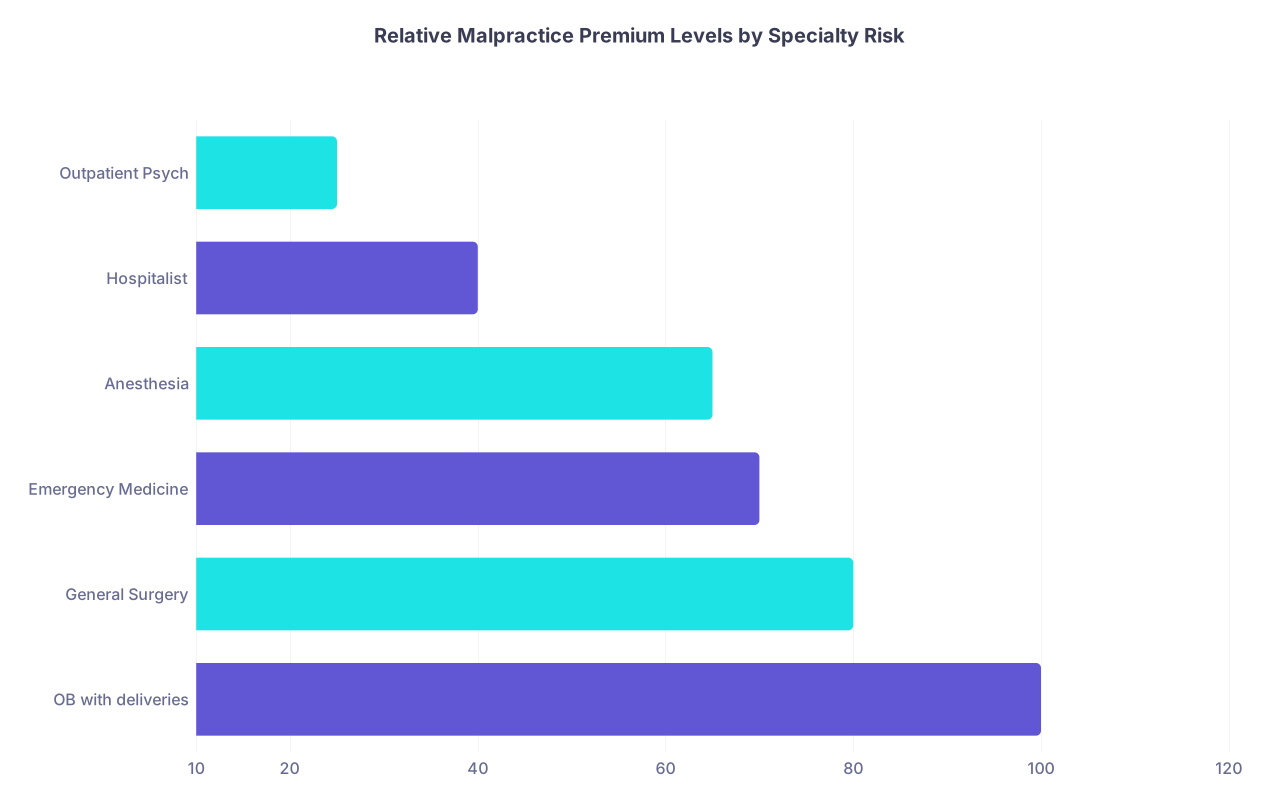
| Category | Value |
|---|---|
| OB with deliveries | 100 |
| General Surgery | 80 |
| Emergency Medicine | 70 |
| Anesthesia | 65 |
| Hospitalist | 40 |
| Outpatient Psych | 25 |
Think of OB with deliveries as “100% baseline” here. Dropping OB might cut your premium by half or more. Moving from EM to outpatient psych may cut it by two‑thirds.
What to do, specifically
Send your new carrier a detailed job description:
- Settings (hospital vs clinic vs telemedicine)
- Procedures you will do
- Procedures you will not do (this matters a lot)
- Call responsibilities
Get it in writing from your new carrier or broker which class code they’re using and what they’re basing it on.
Then be disciplined: don’t “just cover a few deliveries” or “do one scope” on the side if your coverage is rated as if you do not.
Step 6: Handle Transitional Coverage (The Awkward Middle Period)
You might have a messy overlap:
- Locums work while you train in the new field
- Moonlighting in the old specialty while ramping up in the new one
- Part‑time old, part‑time new for a year or two
Each bucket of work needs its own coverage. Sometimes that means:
- One policy through your old group
- A separate policy through the new employer
- Or even a third locums policy via an agency
Do not assume one will pick up the other.
If you’re in a mixed period, lay it out like this for a broker:
- “From July to December, I’ll work 0.6 FTE in EM at Hospital A and 0.4 FTE in outpatient psych at Clinic B. EM will be under the hospital’s policy. Does that policy cover any of my outpatient psych? If not, I need a separate policy for psych only.”
Then confirm limits and carriers:
- Ideally, you don’t want overlapping policies fighting about who’s primary.
- You do want at least one policy clearly primary for each type of work.
If two carriers could plausibly be responsible, get written clarifications now. When there’s an actual claim, nobody is eager to volunteer to be primary.
Step 7: Watch for Specialty‑Specific Traps
Certain transitions are notorious for malpractice puzzles.
Dropping OB from OB/GYN
Trap: Your group says “Sure, you can stop doing OB,” but does not change how you’re classified with the carrier. You’re still paying OB‑rated premiums while not delivering babies.
What to do:
- Get a written date you stopped providing OB services.
- Make sure your carrier:
- Endorses your policy to remove OB going forward, and
- Adjusts your premium for the new period.
- Clarify who covers prenatal care you already provided if someone delivers with another clinician and sues years later. (That’s still OB‑level risk.)
EM → Urgent Care / Telemed
Trap: You start doing telemed across state lines and think your malpractice “just follows you.” It doesn’t always.
- Confirm each state where you’ll be licensed and see patients is listed on your policy.
- Some hospital‑based EM policies explicitly exclude telemedicine outside the system.
Surgery → Non‑operative / Consulting Roles
Trap: You keep hallway‑consulting in the OR, or giving informal guidance on surgical cases, thinking “I don’t operate anymore; I’m just advising.” Plaintiffs can still name you.
- Decide in advance: are you completely non‑operative, or will you still scrub in rarely?
- Make that reality match what your policy says. If your policy states “no surgery,” then do not operate. At all.
Step 8: Use a Broker (And How to Talk to Them Like You Know What You’re Doing)
A good independent malpractice broker is worth it, especially mid‑career.
Here’s the language that signals you’re not clueless prey:
“I’m an anesthesiologist currently on a claims‑made policy with retro date 01/01/2016. I’m leaving my group on 09/30/2026 and transitioning to pain medicine only, no hospital work, starting 10/01/2026. I need:
- A quote for a tail from my current carrier,
- Quotes for a new policy in pain medicine, and
- Options where the new policy picks up my prior acts so I can avoid buying tail.”
That tells them exactly what to shop.
Also ask explicitly:
- “Which carriers will offer prior acts back to my 2016 retro date?”
- “Under what conditions would I qualify for free retirement tail in the future?”
Document all of this via email. People change jobs. Memory is garbage. The paper trail is what matters.
Step 9: Double‑Check the Final Documents Before You See a Single Patient
Last, boring, critical step.
Before you see your first patient in the new specialty, you should physically have:
The new declarations page, showing:
- Correct specialty
- Correct limits (e.g., $1M/$3M, or your state norm)
- Correct retro date (either new or adopted)
- Correct states listed
Written confirmation of:
- Who is responsible for tail on your old policy,
- Whether tail has been purchased, and
- The effective date of any tail endorsement.
I’ve seen physicians start new jobs assuming they were covered because “HR said so,” only to find the application never got completed, and they worked uninsured for a month. Nobody cares about that mistake until the worst possible moment.
Take 15–20 minutes, sit down, and read the actual documents.
Visual: High-Level Flow of Restructuring Your Coverage

| Step | Description |
|---|---|
| Step 1 | Decide to change specialty |
| Step 2 | Confirm current policy type |
| Step 3 | No tail needed for old work |
| Step 4 | Determine tail responsibility |
| Step 5 | Check contract and get tail quote |
| Step 6 | Define new role and risk |
| Step 7 | Shop new coverage or employer policy |
| Step 8 | No separate tail purchase |
| Step 9 | Buy tail for old specialty |
| Step 10 | Verify dec page and retro date |
| Step 11 | Start new specialty with proper coverage |
| Step 12 | Occurrence or Claims-made |
| Step 13 | New policy picks up prior acts? |
FAQs
1. I’m changing specialties within the same hospital system. Do I still need to worry about tail?
Yes. Do not assume “same system” = seamless coverage.
You need to know:
- Are both roles covered under the same master policy or are they separate entities/policies?
- Is your retro date staying the same when you move, or are they “re‑onboarding” you under a fresh date?
Ask risk management or your credentialing office, in writing:
“Will my new role in [specialty] be covered under the same malpractice policy and retro date as my current role, with continuous coverage for prior acts?”
If the answer is yes and documented, you likely do not need separate tail. If no, then you treat the change like a move to a new employer and re‑run the steps above.
2. I’m planning to stop clinical work entirely for 1–2 years to retrain. Do I need malpractice coverage during that gap?
You need coverage for:
- Any past work that may generate a claim during the gap (handled via tail or a continuous claims‑made policy), and
- Any clinical activities you perform during retraining (e.g., fellowship, moonlighting, locums).
If you truly do zero clinical work during the gap and have:
- Occurrence coverage: you don’t need anything extra for that period.
- Claims‑made coverage: you either:
- Keep the policy active (paying premium) through the gap, or
- Cancel it and buy tail to cover the past.
If a fellowship or training program has you seeing patients, they should provide coverage for that work separately. Confirm that with them, and make sure their policy doesn’t try to make your old carrier primary for anything.
3. I’m going from a high‑risk specialty to a low‑risk one. Can I get my old carrier to “downgrade” my past exposure and lower tail cost?
Usually no. Tail is priced based on what you actually did in the past, not what you’re going to do next.
If you spent 10 years doing OB or spine surgery, that risk is baked in. Your future, low‑risk specialty can reduce future premiums but doesn’t retroactively change your old risk profile.
Your main way to soften the hit is:
- Having the new lower‑risk policy pick up prior acts (if the carrier is willing), or
- Negotiating with your old employer to absorb some or all of the tail cost as part of your departure.
Today, do one specific thing:
Pull your current malpractice declarations page and underline three items — policy type (occurrence or claims‑made), retro date, and limits. Once you see those in black and white, you’ll know exactly which of the steps above you need to tackle next.