
The biggest misunderstanding in medical malpractice is this: doctors think state tort caps and immunity laws will “protect” them, and insurers know better.
Let me break this down very specifically: tort caps and immunity laws do not protect you. They protect the payout. And your malpractice carrier prices, structures, and sometimes weaponizes your coverage around those limits.
If you are practicing without understanding how your state’s caps and immunity framework interact with your policy limits, you are gambling with your license, your assets, and your reputation.
1. The Three-Part Framework: Claim, Law, and Policy
Before we touch caps or immunity, you need the basic architecture. Every malpractice event sits at the intersection of three things:
- The claim
- The legal environment (tort caps + immunity + procedural rules)
- The malpractice policy (limits, defense, exclusions)
Most physicians only obsess over the first and vaguely worry about the third. The second—your state’s tort and immunity structure—is actually what dictates how the insurer behaves, how plaintiffs’ firms choose their targets, and how much financial risk you really carry.
Here is the core logic:
- Tort caps limit what can be collected.
- Immunity laws limit who can be sued, or for what.
- Your malpractice insurance responds only to covered claims and only up to your policy limits, within that legal framework.
So the same surgical error looks very different in:
- California (MICRA cap on non-economic damages, but economic damages uncapped, with a recent phase-in of higher caps).
- Texas (strict caps, procedural hurdles, plus strong protections for some public entities).
- New York (no general non-economic cap, very plaintiff-friendly venue, no broad sovereign immunity shield for private practice).
And your policy is priced and structured accordingly.
| State | General Non-Economic Cap | Applies To |
|---|---|---|
| California (MICRA, original) | $250,000 (historically, now increasing) | Non-economic in med mal |
| Texas | $250,000–$750,000 | Non-economic, tiered by defendant type |
| Florida | Cap structure largely invalidated | Effectively no broad cap |
| New York | No general cap | Full jury award possible |
| Colorado | Overall combined cap with exceptions | Economic + non-economic subject to ceiling |
These numbers are moving targets, and the details are ugly, but the pattern is simple: insurers are not guessing. They underwrite to these caps.
2. Tort Caps: How Insurers Actually Use Them
You hear “tort cap” and think: lower risk, less to worry about. The insurer hears “tort cap” and thinks: predictable maximum exposure, easier pricing, stronger settlement leverage.
There are three main types of caps that matter for malpractice:
- Caps on non-economic damages (pain and suffering, loss of consortium).
- Caps on total damages (combined economic and non-economic, sometimes with carve-outs).
- Caps specific to medical malpractice or certain defendants (e.g., community health centers, state-employed physicians).
The interaction with malpractice insurance comes in at several precise points.
2.1 Setting Policy Limits in Cap States
In a state with a strict non-economic cap but uncapped economic damages (like California under original MICRA), carriers will do the following:
- Offer “standard” limits like $1M per claim / $3M aggregate, knowing that catastrophic economic damages (lost wages, lifelong care for a baby with hypoxic injury) can still blow past a non-economic cap.
- Price lower than in non-cap states for the same specialty, because the total verdict potential is still somewhat constrained.
- Rely heavily on the predictability of jury-adjusted awards due to the statutory cap.
In a state with no meaningful caps (e.g., New York):
- Limits are higher in both norm and expectation for certain high-risk specialties.
- Excess layers and umbrella coverage become much more relevant.
- Premiums are substantially higher, especially in OB, neurosurgery, cardiothoracic surgery.
You will see radically different premium quotes for the same physician profile simply by changing the state and venue because the tort environment is doing most of the underwriting work.
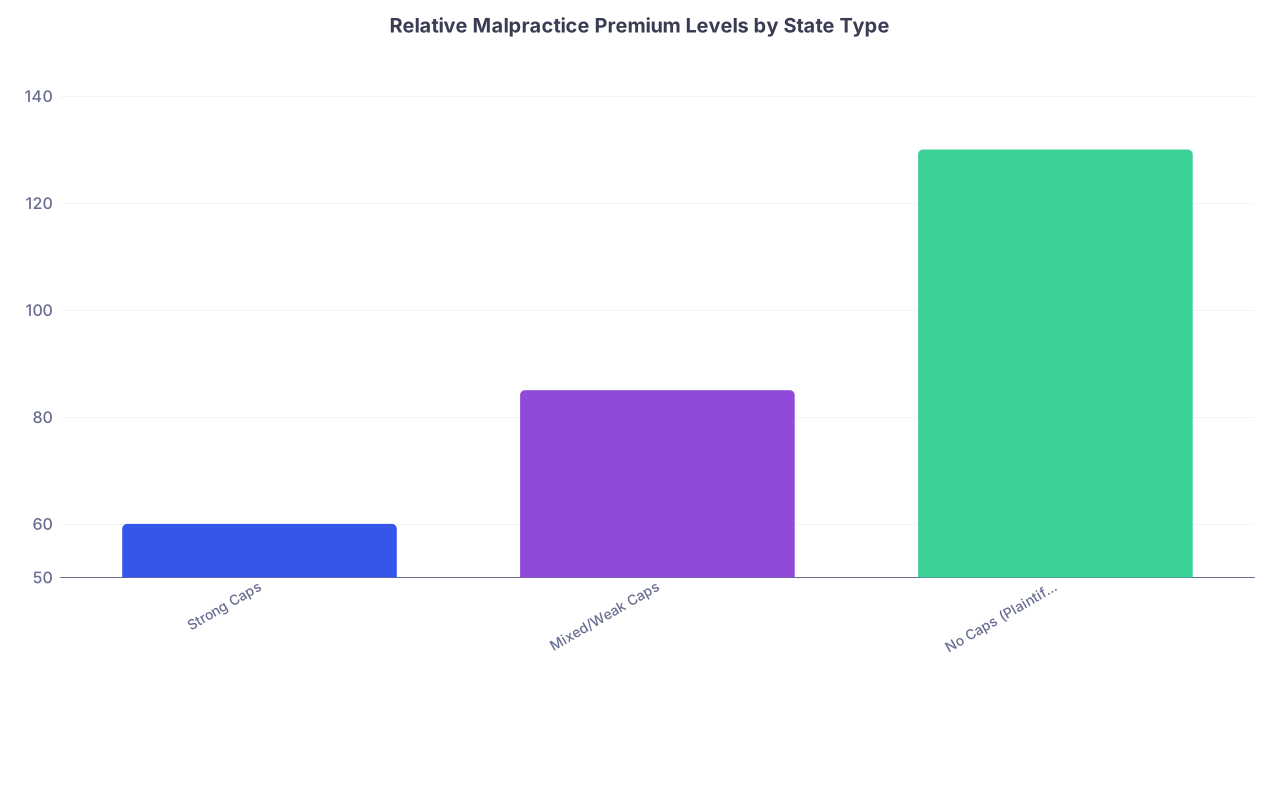
| Category | Value |
|---|---|
| Strong Caps | 60 |
| Mixed/Weak Caps | 85 |
| No Caps (Plaintiff Friendly) | 130 |
(Think of those numbers as approximate relative premium indices for comparable surgeons—insurers actually model this with much more granularity.)
2.2 Settlement Strategy Under Tort Caps
This is where you feel the impact on a day-to-day level.
In a cap state, defense counsel and insurers know there is a predictable ceiling on key parts of the damages. That gives them:
- Stronger negotiation leverage early, because plaintiffs’ attorneys know the top line is bounded.
- Ability to calculate “worst-case” exposure more cleanly.
- Less fear of runaway jury verdicts, so they can roll the dice at trial more often.
In practice, what I have seen:
- In Texas, a clear-liability case with significant but not devastating economic damages and a sympathetic plaintiff might still get tried because the non-economic piece is capped and the economic side is well-characterized.
- In California pre-MICRA changes, defense would simply pencil out: Economic X + 250k non-economic, discount slightly for litigation risk, and make what they called a “MICRA number” offer.
If you wonder why your carrier occasionally refuses to settle what you perceive to be a bad case in a cap state, this is why: they know their upside and downside much better than you do. The cap gives them cover to be aggressive.
2.3 Caps vs. Policy Limits: Which One Actually Matters?
Critical distinction: a statutory cap is a ceiling on what the plaintiff can recover, not on what the insurer will pay.
The relevant scenarios:
- If the jury verdict (or settlement) is below both your policy limit and the statutory cap, the cap is irrelevant to actual payout.
- If the potential verdict exceeds your policy limit but is below the cap, you are exposed personally above the policy limit unless your policy includes certain protections (like consent-to-settle clauses, excess policies, or insurer commitment not to seek contribution).
- If the potential verdict exceeds both your policy limit and the cap, the cap becomes your de facto protection—assuming the cap is constitutional and not later invalidated.
You never want to rely on a cap as your personal asset protection plan. Those caps get challenged in court. They get eroded by “exceptions.” They get interpreted badly by appellate courts.
Your policy limit is within your control. Tort caps are not.
3. Immunity Laws: Who Gets Shielded, Who Gets Thrown Under the Bus
Now to immunity. This is where physicians make the most dangerous assumptions.
“Immunity” in this context does not mean “no lawsuits.” It usually means modified liability, procedural hurdles, or liability that is shifted to a government entity or special fund.
Common flavors:
- Sovereign immunity (state-employed physicians, public hospitals, some university systems).
- Qualified immunity for physicians working under certain federal umbrellas, such as FQHCs (via FTCA coverage).
- Good Samaritan protections (very narrow; wildly overestimated by clinicians).
- Statutory immunity for specific activities (e.g., mandated reporting, certain emergency services, public health activities).
Let’s walk through how these interact with malpractice insurance.
3.1 FTCA and FQHCs: The “You Are the Government Today” Scenario
If you work for a Federally Qualified Health Center (FQHC) that is “deemed” under the Federal Tort Claims Act (FTCA):
- The federal government is the defendant, not you personally.
- FTCA coverage usually replaces the need for private malpractice insurance for actions within the scope of your FQHC duties.
- The case proceeds in federal court, with bench trials (no jury) and liability standards defined by federal law and incorporated state law elements.
This sounds like a dream. No need for private coverage for that part of your practice.
Reality check:
- FTCA coverage usually applies only to care provided within the defined scope of the FQHC’s grant and your official duties. Step outside that, and you fall back on your own malpractice policy (if you have one).
- Many physicians working part-time at FQHCs still need separate policies for non-FTCA-covered activities (moonlighting, hospital privileges, telemedicine, etc.).
- Plaintiffs’ attorneys know who is FTCA-covered and who is not. If there is a non-immune co-defendant with deeper pockets (private hospital, non-deemed specialist), they will be strategically targeted.
So your “immunity” shifts the suit’s target. It does not remove malpractice risk from the system.
3.2 State Sovereign Immunity and Public Hospitals
If you are employed by a state university hospital or a county facility with statutory protections:
- Claims may be subject to strict notice requirements, short statute of limitations, and damage caps specific to public entities.
- In some states, you are technically sued in your “official capacity,” which channels the liability to the governmental entity, not your personal assets.
- The governmental risk pool or self-insurance program usually provides the functional equivalent of malpractice coverage.
How this interacts with private malpractice insurance:
- Many academic physicians still carry separate policies that cover non-immune work (e.g., side gigs, consults outside the hospital system, telehealth through a separate entity).
- If there is a dispute about whether the act was within the scope of employment or not, coverage can get messy: the state argues you were acting outside your role; your carrier may argue it falls under a policy exclusion (e.g., unlisted location, uninsured entity).
- Plaintiffs may strategically sue private entities alongside the public hospital to escape or dilute sovereign immunity protections.
In some states, your immunity is not as ironclad as your HR department brochure implies. You must know exactly which activities are inside that sovereign shield and which are not.

3.3 Good Samaritan Laws: The Most Overrated “Protection” in Medicine
Every physician I have ever spoken with overestimates Good Samaritan protections. Everyone thinks if they help at a roadside accident or respond to an in-flight emergency, they are safe.
Reality:
- Many Good Samaritan statutes only apply when you are rendering emergency care without expectation of compensation.
- They often protect against ordinary negligence but not gross negligence or willful misconduct.
- They vary wildly by state and can be riddled with exceptions (e.g., not applicable if the patient was already in a hospital setting and you had a preexisting duty).
Interaction with malpractice insurance:
- Most standard malpractice policies cover you only for activities you perform in your professional capacity and within the definition of “professional services” in the policy.
- Some policies expressly extend to Good Samaritan acts; others do not, or only in certain jurisdictions.
- Even if you have Good Samaritan statutory immunity, you may still be sued. The statute is a defense, not a force field. Your carrier still has to defend the lawsuit if there is potential coverage.
If your carrier denies coverage because the activity falls outside the policy scope and the Good Samaritan statute is narrower than you think, you could end up defending yourself until the immunity claim is sorted out.
4. How Plaintiffs’ Attorneys Exploit Gaps Between Caps, Immunity, and Coverage
Plaintiffs’ firms in high-volume med mal states do not file blind. They study insurance.
You will see certain patterns:
- Suing the entity that is not immune and has the highest limits.
- Adding product liability claims against device manufacturers or pharmaceutical companies to escape medical malpractice-specific caps.
- Pleading causes of action that fall outside the med mal statute to dodge special damage caps (e.g., negligent credentialing against the hospital, corporate negligence, EMTALA claims).
- Cover you personally but not cover certain institutional or corporate claims.
- Exclude punitive damages in jurisdictions where they are insurable, leaving you personally exposed if the cap does not apply to punitives.
- Limit coverage for vicarious liability for mid-level providers unless they are specifically scheduled on the policy.
You do not see this in the glossy brochure. You see it when a plaintiff’s lawyer files a 40-page complaint and your defense counsel starts parsing which counts are covered, which are capped, and which dodge both.
5. Specific Interaction Patterns You Need to Recognize
Now let us get concrete. Here are the recurring configurations I see that matter for you.
5.1 High-Risk Specialty in a Non-Cap State
Example: OB-GYN in New York or Florida (post-cap invalidation).
Key realities:
- No reliable non-economic cap. Catastrophic infant injury case can easily reach eight figures in a verdict.
- Your “standard” $1M/$3M limits are absolutely inadequate as a true worst-case shield.
- Plaintiffs’ lawyers know insurers hate “nuclear verdict” jurisdictions, so they push cases toward trial and maximize venue advantages.
How malpractice insurance responds:
- Very high premiums, sometimes to the point of driving physicians out of OB.
- Heavy use of risk management programs and loss control as leverage to keep you insured.
- Strong pressure to settle earlier and for larger sums than in cap states, to avoid unpredictable juries.
Your move:
- Consider higher primary limits or excess coverage.
- Understand whether your hospital provides any indemnity backing or excess layer for on-staff physicians.
- Recognize that in a non-cap environment, your personal asset-protection planning matters much more (LLCs, homestead protections where available, retirement accounts).
5.2 Mid-Risk Specialty in a Strong Cap State
Example: General surgeon in Texas with $1M/$3M coverage.
Here, the tort environment does a lot of the work for the insurer:
- Predictable upper bounds on non-economic damages.
- Procedural requirements (e.g., expert report deadlines) that knock out weak cases early.
- Lower volume of truly catastrophic verdicts.
Practical effect:
- Premiums relatively lower.
- Jury trials are less terrifying for insurers and sometimes favored if the plaintiff refuses to discount enough for the cap.
- You are less likely to face personal exposure beyond limits if you maintain reasonable coverage.
Does this mean you can skimp on limits? No. Economic damages can still be substantial, and caps can be reformed or invalidated over time. But in the short term, the tort cap environment does blunt the edge.
5.3 Dual-Role Physicians: Immune + Private Work
Example: Academic hospitalist who also does part-time telemedicine or locums tenens.
Key issue: different legal regimes in play at the same time.
- In your state-funded teaching hospital, you may be under sovereign immunity caps and covered by a state risk pool.
- In your telemedicine work spanning multiple states, you rely on a private malpractice policy that must be properly endorsed for multi-state practice.
The trap:
- An incident occurs that arguably straddles both roles—for example, a complex follow-up via telehealth with a university patient seen under a separate contract structure.
- The state entity argues the encounter is outside the scope of your public employment.
- The private carrier argues it is within the scope of an excluded activity (e.g., unlisted location, non-covered entity, or state-specific restriction).
Meanwhile, the plaintiff’s attorney is deliberately framing the case to hit the most favorable jurisdiction and the deepest pocket.
Your defense is only as strong as the agreements and policy declarations you actually signed, not what departmental leadership “assumed.”

| Step | Description |
|---|---|
| Step 1 | Clinical Event |
| Step 2 | Standard malpractice policy |
| Step 3 | State risk pool and caps |
| Step 4 | FTCA coverage federal court |
| Step 5 | Lower max exposure |
| Step 6 | High verdict potential |
| Step 7 | Where did it occur |
| Step 8 | State immunity? |
| Step 9 | FTCA deemed? |
| Step 10 | State tort caps? |
6. Policy Language That Determines How Caps and Immunity Hit You
You do not need to memorize every clause, but there are several specific things to look for in your declaration page and policy wording.
Jurisdiction and venue coverage
Does your policy clearly state which states and locations are covered? Telemedicine often crosses into states with very different tort caps. You want explicit multi-state coverage if you practice across lines.Consent to settle
In cap states, carriers may be more willing to roll the dice at trial. If your policy gives the insurer unilateral right to settle or try the case without your consent, you are at their mercy. “Pure consent” clauses (where they need your agreement) are protective but rarer. Some policies have “hammer clauses” (if you refuse a recommended settlement, your financial exposure may increase).Coverage of governmental or immunity-related work
If you have FTCA or sovereign coverage for part of your work, your private policy should clearly coordinate with it. Some carriers exclude any claim that could arguably fall under another coverage mechanism, which can be a nightmare when the government and the carrier both deny primary responsibility.Punitive damages and non-compensatory awards
In some jurisdictions, caps apply only to compensatory damages. Punitive awards may sit outside caps and may be either uninsurable by law or excluded by your policy. If a plaintiff pleads punitive damages to dodge caps and your policy excludes them, that excess is aimed directly at your personal assets.Entity vs. individual coverage
Caps sometimes differ for individuals vs. institutions. Your policy may cover you as an individual but not the LLC, corporation, or group entity. Plaintiffs’ attorneys will aim at the structure with the weakest combination of caps and coverage.
7. How to Actually Use This Knowledge
You are not going to become a med mal coverage attorney. You do not need to. But you can stop being blind to how caps and immunity shape your real-world risk.
Here is what I would do if I were practicing now:
- Get a one-page summary from a competent health-care attorney or risk manager explaining:
- Your state’s med mal damage caps (economic vs non-economic, total vs partial, special rules for public entities).
- Applicable immunity structures that affect your practice (FTCA, sovereign immunity, Good Samaritan scope).
- Sit down with your broker or carrier rep and ask explicitly:
- “How do my policy limits align with worst-case exposure under our state’s caps?”
- “Which parts of my work are governed by immunity or government coverage versus this policy?”
- “If a single clinical event triggers multiple legal regimes, which coverage responds first?”
- Review your declarations page and endorsements with a single lens:
- Are all the states you practice in listed?
- Are all entities you practice through either named or clearly included?
- Is there any express exclusion for governmental or FTCA-covered work that could cause finger-pointing later?
You are not trying to rewrite the system. You are just making sure the interactions between malpractice insurance, caps, and immunity are not stacked against you without your knowledge.
8. The Bottom Line
Three key points, without sugarcoating:
- Tort caps protect insurers’ balance sheets, not your career. They shape pricing and settlement leverage but do not eliminate your need for adequate limits or good legal advice.
- Immunity laws shift and fragment liability. They may move risk to governments or special funds, but they also create gaps where carriers and public entities argue over who is responsible while you are stuck in the middle.
- Your real malpractice risk is the intersection of caps, immunity, and policy language. If you do not understand that intersection for your exact practice setup, you are trusting luck instead of design.