
The most common mistake MS4s make about malpractice insurance is simple: they assume “the hospital handles it” and stop asking questions. That’s how you end up exposed, confused, or stuck with a tail policy bill you did not see coming.
Let’s walk the clock from Match Day to orientation, and I’ll tell you exactly what you should be doing, week by week, to avoid that.
Big Picture: What You’re Solving For (Before We Get Chronological)
Before we go month-by-month, you need a working mental model. Without it, every email from GME sounds like legal soup.
At this point you should understand 4 core concepts:
Who covers you:
- Almost all residency programs provide malpractice coverage. But the details vary: occurrence vs claims-made, tail coverage, moonlighting coverage, etc.
When coverage starts:
- Usually your official start date (July 1 for most).
- There is generally no coverage as a student after graduation, unless explicitly extended.
What limits mean:
- You’ll see numbers like $1M/$3M or $2M/$4M.
- First number = max per claim.
- Second number = max total per year.
What can go wrong:
- Working a “transition” or “pre-residency” job with zero coverage.
- Moonlighting without confirming (in writing) that you’re insured.
- Claims-made coverage with no tail if you change programs or have a gap.
Now we lay it out on a timeline.
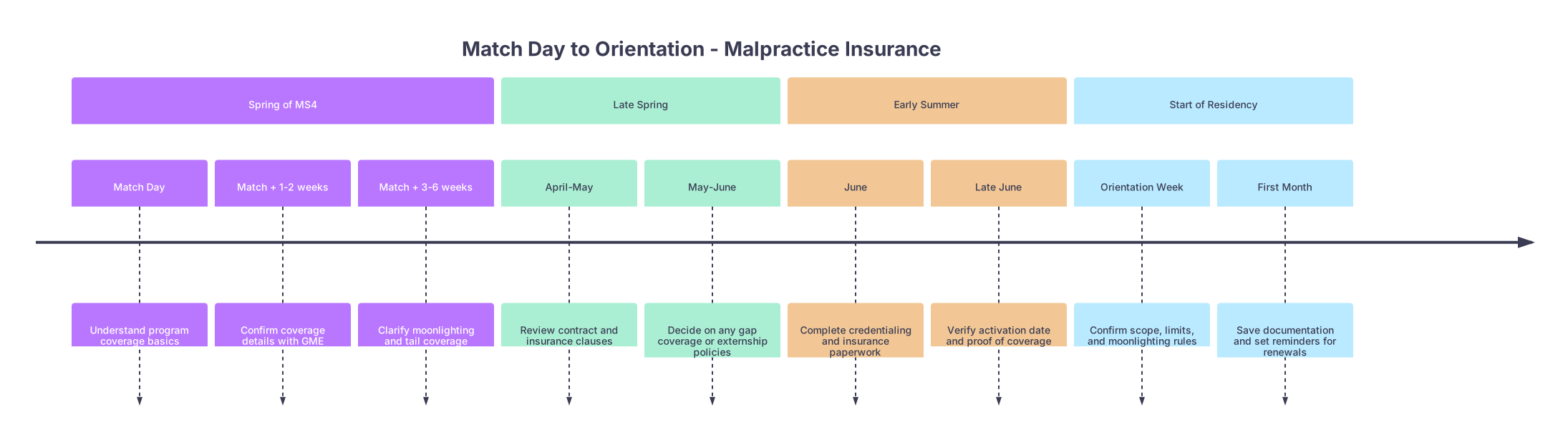
Timeline Overview: Match Day → Orientation
| Period | Event |
|---|---|
| Spring of MS4 - Match Day | Understand program coverage basics |
| Spring of MS4 - Match + 1-2 weeks | Confirm coverage details with GME |
| Spring of MS4 - Match + 3-6 weeks | Clarify moonlighting and tail coverage |
| Late Spring - April-May | Review contract and insurance clauses |
| Late Spring - May-June | Decide on any gap coverage or externship policies |
| Early Summer - June | Complete credentialing and insurance paperwork |
| Early Summer - Late June | Verify activation date and proof of coverage |
| Start of Residency - Orientation Week | Confirm scope, limits, and moonlighting rules |
| Start of Residency - First Month | Save documentation and set reminders for renewals |
We’ll go through each phase with “at this point you should…” checklists.
Phase 1: Match Day to Week 2 – Get Oriented to Your Program’s Coverage
Match Week (Day 0–7)
At this point you should:
- Identify the type of program and typical insurer structure
- University-based academic center
- Community program affiliated with a big system
- Small community hospital, independent
Why it matters: university systems often have self-insured trusts; community hospitals may use commercial carriers (e.g., MedPro, The Doctors Company). Terms differ.
Read the offer email and any attached “Benefits Summary”
- Look specifically for:
- “Professional liability insurance”
- “Malpractice coverage”
- “Limits of liability”
- “Tail coverage” or “extended reporting”
- Look specifically for:
Start a dedicated “Residency Legal & Financial” folder
- Subfolders:
- Contract
- Malpractice
- Moonlighting
- Licensure
- You’ll thank yourself when credentialing asks for something 2 years from now.
- Subfolders:
At this point you are not emailing GME with a list of 20 questions. You’re just gathering what’s already written.
Phase 2: Weeks 2–6 After Match – Nail Down the Details (Quietly and Clearly)
By the end of week 6 after Match, you should be able to answer the following without guessing:
- Is my coverage occurrence or claims-made?
- Who pays for tail coverage, if needed?
- What are the limits?
- Does it cover me only at the main hospital, or all affiliated sites?
- Am I covered for moonlighting? If yes, where and under what conditions?
Week 2–3: First Contact with GME
This is where you stop assuming and start confirming.
At this point you should:
Find the right contact
- Usually:
- GME office coordinator
- Program coordinator
- Occasionally HR Benefits
- Usually:
Send one focused email (not a five-page manifesto)
Example structure:
- Subject: “Incoming PGY-1 – Malpractice Coverage Questions”
- Body (short and clear):
- Ask:
- Type of policy (occurrence vs claims-made)
- Limits (per claim / per year)
- Whether tail is provided if you leave the program or system
- Whether policy covers all training sites
- Ask:
This is a 5–6 sentence email. Nobody reads a wall of text; they just forward it to the legal office.
- Record the answers – don’t leave them in your inbox
- Copy details into a one-page “Coverage Snapshot” for yourself:
- Insurer / trust name
- Policy type
- Limits
- Tail: who pays, under what conditions
- Moonlighting: covered or not, conditions
- Copy details into a one-page “Coverage Snapshot” for yourself:
Week 4–6: Moonlighting, Gaps, and Edge Cases
You’re still in MS4 land, but your future self as a tired PGY‑1 will thank you if you sort this now.
At this point you should:
Clarify moonlighting coverage rules
- Ask specifically:
- Does the residency’s malpractice policy cover any moonlighting?
- Only in-house moonlighting? (e.g., extra ER shifts in your own hospital)
- Is a separate policy required for outside moonlighting?
- When in training can you moonlight (PGY‑2+, fully licensed only, etc.)?
- Ask specifically:
Understand coverage for pre-residency work
- Common scenarios:
- “Transitional” ED scribe or “physician assistant” type roles abroad
- Locums‑style work under supervision in another country
- Paid “sub‑I” style positions between graduation and July
- Reality: Most US residency malpractice policies do not cover anything before your official start date.
- If you’re considering any paid clinical role in that gap:
You either need:- The employer to provide malpractice, in writing
- Or your own short-term policy (expensive and rarely worth it as a fresh grad)
- Common scenarios:
If you matched prelim + advanced (e.g., prelim year + advanced radiology/derm)
- You must treat each program separately:
- Separate contracts
- Separate malpractice policies
- Key questions:
- Does the prelim program provide tail when you leave after 1 year?
- Does the advanced program’s coverage start exactly when you arrive?
- You must treat each program separately:
Phase 3: Late Spring (April–May) – Contract, Clauses, and Comparison
By late spring, you’ll usually have your formal residency agreement or contract. This is the moment most people skim and sign. Do not.
At this point you should:
Find and mark the malpractice clause
- Typical headings:
- “Professional Liability Coverage”
- “Malpractice Insurance”
- What you want to see:
- Clear statement that the hospital provides coverage for your duties as a resident
- Statement that coverage meets state requirements
- Ideally some mention of tail or ongoing protection for acts during training
- Typical headings:
Compare common patterns
| Program Type | Policy Type | Typical Limits | Tail Coverage |
|---|---|---|---|
| Large university | Occurrence | $1M / $3M | Not needed (built-in) |
| Big health system | Claims-made | $1M / $3M | Usually system-paid |
| Small community | Claims-made | $1M / $3M | Sometimes not clear |
| County hospital | Governmental | Varies by law | Often statutory |
| Military program | Federal | N/A (FTCA) | Covered by government |
If claims-made: read carefully about termination
- Clauses to look for:
- “Upon completion of training, the institution will provide extended reporting”
- Or: “Trainee is responsible for any tail coverage required”
- If it says you pay for tail, that’s a problem. As a resident salary earner, you do not want to be stuck with a 5-figure tail bill if you switch programs or take a gap year.
- Clauses to look for:
If anything is unclear or missing
- This is when you politely ask:
- Your program director
- Or GME – “Can you clarify how tail coverage is handled when residents graduate or transfer?”
- This is when you politely ask:
Not angry. Just precise. You are trying to see the whole chessboard before July.
Phase 4: Late Spring to Early Summer (May–June) – Credentialing and Gap Coverage
You’re finishing MS4, maybe traveling, maybe doing a lighter elective. Meanwhile, the hospital is secretly building a thick file on you for credentialing.
May: Decide If You Need Any Personal Coverage
Most MS4s will not need an individual malpractice policy. A few specific groups may:
- You’re doing paid telemedicine as a new grad before residency
- You’re working internationally in a setting that wants proof of personal coverage
- You’re entering a non‑ACGME or non‑standard training track that doesn’t clearly state coverage
At this point you should:
Be brutally honest about your activities post‑graduation
- If it’s:
- Non‑paid clinical observership → usually no malpractice needed
- Short‑term volunteer trip → often covered by the sponsoring org (but get proof)
- Paid physician work anywhere → assume malpractice is required unless explicitly stated otherwise
- If it’s:
If you truly need coverage
- Contact:
- A malpractice broker that works with new grads
- Expect:
- High cost relative to your income
- Lots of underwriting questions (scope of practice, procedures, supervision)
- Contact:
If your answer to “am I independently seeing patients and making medical decisions for money outside approved institutional coverage?” is no, you likely don’t need your own separate policy.
Late May–June: Residency Paperwork and Proof of Coverage
This is where the GME office starts drowning you in forms. Somewhere in that pile, malpractice shows up, often hidden.
At this point you should:
Track what you sign that mentions liability
- Professional staff applications
- Privileging forms
- Any “hold harmless” or “indemnification” language
Watch for any requirement to provide your own coverage
- Rare for standard US residencies.
- If you see language like “resident shall procure and maintain professional liability insurance,” stop and clarify. That’s not normal for a standard ACGME slot.
Ask for written confirmation of policy details
- Many hospitals will give you:
- A certificate of insurance (COI) per request
- Or a generic summary letter for residents
- Many hospitals will give you:
Keep this. Save the PDF. You may need to show it when applying for a moonlighting gig or external rotation later.
Phase 5: Late June – The Activation Details
You’re moving, signing leases, scanning a million documents. This is also when the insurance actually “turns on”.
At this point you should:
Confirm your effective date
- Usually the same as your start date (e.g., July 1)
- Ask GME or HR:
- “Is my professional liability coverage active as of my official start date, including orientation activities?”
Understand what’s covered during orientation
- Many programs do:
- EMR training with fake patients → no issue
- Sim lab and BLS/ACLS → simple
- But some have:
- “Shadow” clinical time, especially in ED or wards
- Make sure you’re under the umbrella from day 1 if you’re in real patient care settings.
- Many programs do:
Check for any requirement to show proof to the state board
- Some states, for training licenses, want confirmation that you’re covered.
- Usually GME sends this automatically, but if you haven’t seen anything by late June and your start date is close, ask.
Orientation Week – Final Reality Check
Orientation is chaotic: HR videos, EMR training, ID badges, payroll.
Somewhere in that madness, they will talk about malpractice. You should not zone out.
At this point you should:
Listen for answers to these specific questions
- Are residents covered:
- Only at the main campus, or all affiliated clinics?
- During off‑site rotations (VA, children’s hospital, private practice clinics)?
- Any activity that’s not covered?
- Unauthorized moonlighting
- Volunteering in clinics not formally affiliated with the hospital
- Serving as an expert witness (yes, this comes up)
- Are residents covered:
Ask in the large-group Q&A or afterwards
- “Can you clarify whether our malpractice policy covers in‑house moonlighting?”
- “If we do an away elective or global health rotation, is coverage automatic or case-by-case?”
It takes 20 seconds to ask and can save you from a nasty surprise.
- Get a copy of whatever they show you
- Slides about resident benefits and malpractice
- Policy summaries on the GME website
- Any handbook pages describing your coverage
Screenshot if you must. Document now, rely on memory later is how people get burned.
First Month as a Resident – Lock Down Your Paper Trail
The malpractice question mostly goes quiet once you start. That’s the trap. People forget the details until they want to moonlight or switch programs.
At this point you should:
Create a one-page “Malpractice Snapshot” and save it
- Include:
- Hospital / System name
- Policy type (occurrence or claims-made)
- Limits (per claim / per year)
- Tail coverage: who provides/pays, under what conditions
- Coverage scope (sites, rotations)
- Moonlighting rules (covered / not covered / conditions)
- Date you last confirmed this + source (email, orientation slides, etc.)
- Include:
Set two calendar reminders
- 6 months in: revisit moonlighting rules if you’re considering extra shifts
- 18–24 months in: re‑check tail coverage before any plan to transfer, switch specialties, or leave
If you pick up any “extra” work
- Before saying yes, you ask:
- Is this under the hospital’s existing policy?
- Will I get a written statement that I’m covered for this specific role?
- If not: you walk away or they provide separate coverage, in writing.
- Before saying yes, you ask:
Quick Reality Check: What You Do NOT Need to Obsess Over
You do not need to:
- Become an insurance lawyer.
- Read every line of the hospital’s full policy document (it’s often 100+ pages).
- Buy your own malpractice insurance “just in case” if your program already fully covers your role as a resident.
You do need to:
- Know the policy type.
- Know who pays for tail.
- Know whether moonlighting is covered.
That’s the core.
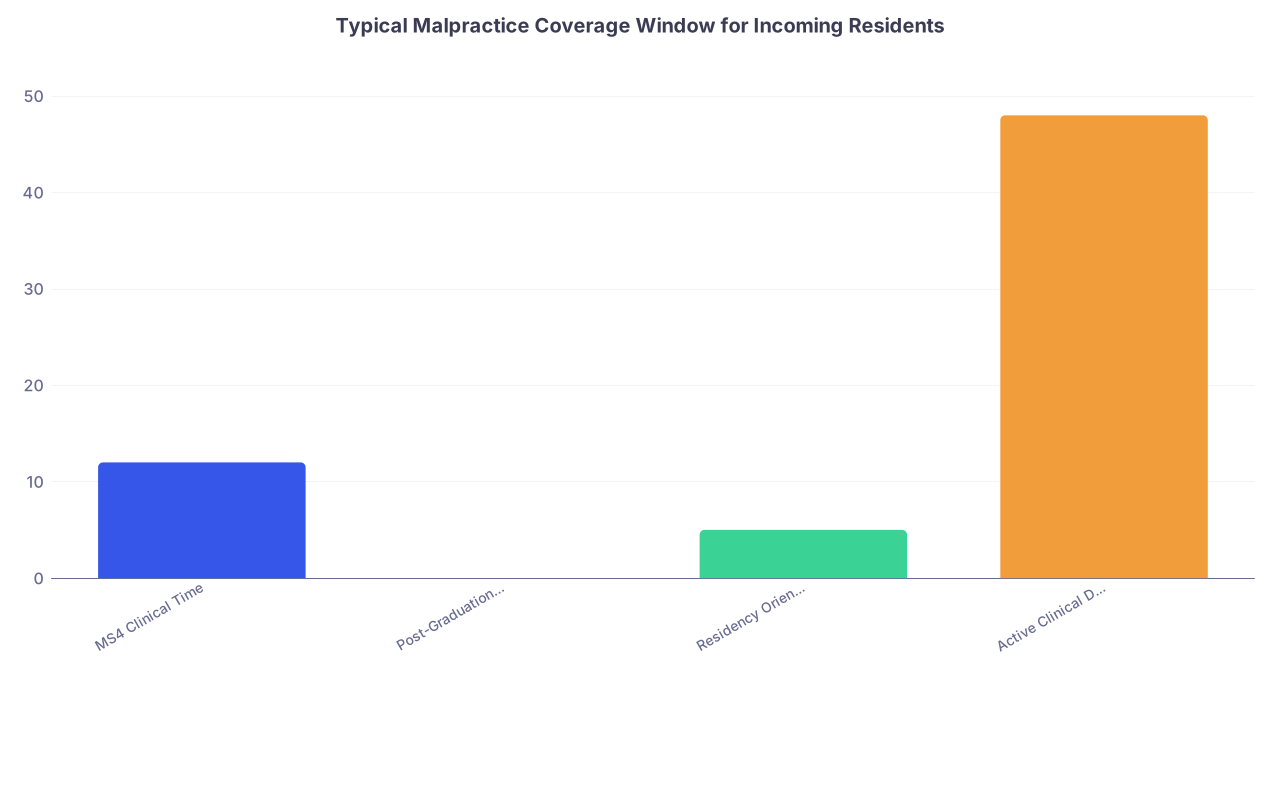
Visual Snapshot: When Coverage Typically Starts and Ends
| Category | Value |
|---|---|
| MS4 Clinical Time | 12 |
| Post-Graduation Gap | 0 |
| Residency Orientation Week | 5 |
| Active Clinical Duties PGY-1 | 48 |
Interpretation:
- MS4 clinical time: covered by school/hospital policies while a student.
- Post‑graduation gap: often zero coverage unless arranged separately.
- Orientation week: short period, usually covered once you’re an official employee.
- Active clinical duties: bulk of your covered time, but under resident policy, not student policy.
If You’re Switching Programs or Doing a Prelim Year
One last scenario that bites people.
At this point (as soon as you even think about switching) you should:
- Re‑read your current contract’s malpractice section.
- Confirm:
- If you leave early, do you still get tail coverage?
- Does coverage extend to all acts while you were there, regardless of why you left?
- Before signing with a new program:
- Confirm their coverage starts on your first day there.
- Avoid any gap between policies, especially if you’re doing locums or moonlighting between programs (which I do not recommend as a trainee).
If your current program expects you to pay for tail to leave early, that’s a serious red flag and deserves a conversation with GME and, if needed, a legal consult.
Bottom Line: What You Must Have Done by Orientation
By the time you sit in that auditorium on Day 1, you should:
- Know your policy type and tail situation
- Have written confirmation (email or document) of coverage limits and scope
- Understand, at least in broad strokes, what is not covered (especially moonlighting and off-site work)
Everything else is details.
If you handle this once, cleanly, between Match Day and orientation, you won’t have to scramble 2 years from now when someone asks: “Are you sure you’re covered for this?”