The biggest malpractice risk in leaving a group practice is not your last patient. It is your last 90 days of paperwork, contracts, and tail coverage decisions.
If you get this timeline wrong, you can do everything else perfectly and still end up uninsured, in a coverage dispute, or paying for a tail you did not need—or worse, assuming someone else paid it when they did not.
I’m going to walk you through those final 90 days, week by week, so you know exactly what to do and when.
90–61 Days Before Your Last Day: Clarify the Ground Rules
At this point you should stop guessing and start reading. The next 2–4 weeks are about one thing: knowing precisely who is responsible for tail coverage and what deadlines apply.
Step 1: Pull Every Relevant Contract (Day 90–80)
In your first 10 days of this 90-day window, sit down and gather:
- Your employment agreement
- Any shareholder/partner agreements
- Practice bylaws or operating agreement (for groups/LLCs)
- The malpractice policy declarations page
- Any separate malpractice agreements or addenda
- Your state medical board's rules on coverage/claims-made policies (often online)
You’re looking for language like:
- “Claims-made policy”
- “Tail coverage” / “extended reporting endorsement”
- “Prior acts coverage” / “nose coverage”
- “Employer shall provide…”
- “Physician shall be responsible for…”
At this point you should make a one-page summary for yourself:
- Current carrier:
- Policy type (claims-made vs occurrence):
- Limits (e.g., $1M/$3M):
- Retroactive date:
- Who is named insured (you or the group):
- Contract language on tail responsibility (quote exact clause):
- Notice period required to terminate or change coverage:
That one sheet will save you from a lot of “I thought you were paying for that” conversations.
| Clause Type | What It Usually Means |
|---|---|
| Employer pays tail | Group buys tail if they terminate you without cause |
| Physician pays tail | You pay if you resign or are terminated for cause |
| Cost-sharing provision | Tail split by formula (years worked, revenue, etc.) |
| Silent on tail | Ambiguous, often ends in dispute—get legal review |
| Nose coverage allowed | New employer can cover prior acts instead of tail |
Step 2: Confirm Policy Type and Retro Date (Day 80–75)
If your current policy is occurrence, tail coverage is usually not needed for that period. If it’s claims-made, tail or prior acts coverage is non-negotiable.
At this point you should:
- Call the malpractice broker or carrier directly.
- Ask for:
- Confirmation of policy type
- Your retroactive date
- Whether the policy is individual or part of a group policy
- Standard options and pricing for tail (e.g., 1-year, 5-year, unlimited)
- Whether the carrier allows tail purchase after policy expiration, and for how long (some give 30–60 days; miss that, and you're done)
Write down names, dates, and responses. Future you—and your lawyer—will be grateful.
Step 3: Check State and Hospital Requirements (Day 75–70)
This part gets ignored until credentialing blows up:
- Your state or hospital may require continuous coverage without gaps.
- Some hospitals require proof of tail coverage as part of resigning or transferring privileges.
- Certain states have patient compensation funds or special limits requiring specific tail terms.
At this point you should:
- Review your hospital staff bylaws or medical staff office policies.
- Email the medical staff office:
- Ask what they require for physicians leaving the medical staff regarding malpractice and tail.
- If you're moving to a new hospital:
- Ask their credentialing office what they require for prior acts proof.
60–46 Days Before Your Last Day: Decide Who Pays Tail and How
By now, you know what your contract says, what your policy is, and what your state/hospitals will accept. Next 2 weeks: negotiating and planning.
Step 4: Have the Tail Coverage Conversation With the Group (Day 60–55)
Do this before you submit final resignation letters or negotiate your separation agreement (if possible).
At this point you should:
- Ask practice leadership or HR:
- “How is tail typically handled for departing physicians?”
- “What has been done in the last 3 departures?” (People will often tell you stories.)
- If your contract says employer pays, confirm:
- In writing, that the group will purchase tail.
- What limits and duration they will buy (unlimited is standard in many policies).
- If your contract says you pay, clarify:
- Whether you can access any group-negotiated rates.
- Whether they’ll let the coverage stay in place short-term so your new employer can pick up prior acts.
Do not rely on hallway conversations. Get an email. “As we discussed, you confirmed that the group will purchase unlimited tail coverage on my current policy…”.
Step 5: Get Tail and Nose Coverage Quotes (Day 55–50)
You cannot choose intelligently until you know the numbers.
Call:
- Your current malpractice carrier for tail quotes
- Potential new employers’ carriers or a broker for prior acts (nose) coverage
At this point you should push for side-by-side numbers:
| Option | One-Time Cost | Coverage Scope |
|---|---|---|
| Carrier A – Unlimited Tail | $45,000 | All prior acts at group |
| Carrier A – 5-Year Tail | $30,000 | Claims first made in 5 yrs |
| New Employer Nose Cover | $8,000/year | Prior acts + new practice |
| Do Nothing (not allowed) | $0 | Massive uncovered risk |
Key questions to ask the carrier or broker:
- Is the tail premium a one-time, non-refundable payment?
- Are there cheaper tail options (shorter duration) and are they acceptable to:
- Your state
- Your hospital(s)
- Your risk tolerance
- Will your new employer’s policy:
- Match or exceed current limits
- Backdate the retroactive date to your original start date with the group
Step 6: Loop in an Attorney if Anything Is Fuzzy (Day 50–46)
If your contract is vague, conflicting, or the group is trying to change the rules on the way out:
At this point you should:
- Spend 1–2 hours with a healthcare attorney, not a random generalist.
- Ask for:
- A written interpretation of the contract language around tail.
- A short list of bargaining positions you can reasonably push.
- A quick review of any proposed separation agreement language about malpractice.
That hour will cost much less than paying a full tail that should have been the group’s responsibility.
45–31 Days Before Your Last Day: Lock in the Coverage Plan
Now you know who should pay and what your options are. This month is about getting commitments and paperwork started.
Step 7: Decide: Tail vs Nose (Day 45–40)
You should now choose one of three paths:
- Group buys tail (best if contractually required)
- You buy tail personally
- New employer buys prior acts coverage (nose) and group keeps policy in place until transition
At this point you should ask yourself:
- Am I 100% certain the new job will happen (contract actually signed, not just verbal)?
- Is the new carrier reputable and stable?
- Do their limits and policy terms meet or exceed what I had?
If your future role is even slightly uncertain, leaning toward a carrier-provided unlimited tail from your current insurer usually makes sense. Nose coverage is great—when the new job actually happens and stays stable.
Step 8: Coordinate With the New Employer (Day 40–35)
If you are moving to another practice or hospital:
At this point you should:
- Send their HR/credentialing your:
- Current policy declarations page
- Retroactive date
- Any hospital requirements you’ve learned about tail
- Ask explicitly:
- “Will your malpractice carrier provide prior acts coverage back to [retro date]?”
- “Will you cover the cost of prior acts coverage?”
- “Does your offer letter or employment contract address tail/prior acts?”
Push to get this written into the offer letter or contract, not in a casual email.
If they balk at prior acts coverage or give vague answers, that’s a red flag. You may need to fall back to buying your own tail.
Step 9: Start Tail / Nose Application Process (Day 35–31)
Do not wait until the last week. Underwriters move slowly.
At this point you should:
- Request the tail endorsement application from your existing carrier.
- Or, if choosing nose coverage:
- Have the new employer’s carrier send you the supplemental prior acts questionnaire.
Prepare for:
- Detailed practice history
- Procedures performed
- Claims or incidents history
- Dates of coverage periods
You don’t want to be answering these for the first time the week before you leave.
30–15 Days Before Your Last Day: Execute and Document
Now we’re in the risk-heavy window. This is where people get sloppy.
Step 10: Finalize Tail / Prior Acts Coverage (Day 30–25)
At this point you should:
- Submit completed applications to the carrier.
- Confirm:
- Effective date of tail (usually the day after policy cancellation)
- Coverage period (unlimited vs fixed term)
- Limits of liability
Ask for a binder or written confirmation of tail or prior acts approval, not just “we received your paperwork.”
If the group is buying tail:
- Ask to be copied on the tail endorsement or get your own copy direct from the carrier.
- Verify the endorsement lists:
- Your name
- Correct retroactive date
- “Unlimited reporting period” or clear duration language
Do not assume “we always handle this” equals “you are covered appropriately.”
Step 11: Align Coverage Dates With Last Day of Practice (Day 25–20)
You want zero gaps. Not one day.
At this point you should:
- Confirm your last day seeing patients with the group.
- Match that date with:
- End date of the current claims-made policy
- Start date of tail or nose coverage (if new employer chooses to cover)
Example:
- Group policy terminates: June 30
- Your last patient encounter: June 29
- Tail effective: July 1, with retro date from original hire date
- New employer prior acts: Policy active July 15, retro date same as above
If you have a gap between jobs (say, 1–3 months off), tail still needs to be in place. Malpractice claims do not care that you were on vacation when they were filed.
Step 12: Complete Separation Agreement and Credentialing Notices (Day 20–15)
If there’s a formal separation agreement:
At this point you should:
- Ensure the malpractice section clearly states:
- Who will purchase tail or prior acts.
- The deadline for purchase.
- Required proof (copy of endorsement, letter from carrier, etc.).
- Avoid vague wording like “physician shall be responsible for arranging adequate coverage.” Adequate means nothing in court. You want specifics.
Notify:
- Hospitals where you hold privileges
- Ambulatory surgery centers
- Major payors if required (some credentialing forms ask for proof of continuing coverage)
They’ll often ask for:
- Proof of tail or continuing coverage
- New practice information if applicable
14 Days to Last Day: Tighten Clinical and Documentation Risk
You’re almost out clinically. Now the malpractice risk shifts to what’s in the chart and what gets handed off.
Step 13: Clean Up High-Risk Patient Panels (Day 14–10)
At this point you should:
- Identify:
- High-risk patients (complex comorbidities, diagnostic uncertainty, frequent ER visits).
- Patients with pending test results or biopsies.
- Patients mid-workup (e.g., breast mass awaiting imaging, abnormal labs under evaluation).
For each, decide:
- Who will take over their care in the group.
- Whether they need:
- A specific transition note.
- A follow-up appointment scheduled before you leave.
- Direct communication (e.g., “I’m leaving on X date; Dr. Y will be your new physician.”).
Document clearly in the chart:
- Handoffs
- Pending results
- Future plan
Future plaintiffs’ attorneys will read your final notes line by line. Make them boringly clear.
Step 14: Close Out Open Results and Messages (Day 10–5)
This is where loose ends become lawsuits.
At this point you should:
- Review:
- All open lab/imaging orders
- All “results to be reviewed” queues
- Outstanding referrals
- In-basket messages (EMR inbox)
Resolve or reassign:
- If you can, close the loop before you go.
- If not, create a formal handoff note in the EMR flagging:
- What’s pending
- Who is assuming responsibility
- Any time-sensitive concerns
If your EMR allows, print or export a “pending items” report and review it line by line.
Final Week and Last Day: Proof, Copies, and Future Claims
The last 7 days are about locking in your coverage proof and making sure you can defend yourself years from now.
Step 15: Get Final Written Proof of Coverage (Day 7–3)
At this point you should:
- Obtain from the carrier:
- Tail endorsement document (if you or group purchased tail).
- Or, prior acts coverage confirmation with:
- Your name
- Retro date
- Policy number
- Effective date
Store:
- Digital copies in a secure, personal location (not just work email).
- A hard copy folder labeled “Malpractice — [Group Name] Period.”
If you ever face a claim 6 years from now, you do not want to be tracking down a defunct practice manager to prove you were covered in 2026.
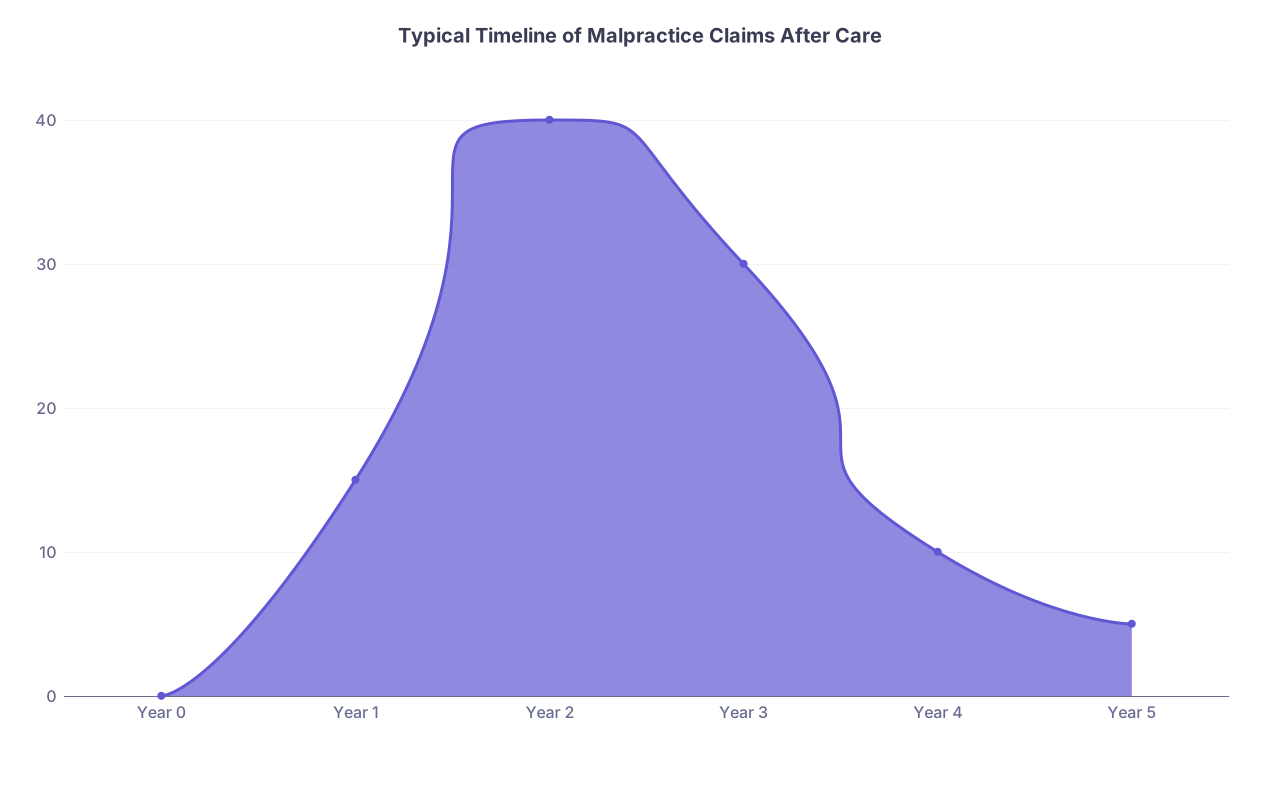
| Category | Value |
|---|---|
| Year 0 | 0 |
| Year 1 | 15 |
| Year 2 | 40 |
| Year 3 | 30 |
| Year 4 | 10 |
| Year 5 | 5 |
(That’s roughly how the reporting curve often looks—claims peaking 1–3 years after care.)
Step 16: Confirm Status With Hospitals and Payors (Day 3–1)
At this point you should:
- Email medical staff offices:
- Confirm your end date for privileges.
- Provide tail or new coverage documentation if requested.
- Keep copies of any acknowledgment emails or forms.
You want no ambiguity later about your status on a given date.
Step 17: Last Day Checklist
On your final day (or the day before if you’re smart), run this checklist:
- Tail or prior acts coverage approved and in writing
- End date of old policy and start date of tail/nose confirmed
- Copies of:
- Employment contract
- Separation agreement
- Malpractice policies (dec pages, tail/nose endorsements)
- List of:
- Start and end dates of your employment
- Hospitals where you had privileges and those dates
- Any claims or board complaints during that time (just for your records)
- EMR access:
- Confirm you will have appropriate access for legal defense (often via the group or carrier).
- Understand the process to obtain records if you are sued later.
After You Leave: The 0–90 Days Post-Departure Window
You’re gone. But the risk didn’t leave with you.
Step 18: Verify Final Policy Documents Arrived (0–30 Days After)
At this point you should:
- Watch for:
- Official tail endorsement policy packet in the mail or via portal.
- Any corrections or amendments (names, dates).
- If you do not receive it within 30 days:
- Contact the carrier or broker and ask for a copy.
Do not assume silence means everything is perfect.
Step 19: Update Your CV and Disclosure Records (0–60 Days After)
Your next credentialing packet will ask about:
- Employment dates
- Coverage dates and carriers
- Any gaps
- Claims history
At this point you should:
Update your CV with precise start/end dates.
Keep a simple coverage timeline document you can reuse:
2018–2026: Group ABC
- Carrier: MedPro
- Policy Type: Claims-made
- Retro date: 07/01/2018
- Tail: Unlimited, effective 07/01/2026
Step 20: Respond Properly if a Claim or Letter Arrives (Anytime After)
If, months or years later, you get:
- A letter from an attorney
- A notice of claim
- A records request that smells like litigation
At this point you should:
- Immediately notify:
- The carrier providing tail/prior acts for that period.
- Your former group’s risk manager if applicable.
- Do not:
- Ignore it.
- Respond directly to the plaintiff’s attorney yourself.
- Assume “the group will handle it.”
Your tail or nose coverage is only as good as your timely reporting.

| Period | Event |
|---|---|
| 90-61 Days - Day 90-80 | Gather contracts and policies |
| 90-61 Days - Day 80-70 | Confirm policy type and retro date |
| 90-61 Days - Day 75-70 | Check state and hospital rules |
| 60-31 Days - Day 60-55 | Discuss tail with group |
| 60-31 Days - Day 55-50 | Get tail and nose quotes |
| 60-31 Days - Day 50-46 | Legal review if needed |
| 60-31 Days - Day 45-40 | Decide tail vs nose |
| 60-31 Days - Day 40-35 | Coordinate with new employer |
| 60-31 Days - Day 35-31 | Start applications |
| 30-0 Days - Day 30-25 | Finalize coverage |
| 30-0 Days - Day 25-20 | Align dates with last day |
| 30-0 Days - Day 20-15 | Finalize separation terms |
| 30-0 Days - Day 14-5 | Clean up clinical handoffs |
| 30-0 Days - Day 7-0 | Get proof and close out |

The 3 Things You Cannot Afford to Miss
- Know exactly who is responsible for tail and get it in writing—from your contract, your group, and your new employer. Assumptions are where people get burned.
- Lock in continuous coverage with the right retro date—no gaps, clear start/end dates, and documented proof of tail or prior acts.
- Use your last 2 weeks to close clinical loops—pending results, high-risk patients, and clear handoffs matter as much as the policy paperwork when the lawsuit letter shows up three years later.