
Most attendings changing jobs are dangerously casual about malpractice coverage. That is how careers get wrecked over a technicality.
You are not just changing offices. You are changing risk environments, policy holders, and who is on the hook when a letter from a plaintiff’s attorney shows up three years from now.
This is your chronological, no-excuses checklist for a clean malpractice coverage transition when you switch jobs as an attending.
6–9 Months Before Your Planned Job Change: Foundation Phase
At this point you should stop thinking “new job” and start thinking “coverage gap prevention project.”
1. Map your current and future coverage
By 6–9 months out, you should:
Pull your current malpractice declarations page
- Policy type: occurrence vs claims-made
- Retroactive date (if claims-made)
- Limits (e.g., $1M/$3M)
- Who owns policy: you vs group vs hospital
- Tail responsibilities per contract
Get written details from your new employer:
- Policy type and limits
- Who pays premiums and tail
- Whether they will:
- Cover your prior acts (nose coverage), or
- Require your own tail
If you do not know whether your current policy is occurrence or claims-made, that is your first red flag. Fix that this week.
| Feature | Occurrence | Claims-Made |
|---|---|---|
| Covers incidents | When they occur | When claim is filed |
| Tail needed on leaving | No | Yes, unless prior-acts |
| Premium cost | Higher | Lower |
| Common for | Large systems | Private groups |
2. Read your current contract like a lawyer who has had coffee
At this stage you must know, in writing:
Who pays tail if you leave:
- You regardless of reason
- You only if you resign
- Employer if they terminate without cause
- Pro-rated formulas (e.g., after 3 years employer pays 50%)
Deadlines:
- How soon after termination you must secure tail
- Any requirement to show proof of tail
Post-termination obligations:
- Cooperation with defense counsel
- Chart access issues
If the clause says “physician shall be responsible for obtaining adequate malpractice coverage following termination,” that usually means: you are buying your own tail.
3. Start a malpractice transition file
Yes, an actual folder (digital is fine). At this point you should create:
- A PDF of current policy and declarations page
- Copies of your employment contract and any amendments
- Emails with HR / risk management from both current and future employers
- A running timeline note of calls and decisions (dates, names, what was said)
You will not remember verbal promises two years from now when there is a claim. Document now.
3–4 Months Before Leaving: Strategy and Negotiation Phase
You have the basics. Now you move pieces on the board.
4. Confirm final employment dates and coverage end dates
By 3–4 months out, you should:
- Lock in your last working day with current employer
- Ask, explicitly, in writing:
- “On what date will my malpractice coverage under your policy terminate?”
- “Will coverage extend for services rendered up to that date?”
Watch for traps like:
- Policy tied to credentialing end date, not your last clinical day
- Group planning to switch carriers, which can affect your future claim handling
5. Clarify your future employer’s stance on prior acts
At this point, no guesswork. You should have written answers to:
Will new employer’s carrier:
- Provide prior-acts (nose) coverage back to your original retro date?
- Only cover you from the new start date forward?
If they will not cover prior acts:
- Do they require written proof of tail coverage from the old job?
- Do they have minimum tail limits they expect?
Get the phrase “prior acts coverage back to [date]” in writing if they agree. Vague “we usually cover that” means nothing.
6. Price out tail coverage realistically
Around 3–4 months before leaving, you should:
- Ask your current carrier (not employer) for:
- Formal tail quotes at several tail durations (e.g., unlimited vs 5 years)
- Payment options (one-time vs financed payments)
Typical ballpark: Tail = 1.5–2.5 times your annual premium.
I have seen hospitalists quoted $80K+, surgeons hit six figures. It is not rare.
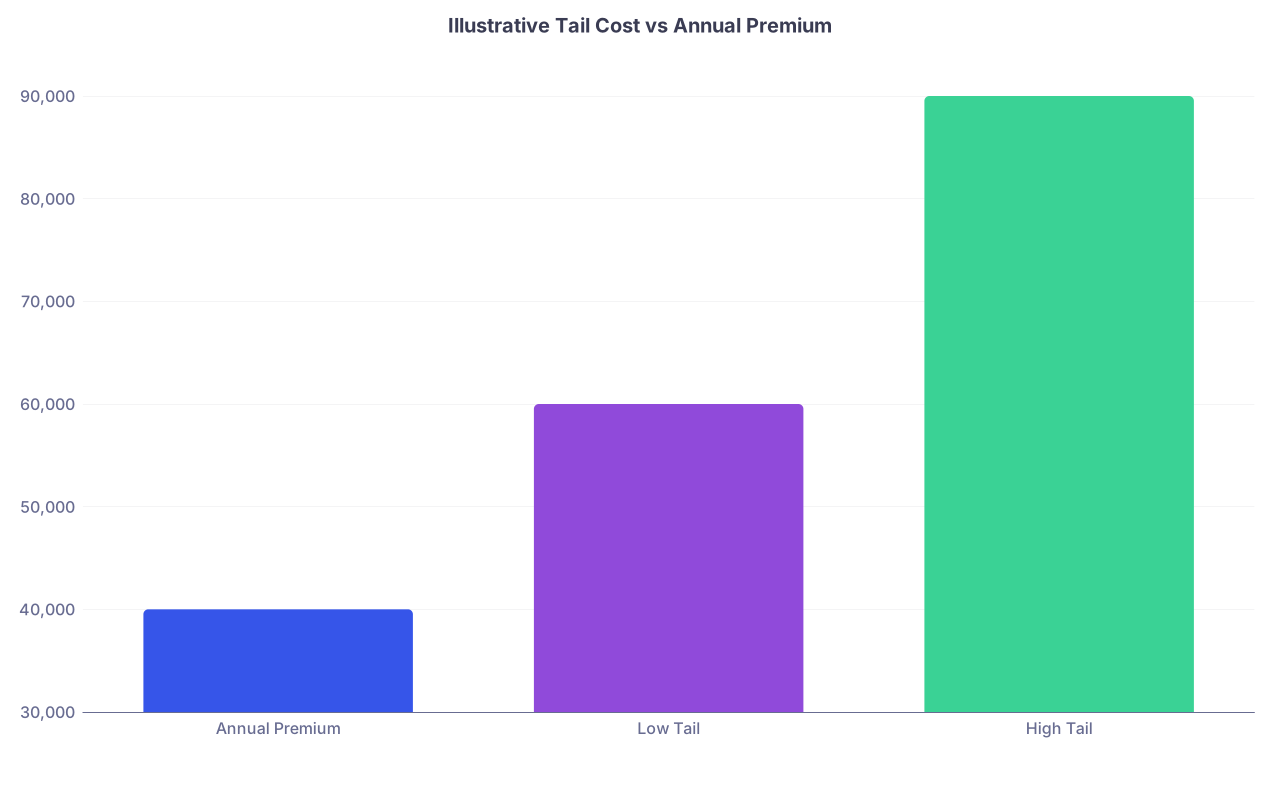
| Category | Value |
|---|---|
| Annual Premium | 40000 |
| Low Tail | 60000 |
| High Tail | 90000 |
If the number makes you queasy, good. That is why you negotiate early (next step).
7. Negotiate tail responsibilities before you sign the new contract
Here is where most attendings mess up. They sign a new offer without ever mentioning tail, and then try to complain later.
By this stage, you should:
Go back to your new employer and explicitly discuss:
- Will you:
- Split tail cost? (e.g., 50/50 up to a cap)
- Get a sign-on bonus specifically earmarked for tail?
- Have your prior acts covered by their carrier instead of tail?
- Will you:
Go back to your current employer if feasible:
- Ask if extended service or delayed resignation date changes tail responsibility
- Ask if they would split cost if you stay through a high-need period
The exact phrases I have seen work:
- “Can we structure the sign-on bonus to include a malpractice tail stipend of $XX,XXX?”
- “If I agree to stay through the summer surge, would the group consider covering 50% of my tail?”
Do this before you announce a firm resignation date. That is your leverage point.
6–8 Weeks Before Leaving: Implementation Phase
Now you stop planning and start locking things in.
8. Finalize your coverage path (tail vs prior acts)
At this point you should:
Decide, in writing, one of three paths:
- Occurrence policy currently → No tail needed for this job. Confirm in writing.
- Claims-made with tail → You will purchase and document tail.
- Claims-made with prior acts → New employer’s carrier will cover prior acts.
Get formal documentation:
- Tail: quote + paid confirmation + tail declarations page
- Prior acts: onboarding coverage letter or certificate stating:
- Retro date
- Limits
- Any exclusions
If someone “promises” you prior acts but refuses to put the retro date in writing, assume you do not have prior acts.

9. Verify continuous coverage with dates lined up
You now build a very simple but critical date map:
- Last day of service at old job
- Last day of coverage under old policy
- Effective date of tail (if applicable)
- Start date at new job
- Effective date of new malpractice policy
Your checklist at this point:
- No gap between:
- Last day seeing patients and last day covered under the old policy
- New start date and new policy effective date
If there is even a one-day credentialing hiccup, you do not see patients. Period.
Final 2–3 Weeks Before Leaving: Documentation and Risk Control
You are almost out. This is where clean documentation matters.
10. Get and file your final proof of coverage
By 2–3 weeks before departure, you should have:
From your current carrier:
- Final certificate of insurance for the job you are leaving
- If tail purchased:
- Tail endorsement / declarations page
- Confirmation of coverage period (“indefinite” or dates)
From your new carrier:
- Certificate of insurance showing:
- Effective date
- Limits
- Retro date (if claims-made with prior acts)
- Certificate of insurance showing:
Print them. Save them to cloud. Save to external drive. Yes, all three.
11. Control your clinical footprint in the final weeks
At this point you should quietly think like a plaintiff’s attorney and reduce opportunities:
Avoid:
- Taking on complex new patients you cannot properly hand off
- Major high-risk elective procedures right before departure, unless absolutely necessary
- Starting long, complex treatment plans you know you will not be around to manage
Do:
- Document handoffs in the chart:
- “Care transitioning to Dr X as of [date].”
- “Discussed follow-up plan with patient; provided clinic contact information.”
- Document handoffs in the chart:
You are not running away from patients. You are making sure the record shows thoughtful transitions, which matters in hindsight.
Last Week and Final Day: Lockdown Checklist
This is the week you prevent future “he said / she said” disputes.
12. Confirm tail payment and prior acts one more time
In this final week, you should:
Email your broker or carrier:
- “Please confirm tail coverage is bound and effective as of [date] for retro date [date]. Please send final declarations when available.”
Email your new employer or carrier contact:
- “Just confirming that my malpractice coverage with retro date [date] is active as of my start date [date]. Please confirm in writing.”
Archive those emails in your malpractice folder.
13. Lock down your personal malpractice history records
By your last day you should have, saved outside the employer’s system:
- Complete list of all carriers you have had
- All retro dates and coverage types for each job
- Copies of:
- Certificates of insurance from each position
- Any tail endorsements
- Any prior-acts confirmations
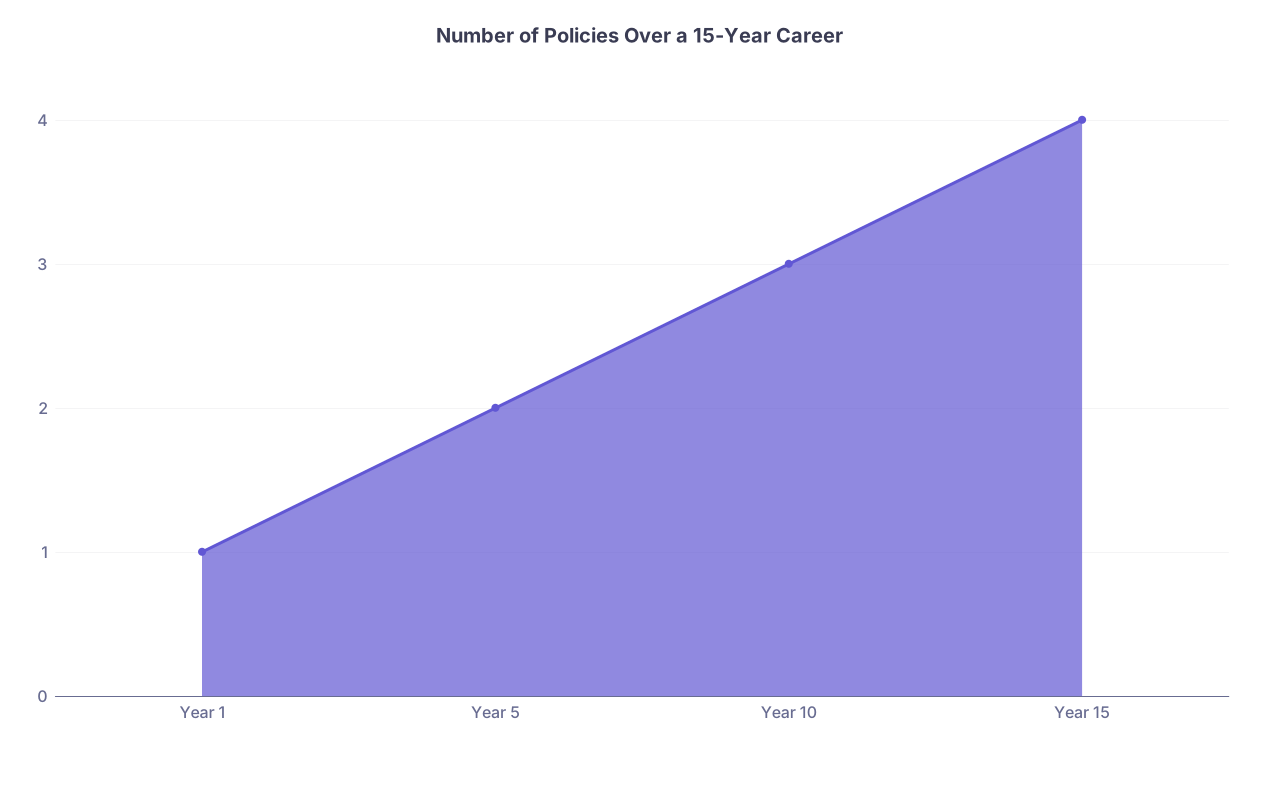
| Category | Value |
|---|---|
| Year 1 | 1 |
| Year 5 | 2 |
| Year 10 | 3 |
| Year 15 | 4 |
You are building an audit trail of your career. When a hospital credentialing office asks for 10 years of coverage history—and they will—you will not be scrambling.
14. Clarify post-employment communication expectations
On or before your last day, you should know:
- How your former group wants you to respond if:
- An attorney contacts you directly
- You receive a subpoena at home
- A risk manager calls about an old patient
The right answer most of the time:
- Do not discuss the case directly with plaintiff’s attorney
- Immediately notify:
- The malpractice carrier you believe is on the risk for that date
- The former employer’s risk management office
- Cooperate with defense counsel once assigned
After You Start the New Job: First 30–90 Days
You are in the new role, but the transition is not fully complete until coverage and records are clean.
15. Validate your credentialing and coverage live
Within the first month you should:
Log into your institution’s credentialing portal and confirm:
- Your privileges are active
- Malpractice coverage and limits are listed correctly
- Retro date is correct, if claims-made
Ask for a fresh certificate of insurance with your name and retro date, sent to you directly.
If the retro date is wrong (for example, set to your new start date instead of your original practice date), escalate immediately. Do not let that sit.

16. Update your own records and professional profiles
By 60–90 days in, you should:
Update:
- CV with accurate start/stop dates
- Any hospital staff offices that require updated certificates
- Your personal malpractice folder with:
- New job’s COI
- Any updated tail documents from the prior job
Consider meeting with:
- A physician-focused attorney for a one-time review of your overall contract and malpractice position
- A financial planner if your tail cost and new compensation structure affect your broader financial plan
One-Page Timeline Checklist: Switching Jobs with Malpractice Coverage
Here is the whole thing condensed.

| Period | Event |
|---|---|
| 6-9 Months Before - Confirm current policy type and retro date | 6-9 months out |
| 6-9 Months Before - Review current contract tail clause | 6-9 months out |
| 6-9 Months Before - Get new employer malpractice details | 6-9 months out |
| 3-4 Months Before - Confirm final employment and coverage end dates | 3-4 months out |
| 3-4 Months Before - Clarify new employer prior acts policy | 3-4 months out |
| 3-4 Months Before - Obtain and review tail quotes | 3-4 months out |
| 3-4 Months Before - Negotiate tail or sign-on support | 3-4 months out |
| 6-8 Weeks Before - Choose tail vs prior acts path | 6-8 weeks out |
| 6-8 Weeks Before - Align coverage effective dates | 6-8 weeks out |
| 2-3 Weeks Before - Collect all certificates and endorsements | 2-3 weeks out |
| 2-3 Weeks Before - Document patient handoffs and transitions | 2-3 weeks out |
| Last Week - Confirm tail payment and prior acts in writing | last week |
| Last Week - Finalize personal coverage history records | last week |
| First 30-90 Days New Job - Verify credentialing and retro date | first 30 days |
| First 30-90 Days New Job - Update personal and professional records | first 90 days |
FAQ (Exactly 4 Questions)
1. Do I really need tail coverage if I have never been sued and my patients love me?
Yes. Malpractice is about allegations, not your perception of how much patients like you. Claims often show up 2–4 years after care, sometimes longer. If you were on a claims-made policy and walk away without tail or prior acts, you are effectively uninsured for all prior care. Plaintiff attorneys do not care that you changed jobs.
2. Is it ever reasonable to skip unlimited tail and buy a shorter tail period to save money?
Sometimes, but it is a calculated risk and you should make it eyes open. Some states or carriers offer 3–5 year tails at lower cost. If your specialty has a long statute of limitations (pediatrics, OB) or you practice in a particularly litigious environment, skimping on tail is usually a bad idea. Have an attorney or experienced broker walk through your specialty, state statutes, and claim patterns before you gamble.
3. What if my group changes carriers while I am employed—does that affect my tail later?
Yes, it can. When a group switches carriers, the new carrier may either:
- Pick up prior acts to the original retro date, or
- Start fresh with a new retro date and leave the old carrier on the hook for older claims.
You need documentation of:
- Original retro date
- Any changes at time of carrier switch
- Which carrier covers which time periods.
When you eventually leave, tail needs to cover any segment of your practice that is not already protected by current prior-acts coverage.
4. My new job says “we cover malpractice,” but will not talk about prior acts. Is that a deal-breaker?
It might be. At minimum it is a negotiation problem and a risk signal. “We cover malpractice” is meaningless without:
- Policy type
- Limits
- Retro date (if claims-made)
- Written statement on whether they will cover prior acts back to your original retro date.
If they refuse to clarify prior acts and expect you to walk away from a claims-made job with no tail, that is reckless. Push for clarity, involve an attorney if needed, and be willing to walk away from an offer that sets you up for a coverage gap.
Open your current employment contract and your malpractice declarations page right now. Find the words “claims-made” or “occurrence” and the tail clause. That is your starting gun—do not move to the next job until those two facts are crystal clear.