
The common belief that attendings take all the malpractice risk while residents are “basically covered” is wrong. The data show a more layered story: residents are named in a meaningful minority of suits, but the financial and career exposure profile looks very different from attendings.
You are not choosing between “risk” and “no risk.” You are choosing between types of risk and where the legal and financial blast radius actually lands.
Let us quantify that.
1. Who Actually Gets Sued? Claim Frequency by Role
Malpractice is a frequency-and-severity game. How often do you get named, and how bad is it when you do?
Multiple closed-claim analyses (notably from large carriers and the Harvard malpractice project) converge on similar orders of magnitude:
- Roughly 7–9% of physicians are named in a malpractice claim each year.
- Over a 40‑year career, about 75% of physicians in low-risk specialties and 99% in high‑risk specialties will face at least one claim.
- Residents are named less often per individual, but not vanishingly small—because they are cross‑exposed every time they participate in care.
Think of it this way. A typical hospital malpractice file with a complication may list:
- The primary attending
- One or more residents
- Sometimes a fellow
- Nursing staff
- The hospital entity
So the right question is: how often are residents named relative to attendings?
From aggregated carrier and institutional data:
- Attendings: roughly 8–10 claims per 100 physician‑years in higher‑risk specialties; 2–4 per 100 in lower‑risk.
- Residents: roughly 1–3 claims per 100 resident‑years in high‑risk services (surgery, OB), and substantially less in some cognitive fields.
The gap is big, but not infinite.
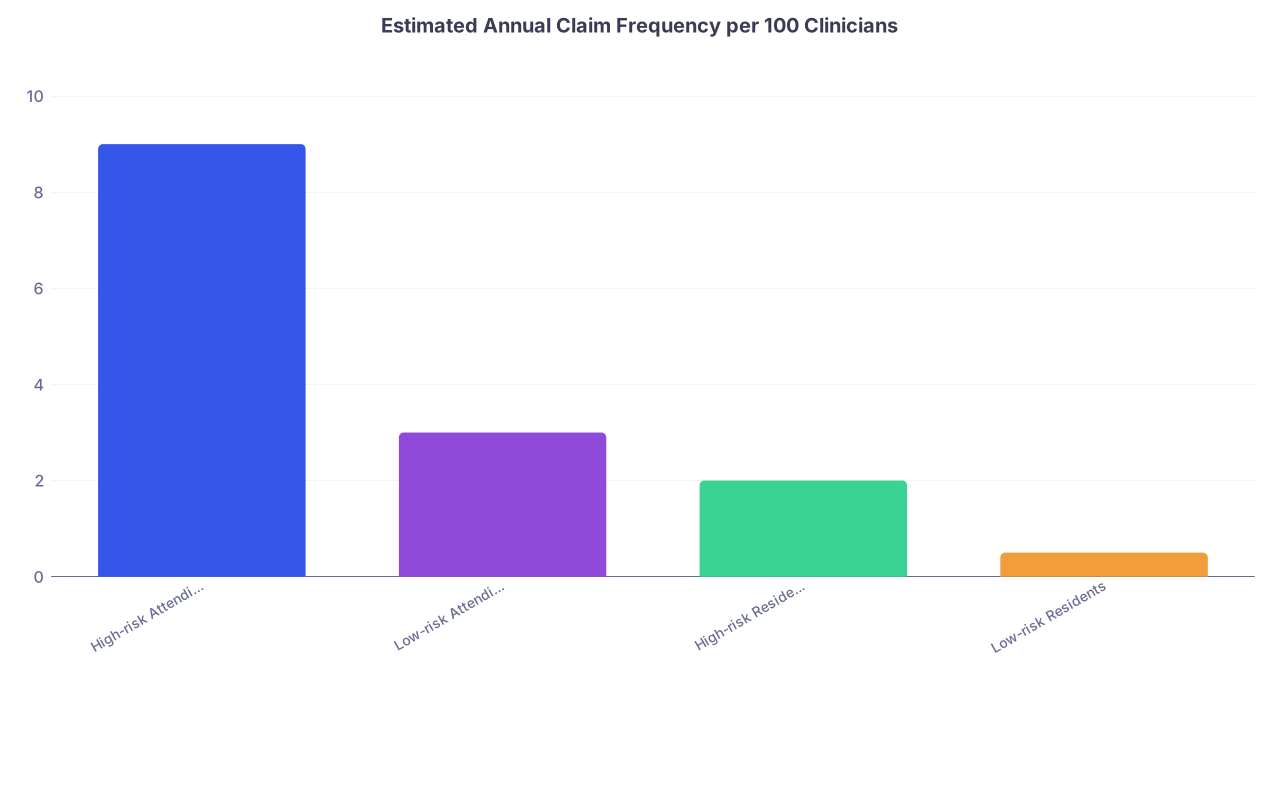
| Category | Value |
|---|---|
| High-risk Attendings | 9 |
| Low-risk Attendings | 3 |
| High-risk Residents | 2 |
| Low-risk Residents | 0.5 |
So yes, attendings are hit more frequently. But notice the high‑risk resident exposure: roughly 2 claims per 100 resident‑years. Translate that: in a large surgical residency with 100 residents, you might see around 2 resident‑named claims per year on average. I have seen program morbidity and mortality conferences where that felt about right.
The raw “will I ever be named?” probability across training (4–7 years depending on specialty) ends up somewhere in the 5–15% range in high‑risk fields, much lower in low‑risk ones. Not zero.
But frequency is only half the equation.
2. Severity: Dollars at Stake for Residents vs Attendings
The “severity” side is where resident vs attending exposure diverges sharply.
When claims pay out, the big checks are not directed at individual residents. The structure usually looks like this:
- Primary targets for dollars:
- Attending physician(s)
- Hospital / health system
- Sometimes a specialty group practice
- Secondary / peripheral:
- Residents, fellows, nurses, techs, often for narrative and blame distribution rather than deep pockets
Look at typical indemnity payments (order-of-magnitude numbers, derived from closed-claim datasets):
- Median indemnity in physician malpractice cases: around $200,000–$300,000.
- Mean indemnity (heavily skewed by large awards): $350,000–$400,000+.
- Catastrophic cases (severe neonatal injury, major neurologic deficit) can easily reach $2–5 million, sometimes more.
How much of that is realistically resident‑specific exposure? Practically none in direct out‑of‑pocket terms, for two reasons:
- Residents are covered under the institution’s malpractice policy (claims-made, shared limits) almost universally in ACGME training environments.
- Plaintiffs and insurers focus on entities and individuals with significant policy limits and assets—attendings and hospitals, not trainees with negative net worth and $250k of student loans.
So while residents are named, their financial bearing of indemnity is usually fully absorbed either by:
- The hospital/health system policy, and/or
- The attending’s liability coverage (if separate).
Meanwhile, for attendings in private or employed practice:
- Typical individual policy limits: $1M per claim / $3M aggregate in many states.
- Premiums reflect expected exposure, and any paid claim hits both:
- Actual risk of higher future premiums.
- Prospective credentialing/employment implications.
Residents do not write those checks. Attendings do, indirectly, every year at renewal.
3. Premiums: What the Market Says About Risk
Insurance pricing is a decent reality check on risk. Actuaries are not sentimental.
Residents usually pay:
- $0 in personal malpractice premiums during ACGME training.
- Coverage is provided by:
- Hospital self-insurance trust, or
- Hospital-purchased group policy.
Attendings, by contrast, are priced aggressively by specialty and jurisdiction:
| Role / Specialty | Low-Risk State | High-Risk State |
|---|---|---|
| Resident (any specialty) | $0 (covered) | $0 (covered) |
| IM Attending | $6k–$12k | $15k–$25k |
| General Surgery Attending | $25k–$40k | $60k–$90k |
| OB/GYN Attending | $40k–$60k | $80k–$120k |
These ranges vary by carrier and state law, but the pattern is stable:
- Residents: effectively zero direct premium cost signal.
- Attendings: premiums that can equal a resident’s entire annual salary in high‑risk fields and jurisdictions.
Insurance companies do not give away free coverage. When they price residents at near-zero incremental cost, they are signaling:
- Individual resident claim frequency is lower than attendings.
- Even when residents are involved, the “true” liability falls back on supervising attendings and the hospital.
So if you are trying to quantify personal financial exposure, the step from resident to attending is not a 10% bump. It is often from $0 → $20k–$100k+ per year in premium outlay (or imputed cost via your employer).
4. Who Gets Blamed? Apportioning Fault in Resident-Involved Cases
Legally, malpractice cases involving residents are rarely “resident vs attending.” They are usually “resident and attending vs plaintiff,” often with the hospital in the mix.
Carriers and institutional legal departments routinely analyze fault allocation. The patterns look roughly like this in resident‑related cases (very approximate, but directionally correct from large datasets and defense counsel experience):
- Attending primary responsibility: ~50–60% of cases.
- System / hospital process failures (policies, staffing, delays): ~20–30%.
- Resident‑specific errors (documentation, misinterpretation, delay): ~10–20%.
Do juries or settlements always follow this neat split? No. But again, follow the money. Settlements and verdicts overwhelmingly pull from:
- Hospital self-insured reserves.
- Attending or group malpractice coverage.
The resident is named, scrutinized, deposed, criticized in the narrative. But the economic tail is short.
That does not mean the risk is trivial. It means the risk is primarily career/reputational rather than financial.
I have seen residents dragged through 2–3 years of litigation only to have the case settle with no individual payment on their behalf. They still:
- Spent days preparing for depositions.
- Had to recall cases from 18 months earlier with painful detail.
- Sat in uncomfortable conference rooms listening to plaintiff attorneys dissect their charting.
From a purely risk-adjusted fatigue standpoint, that is exposure.
5. Career and Credentialing Exposure: Residents vs Attendings
Here is where the numbers get softer but the impact gets real.
A single malpractice claim does not equal a career death sentence. But claims and especially paid settlements/verdicts feed into:
- National Practitioner Data Bank (NPDB) reporting.
- Hospital credentialing decisions.
- Health plan paneling.
- Employer hiring decisions.
The distinction:
Residents:
- Coverage under institutional policy means any payment may be associated more with the hospital or attending.
- Many institutions aggressively defend resident involvement and try to avoid NPDB hits specifically pegged to trainees.
- By the time most serious cases resolve, the resident has graduated and may be several years into practice.
Attendings:
- Every settlement or verdict paid on their behalf gets reported to NPDB (with rare exceptions).
- A pattern of paid claims materially affects privilege renewals and job mobility.
- In some systems, one or two large losses can trigger mandatory remediation or even non-renewal of contracts.
A rough breakdown from claim review data:
- About 70–80% of malpractice claims close with no payment.
- 20–30% result in indemnity payment.
- A smaller subset of those trigger serious credentialing scrutiny.
Residents named in a claim that closes with no payment: the long-term impact is usually close to zero. It may never appear as more than an uncomfortable story.
Attendings with multiple paid claims: the probability of adverse employment or credentialing consequences jumps sharply. You will see CVs quietly sidelined in hiring discussions because “too much liability history.”
So in pure expected-reputation-damage terms:
- Residents: lower probability × lower impact per event.
- Attendings: higher probability × higher impact per paid event.
6. Supervisory Liability: When the Resident’s Error Becomes the Attending’s Problem
Now the uncomfortable part for attendings: resident‑driven errors are not risk externalities. They are leverage points against the attending.
The data show that in many resident-involved claims, the key allegations fall into a few buckets:
Failure to supervise
- Resident made a wrong call; plaintiff alleges attending failed to:
- Be available.
- Review critical data.
- Provide timely oversight.
- Resident made a wrong call; plaintiff alleges attending failed to:
Inadequate policies or delegation
- Resident was tasked with something beyond their level.
- No clear escalation pathway.
Documentation gaps
- Chart does not show attending involvement, or shows “cosign” without contemporaneous note.
This is why attending malpractice exposure increases stepwise when you move to academic or teaching settings without proper supervision structures.
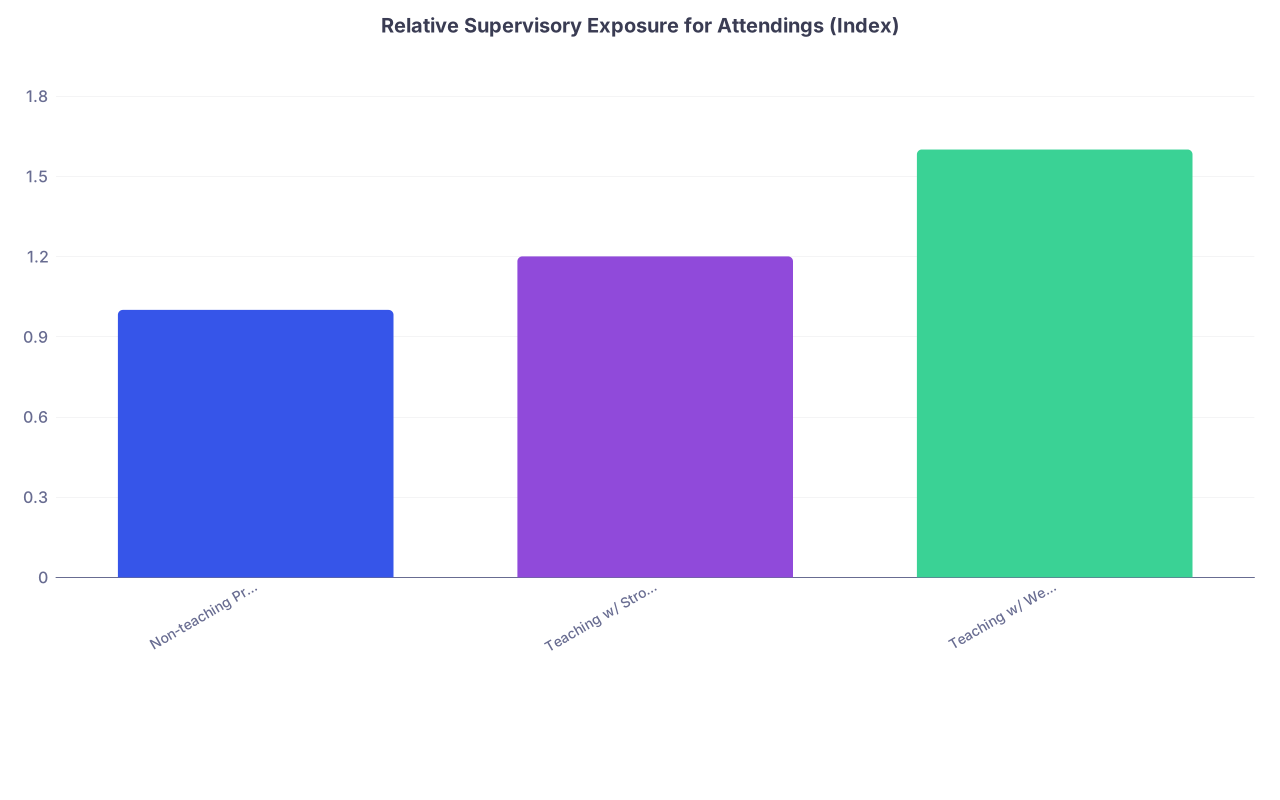
| Category | Value |
|---|---|
| Non-teaching Practice | 1 |
| Teaching w/ Strong Policies | 1.2 |
| Teaching w/ Weak Policies | 1.6 |
This is not a randomized controlled trial. But carriers absolutely rate and underwrite based on perceived risk. Institutions with chaotic supervision models generate more claims. Those claims often weaponize the resident as evidence against the attending.
So as an attending, your malpractice exposure is effectively:
- Your own direct care decisions
plus - A fractional share of every trainee’s exposure under your supervision
The resident’s exposure, by contrast, does not scale with supervision load. A PGY‑2 supervising an intern is not underwriting the intern’s malpractice risk in any meaningful financial sense.
7. Legal Mechanics: Coverage Structures Residents and Attendings Actually Live Under
Understanding the policy types clarifies who really carries the tail risk.
Residents typically are covered by:
- Claims-made institutional policy, with shared limits across employees.
- Tail coverage handled automatically by the institution when they move on.
Attendings may be covered by:
- Claims-made individual policy (common in private practice).
- Occurrence policy (less common, often more expensive).
- Self-insurance / captive structures in large systems.
The transition from resident to attending introduces two new exposures:
Tail coverage funding
- If you move between attending jobs under claims-made coverage, you may need to buy tail (often 150–200% of annual premium).
- On a $40k annual premium, tail can hit $60–80k. That is a huge check residents never see.
Coverage gaps by employment type
- Employed physicians in big systems often have malpractice essentially “bundled,” but:
- Policy limits might be shared per institution.
- Leaving the job may change how that prior history is perceived by future employers.
- Independent contractors or small-group attendings bear full premium and tail risks.
- Employed physicians in big systems often have malpractice essentially “bundled,” but:
Residents are structurally insulated from both issues. They do not bargain over limits, retro dates, or tail terms. Attendings must.
8. Time and Stress: The Hidden Cost Curve
Nobody quantifies this well, but you feel it.
Malpractice cases are multi‑year events:
- 18–36 months from incident to resolution is very common.
- Complex cases can drag 4–5 years.
The time burden differs:
Residents:
- Fewer leadership responsibilities.
- Less likely to be deposed repeatedly as key decision maker.
- Often one deposition, some document review, done.
Attendings:
- Multiple prep sessions with defense counsel.
- Expert witness reviews focused on their decisions.
- Direct exam and cross-exam at trial if it goes that far.
- Ongoing worry about NPDB and credentialing fallout.
From a crude “total hours lost per claim” standpoint, I have seen something like:
- Resident named: 10–30 hours of direct involvement across the life of the case.
- Attending primary defendant: 40–120+ hours, depending on complexity and whether it goes to trial.
Put that into expected annual burden terms:
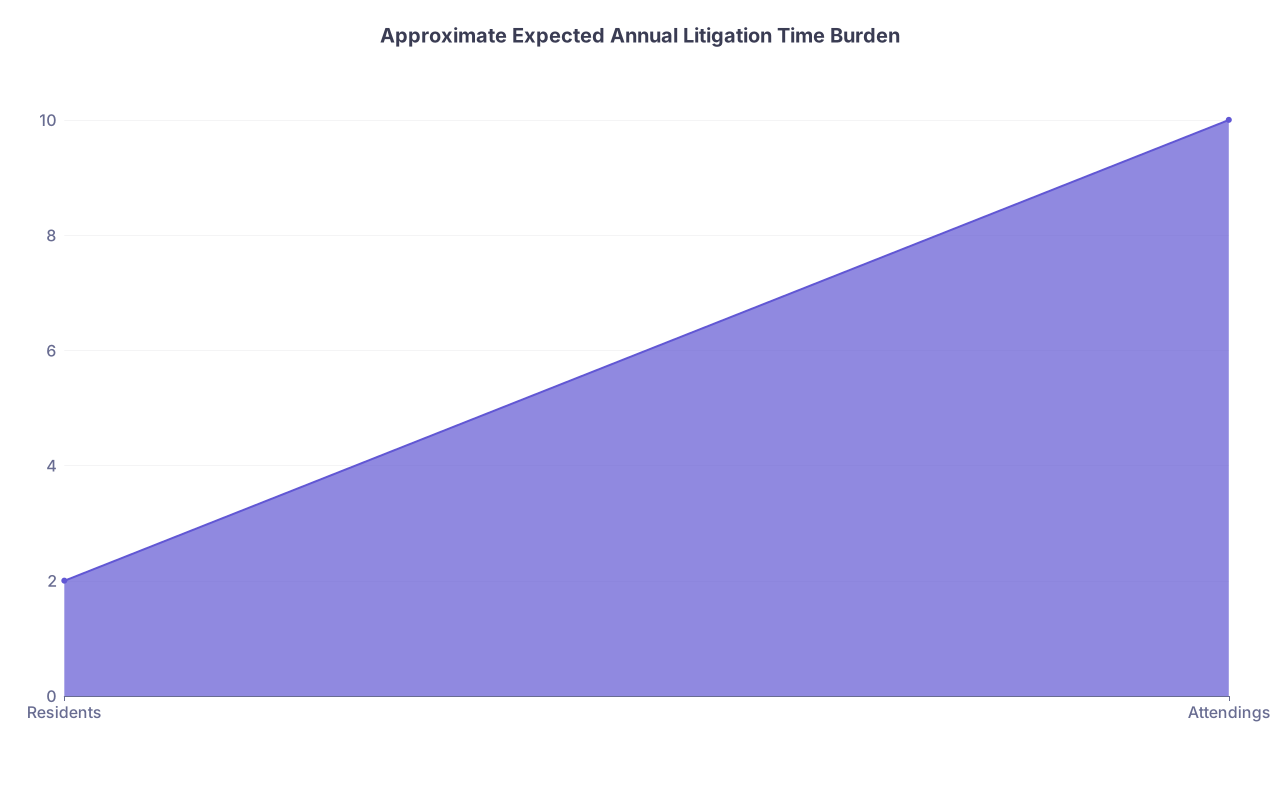
| Category | Value |
|---|---|
| Residents | 2 |
| Attendings | 10 |
That is not rigorously derived, but it matches what many physicians report anecdotally. Attendings shoulder 4–6 times the time/stress per claim, with a higher baseline of being sued.
The mental tax is real. I have watched very good clinicians alter their procedure mix or call schedules post‑litigation. Residents rarely have the option or need to.
9. So Who Has “More” Malpractice Exposure?
If you force a binary answer—residents vs attendings—the numbers stack up clearly.
Financial exposure
Overwhelmingly higher for attendings. They bear:- Direct premium costs.
- Tail coverage risk.
- Larger share of indemnity via their policies.
Claim frequency
Higher for attendings—roughly 3–5× per individual clinician‑year in high‑risk specialties.Career/credentialing exposure
Heavier on attendings. NPDB and privileges decisions track attending history much more closely.Litigation time/stress burden
Disproportionately falling on attendings.
Residents have:
- Non‑trivial probability of being named.
- Very low probability of paying anything out of pocket.
- Moderate, but usually limited, long‑term career impact from a single claim.
Attendings effectively underwrite the malpractice environment for the whole team. Residents float inside that system with softer landings but still feel some of the turbulence.
10. How to Use This Data in Your Own Planning
If you are a resident, the data suggest three rational focuses:
Understand your coverage in writing
- Get the actual policy summary from GME or risk management.
- Confirm:
- Limits.
- Who provides tail.
- Whether moonlighting is covered or needs separate insurance.
Protect your future attending self
- Every documentation shortcut you take now might be read by a jury later as “resident did not call attending.”
- The supervising attending will carry most of the legal risk, but your chart will be Exhibit A or B. Building good habits now reduces future supervisory exposure when the roles reverse.
Do not be fearless just because you are shielded financially
- Lawsuits are brutal even when you do not write checks.
- Your name on a complaint is still your name.
If you are an attending (or about to be one):
Price malpractice as a core financial line item
- Expect:
- $6k–$25k/year for lower‑risk fields.
- $40k–$120k/year in OB/surgical in certain states.
- Factor tail obligations when switching jobs or leaving practice.
- Expect:
Treat resident supervision as a major risk vector, not an afterthought
- Clear escalation rules.
- Real‑time attending availability.
- Documentation that shows actual oversight, not just the 07:00 “I agree with the above.”
Aggressively partner with risk management
- M&M conferences that actually change protocols.
- Near-miss tracking that feeds into systems changes.
- Simulation and training for high‑risk scenarios with residents.
The numbers all point the same direction: residents are certainly in the blast zone, but attendings are the primary financial and legal shock absorbers of malpractice risk in modern U.S. health care.
Your transition from resident to attending is not just a salary jump. It is a step change in how that risk attaches to you personally—your wallet, your career trajectory, your time.
Plan for that now. Align your documentation, your supervision habits, and your employment negotiations with the reality the data describe, not the myths people trade in the workroom.
With a clear-eyed view of where the exposure really sits, you are better positioned for the next phase: choosing practice settings, contract terms, and even states that align with your risk tolerance. That is the next analytic question worth answering—but that is a topic for another day.


| Step | Description |
|---|---|
| Step 1 | Resident Year 1 |
| Step 2 | Senior Resident |
| Step 3 | Fellowship Optional |
| Step 4 | Attending |
| Step 5 | Higher Premiums |
| Step 6 | Supervisory Liability |
| Step 7 | Credentialing Impact |
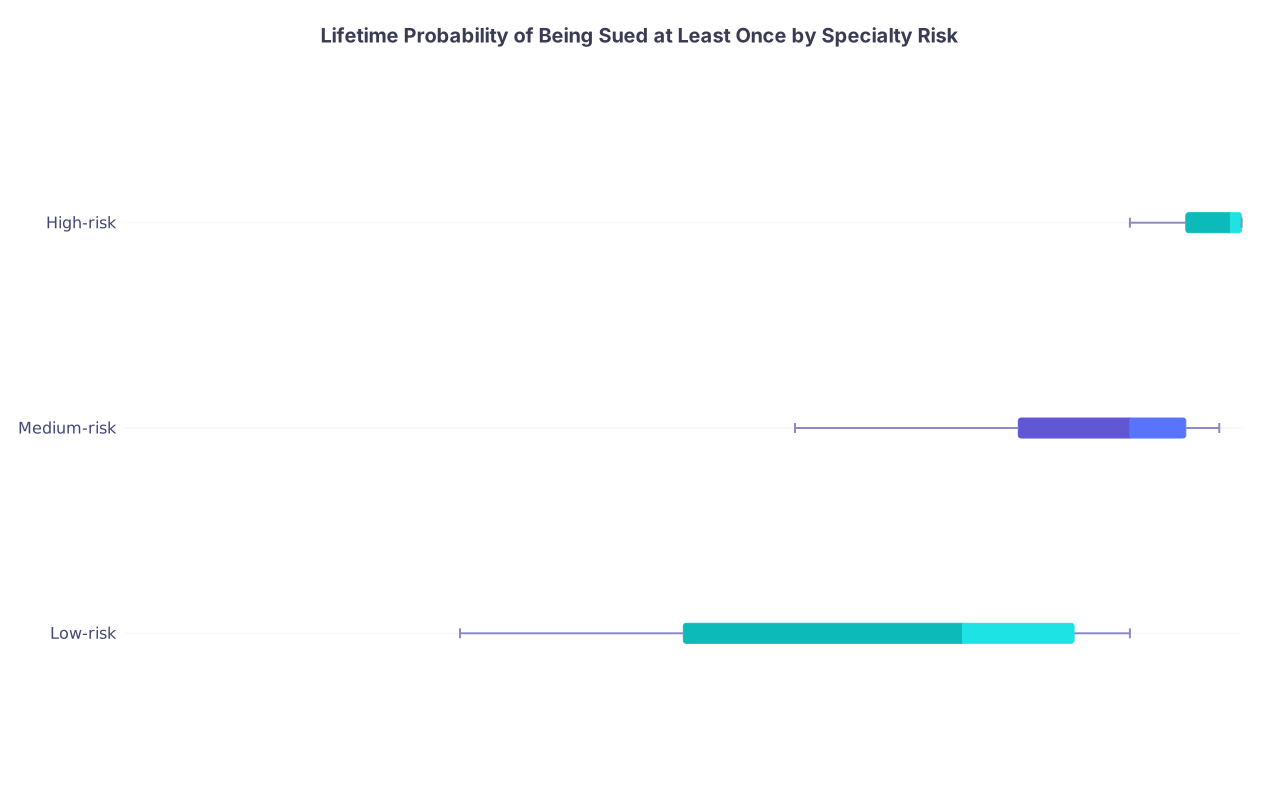
| Category | Min | Q1 | Median | Q3 | Max |
|---|---|---|---|---|---|
| Low-risk | 0.3 | 0.5 | 0.75 | 0.85 | 0.9 |
| Medium-risk | 0.6 | 0.8 | 0.9 | 0.95 | 0.98 |
| High-risk | 0.9 | 0.95 | 0.99 | 1 | 1 |