
You’ve just matched. The email hits your inbox: “Congratulations and welcome to the Class of 20XX!” You’re still buzzing from the relief, the texts, the champagne. Then, about three days later, it starts:
- “Please complete the attached onboarding packet.”
- “We need your USMLE transcript by Friday.”
- “Confirm your ACLS/BLS status.”
- “Sign and return your contract.”
Suddenly you’re sending more emails to program coordinators and program directors than to your own family.
This is where people blow it.
Not with medicine. Not with knowledge. With email. With tone, timing, and basic professionalism. And programs notice. Coordinators talk. PDs remember names — especially the ones attached to annoying, careless, or vaguely entitled emails.
Let me walk you through the biggest email etiquette errors I see new matches make with coordinators and PDs, and how to avoid quietly sabotaging your reputation before day one.
1. Treating Coordinators Like Admin Clerks Instead of Your Lifeline
Here’s the mistake: you treat the coordinator like a task rabbit, not a key part of the program.
I’ve literally heard a coordinator say, “If this is how they email now, I don’t want to see their sign‑out.” That resident started the year with a target on their back.
Common screw-ups:
- One-line demands:
- “Send me the schedule.”
- “I need my contract ASAP.”
- Zero greeting, zero sign-off.
- Not using their name.
- Emailing them at 11:58 pm, then sending “?” at 8:02 am.
- CC’ing the PD on minor issues to “get it handled faster.”
Here’s what you’re missing: the coordinator can make your life smooth or miserable. They control:
- Your schedule swaps
- Your credentialing paperwork actually going through
- Who gets reminders and nudges for things
- Who gets the benefit of the doubt
Don’t make these mistakes:
No greeting, no name
- Wrong:
Need updated contract. Last one had wrong start date. - Better:
Hi [Ms. Smith],I reviewed the contract and noticed the start date is listed as July 11 instead of July 1. Could you let me know if this is correct or if an updated version will be sent?Thank you,First Last
- Wrong:
Implied entitlement
- Wrong:
I was told housing would be available by June 1. Please confirm where I should go and when my unit will be ready. - Better:
Hi [Name],I’m planning my move and wanted to check if there are any updates about [housing availability](https://residencyadvisor.com/resources/match-day-results/no-housing-lined-up-post-match-stepwise-strategy-to-secure-a-place) around June 1. If there’s a standard timeline residents usually follow, I’d really appreciate your guidance.
- Wrong:
Using the PD to pressure them
- Wrong: CC’ing PD on: “She hasn’t sent me the schedule yet. Can someone clarify?”
- That’s how you start a silent war. Don’t.
Rule: Unless it’s a serious problem, your default route is coordinator first, politely, with normal human courtesy. CC the PD only when:
- It’s an issue the PD clearly must know about (serious personal circumstances, contract issues, needing accommodation/disability disclosure, major professionalism/harassment issues)
- The coordinator specifically says, “Loop in Dr. X.”
You want the coordinator thinking: “They’re respectful, clear, and easy to work with.” That’s gold.
2. Writing Like a Text Message Instead of a Professional Email
You’re used to WhatsApp groups and Slack, not business email. This transition trips people.
Common errors:
- No subject line, or garbage subject lines like:
- “Question”
- “Hey”
- “Re:”
- No capitalization, abbreviations everywhere: “thx”, “u”, “plz”
- Emojis in emails to PDs
- Over-familiar language: “Hey there!”, “Hope you’re crushing your week!”
You’re not emailing your co-intern yet. You’re emailing the people who decide:
- What letters get written about you
- Whether you’re chief material
- How much they trust you with sick patients at 2 am
Fix the basics. Every time:
- Subject line: specific, searchable, boring is fine.
- Greeting: “Hi Dr. X,” or “Dear Dr. X,” / “Hi Ms. Y,”
- One main question or purpose per email whenever possible.
- Sign-off: “Best,” / “Sincerely,” / “Thank you,” + full name + “Incoming PGY‑1, [Program]”
| Bad Subject | Better Subject |
|---|---|
| Question | Question about start date for PGY-1 orientation |
| URGENT | Time-sensitive: immunization records due this Friday |
| Contract | Clarification on salary line in PGY‑1 contract |
| Housing | PGY‑1 housing waitlist status – [Your Full Name] |
| Forms | Onboarding forms – missing item clarification |
Do not try to be “cute,” overly clever, or quirky. Nobody wants a subject line like “The saga of my TB test continues…” from someone who isn’t even on payroll yet.
3. Emailing the PD About Things the Coordinator Owns
This one screams “doesn’t understand hierarchy” and “going to be extra work.”
New matches often make this mistake because:
- They think PD = more important, so they’ll answer faster.
- They’re anxious and want the “top person” to fix something.
- They think copying the PD signals they’re serious.
It usually backfires.
Typical misfires:
- “Hi Dr. X, can you send me the link to the onboarding portal? I can’t find it.”
- “I need to know my elective schedule so I can plan a trip.”
- CC’ing the PD on every minor clarification: “What day is orientation again?”
Behind the scenes, what happens:
- The PD forwards your email to the coordinator.
- The coordinator is now doing extra work cleaning up something that should’ve gone to them directly.
- Your name gets a small mental tag: “Doesn’t read instructions. Escalates unnecessarily.”
General rule:
- Coordinator first for:
- Dates, forms, portals, credentialing, schedules, vacation requests, badge/EMR access, logistics, basic HR-ish questions.
- PD for:
- Major personal issues affecting training (serious illness, pregnancy complications, leave needs, family crisis)
- Concerns about discrimination, harassment, intimidation (may go to GME or ombuds too, but PD should know)
- Big career development questions (fellowship focus, research mentorship — though often better after you start)
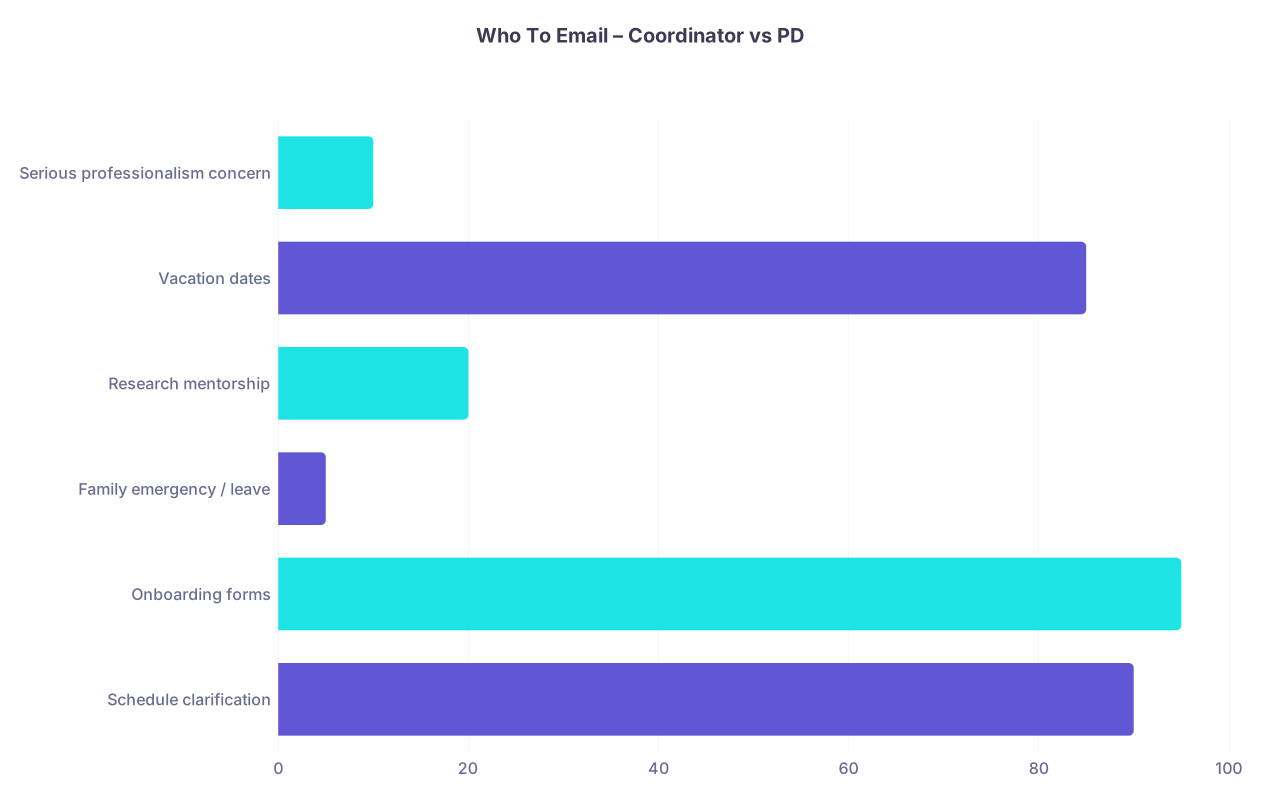
| Category | Value |
|---|---|
| Schedule clarification | 90 |
| Onboarding forms | 95 |
| Family emergency / leave | 5 |
| Research mentorship | 20 |
| Vacation dates | 85 |
| Serious professionalism concern | 10 |
(Think: ~90–95% of nuts-and-bolts stuff → coordinator. PD sees the filtered, higher-level signal.)
If you’re not sure, you can write the coordinator:
Hi [Name],
I have a question about [topic]. Is this best directed to you or to Dr. [PD Last Name]?
That shows respect for roles. Much better than blasting the PD because you’re impatient.
4. Sloppy, Confusing, or Vague Emails That Waste Their Time
Coordinators and PDs are already buried. If they open your email and can’t quickly see:
- Who you are
- What you’re asking
- What you’ve already tried
…you’ve just made their job harder. That gets remembered.
Typical sloppy patterns:
- “I’m missing a form. What should I do?”
- No identifying info (there are 16 Johns in a big program).
- Huge blocks of unbroken text that read like a stream of anxiety.
- Long back-and-forth chains where you keep adding new unrelated questions.
Here’s the standard you want:
- Identify yourself up top.
- State the issue clearly in 1–2 sentences.
- Offer any relevant context (brief).
- Ask a specific, reasonable question or two.
Example of a mess:
Hi,
So I was looking at my onboarding and I think something is missing but I’m not sure because when I clicked on the link it took me to a different login and now I can’t tell if it went through, and also I never got the TB form but it might be in the portal? I’m not sure. What should I do? Also when is orientation.
Thanks
Better:
Subject: Onboarding portal question – [Your Name], Incoming PGY‑1
Hi [Ms. Smith],
This is [Your Full Name], incoming PGY‑1 in Internal Medicine.
I logged into the onboarding portal today and noticed that I only see items for direct deposit and tax forms. I don’t see the TB or immunization forms mentioned in your previous email.
Could you let me know if those will appear later, or if I’m missing a step to access them?
Thank you for your help,
[Your Full Name]
Incoming PGY‑1, Internal Medicine
You’re not writing essays, but you are making it easy for them to help you.
5. Being Weird About Titles, Names, and Tone
Here are two fast ways to annoy people:
- Ignoring titles (especially early).
- Getting too familiar too quickly.
This is not about ego. It’s about basic professional respect and reading the room.
Mistakes I see:
- Emailing the PD: “Hey John,” because the website said “John Smith, MD.”
- Calling the coordinator by their first name when everyone internally uses “Ms. LastName.”
- Switching to first names after they have not invited you to do so.
- Over-apologizing or being emotionally heavy-handed (“I’m so so so sorry, I’m freaking out, I promise I’m usually more organized…”)
How to not make it weird:
- Default for PDs and faculty:
- “Dr. [Last Name]”
- Default for coordinators:
- “Ms. [Last Name]” or “Mr. [Last Name]” unless they sign with their first name only and the culture seems casual.
- If they reply and sign with just first name:
- You can usually mirror that in follow-ups: “Hi Sarah,”
Tone wise:
- You want:
- Calm
- Brief
- Polite
- Solution-oriented
- You don’t want:
- Dramatic (“I’m totally lost help!!!”)
- Over-chummy (“Hi!! Hope you had an awesome weekend!!”)
- Defensive (“Well, I was never told that this was due earlier.”)
Also: don’t make your emails therapy sessions. They are trying to solve a concrete problem, not process your anxiety.
6. Ignoring Instructions, Attachments, and Deadlines — Then Emailing in a Panic
This is the mistake that really irritates people: not reading what they already sent you.
I have watched coordinators open a clearly written email they sent a week ago, scroll through, and point to the exact line that answers the panicked question a new resident just sent. The eye-roll is…not subtle.
Patterns that scream “red flag”:
- Asking for details clearly spelled out in the last email or two.
- Missing a deadline, then sending a panicked “I just saw this, can I still…?”
- Replying to the wrong email thread so they have to dig to know what you mean.
Before you hit send, do this:
- Search your inbox with keywords.
- Re-read the most recent email from that person and any attachments.
- Check if there was a link, portal, or FAQ you skimmed.

| Step | Description |
|---|---|
| Step 1 | Need to email coordinator or PD |
| Step 2 | Check prior emails |
| Step 3 | Do not email |
| Step 4 | Clarify your question |
| Step 5 | Write clear subject |
| Step 6 | Use proper greeting and sign off |
| Step 7 | Send single concise email |
| Step 8 | Answer already there |
If you truly missed something:
Hi [Name],
I apologize for missing the original deadline on [item]. I’ve now completed [step]. Is it still possible to submit this, or should I plan for [alternative]? I understand if the window has closed.
Take responsibility. Do not blame their instructions, the portal, or “so many emails.” Everyone knows it’s a lot. You still have to function.
7. Overusing “Urgent” and Emailing at Wild Hours
You’re anxious. Everything feels high-stakes. That doesn’t mean everything is “URGENT” in the subject line.
Bad habits:
- Marking non-time-sensitive things as high priority.
- Emailing at 1:30 am about something that could easily wait until business hours.
- Following up in less than 24 hours with “Just checking on this” or, worse, “???”
Let me be blunt: you are not a crisis to them. They have hundreds of moving pieces. Respect that.
Reasonable expectations:
- Normal non-clinical emails: 1–3 business days for a response.
- If something is truly time-sensitive:
- Use “Time-sensitive” in the subject line.
- Explain the specific deadline in the first sentence.
- Don’t escalate to calls unless:
- It’s the day-of deadline and you haven’t heard back.
- Or it’s an urgent leave/emergency situation.
Example:
Subject: Time-sensitive: Immunization upload deadline – [Your Name]
Hi [Ms. Smith],
I received the reminder that immunizations are due tomorrow. I uploaded all my records today but noticed the portal still shows “incomplete.”Could you let me know if there is anything else I need to do on my end today so that this is processed on time?
Thank you,
[Your Name]
Use urgency sparingly so that when you do flag something as time-sensitive, they actually believe you.
8. Sending Sensitive Content Over Email Without Thinking
You’re about to become a physician. You should already be paranoid about privacy and professionalism.
New matches make sloppy choices like:
- Emailing screenshots of patient charts as “examples” from med school. Absolutely not.
- Sending personal medical details in excessive depth to coordinators.
- Forwarding chain messages with embedded institutional info from another hospital.
- Using a silly or questionable personal email address if they haven’t switched to their institution one yet.
Do not:
- Put actual patient identifiers (names, MRNs, DOB, full dates, images) in any email.
- Forward internal documents from prior institutions unless specifically asked and allowed.
- CC random people on sensitive topics.
Do:
- Keep health disclosures brief when needed:
- “I have a chronic medical condition that may require occasional appointments. I’m happy to discuss details in person or through the appropriate channel.”
- Use a professional personal email until you get your hospital one:
- [email protected] is fine.
- “surgerystud69@” is not.
If you need to disclose pregnancy, disability, or mental health concerns that could affect your start, email the PD (and possibly the DIO or GME) in a short, focused, respectful way. Ask how they prefer to proceed — many institutions will want certain conversations documented through specific HR or occupational health channels, not freeform email essays.
9. Over-sharing, Under-sharing, and the “Drama Email”
There’s a sweet spot in how much you say. New matches rarely hit it on the first try.
Two extremes:
Entire life story in one email.
- 12 paragraphs.
- Multiple crises, family dynamics, childhood trauma.
- Vivid detail that has nothing to do with scheduling, leave, or patient care.
Cryptic non-information.
- “I am dealing with something personal that may affect my ability to start on time. Please advise.”
- No dates, no sense of severity, no info on what you’re doing about it.
Both are a problem.
You want:
- Enough to let them plan.
- Respect for your own privacy.
- Concrete ask.
Example for a serious issue:
Subject: Request to discuss potential adjustment to start date – [Your Name]
Dear Dr. [Last Name],
I am an incoming PGY‑1 in [Program]. I’ve had a recent change in my personal health situation that may affect my ability to start orientation on the scheduled date.
I’m under active care and working with my treating physician to clarify my anticipated timeline. I wanted to alert you early so we can discuss possible options, including whether a brief deferral or accommodation is appropriate.
Would it be possible to schedule a brief call this week to discuss the situation and next steps?
Sincerely,
[Your Name]
That’s enough for them to understand: serious, real, proactive, not drama.
10. Burning Goodwill Before You Even Start
Every email you send pre-July 1 builds or drains your goodwill account.
Things that quietly drain it:
- Needing three reminders for forms.
- Constant small clarifications that could’ve been answered by carefully reading.
- A snippy or dismissive sentence here and there.
- Acting like their job is to make your life easy, not to run a complex system.
Things that build it:
- Responding to requests on time, with complete information.
- A quick “Received, thank you — I’ll complete this by Friday” (you don’t need this every time, but occasionally it helps).
- Making your emails clear, short, and easy to act on.
- Admitting when you messed something up and fixing it without argument.

Remember: you’re not just another name in an inbox. You’re a future colleague. People form impressions fast. Those impressions influence:
- How much benefit of the doubt you get when you’re late on notes.
- Whether they go the extra mile to help you get that elective you want.
- Whether someone quietly advocates for you behind closed doors.
Don’t make it harder for Future You.
2–3 Things to Actually Remember
If you forget every detail above, keep these:
- Coordinator first, always respectfully. Most logistics and questions go to them. Use clear subjects, polite tone, and answer what they ask the first time.
- PD emails are high-stakes. Use them for big issues, be concise, professional, and solution-focused. Don’t CC them on petty problems.
- Read before you email. Comb through prior emails and attachments, then send one clear, calm message instead of five frantic ones.
You’ve already done the hard part — you matched. Don’t let careless emails be the first thing your new program really learns about you.