
The Match does not care about your relationship. You have to.
You got matched in one state. Your partner is in another. The email was supposed to be relief; instead, your stomach dropped. Now you’re staring at a map, a contract, and a relationship you actually care about, wondering how the hell you’re supposed to make this work.
Here’s the reality: plenty of couples survive long-distance residency. Some even get stronger. But the ones who “just see how it goes” usually don’t. You need an actual game plan, not vague optimism.
Let’s build one.
Step 1: Calm down, then define the problem precisely
Before you start making dramatic promises or Googling “break up or stay together quiz,” you need specifics.
Where are you and your partner actually going to be, and for how long?
| Scenario | What It Usually Feels Like |
|---|---|
| Same region, 1–3 hr drive | Weekend relationship, frequent visits |
| 3–6 hr drive | Monthly visits, more planning, more fatigue |
| Short flight (1–2 hr) | Expensive, airport-centered relationship |
| Cross-country | See each other a few times per year unless very intentional |
| International | Visa + cost + time zones = advanced mode |
Do this today: write down
– Your program city and state
– Your partner’s city and state
– The expected length of your residency and theirs (or their job/school timeline)
– The realistic travel time door-to-door (not just flight time)
Most people skip this and just say “we’ll visit a lot.” No. Door-to-door matters. A “2-hour flight” is actually 5–7 hours each way by the time you factor in transit, security, and delays. Which, during an 80-hour week, is brutal.
You’re not deciding “can I handle distance in theory.” You’re deciding “can I handle this exact distance under these exact training conditions.”
Step 2: Have the uncomfortable, grown-up conversation (fast)
Do not wait until orientation week to talk. You talk now, while you still have time to think instead of only reacting.
Here’s the structure I’ve seen actually work.
A. Explicitly name the situation
Something like:
“We matched in different states. Residency will be insane. I want to be intentional about us instead of just hoping we survive this. Can we have a real, maybe uncomfortable, planning conversation?”
This signals three things: you care, you’re realistic, and you’re willing to do uncomfortable work. All three matter.
B. Align on whether you’re both actually “in”
You cannot build a serious long-distance plan if one of you is half-in and just afraid to say no.
Questions to walk through out loud (not just in your head):
- Are we both willing to try to make this work long-distance for at least the first year?
- Do we both see this as a serious, committed relationship, not just “let’s see”?
- Are we both willing to adjust other life choices (jobs, housing, money, vacations) around this?
If either of you hesitates, that’s not a deal-breaker by itself, but it’s a red flag to slow down on promises.
C. Set a “decision checkpoint” date
You should not be re-litigating the entire relationship every bad call night. Pick a future date for a serious re-evaluation. For example:
- After intern year
- After PGY-2
- After partner finishes grad school / their training phase
Put this in your calendars. Shared. Label it clearly: “Relationship Checkpoint – Big Picture Talk.”
That way, you’re not running on endless, vague “someday we’ll be together.” You’re working toward a defined reassessment.
Step 3: Build an actual visiting and communication schedule
“Let’s talk every day and visit when we can” is not a plan. It’s a wish.
You need two separate systems: communication rhythm and physical visits.
A. Communication rhythm that fits residency reality
Residency will chew your time, brain, and empathy. If you pretend it won’t, you will overpromise and underdeliver, and your partner will feel like they’re last in line after notes, nurses, and your co-residents.
Make decisions about:
Baseline text expectations
What’s reasonable most days?
Examples that actually work:
- A few check-in texts plus a short “good morning” and “good night”
- A shared photo each day instead of long chatting (your lunch, their walk, etc.)
Explicitly say: “If I go dark for X hours, it means I’m slammed or sleeping, not mad.”
Call/FaceTime schedule
Decide on:
- Standard “anchor” calls per week (e.g., Sunday long talk, two mid-week 20-minute calls)
- A backup plan when you are post-call or on nights (e.g., async voicemails, videos)
That might sound cold and clinical. It’s not. It’s how you protect the relationship from resentment when your schedule goes sideways.
Protected no-hospital time
Decide which time is relationship-protected and which is work-protected.
Example:
- Post-call day: 100% sleep and survival, no expectation of long calls
- One evening weekly: no charting at home, no picking up extra shifts, just “our time”
You are allowed to tell your chief “I can’t pick up that extra call; I have a prior commitment.” They do not need to know it’s FaceTime with your partner. Protect it like it’s mandatory.
Step 4: Money, flights, and who travels more
This is where a lot of long-distance relationships die quietly: time and money costs aren’t shared fairly.
Get concrete:
- Who has more flexibility in their schedule?
- Who will earn more over the next few years?
- Which city is more expensive to fly to/from?
- Is driving realistically an option for one of you?

| Category | Value |
|---|---|
| 3 hr drive | 1200 |
| Short flight | 2800 |
| Cross-country | 4500 |
Rough yearly costs above assume one visit/month, sharing expenses. That’s not pocket change, especially on resident pay or grad stipend.
You do not need a marriage-level financial planning session, but you do need some rules of the road:
- How often can each of you realistically afford to travel? Monthly? Every other month?
- Will you roughly split travel costs 50/50? Or adjust based on income?
- Are you sharing other costs (rental car, hotel if you can’t stay with them, etc.)?
I’ve seen couples do this well by designating a “travel fund”:
- Each person auto-transfers a set amount monthly into a joint trip account (or each keeps a dedicated savings pot).
- Visits are planned against that instead of fantasy money.
You’re not just protecting your relationship; you’re protecting yourself from quietly resenting “I’m always the one paying for flights.”
Step 5: Decide the purpose and structure of visits
Not all visits are equal. A weekend can feel amazing or like a stress test.
You need to answer: when we visit, what’s the point?
Some visits are mostly:
- Reconnection and intimacy
- Seeing each other’s world (colleagues, city, routines)
- Planning the future (housing, fellowship cities, etc.)
- Emotional triage after rough rotations
Talk about expectations beforehand, especially when you’re the resident:
“This weekend I’m post-call Friday and on call Sunday. Saturday can be ours, but I’ll be a zombie Friday night and probably distracted Sunday.”
Is that ideal? No. Is it honest? Yes. Which gives your partner a chance to decide if the trip is worth it or whether to pick a different weekend.
Also—rotate whose city you visit. If they always come to you, they’ll eventually feel like a visitor in your life, not a partner in it.
Step 6: Set boundaries and trust rules before the cracks show
Residency plus distance is fertile ground for insecurity. Long days with attractive, high-achieving peers. Social events they aren’t at. “Work spouses.” Nights out after call.
If you don’t talk about your boundaries now, you’ll be talking about them in the context of a fight later.
Hit these topics explicitly:
- Are we monogamous? (If you think this is obvious, it’s not. Make it explicit.)
- Are we okay with 1:1 dinners with co-residents? Late-night debriefs?
- How do we feel about sharing beds with friends on conferences / trips?
- What’s our honesty policy around attraction to other people? (Yes, it will happen. You’re human.)
I’ve heard the exact phrase, “We never said I couldn’t,” in more than one post-breakup residency story. Do not rely on “common sense.” Common sense differs.
Simple rule that works:
If you would be uncomfortable describing a social situation to your partner in detail, that’s a yellow light. Either don’t do it, or talk to them about it first.
Step 7: Career planning as a couple, not two parallel tracks
If you’re both in medicine or training-heavy careers, distance might not be a one-year thing. It might be:
- 3 years of IM in one city + 3 years of fellowship elsewhere
- Their PhD program + your residency + your fellowship all misaligned
- Your military obligation + their private-sector job
You need to zoom out. Where, realistically, could you end up together?

| Step | Description |
|---|---|
| Step 1 | Now - Separate States |
| Step 2 | PGY2 - Evaluate options |
| Step 3 | Fellowship search in partner region |
| Step 4 | Job search in partner region |
| Step 5 | Together in same region |
| Step 6 | Fellowship needed |
Have an explicit “convergence plan” conversation:
- Are you willing to prioritize being in the same city over dream fellowship location or dream job?
- Are you both open to less prestigious programs if it means same city?
- What cities are realistic targets for both of your careers long term?
Write down a rough “convergence map”:
Year 1–3: you in State A, them in State B
Year 4+: aim for City X, Y, or Z together (jobs/fellowships focused there)
Without this, distance just feels endless.
Step 8: Emotional survival strategies (for both of you)
You will not be your best self all the time. Neither will they. This is where couples implode or level up.
For you (the resident):
Do not make your partner your only outlet.
You need at least:- One co-resident you can be raw with
- One non-med friend or therapist to vent to
If you dump 100% of your stress on your long-distance partner, every call turns into therapy for you and emotional cleanup for them. That erodes connection fast.
Signal distress early.
Say: “This month is rough; I may be quieter. Please don’t read it as me caring less. I’ll need a bit more grace.”Beware of idealizing your partner as “the only good thing.”
That sounds romantic. It’s not. It puts insane pressure on both of you. Let yourself build some local support too.
For your partner (who’s not in your program):
If they’re reading this, here’s the blunt truth I’d tell them:
- Residency is not normal busy. It’s system-level insane.
- Your partner will forget texts, call late, and sometimes sound emotionally flat. It’s not automatically about you.
- You need hobbies, friends, and meaning that do not depend on waiting for them to be available.
The healthiest partners I’ve seen have their own full lives and treat the resident as a deeply valued part of that life, not the sun everything orbits.
Step 9: When tension builds: fight rules and repair
You will fight. You’re both tired, sometimes lonely, and living in different worlds day-to-day. That doesn’t mean you’re doomed; it means you’re normal.
Set some “fight rules” before you’re in one:
- No break-up threats in anger. If you’re going to end it, do it in a calm, planned conversation, not as a grenade.
- No disappearing for days. If you need space, say: “I need 24 hours to cool off. I’ll text you tomorrow by 8 pm.”
- No multi-front wars. Stay on one topic per argument.
And have a repair routine for after a blow-up. Something like:
- Each person gets uninterrupted 5 minutes to explain their side.
- Both say out loud: “What I hear you saying is…” and reflect back, even if they disagree.
- Each identifies one thing they could do differently next time. Not just “you need to…”
You don’t have time for endless spiraling fights stretched over five days of angry texting. You need fast repair skills.
Step 10: How to know if it’s not working (and what to do)
Sometimes, despite best efforts, it’s not salvageable. Staying in a relationship purely out of guilt or fear while resenting each other is worse than breaking up.
Red flags that the current setup is unsustainable:
- You consistently dread calls because they feel like interrogation or complaint sessions
- Major life decisions are made unilaterally “because my schedule is harder”
- You’ve stopped sharing real things because it always turns into a fight
- One or both of you start hiding contact with other people or downplaying emotional connections with new friends
If you see consistent patterns like this for months, not just during one horrible ICU month, it might be time to:
- Get a couples therapist (virtual is fine, even if in different states)
- Move your “relationship checkpoint” date up
- Consider an honest separation or “pause” rather than white-knuckling through years of resentment
You’re not a failure if the relationship doesn’t survive distance plus residency. It just means the structure couldn’t hold. What would be a failure is using medicine as an excuse to treat each other badly while clinging to the title “together.”
Tools and structures that make this easier
Some small, very practical things I’ve seen couples use effectively:
Shared Google Calendar: put both of your major events, call schedules, visits, and checkpoints.
Ongoing shared note or document: running list of “stuff to talk about when we’re both awake and calm” so serious topics don’t explode via text at 11 pm.
Monthly “state of us” check-in: 30 minutes where you ask each other:
- What’s working?
- What’s not working?
- What’s one small change each of us can make?
Intentional rituals:
- Same movie watched together with a call after
- Coffee FaceTime every Sunday morning if nights/weeks allow
- Sending a screenshot or short note about one good thing each day
None of these are magic. But they give your relationship some scaffolding while everything else is chaos.
The long view: protecting both your career and your relationship
You’re going to get advice like:
“Just focus on residency; relationships can wait.”
or
“Love is more important than career; just quit or transfer.”
Both extremes are lazy thinking.
You’re allowed to care about both. You’re allowed to say:
- “I won’t sabotage my training for this relationship, but I will sacrifice convenience and some prestige to get us in the same city down the line.”
- “I won’t demand my partner drop their dreams for mine, but I expect us both to bend so we can meet in the middle eventually.”
Your job is not to pick one thing to ruin yourself for. It’s to make intentional trade-offs, eyes open, with the person you’re choosing.

If you’re reading this on Match Week: triage your next 7 days
Right now, your brain is molten. So here’s your immediate, short-term plan.
Today or tomorrow:
- Text/call your partner: set up a specific time for a longer talk (not just piecemeal during the day).
- Write down your program details, expected start date, and any known rotation patterns (nights, ICU blocks, etc.).
Within 1 week:
- Have the “are we both in?” conversation.
- Build a draft visiting and communication plan for July–December. Just the first 6 months. Not the whole residency.
- Put one relationship checkpoint date on the calendar.
Within 1 month:
- Look at your contract and orientation schedule together.
- Estimate travel costs for the first year and see if your plan matches your budget. Adjust.
- Start a simple shared calendar.
You don’t need to solve the next 3–7 years this week. You do need to stop pretending “we’ll figure it out later” is a strategy.
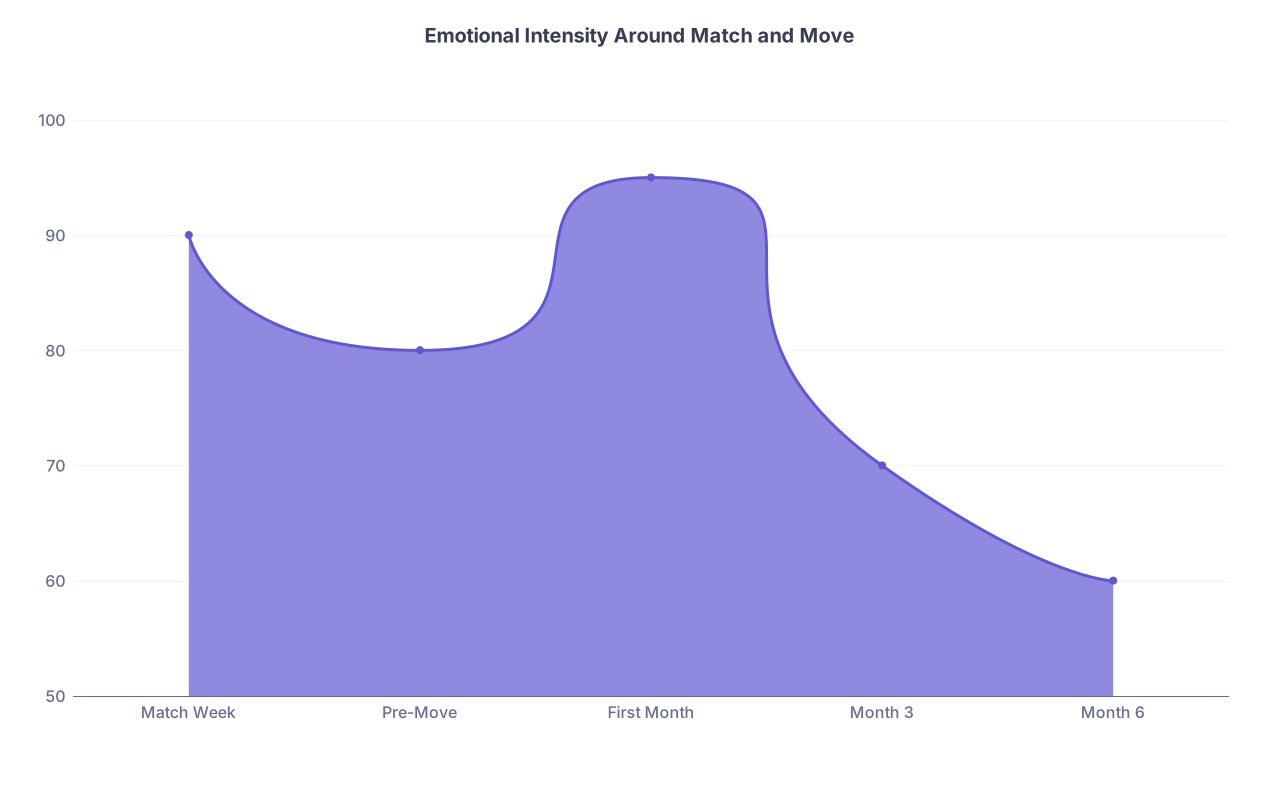
| Category | Value |
|---|---|
| Match Week | 90 |
| Pre-Move | 80 |
| First Month | 95 |
| Month 3 | 70 |
| Month 6 | 60 |
That spike? First month of residency. That’s when couples with no plan crack. You’re getting ahead of it.

Open your calendar app right now and create a 45-minute event in the next 3 days called “Relationship Game Plan Call.” Invite your partner. That’s where this turns from ideas into an actual life you two can live.