

What do you do when the Match email says “Congratulations!” but your body is already quietly asking, “Can we actually survive this?”
You are not the only one in that gap between excitement and dread. I’ve seen people match into phenomenal programs and still end up on leave, or quietly drop out, not because they were lazy or weak, but because they had no realistic support system around their chronic illness.
Let’s build yours properly.
Step 1: Get Honest About Your Actual Capacity (Not Your Fantasy Self)
Before you talk to anyone or sign anything, you need a brutally accurate snapshot of what your body can do under stress. Not what you hope it can do. What it actually does.
Ask yourself, based on the last 1–2 years:
- How many hours a day can you reliably function before symptoms spike?
- What happens to you on 4–5 hours of sleep?
- How often do you need medical appointments, infusions, labs, or therapies?
- Are there predictable triggers: night shifts, missed meals, dehydration, cold exposure, prolonged standing, infection risk?
If you have no idea because med school was more flexible or you “pushed through” everything, assume residency will expose every crack.
Write this down. Literally. One page:
- Typical good day = what you can do
- Typical bad day = what collapses first
- Absolute deal-breakers = what will send you to the ER or bed for 48 hours
You’ll use this page to guide conversations with doctors, your program, and your family. It’s your reality check when your mind starts saying “It’ll be fine” without evidence.
Step 2: Get Your Medical Team in Residency Mode
Right now, your specialists might be managing you like a med student with a semi-flexible schedule. You’re about to be a shift worker with long hours and unpredictable days. Different game.
You need a “residency plan” with your medical team. That means:
Clear treatment plan for flares
- What’s the first-line plan you can do at home?
- When should you call them?
- When is urgent care/ED appropriate?
- Do you have standing scripts for things that reliably help?
Medication schedule compatible with call
- Can anything be shifted to once-daily dosing?
- Are there meds that cannot be taken if you might be driving or doing procedures?
- Are there meds you absolutely must not miss? How will you handle nights and 28‑hour calls?
Monitoring and labs
- Can routine labs be stretched a bit or consolidated into fewer visits?
- Can you get standing lab orders so you can go early morning before work?
Backup plan for supply and refills
- 90‑day supplies where allowed.
- A local pharmacy near your new hospital and one near your home.
- Clear instructions in your chart for urgent refills.
Bring your “reality page” to this appointment. Tell them plainly:
“I start residency on [date] at [program]. Typical weeks will be 60–80 hours, nights, call. I need a treatment and monitoring plan that is realistic for this life.”
If your specialist does not understand residency demands, spell it out. “There will be times I cannot leave the hospital during the day. Night shifts. 28‑hour calls. I need options that work within that.”
Step 3: Map Your Legal/Policy Protections Early (Before Crisis Hits)
You are not asking for “special favors.” You are using legal tools that exist for a reason. The people who suffer most are usually the ones who try to be heroes and tell no one anything until they’re collapsing.
You should understand three things at minimum:
- Reasonable accommodations (ADA / disability laws)
- Medical leave structures (FMLA type protections, institutional medical leave policies)
- Your hospital’s own GME and wellness policies
Most programs will not spoon-feed you this. You have to dig.
Who to talk to (in roughly this order)
- GME office or resident affairs
- Institution’s disability services / accommodations office
- Occupational health
You do not have to open your full life story to your program director on day one. But you do need a private, documented channel somewhere in the system that:
- Knows you have a chronic illness
- Has your documentation on file
- Has discussed what accommodations might look like if/when you need them
Examples of reasonable accommodations I’ve seen work:
- Protected time for infusions or critical specialist visits scheduled well in advance.
- Avoiding specific rotations that are physically impossible (e.g., transplant surgery nights for someone with POTS who collapses if standing > 4 hours).
- Slightly reduced schedule for a period, with extension of training.
- Strategically limiting consecutive nights.
- Access to a call room near a bathroom or with a fridge if meds require cooling.
Unreasonable expectations that often fail:
- “I want to work 40 hours a week when my peers work 70, but still graduate on time.”
- “I never want to do nights.”
- “I can’t tolerate any stress or sleep disruption.”
Residency is intense by definition. The support system is about making it survivable, not turning it into a 9–5 office job.
Step 4: Decide What to Disclose, To Whom, and When
People get stuck here and then default to either over-sharing or saying nothing and imploding. You need a deliberate strategy.
Think in circles:
- Inner medical circle – PCP, specialists, possibly occupational health and disability office
- Formal program circle – Program director, assistant PD, chief residents
- Peer circle – Co-residents, friends in the program
You do not owe everyone full details. You do owe your program enough information that:
- They’re not blindsided if you suddenly need time off.
- They know this is a chronic condition, not a single episode you “got over.”
- They understand what actually helps (e.g., earlier notice for clinic scheduling, not pity).
A simple, functional script to a PD or chief can look like:
“I want you to be aware I have a chronic medical condition that’s being followed by specialists. It’s stable right now, I’ve safely completed my clinical rotations, and I fully expect to do the work of residency. There are a few things that help me stay functional long-term, and I’d like to talk with GME/disability services about how we can structure that if needed.”
You do not need diagnostic labels up front if you’re not comfortable. It can help, though, especially for visible conditions or things that might affect procedures, driving, or infection risk.
For peers, pick 1–2 people you somewhat trust and try a small disclosure:
“Hey, just so you know, I have a chronic illness that sometimes flares. If you ever see me looking like a zombie or barely standing, I’m not just tired-tired. I might need a quick 10 minutes to reset or some help swapping a task.”
You want at least one person on each rotation who knows that “you looking bad” means something specific, not just “new intern is tired.”
Step 5: Build Your “Day 1–30” Infrastructure Before You Start
Do not wait to “see how it goes.” By the time you see, it might be too late.
You need concrete support in place for the first month:
Housing
- Close enough to the hospital that commute isn’t another 90 minutes of stress.
- Elevator access if mobility or fatigue are issues, not six flights of stairs.
- Air conditioning/heating that’s reliable (yes, temp changes matter for a lot of illnesses).
- A quiet sleep space that can actually be dark during the day if you’re on nights.
Transportation
- Primary method: driving, walk, public transit, ride-share? Decide now.
- Backups: What if your car dies? Too symptomatic to drive?
Have one or two concrete backup routes/people, not just “I’ll figure it out.”
Food and meds
- Identify 2–3 simple, repeatable meals that don’t require brainpower.
- Stock your freezer and pantry before you start.
- Set up automatic refills for meds where possible.
- One small go-bag in your work bag:
- 1–2 doses of critical meds
- Snacks that won’t go bad
- Electrolyte packets if dehydration is your enemy
Sleep strategy
If your condition flares badly with sleep deprivation, you can’t wing this.
- Blackout curtains or eye mask at home.
- Earplugs or white noise app.
- Tight boundaries with your phone (named “Do not disturb except for X and Y” periods).
You will be tempted to stay up scrolling after call. Your body will not tolerate that long-term.
Step 6: Design Your “At Work” Micro-Supports
This is where people either sink or manage to tread water.
You are not going to get 8 hours of sleep and three meals a day. But you can still make things less brutal.
Hydration and bathroom reality
Residents who never pee aren’t heroic; they’re short-sighted.
If your illness involves kidneys, POTS, bladder, GI, or meds that need fluid:
- Bring a water bottle that actually holds enough.
- Put bathroom breaks on the same mental level as checking a lab: non-negotiable tiny tasks.
- Ask early: “Where are the closest bathrooms to [ICU/OR/clinic X]?” Know your terrain.
Micro-breaks
On a crazy day you might not get a formal break. You can still get 60 seconds.
Use them deliberately:
- 3 slow breaths before entering each new room.
- 60 seconds to sit down while reading labs instead of standing.
- 2 minutes to eat half a snack between tasks.
This sounds small and stupid. It isn’t, especially for conditions where orthostasis, blood pressure, glucose, or pain are sensitive to tiny changes.
Physical pacing
If standing wrecks you, trade tasks when possible:
- Offer to finish notes or make phone calls while a peer does another walk to radiology.
- Volunteer for the “brain-heavy, body-light” tasks when your symptoms spike.
Do not use your illness as a card to avoid all hard work. Do use it to shift which hard work you do when.
Step 7: Coordinate Your Personal Life Like a Second Residency
Your life outside the hospital can either buffer you or destroy you. With chronic illness, there is no neutral.
You need to decide what absolutely must stay in your life and what you are willing to freeze.
Some things probably need to be paused:
- Extra volunteering unrelated to your health or sanity.
- Leadership roles that demand evenings/weekends.
- Social obligations that leave you exhausted for days.
Some things should not be cut, even if people pressure you:
- Regular medical appointments.
- One or two grounding habits: short walks, stretching, therapy, religious/spiritual practice, whatever actually stabilizes you.
You’re not trying to be a monk. But you cannot live like your non-illness peers who finish a 28‑hour call and then go hiking, brunching, and drinking. If you try that, something will give—and it’ll be your body first, your residency second.
Enlist your people:
- Family: Very clear expectations. “I cannot travel home every other weekend. I will likely be MIA during ICU months. Here’s when I can talk.”
- Partner/roommate: Explain your bad days and what helps: “If I stumble in and go straight to bed without talking, it’s not about you.”
- Friends: Pick 1–2 who get it and explicitly say, “You’re my emergency person if I start spiraling. I need you to text me if I disappear for weeks.”
Step 8: Have a Flare Plan That Isn’t “Hope It Goes Away”
You will probably flare at some point. Not because you’re weak. Because residency.
Plan for that in detail.

| Step | Description |
|---|---|
| Step 1 | Notice flare symptoms |
| Step 2 | Use at work strategies |
| Step 3 | Hydrate, micro breaks, meds |
| Step 4 | Notify senior or chief |
| Step 5 | Consider going home or clinic |
| Step 6 | Call in sick |
| Step 7 | Notify chief or PD |
| Step 8 | Contact specialist or PCP |
| Step 9 | Adjust meds or visit ED |
| Step 10 | Able to work safely? |
| Step 11 | Still worsening? |
You should know in advance:
- What “mild flare” looks like for you vs. “I should not be in the hospital.”
- Who you will text/call first at work: senior resident, chief, program coordinator?
- What language you’ll use that is clear but not dramatic.
Example:
“I’m having a significant flare of my medical condition. I’m safe right now, but I’m not sure I can safely complete the rest of this shift. Can we discuss coverage options?”
Or, if you must call out sick:
“I need to call in sick today due to a significant flare of my chronic illness. I’m following up with my specialist. I’ll keep you updated as soon as I know more.”
You are not required to give a full symptom list to every chief on call. Keep it simple and consistent.
Also: familiarize yourself with your program’s sick policy early. How many sick days? How do you report them? Is there a “jeopardy” system for coverage? Do not wait until you are half-conscious in bed to try to find that PDF.
Step 9: Monitor Yourself Like You Monitor Patients
You know how patients slowly decompensate while saying, “I’m fine”? You’re at high risk of doing the same thing.
Pick 3–4 objective-ish metrics for yourself:
- Hours of sleep per 24‑hour period, averaged over the week.
- Number of days with pain or severe symptoms > X/10.
- Number of missed meds per week.
- Frequency of near-syncope, GI crises, migraines, whatever your signature disaster is.
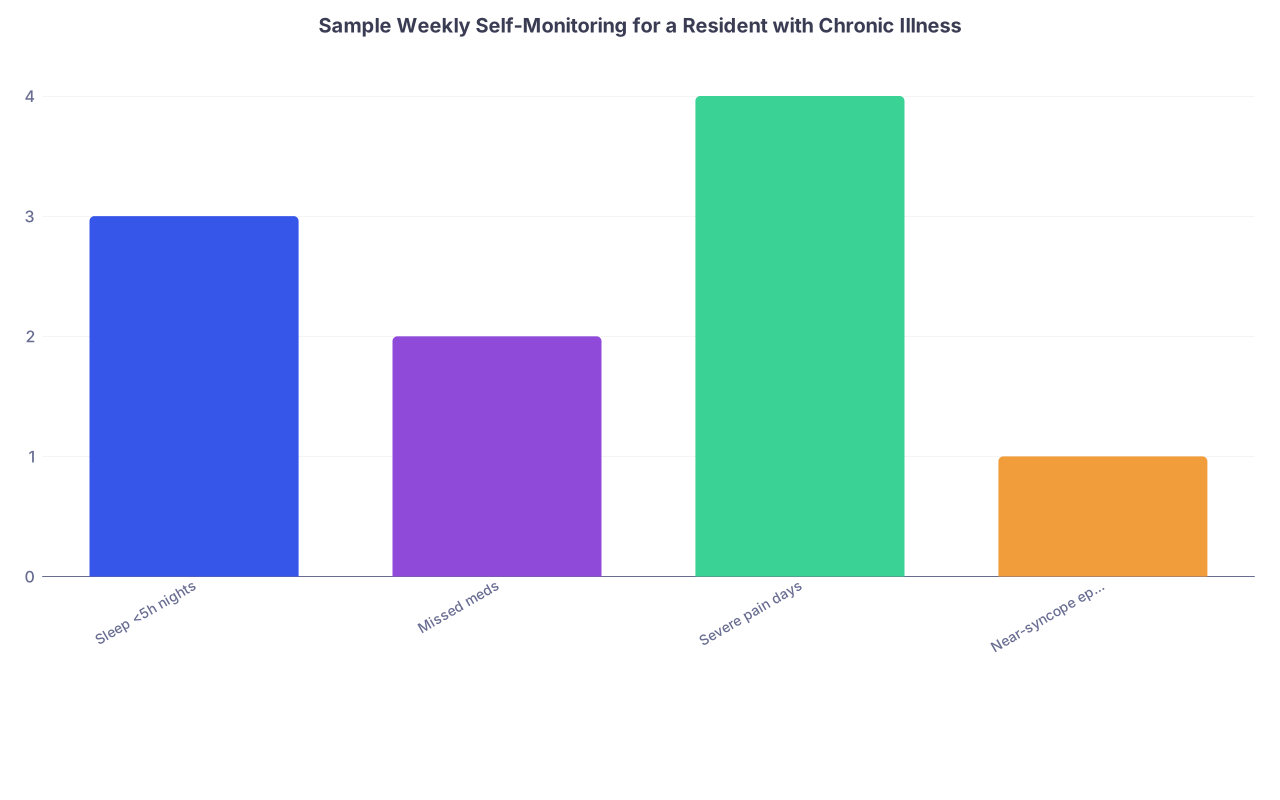
| Category | Value |
|---|---|
| Sleep <5h nights | 3 |
| Missed meds | 2 |
| Severe pain days | 4 |
| Near-syncope episodes | 1 |
Set thresholds with your medical team:
- “If I have more than 3 severe days in a week, I will contact you.”
- “If I miss meds more than twice a week because of work, we reconsider regimen.”
- “If I have X episodes of near-syncope at work, we adjust schedule or accommodations.”
This is not about being dramatic. It’s about not slowly boiling yourself alive in the residency pot.
Step 10: Know When to Consider Bigger Changes (And That It’s Not Failure)
Sometimes, even with good planning, the combination of your illness + that specific program or specialty is just not compatible. That’s not a moral failing.
Signs you may need to consider a major adjustment:
- Repeated hospitalizations or near-misses directly related to work demands.
- Your specialists explicitly saying, “This schedule is harming you long-term.”
- You’re using all sick days, constantly teetering on the edge, and still decompensating.
- You’re cutting everything outside of residency and still not remotely stable.
Major changes could include:
- Reduced schedule with extension of residency.
- Official medical leave to stabilize and re-evaluate.
- Switching to a less physically intense specialty or program.
- In rare cases, deciding that full clinical residency is not medically safe and pivoting careers.
Do not wait until your body forces the decision in a catastrophic way. Quiet, proactive conversations early—especially with GME and your doctors—give you more options and less damage.
Quick Comparison: High-Risk vs Smarter Approaches
| Situation | High-Risk Approach | Strategic Approach |
|---|---|---|
| Before start | Tell no one, no plans | Meet specialists, GME, plan for rotations |
| On flare | Hide it, push through | Use scripted, early communication |
| Schedule | Accept any rotation mix | Request reasonable adjustments |
| Meds | Same med school regimen | Adjust timing/dosing for shifts |
| Support | “I’ll handle it alone” | Build family/peer/therapy supports |
Mental Health: Don’t Pretend You’re Invincible
Chronic illness plus residency is a setup for anxiety, depression, and burnout. Even if you’ve “never been a mental health person.”
You’re going to:
- Watch your co-residents do things your body can’t.
- Feel guilty more often than you should.
- Worry constantly about being “the weak link.”
Two things that help enormously:
Therapy or counseling with someone who understands healthcare workers.
Not to vent forever, but to build specific coping strategies, challenge the toxic “I must destroy myself to be good” narrative, and help you make big decisions if a change is needed.One or two colleagues you can be honest with.
Not everyone. Just enough that you aren’t performing 24/7.
Also, watch for the classic shame-driven self-talk: “If I were stronger this wouldn’t be a problem.” That’s nonsense. You are not less of a physician because your body has constraints. In fact, most patients will relate to you more than to the “I run marathons post-call” crowd.
Timeline: What To Do When
To keep this from feeling abstract, here’s a rough sequencing.
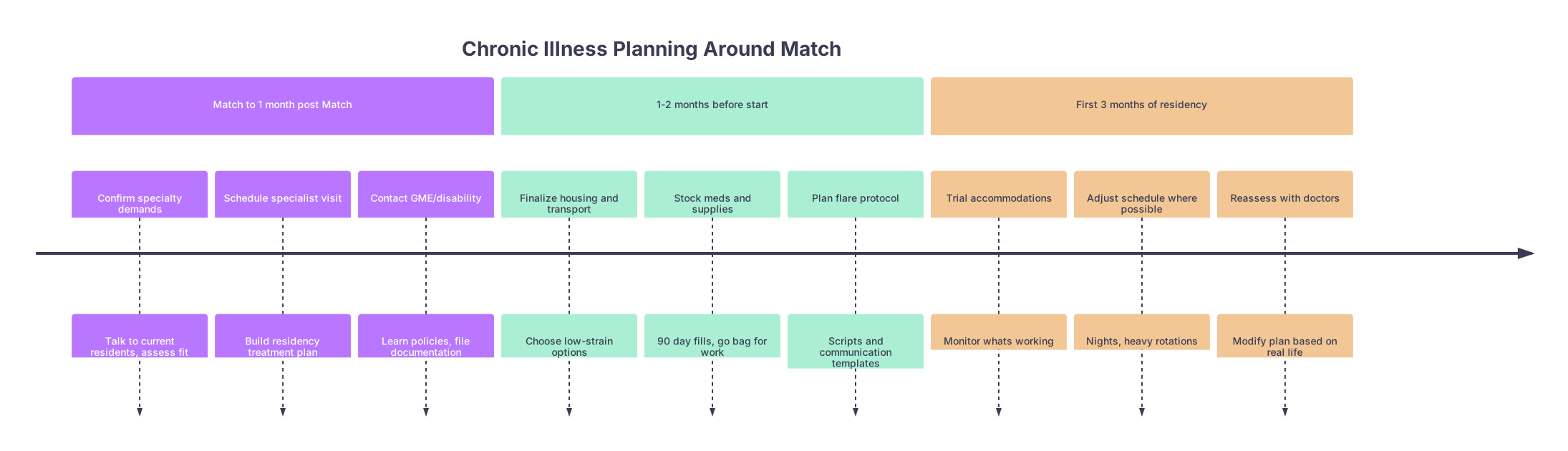
| Period | Event |
|---|---|
| Match to 1 month post Match - Confirm specialty demands | Talk to current residents, assess fit |
| Match to 1 month post Match - Schedule specialist visit | Build residency treatment plan |
| Match to 1 month post Match - Contact GME/disability | Learn policies, file documentation |
| 1-2 months before start - Finalize housing and transport | Choose low-strain options |
| 1-2 months before start - Stock meds and supplies | 90 day fills, go bag for work |
| 1-2 months before start - Plan flare protocol | Scripts and communication templates |
| First 3 months of residency - Trial accommodations | Monitor whats working |
| First 3 months of residency - Adjust schedule where possible | Nights, heavy rotations |
| First 3 months of residency - Reassess with doctors | Modify plan based on real life |
And yes, you’ll keep iterating. Year 1 won’t look like Year 3. But if you do this work now, you’ll actually be around to see Year 3.
Two Realities You Need To Hold At The Same Time
- Residency will be hard even if you were perfectly healthy. There is no path where this is easy.
- You are allowed to protect your health and still be a serious, committed physician.
You are not a burden because you need structure. You are dangerous if you pretend you don’t.
Key Takeaways
- Build a residency-specific medical and support plan now: with your specialists, GME, and at least one trusted peer, grounded in what your body has actually shown it can handle.
- Decide intentional disclosure and flare strategies: know who you’ll tell, what you’ll say, and when you’ll escalate from “push through” to “this is unsafe.”
- Treat your health like you treat your patients’ safety: monitor objectively, adjust early, and be willing to change the plan—including schedule, rotations, or even path—before the system or your body makes the decision for you.


