
It’s late March. You matched. Everyone around you is celebrating, posting Instagram stories in their new program hoodies. You’re smiling in the group photo, but the second you’re alone, the truth hits you:
“I’m not sure I actually want to do this. At least not like this.”
You’re thinking about the military. Or a research year. Or maybe you’re wondering if you should leave medicine entirely. And now you’re stuck in this mental loop:
“I already signed that Match contract… Can I get out? What happens if I bail? Am I about to blow up my career?”
This is exactly the situation: matched, but your gut is pulling you somewhere else. Let’s walk through your real options, the risks, and what to do this week—not someday.
First: Reality Check on the Match Contract
Let me be blunt: the Match is not casual.
When you certified your rank list, you agreed:
- If you matched, you would start that residency.
- Programs agreed they would train you.
- NRMP (or SF Match, etc.) exists to make sure people actually honor that.
Breaking that has consequences. Sometimes severe. Sometimes manageable. Depends how you do it.

Here’s the short version of the NRMP side:
If you simply don’t show up in July:
You risk an NRMP violation. This can lead to being barred from future Matches for a period, being flagged to programs, and having a permanent disciplinary notation in the NRMP system.If you coordinate a release with your program:
Much safer. Program releases you from the position, NRMP is notified, no violation. But: the program does not have to agree.
Do people walk away after matching? Yes. I’ve seen it in all three categories you’re asking about: military, research, and leaving medicine. Some handled it well and landed on their feet. Some torched their future options.
The difference is planning and honesty.
Step Zero: Get Your Own Situation on Paper
Before we split into “military,” “research,” and “leave,” you need clarity. Right now your brain is probably doing this unhelpful blend: “I’m burned out; I hate this specialty; maybe the military would fix it; maybe I just like research; or maybe I should be a barista.” That mess won’t lead to a good decision.
Do this tonight—literally:
- Set a 20-minute timer.
- Write three separate lists (no editing, just brain dump):
- Reasons to go through with this residency as planned.
- Reasons to change course (military / research / leave).
- Absolute dealbreakers for your life over the next 5 years (location, debt, family, mental health, etc.).
Now you at least know what you’re actually choosing between.
Option 1: Matched but Now Considering the Military
Here’s what you’re probably thinking: “I like structure, service, loan repayment, maybe I should join the military instead of this civilian residency.”
Key point: the military is not a casual Plan B. It’s a binding service commitment with its own timelines and match systems.
Scenarios I see most:
- You matched civilian but want to apply to a military GME path next cycle.
- You matched civilian but want to do active duty as a fully trained attending later.
- You’re fantasizing about the military mostly because you hate your current Match result.
Let’s break the actual mechanics.
A. Joining the military instead of starting residency this July
This is the most dangerous plan. Why?
- Military accession processes are slow, highly selective, and can fall through for reasons outside your control (medical, security, budget, etc.).
- You cannot assume, in March, that you’ll be in uniform by July.
- If you walk away from your matched spot without a signed, guaranteed military contract in hand, you may end up with: no residency, no military, and a Match violation on your record.
If you’re serious about this route:
- Talk to a military health professions recruiter immediately (Army, Navy, Air Force, depending on your interest).
- Ask specifically:
- Earliest realistic accession date.
- Whether you’d enter as GMO/Flight Surgeon vs straight to residency vs clinical duty later.
- How your current Match contract interacts with their timeline.
- Then talk to your matched program before you burn bridges. Something like:
- “I’ve been approached about a military opportunity that may affect my start date. I want to be transparent, and I’m gathering information. My intent is not to abandon my commitment without working with you and respecting the process.”
Do not announce “I’m leaving for the military” until you have:
- A signed military contract with dates.
- A discussion with NRMP (or the relevant match system) and your program about a formal release.
B. Completing this residency, then joining the military
This is often the sanest route.
Pros:
- You fulfill your Match obligation.
- You enter the military with a full specialty (more control over your role and location).
- You don’t risk an NRMP violation.
Cons:
- Loans accumulate during residency (though you may get bonuses/loan repayment later).
- You delay active duty service by 3–7 years.
If your core desire is service/structure and not immediate escape, this is usually the low-risk, high-control path.
C. Do NOT do this
Do not:
- Bail on your program last-minute banking on a speculative military option.
- Assume “they’ll understand” if your orders get delayed or canceled. Programs have service lines to cover and accreditation requirements.
Bottom line:
Military is a valid path. As an immediate alternative to this July, it’s very high risk. As a future direction after residency, it’s totally reasonable and often the best compromise.
Option 2: Matched but Considering a Research Year
This is common, especially in specialties like derm, ortho, plastics, rad onc, competitive fellowships, or for people considering a re-application in a different field.
Two completely different beasts here:
- Research as a structured, planned detour with program support.
- Research as an escape hatch from a residency you don’t want.
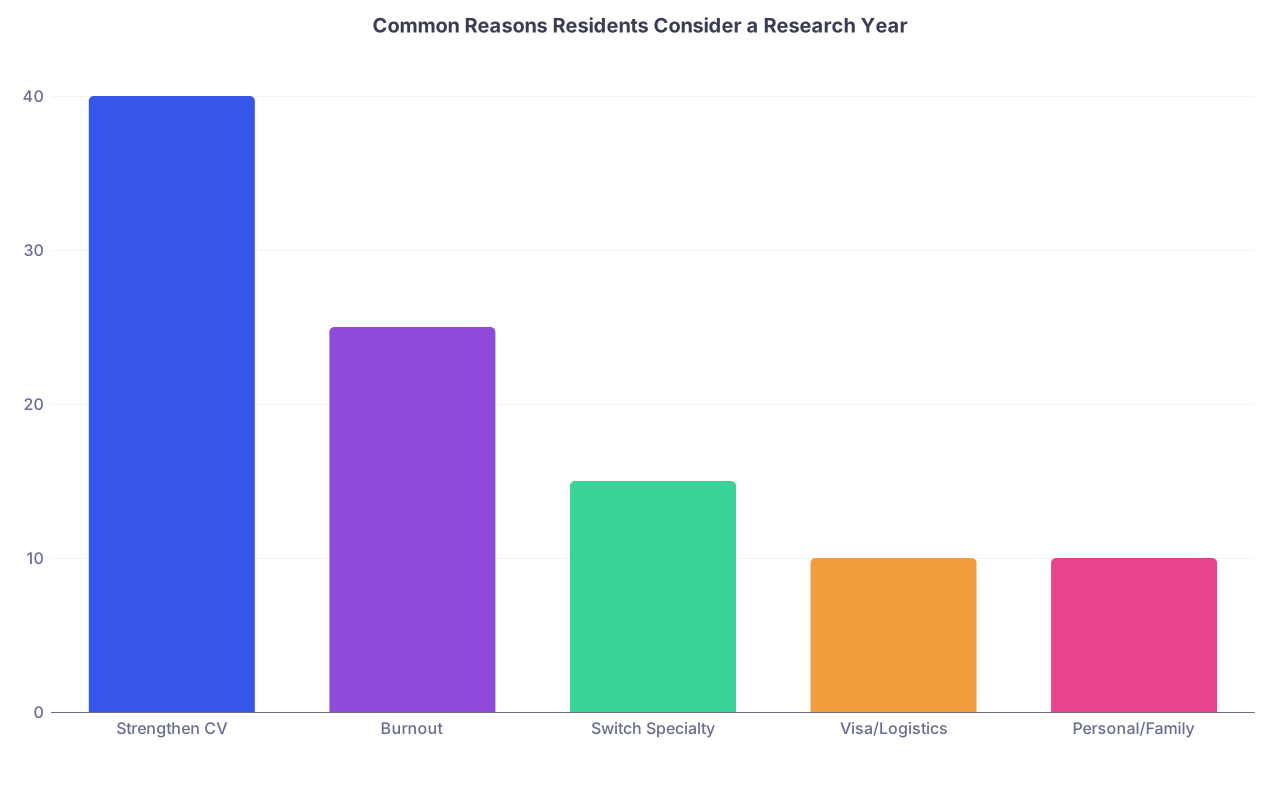
| Category | Value |
|---|---|
| Strengthen CV | 40 |
| Burnout | 25 |
| Switch Specialty | 15 |
| Visa/Logistics | 10 |
| Personal/Family | 10 |
A. Taking a research year with your program’s blessing
Some programs will:
- Let you defer your start by 1 year for a funded research position.
- Or let you do a research year after PGY-1 or PGY-2 and then return.
This is the gold standard if you’re looking to buy time or build your CV without burning the Match contract.
What you do:
- Identify a real, funded position (NIH year, T32, lab, clinical trials group, outcomes research, etc.).
- Set up a meeting with your PD:
- “I matched here and I’m committed, but I’m very interested in doing a dedicated research year in [specific area] to support long-term goals in [fellowship/specialty]. Is there a mechanism to defer or integrate a research year?”
- Be ready to explain:
- How this benefits the program (publications, visibility, future fellowship placements).
- That you’re not just fleeing responsibility.
They may say no. But some will work with you, and you keep your NRMP record clean.
B. Dropping out to do research elsewhere
If your real goal is: “I hate this specialty and want to switch, but I’m scared to go straight into a new Match,” research often becomes the cover story.
Not saying it’s wrong. Just be honest with yourself about why you’re doing it.
Risks:
- If you leave your program abruptly or without full transparency, you can end up with:
- A negative or very cautious PD letter.
- Program reporting your resignation to NRMP/state board.
- Programs can be very suspicious of “I left residency to do research” when it’s clearly a rebranding attempt.
If you truly want to change fields:
- Start the residency you matched into, unless you have overwhelming reasons not to. Complete at least several months.
- Perform well. Show up. Don’t act like you’re half out the door.
- Quietly explore:
- Mentors in your target specialty.
- Research projects you can do in that area.
- When you’re sure, schedule a frank meeting with your PD:
- “I’ve realized my long-term fit is in [different specialty]. I want to do this in a way that reflects well on the program and on me. I’m exploring a research year and then reapplying. Could we discuss what would be acceptable from your standpoint and what sort of letter you’d be comfortable with?”
Programs respect honesty a lot more than disappearing.
Option 3: Matched but Considering Leaving Medicine Entirely
This is the one people whisper about in hallways but rarely say out loud.
Thoughts like:
- “I don’t want to be a doctor.”
- “Even best-case scenario in this residency, this is not my life.”
- “I’m here because of sunk cost and everyone else’s expectations.”
I’ve seen people stay and become bitter, unsafe physicians. I’ve also seen people leave, regroup, and build completely different, fulfilling careers.
First pass: Are you burned out or truly done?
You need to distinguish:
Acute burnout:
4th-year fatigue, Step 2 stress, family pressure, depression, anxiety, exhaustion. If you changed nothing, you might feel differently in 12 months with sleep and a functioning brain.Fundamental mismatch:
You dislike the work itself, the identity, the entire trajectory.
Concrete test:
Imagine yourself as an attending in your matched specialty, 10 years from now. You’re reasonably well-rested, in a decent job, paid okay, with some control over your schedule.
If that future still feels like a prison, that’s not just burnout.
Hard truth about leaving after matching
You absolutely can leave. There is no legal entity that can force you to practice medicine.
But:
- There may be financial consequences:
- Loan repayment terms.
- Visa status if you’re an IMG.
- Contractual obligations if you had scholarships/commitments.
- There may be professional consequences:
- Program will report you as a resignation.
- NRMP record of leaving a position (not as bad as a violation, but it exists).
- There will be personal fallout:
- Family expectations.
- Identity shift.
Still—staying because you’re scared to leave is how you end up 15 years in, hating patients and your own life.
A rational path if you’re strongly considering leaving
- Find one trusted, non-judgmental person in medicine (faculty, dean, therapist familiar with physicians) and say it out loud:
“I am seriously considering not practicing medicine.” - Start residency unless:
- You’re actively suicidal / severely depressed, or
- You have an immediate alternative plan that is guaranteed and safe.
Why start? Because a few things might happen:
- You discover that being a real physician is different from med school and you actually like it more than you expected.
- You confirm—very quickly—that this life is not yours. Then you resign early and honestly, with more data and a clearer head.
- If, after a few months, you still know you’re done:
- Meet with your PD and say something like:
- “I’m grateful for the opportunity, but I’ve realized that a career in clinical medicine is not something I can commit to in good faith. I don’t want to occupy a spot that could go to someone who intends to complete training. I’d like to discuss an orderly plan for resignation.”
- Offer a transition plan.
- Do not ghost or bail mid-call.
- Meet with your PD and say something like:
Then build the next chapter deliberately. You’re not running away—you’re exiting one path and choosing another.
How Different Choices Impact Future Options
Here’s what you probably care about: “If I do X, will I destroy my ability to ever train/practice later?”
Let’s simplify:
| Decision | NRMP Risk | Future Residency Chances | Notes |
|---|---|---|---|
| Start and complete matched residency | None | Strong | Safest; opens most doors |
| Start, then leave with proper resignation | Low–Moderate | Variable, but possible | Depends on reasons and PD support |
| Program-approved deferral or research year | Low | Good | Clean record if well documented |
| No-show / abandon without notice | High (violation) | Poor to very poor | Can be career-ending in GME context |
| Military after residency | None | N/A | No effect on Match history |
| Military instead of residency (w/o release) | High | Poor | Messy and risky |
The single dumb move: just not showing up on July 1 without talking to anyone. That’s the “light yourself on fire professionally” option.
Timeline: What to Do Month by Month
Let’s assume you’re reading this in late March, just post-Match.
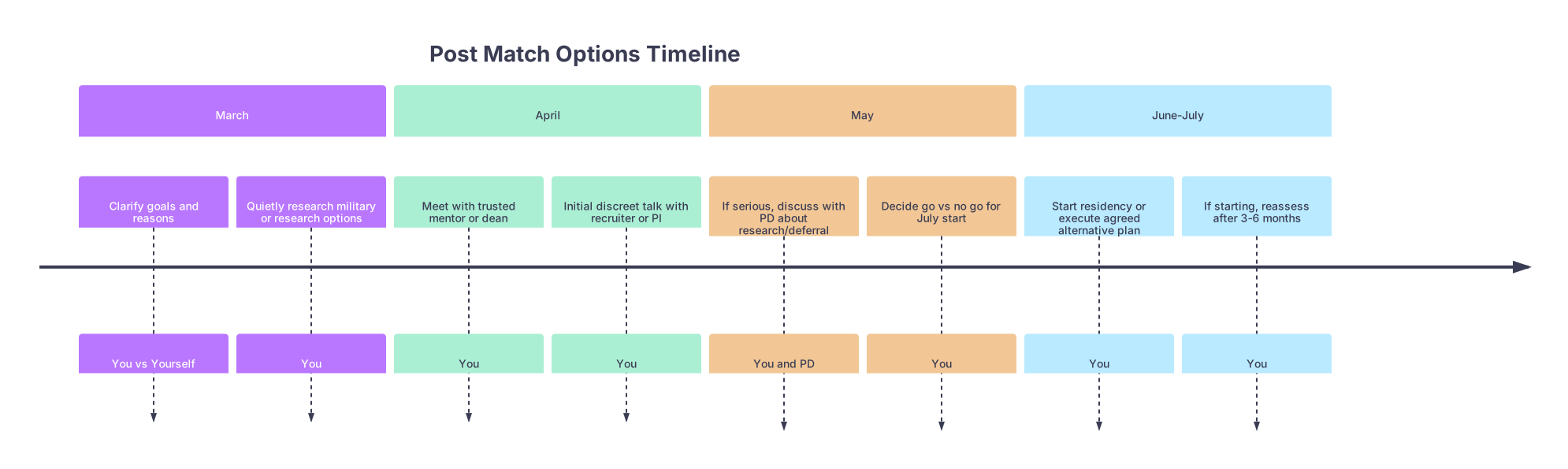
| Period | Event |
|---|---|
| March - Clarify goals and reasons | You vs Yourself |
| March - Quietly research military or research options | You |
| April - Meet with trusted mentor or dean | You |
| April - Initial discreet talk with recruiter or PI | You |
| May - If serious, discuss with PD about research/deferral | You and PD |
| May - Decide go vs no go for July start | You |
| June-July - Start residency or execute agreed alternative plan | You |
| June-July - If starting, reassess after 3-6 months | You |
Do not wait until late June to drop the bomb on your program. Even if you’re unsure, early transparency (phrased carefully) gives you more control and preserves trust.
How to Talk to Your Program Director (Without Setting Off Alarms Too Early)
You’re probably scared of this part, and reasonably so. PDs vary from incredibly supportive to… not.
Strategy:
Start with curiosity, not ultimatums.
Example for research:
“I’m very interested in a career that’s research-heavy in [subfield]. Do residents here ever take dedicated research time or a year out?”Only escalate to “I might not be able to start / I might need to step away” once:
- You have an alternative clearly mapped out, or
- You’re absolutely sure you cannot in good conscience continue.
Keep the tone:
- Grateful.
- Honest but measured.
- Focused on patient care and program needs, not just your feelings.
You’re not groveling, but you are recognizing you joined a team that now has to adjust if you leave.
Mental Health: If What You Really Feel Is “I Can’t Survive This”
Different case. More urgent.
If your thoughts are more like:
- “I don’t want to be alive if this is my future.”
- “I can’t see any path that doesn’t end in me breaking.”
Then step one is not “figure out NRMP” or “talk to your PD.” Step one is:
- Get immediate mental health support:
- School counseling if you’re still technically a student.
- Physician health program.
- Private therapist experienced with trainees.
- Loop in at least one real person (mentor, partner, friend) about how bad it is.
Programs and contracts are secondary if your life is at stake. You can repair a career; you do not get extra lives.
Concrete Next Steps You Can Take Today
Do not just close this tab and go back to doom-scrolling.
Here’s one thing you can do right now:
Open your Match email or letter. At the top of a blank page, write:
“I matched at [Program, Specialty]. My top 3 real options are: [military / research / leave / stay]. The one that scares me most but feels most honest is: ______.”
Then:
If you don’t know enough about the military path:
Find the official health professions recruiter email for the branch you’re interested in and send a short, specific inquiry.If you’re leaning research:
Identify one PI or research group whose work you respect and send a concise email about potential positions or a research year.If you might leave medicine:
Schedule a 1-hour session with a therapist or your school’s mental health service and tell them ahead of time: “I want to talk about potentially not doing residency.”
One concrete action. Today.
FAQ (Exactly 3 Questions)
1. If I back out of my matched residency before July, can I ever match again?
Possibly, but it will be harder and depends heavily on how it’s done. If your program formally releases you and there’s no NRMP violation, you may be able to reapply later with an honest explanation and strong letters. If you no-show or get hit with a Match violation, some specialties and programs will blacklist you informally. It’s not an automatic life sentence, but you’ll be climbing uphill and will need to own the decision and show a clear, stable path forward.
2. Is doing a research year between med school and residency safer than backing out after matching?
Yes—if you plan it early and apply through the Match with that timeline in mind. Once you’ve already matched, trying to insert a research year by abandoning your position is much riskier. The safest “research year” after a Match is one that’s either integrated with or explicitly approved by your program. Anything else starts to look like bailing, and programs—and NRMP—do not like that.
3. How bad is it, really, to just stick it out in a specialty I don’t love?
Depends what you mean by “don’t love.” If you’re neutral, mildly disappointed, or just grieving your dream specialty, but the day-to-day work is tolerable and you can see a workable attending life, staying can be a rational, even good choice. If you actively dread the core work, resent patients, or feel trapped and hopeless when you picture 10 years ahead, forcing yourself through may damage your mental health and lead to burnout, impairment, or early exit anyway. In that case, it’s better to confront the problem now and choose a deliberate pivot—even if it’s messy—than to let inertia run your life.