
It is the morning after Match Day. Your phone is full of congratulations. Your family is telling everyone you are basically a doctor now. Your email has a “Welcome to the Class of 2028” message from your new program director.
And you feel…sick.
You are not thinking, “I did it.”
You are thinking:
- “They made a mistake.”
- “Everyone else in my class is more qualified.”
- “What if I am the weakest intern they have ever taken?”
I have seen this play out every year. Applicant matches a great program, looks thrilled on Friday, quietly spirals by Sunday. By April they are googling “how to back out of residency” at 2 a.m.
Let’s not do that.
You are not going to mindset your way out of impostor syndrome with vague affirmations. You need structure, data, behavior, and repetition. So here is a 30-day reset plan designed specifically for the “I matched but I feel like a fraud” phase.
This is a protocol. Not therapy. Not philosophy. A step-by-step plan.
Step 0: Understand What You Are Actually Fighting
Before the 30 days start, you need to know what you are dealing with. Otherwise you fight smoke.
Impostor syndrome in new interns usually has three components:
Cognitive distortion
- “I got lucky; everyone else earned it.”
- “If I ask questions, they will realize I am incompetent.”
- “One mistake = proof I should not be here.”
Comparison addiction
- Staring at other people’s Step scores, publications, or fellowship goals.
- Constantly mentally ranking yourself. Dead last, of course.
Skill ambiguity
- You do not actually know what you are supposed to be able to do on Day 1.
- So your brain fills in the blanks with “probably everything,” then concludes you are behind.
The 30-day reset plan attacks all three:
- We structure your thinking (cognitive).
- We control your information diet and environment (comparison).
- We define and start rehearsing actual intern skills (skill ambiguity).
And no, this is not about “believing in yourself.” It is about building a system where your brain has less room to lie to you.
30-Day Overview: What You Are Actually Going To Do
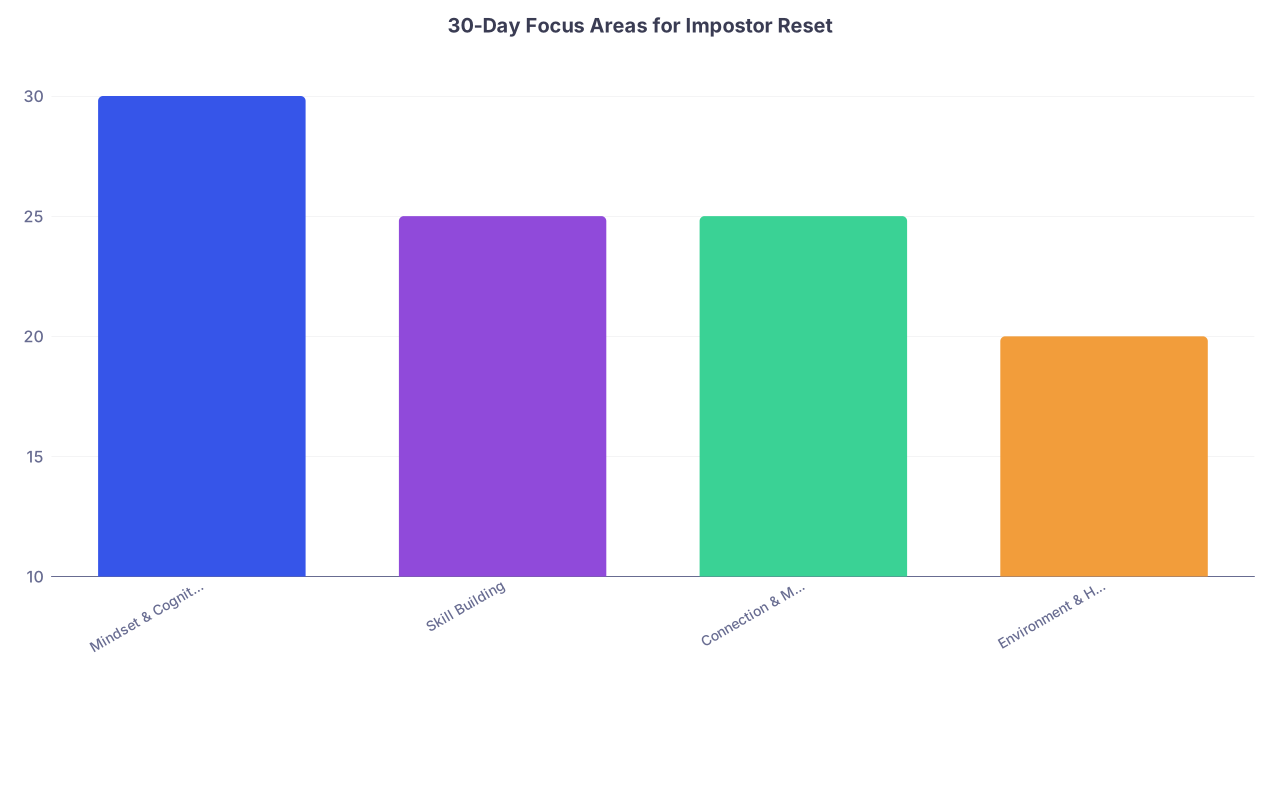
| Category | Value |
|---|---|
| Mindset & Cognition | 30 |
| Skill Building | 25 |
| Connection & Mentorship | 25 |
| Environment & Habits | 20 |
Here is the structure:
Week 1 (Days 1–7): Data and Decompression
You stop the emotional bleeding, get real numbers, and build a basic routine.Week 2 (Days 8–14): Define “Good Enough Intern” and Build a Baseline
You clarify expectations and start targeted skill drills.Week 3 (Days 15–21): Exposure and Identity Shift
You do controlled “I feel dumb” reps and start acting like you belong.Week 4 (Days 22–30): Consolidation, Contingency Plans, and Future-Proofing
You lock in habits that will actually survive PGY-1 chaos.
We will walk day-by-day in clusters. Some days will take 10 minutes. Some will take an hour. That is fine.
Week 1 (Days 1–7): Stop the Spiral and Get Real Data
Your goal this week: move from vague dread to concrete facts, plus a minimal daily structure.
Day 1: Snap the Autopilot
You are probably doom-scrolling Reddit threads about malignant programs and “worst intern ever” stories. Stop.
Today’s tasks:
Set three hard information boundaries:
- Unfollow or mute:
- Med Twitter/IG accounts that trigger comparison.
- Group chats that are humble-brag central.
- Decide:
- Max 15 minutes/day on med social content. Use a timer.
- Unfollow or mute:
Write the “Fraud Narrative” once, on paper.
- One page, stream-of-consciousness:
- “I do not deserve this spot because…”
- “Everyone else is better because…”
- “What I am most afraid will happen is…”
- Then put it in an envelope. Label it: “Impostor Script – Day 1.” You’ll revisit it later.
- One page, stream-of-consciousness:
You cannot fix what you refuse to name.
Day 2: Get Program Reality, Not Imagination
Most impostor thoughts are built on zero actual knowledge of how your program chose you.
Today’s tasks:
Re-read your match email / welcome packet.
- Circle any phrases that suggest they think you belong.
Examples I have seen:- “We were impressed by…”
- “We are excited to train you because…”
- Write these down in a notebook.
- Circle any phrases that suggest they think you belong.
Send one concise email to your future chief or program coordinator:
Subject: Quick Question as Incoming Intern
Hi [Name],
I am very excited to be joining the program this July. As I prepare, I wanted to ask a quick question that might help guide my studying over the next few months:
From your perspective, what 2–3 core skills or qualities make a successful intern in this program?
Thank you for your time,
[Your Name]
You are collecting real expectations, not imaginary ones.
Day 3: Do a Competence Inventory
You need evidence that you are not starting from zero.
Today’s tasks:
Draw three columns on a page:
- Column 1: “Solid”
- Column 2: “Rusty but OK”
- Column 3: “Weak / Need Help”
Then, list under each:
- Knowledge areas (e.g., “DKA management,” “EKG basics,” “OB triage”).
- Skills (e.g., “phlebotomy,” “writing progress notes,” “calling consults”).
- Non-clinical strengths (e.g., “organized,” “good with anxious families,” “calm in chaos”).
Force yourself to have at least:
- 8–10 items in “Solid”
- 8–10 items in “Rusty”
- 5–10 in “Weak”
Your brain will want to dump everything in “Weak.” Do not let it.
Day 4: Build a Basic Daily Structure (Pre-Residency Version)
Chaos feeds impostor thoughts. You want a skeleton routine before internship wrecks your schedule.
Today’s tasks:
Design a simple daily template for the rest of this month:
- Wake + sleep times (consistent ±60 minutes).
- 1 “mind” block (30–45 minutes of focused learning).
- 1 “body” block (20–30 minutes movement: walk, run, yoga, whatever).
- 1 “connection” block (10–15 minutes: text/call someone supportive).
Write it out like this:
| Time | Activity |
|---|---|
| 07:30–08:00 | Wake, shower |
| 08:00–08:20 | Walk outside |
| 10:00–10:45 | Focused study |
| 17:00–17:15 | Call friend/family |
| 23:30 | Lights out |
You will adjust later. For now, just follow something.
Day 5: Learn the “Bare Minimum Intern” Standard
Interns do not need to be attendings. Programs know this. You need to get that into your head.
Today’s tasks:
Look up an official PGY-1 milestone document for your specialty.
- Example: ACGME “Milestones” for Internal Medicine, EM, etc.
- Skim level 1–2 expectations.
Translate into plain English:
- Write 5–7 bullet points: “By the end of PGY1 I should be able to…”
- You will notice:
- They say “with supervision,” “with guidance,” “in most cases.”
- They do not say “manage everything alone at 2 a.m. flawlessly.”
Put this page where you can see it daily.
Day 6: Start the Anti-Impostor Log
You are going to track reality, not feelings.
Today’s tasks:
Create a running note (paper or app) titled “Evidence Log.”
Today, add three headings:
- “Things I have already done that an intern does.”
- “Reasons my program might have ranked me.”
- “People who trust me clinically.”
Under each, list at least 3 bullet points. Examples:
- “Managed 5 admissions on night float with my senior last month.”
- “Clerkship director wrote that I ‘handled uncertainty well’.”
- “Attendings let me run pre-rounds independently.”
You will add to this log throughout the 30 days.
Day 7: One-Day Tech and Comparison Fast
Your nervous system needs a baseline reset.
Today’s tasks:
- No:
- Med Twitter/IG/Reddit
- Step score talk
- “Where did you match?” comparison loops
Instead:
- Move your body for at least 45 minutes.
- Do something non-medical that absorbs your brain for 1–2 hours:
- Cooking a real meal
- Long bike ride
- Deep clean of your room
- Reading completely non-medical fiction
You are proving to yourself that your entire identity is not just “future intern who might be a fraud.”
Week 2 (Days 8–14): Define “Good Enough Intern” and Build a Baseline
Now we get more operational. What does a competent intern actually do?
Day 8: Create Your “Good Enough Intern” Profile
Using the milestone document and any email reply from chiefs/faculty:
Today’s tasks:
On a single page, define “Good Enough [Specialty] Intern at My Program”:
- Capacity:
- “I can manage 8–10 patients with supervision and not lose track of major issues.”
- Communication:
- “I call for help early and clearly.”
- Learning:
- “I identify and close 1–2 knowledge gaps each day.”
- Professionalism:
- “I show up prepared, follow through on tasks, and own my mistakes.”
Important:
Write in present tense, first person. We are building identity.
Day 9: Skill Map – What Actually Matters on Day 1
Quit studying like you are taking Step 2 again. You are not.
Today’s tasks:
Break PGY-1 skills into four buckets for your specialty:
- Core emergencies (you must recognize / start initial steps)
- Daily bread-and-butter (what you see constantly)
- Systems and workflow (notes, orders, paging, handoffs)
- Human factors (calling consults, talking to families, teamwork)
Example for Internal Medicine:
- Emergencies:
- Chest pain / ACS
- Sepsis
- DKA
- Acute GI bleed
- Bread-and-butter:
- COPD exacerbation
- CHF exacerbation
- Community-acquired pneumonia
- Uncomplicated UTI
- Systems:
- Writing an H&P
- Standard admission orders
- Discharge summary basics
- Handoff structure (e.g., I-PASS)
- Human:
- “How to page a consult”
- “Giving a quick hallway update to an attending”
- “Setting expectations with a difficult family”
Pick 3 high-yield topics from Emergencies + Bread-and-butter to focus on this week.
Day 10–11: Build One-Page Playbooks (Not Textbook Chapters)
You are not going to remember 30-page review chapters at 3 a.m. You will remember a one-page algorithm you wrote yourself.
Today’s tasks (spread over 2 days):
For each of your 3 topics, create a one-page playbook with:
- “Red flags” that must trigger senior/attending call
- Initial orders (labs, imaging, meds)
- Monitoring (vitals, labs, nursing parameters)
- Common pitfalls and “do not forget” items
For example, DKA:
- Call senior if:
- pH < 7.0
- K < 3.3 or > 6.0
- Mental status changes
- Initial:
- 1–2 L NS
- Basic labs + VBG + serum ketones
- Insulin drip protocol (hospital-specific)
- Monitoring:
- Fingersticks q1h, BMP q4h
- Pitfall:
- Replace potassium early, do not start insulin if K very low
You want fast, usable tools, not academic essays.
Day 12: Do a 20-Minute Simulation (On Paper)
No fancy sim lab. Just run cases in your head.
Today’s tasks:
Pick one of your topics. Set a timer for 20 minutes.
- Write a quick case:
- “56-year-old with chest pain on the floor, nurse pages you.”
- Force yourself through:
- What do you ask on the phone?
- What orders do you put in before seeing them (if any)?
- What do you look for on exam?
- What is your initial plan?
- When do you call your senior?
Then compare to your one-page playbook. Fill any gaps.
You are training the “caught off guard but not frozen” muscle.
Day 13: Rehearse Human Skills Out Loud
Most impostor spirals are social: “I will sound stupid.” Fine. Then you practice.
Today’s tasks:
Stand in your room and practice, out loud:
Asking for help efficiently:
“Hey [Senior], quick update on Ms. Rivera in 312. She is a 68-year-old with CHF admitted yesterday. Over the last hour her blood pressure has dropped from 120s to 80s, HR is now 115, she is more short of breath, on 4 L from 2 L. I have ordered a stat CXR and labs, I am at bedside now. I am worried she might be decompensating and would like you to come see her with me.”
Admitting you do not know:
“I am not sure about the best next step here. My initial thought is X because of Y, but I would like your guidance.”
Paging a consult respectfully and clearly.
Yes, you will feel ridiculous talking to your wall. Do it anyway.
Day 14: Midpoint Check-In and Adjust
Today you zoom out.
Today’s tasks:
Re-read:
- Your “Fraud Narrative” (Day 1)
- Your “Good Enough Intern” profile (Day 8)
- Your Evidence Log
Answer, in writing:
- What has actually changed in 2 weeks?
- Which impostor thoughts are still loud?
- Which are weaker than before?
Adjust:
- Pick 3 more topics for next week’s skill work.
- Note 1–2 patterns you want to target (e.g., “I freeze around attendings.”)
Week 3 (Days 15–21): Do Controlled “I Feel Dumb” Reps
At some point, you must do the thing you fear: look like a learner in front of people you respect. You will do it now, on your terms.
Day 15: Schedule One Honest Conversation With A Resident/Fellow
Find someone 1–3 years ahead of you. Ideally in your specialty. If not, any resident will do.
Today’s tasks:
Send a brief message:
Hey [Name],
I matched at [Program] this year and I have been feeling a lot of impostor-type anxiety about starting. I would really value 15–20 minutes of your time to ask what you actually struggled with as a new intern, and what you wish you had known.No pressure if you are busy, but if you are open to it I would really appreciate it.
[Your Name]
The point here is simple: expose yourself to the reality that everyone felt like you do.
Day 16: Script Your “I Am New And Learning” Lines
You are going to use stock phrases until they feel natural.
Today’s tasks:
Write down 5 phrases you will use frequently as a new intern:
- “Let me think out loud for a minute.”
- “This is what I am considering. Can you tell me where you would adjust my plan?”
- “I am not familiar with that protocol yet. Can you walk me through how you want it done?”
- “I have not done this procedure independently yet. I would like supervision the first time.”
- “I want to make sure I understand. Are you saying…?”
Practice them out loud 2–3 times each.
You are training your default reaction to confusion to be communication, not silence.
Day 17–18: Two Days of Deep Practice on Weak Areas
Pick the 2 weakest topics from your skill map.
Over two days:
Spend 45–60 minutes each day:
- Watch 1–2 high-yield videos (EMCrit, OME, OnlineMedEd, etc.).
- Do 10–15 practice questions, if available.
- Update your one-page playbook for each topic.
End each day by summarizing the topic in 5 bullet points, from memory, without notes.
You are convincing your brain that some deficits are fixable in a few focused sessions. Because they are.
Day 19: Create Your “Failure Contingency Plan”
A lot of impostor anxiety is about catastrophic thinking:
- “If I screw up once, I am done.”
- “If an attending yells at me, I will crumble.”
So you write down, now, how you will respond.
Today’s tasks:
For each scenario, write a 3-step response:
You miss something on a patient (non-catastrophic).
- Step 1: Own it: “I missed X. I see now that Y was an earlier sign.”
- Step 2: Fix it: “What I have done to address it is…”
- Step 3: Learn: “I will add Z to my checklist for similar patients.”
You get harsh feedback on rounds.
- Step 1: Do not defend in the moment. Say, “Understood. I will work on that.”
- Step 2: After rounds, ask for 5 minutes of clarity: “Can you give me 1–2 specific examples so I can improve?”
- Step 3: Convert to a concrete behavior change (write it down).
You completely blank when asked a question.
- Step 1: Say, “I do not know off the top of my head.”
- Step 2: “My guess would be X because Y.”
- Step 3: “I will look this up after rounds and follow up with the answer.”
You now have a script for failure. That alone cuts its power.
Day 20: Exposure – Do Something You Feel Underqualified For (Safely)
No, not central line on your neighbor. Calm down.
Today’s tasks:
Pick one low-risk “stretch” task:
- Present a recent patient you saw to a faculty member (if you are still on rotations).
- Offer to teach a med student or peer something you actually know well.
- Volunteer to lead part of a small group or case discussion.
Then afterward, write:
- What you were afraid would happen.
- What actually happened.
- What you learned about your ability to function while anxious.
This is training: feeling like an impostor and acting anyway.
Day 21: Redefine Success For PGY-1
A lot of people fail because their standard is absurd. “I will be calm, always right, and everyone will love working with me.” No.
Today’s tasks:
Write a one-paragraph definition of success for your intern year that is:
- Behavioral
- Achievable
- Not perfectionist
Example:
Success for my PGY-1 year means: I show up prepared and dependable, I ask for help early when I am unsure, I steadily expand what I can handle independently, I treat nurses, patients, and colleagues with respect, and I actively learn from mistakes rather than hiding them.
Tape this somewhere visible.
Week 4 (Days 22–30): Lock It In And Future-Proof
Now you build systems that can survive 80-hour weeks.
Day 22: Design Your “Intern Micro-Habits”
You will not maintain a 90-minute morning routine on wards. Forget it. You need micro-habits.
Today’s tasks:
Choose no more than 3 daily micro-habits that:
- Take under 5 minutes each
- Can be done on literally any schedule
Examples:
- While walking into the hospital:
- 3 deep breaths + quick review of 1 one-page playbook.
- At some point before bed:
- Write 2 bullet points:
- “One thing I did well today.”
- “One thing I want to do 1% better tomorrow.”
- Write 2 bullet points:
- During lunch / quick break:
- Do 5 minutes of flashcards (Top 100 emergencies, meds, etc.).
Write them down and commit to them for the first 60 days of residency.
Day 23–24: Build Your Personal “Intern Handbook Lite”
You are not going to memorize everything, and you do not need to. You need a curated, fast-access cheat system.
Today’s tasks (over 2 days):
Create a small digital or physical “Intern Handbook Lite” containing:
- Your 6–8 one-page playbooks (emergencies + common stuff).
- A checklist for:
- Admission notes
- Discharge summaries
- Daily progress note structure
- Common order sets or protocols (for your hospital, once you know them).
- Your “Failure Contingency Plan” (Day 19).
Use tabs, bookmarks, or a note app with search. The goal: you can find anything in under 20 seconds.
Day 25: Choose Your Support Triangle
You need three categories of people:
- Peer (co-intern, friend) – for venting and reality checks
- Near-peer (PGY2–3, fellow) – for practical guidance and survival tips
- Senior/Faculty – for bigger-picture perspective
| Role | What You Use Them For |
|---|---|
| Peer | Emotional support, venting |
| Near-peer | Day-to-day tips, workflow help |
| Senior | Feedback, career guidance |
Today’s tasks:
- Identify by name:
- 1 person for each role (even if it is “my M4 buddy at another program” for now).
- Send a simple check-in message to each:
- “Hey, I may ping you occasionally once intern year starts when I am stuck or spiraling. Only if you are ok with that.”
You are pre-building your lifelines.
Day 26: Set A Hard Rule About Self-Talk
You cannot always control your first thought. You absolutely can control your second.
Today’s tasks:
Pick one replacement phrase for “I am a fraud.”
Example:- “I am a new doctor, still learning, and I am allowed to ask for help.”
- “Feeling behind does not mean I am behind.”
Commit:
- Every time you catch “I am a fraud” or its cousin, you say the replacement out loud or in your head.
No debate. No analysis. Just automatic swap.
Day 27: Re-Read Everything And Update The Evidence Log
By now you have:
- Fraud Narrative (Day 1)
- Good Enough Intern profile (Day 8)
- Evidence Log (Days 6+)
- Success definition (Day 21)
Today’s tasks:
- Read them in order.
- Update your Evidence Log with at least 5 new items from the past 3 weeks:
- “I built X one-page playbooks.”
- “I practiced Y out loud.”
- “I had a resident tell me they also felt this way.”
You are showing your brain: “I act, even while anxious.”
Day 28: Run The “If They Are Right” Thought Experiment
This will sting, but it is useful.
Today’s tasks:
Ask yourself:
- “If my program actually made a mistake and I am objectively the weakest intern in my class, then what?”
Write out:
- What would I still be allowed to do? (Answer: be safe, ask for help, learn.)
- How do weak interns get through? (Answer: they work, they ask for help, some repeat a year, nobody dies of embarrassment.)
- What is my plan if mid-year I get serious feedback that I am behind?
You will realize: even the “worst case” is survivable with humility and effort. Catastrophic thinking loses its grip when you name the actual consequences.
Day 29: Visualize Day 1 Like A Process, Not A Performance
You will be tempted to see Day 1 as a test. It is not. It is the first of 300+ days.
Today’s tasks:
Do a 10–15 minute visualization:
- Picture:
- Your alarm going off.
- Your walk to the hospital.
- Meeting your team.
- Being confused by something by 9 a.m. (because you will).
- Saying one of your scripted lines: “This is what I think; can you tell me how you would approach it?”
- Getting a small win (catching a med error, making a patient smile, writing a clean note).
Focus not on “I crush it” but on:
- I show up.
- I communicate.
- I ask for help.
- I learn one thing.
You are resetting the bar from “perfect” to “present and engaged.”
Day 30: Final Reset And Written Commitment
Last day of the plan. Now you commit to how you will show up, not how you will feel.
Today’s tasks:
Write a one-page “Letter To Future PGY-1 Me.” Include:
- Acknowledgment: “You will feel underqualified and overwhelmed. That is normal.”
- Promises:
- “I will not hide mistakes.”
- “I will ask for help when I am unsure.”
- “I will treat myself as I would treat a struggling co-intern: with firmness and compassion.”
- Reminders:
- “They did not pick you by accident.”
- “Competence is earned on the job, not granted on Match Day.”
Put this letter somewhere you can find it in October when you are tired and questioning everything.
How This 30-Day Plan Actually Helps
Let me be blunt: this plan does not guarantee you will feel confident. Many interns do not feel confident until 6–9 months in.
What it does ensure:
- You have structured your anxiety instead of letting it run wild.
- You have real evidence that you are preparing like a professional, not spiraling like a victim.
- You have systems and scripts ready for when (not if) you feel lost.
You will still have bad days. You will still blank on basic questions. Someone will make you feel small on rounds at some point. That does not mean you are an impostor. It means you are in training.
To close, keep three things in front of you:
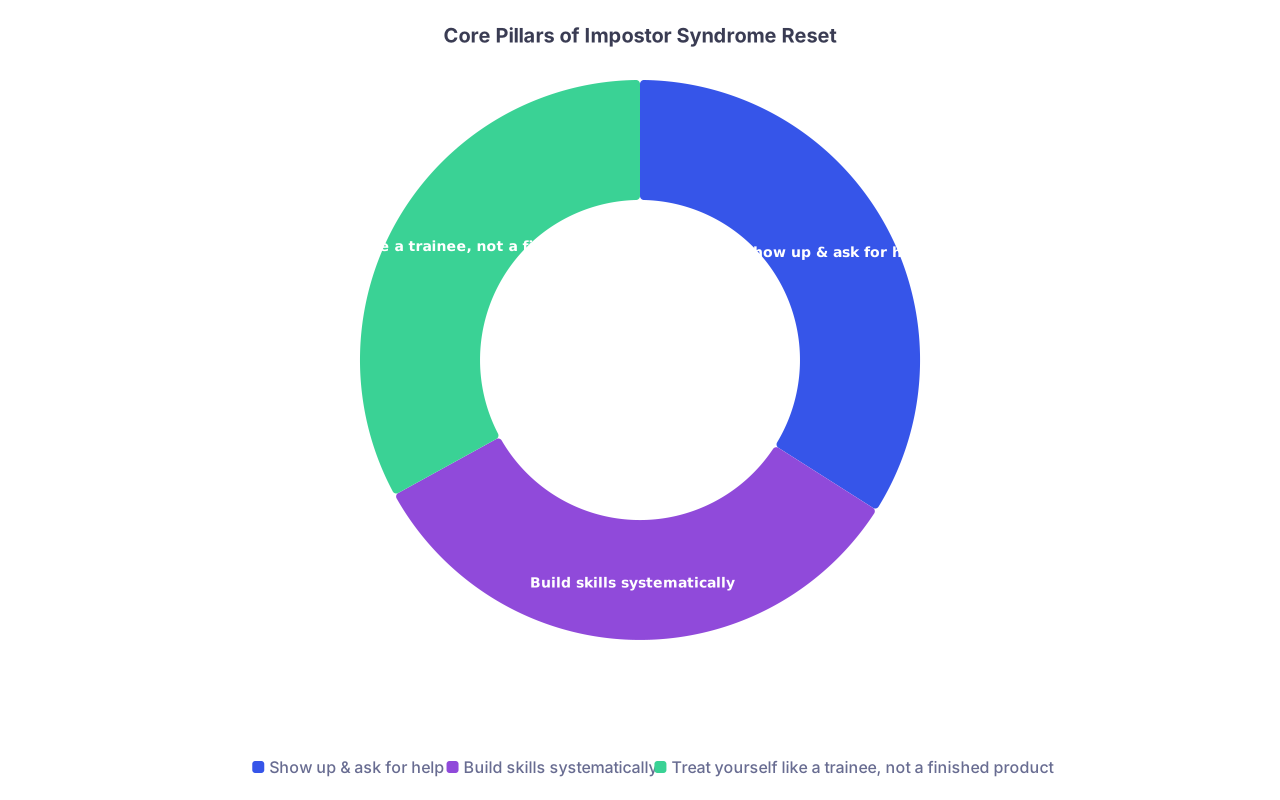
| Category | Value |
|---|---|
| Show up & ask for help | 34 |
| Build skills systematically | 33 |
| Treat yourself like a trainee, not a finished product | 33 |

Three Takeaways
- Feeling like an impostor after matching is common; staying there is a choice. A 30-day structured reset gives your brain less room to lie.
- Define what a “good enough intern” looks like, build concrete tools (playbooks, scripts, evidence log), and practice looking like a learner on purpose.
- You do not need to be the strongest intern. You need to be safe, coachable, and consistently moving forward. The rest comes with reps.