
The gut punch you felt when you saw your future co-intern list is real—and wildly common. The way most people cope with it is wrong.
You are not supposed to feel instantly “honored and grateful” reading that email. You are supposed to feel a spike of panic, a flood of comparison, and then—if you handle it correctly—a hard reset and a concrete plan.
This is that plan.
1. First 24 Hours: Stop the Mental Spiral Before It Sets the Tone
You saw the list. You googled everyone. You saw Gold Humanism. HHMI. MD/PhD. 270 on Step 2 rumors. T10 med schools. You felt small.
You have about 24 hours before this becomes a story you start believing about yourself.
Here is the immediate damage-control protocol:
Hard stop on cyberstalking
- Close Instagram, LinkedIn, Doximity, SDN, GroupMe.
- No “just one more” google search.
- You already have enough information to trigger insecurity. More will not help.
Name the actual fear. Not the vague anxiety Sit down and write (yes, physically or in a note on your phone) answers to these three prompts:
- “I feel intimidated because…”
- “The worst thing I am telling myself this means about me is…”
- “If that were true, what bad outcome am I afraid will happen this year?”
Example:
- “I feel intimidated because everyone else matched from top programs and I’m from a state school.”
- “The worst thing I’m telling myself is I only got in to fill a quota, not because I’m actually strong.”
- “If that’s true, I’m afraid attendings will think I’m the weak link and I’ll get trashed in evaluations.”
Once it is on paper, you have something specific to attack. Vague dread is unbeatable. Concrete fears are fixable.
Interrupt the physiological stress response You will not think clearly while your heart rate is at 110 and your shoulders are up by your ears.
Do this 6-minute reset:
- 2 minutes: Box breathing (inhale 4, hold 4, exhale 4, hold 4).
- 2 minutes: Slow walk—no phone—just to the end of the hallway and back.
- 2 minutes: Progressive muscle tension: clench fists for 5 seconds, release; shrug shoulders 5 seconds, release; repeat down your body.
You are not being “soft.” You are clearing the static so you can actually problem-solve.
Lock in one reframe that is actually true Not fake affirmation. Something grounded.
Pick one of these that fits and write it at the top of your match folder, or set it as your phone note title:
- “The program saw all of us and still picked me on purpose.”
- “They chose this mix of people because our skills complement each other, not because we’re copies.”
- “There is room for multiple kinds of ‘strong’ here, not just one archetype.”
You are not trying to feel amazing. You are trying to feel clear-headed enough to plan.
2. Reality Check: How Match Lists Actually Work (And Why Your Story Is Probably Wrong)
You are comparing your outside story to their highlight reel and then treating the result like objective fact.
Let me be blunt: that is garbage data.
Here is what you keep forgetting about your co-interns when you see “intimidating”:
- The match is not a pure meritocracy scoreboard. It is fit, geography, couples matching, personal life, weird interview chemistry, visa status, mentor influence, and luck.
- Your PD and committee did not sit around only looking at Step scores and med school rank. They looked at:
- Rotation comments like “calm under pressure,” “patients love them,” “incredible teammate.”
- How you spoke about mistakes in your interview.
- Whether you sounded like someone they want to staff at 3 am in February.
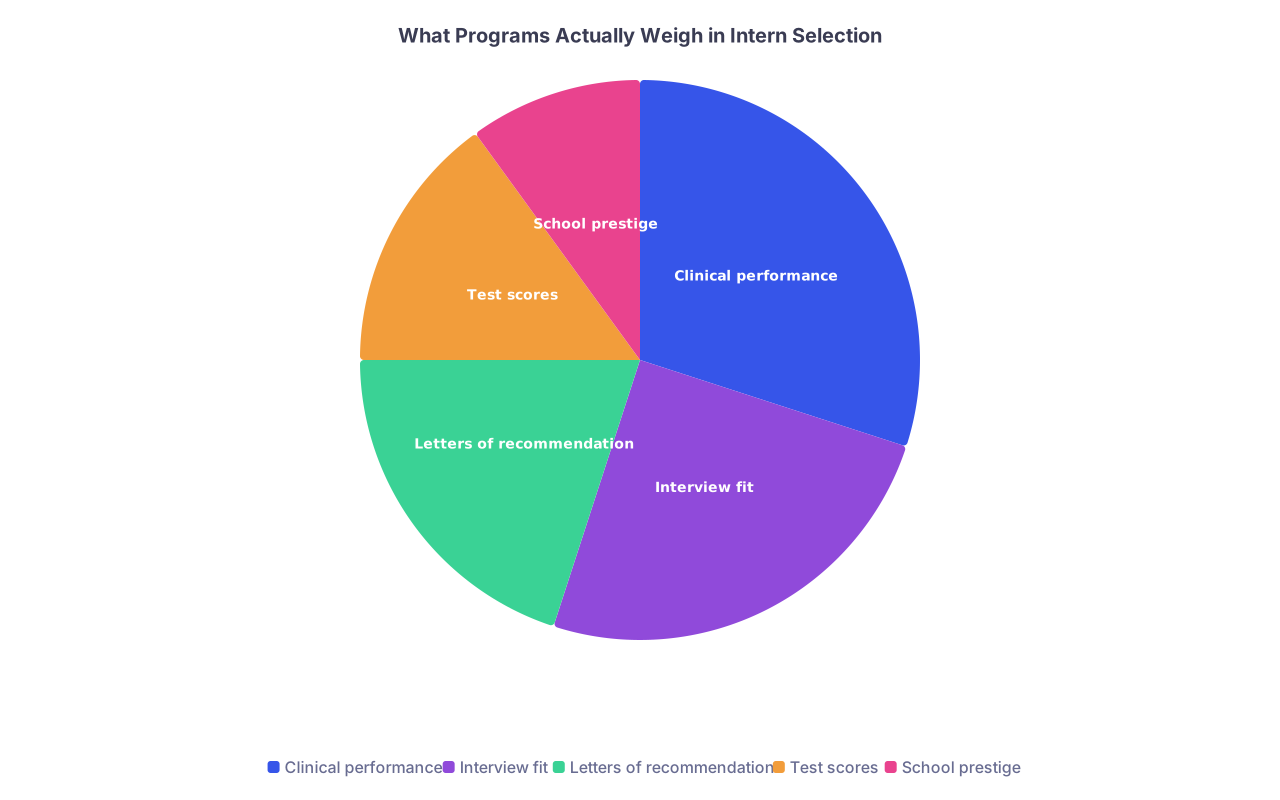
| Category | Value |
|---|---|
| Clinical performance | 30 |
| Interview fit | 25 |
| Letters of recommendation | 20 |
| Test scores | 15 |
| School prestige | 10 |
You are probably doing one or more of these mental errors:
- Prestige distortion – assuming T10 school = better at everything.
- One-dimensional ranking – reducing complex humans to a single number (Step score, number of pubs).
- Self-discounting – treating your strengths as common and theirs as extraordinary.
Run this quick audit:
List the top 3 reasons you believe each co-intern is “intimidating.” Concrete, not vague.
Example: “X has 12 publications; Y is from Hopkins; Z did a chief year in prelim surgery.”Next to each, write:
- “Does this actually matter on night float with 18 cross-cover patients?”
- “Does this automatically make them a better intern than me?”
You already know the answers.
That Hopkins grad might never have carried more than 4 patients alone.
That MD/PhD may not have written a single progress note in under 12 minutes.
That Step 270 person might crumble the first time a nurse raises their voice.
The point is not to tear them down. The point is: stop making up a hierarchy that does not exist in the way you think.
3. Map the Threats: What Exactly Are You Worried Will Happen?
You feel intimidated. Translate that into concrete scenarios. Then you can design counters.
Common “intimidating co-intern” fears:
- “They will make me look slow or dumb on rounds.”
- “Attendings will like them more and I will get overlooked.”
- “They will dominate teaching, and I will sit there silent and exposed.”
- “I will be the one always asking for help while they seem independent.”
- “GroupMe / social stuff will feel like high school all over again and I will be the outsider.”
Good. Now you have targets. Let’s make this tactical.
Pick the top 2 that hit you hardest. We will build a specific playbook for each in the next sections.
4. Concrete Skill Upgrade Plan: Out-Prepare Your Anxiety
Feeling intimidated is often a sign your brain does not trust your own skill base. So fix that. Not in a vague “study more” way. In a focused, 8-week pre-internship build.
Step 1: Choose 3 core domains to sharpen
For most interns, these are the highest-yield:
Clinical fundamentals
- Admit notes and H&Ps.
- Daily progress notes.
- Cross-cover calls and basic overnight management.
System navigation
- Order sets.
- Common pathways and protocols.
- How to get consults, imaging, and discharges done efficiently.
Communication under pressure
- Calling rapid responses.
- Giving clear updates to attendings.
- Handling “difficult” nurses or family conversations.
You do not need to be a genius. You need to be solid and dependable.

Step 2: Build a 6–8 week micro-curriculum
Example 6-week pre-intern plan (adjust days as needed):
| Week | Focus Area |
|---|---|
| 1 | Admit notes & H&Ps |
| 2 | Daily progress notes |
| 3 | Cross-cover basics |
| 4 | Common floor orders |
| 5 | Rapid responses & codes |
| 6 | Difficult conversations |
For each week:
- Spend 2–3 focused hours on that one skill.
- Use:
- Online free cases (e.g., Simulated cases from textbooks, AMBOSS questions if you have access).
- Old patient charts you can still access (de-identified, for structure).
- Templates from upper-level residents if you know any.
Example for Week 1 (Admit notes & H&Ps):
- Review 3 solid H&Ps from residents you respected.
- Write 2 fake H&Ps from online cases, time yourself to 35–40 min each.
- Ask one trusted resident or fellow student to glance at 1 and tell you: “What is confusing? What is excess?”
Step 3: Practice “fast and safe,” not “perfect”
You will be tempted to obsess over obscure ICU questions so you “keep up” with the apparent geniuses. Do not.
Focus on:
- Clear one-liner.
- Problem list organized by priority.
- Concrete plan for each problem, even if basic.
Template in your head:
- “This is a [age] [sex] with [key comorbidities] here with [acute issue] most likely due to [top 1–2 causes]. The plan focuses on [stabilize X, treat Y, evaluate Z].”
Once that flows smoothly, your confidence goes up. And intimidation drops because you trust your own floor.
5. Social Dynamics: Stop Predicting a Hierarchy, Start Designing Your Role
You see all the credentials and you immediately slot yourself at the bottom.
You are making two mistakes:
- Assuming your co-intern group will behave like a ranking contest.
- Treating “impressive on paper” as the same as “socially dominant” or “beloved by the team.”
You need a social strategy, not vague hope.
Decide your “intern brand” ahead of time
Yes, I used that word on purpose. You get to choose how you show up.
Pick one of these (or define your own) and lean into it:
The Reliable Closer
- Always answers texts.
- Volunteers to help tie up loose ends.
- The one others trust to finish discharges and check follow-up tasks.
The Systems Hacker
- Learns EMR tricks, templates, order sets.
- Shares “here is how to do this in 3 clicks instead of 10” tips.
- Quietly makes everyone else’s life easier.
The Calm in Chaos
- Not the loudest, but not flustered.
- During codes, calls, family meltdowns, you stay steady.
- People remember how they felt around you more than what you said.
The Connector
- Remembers birthdays.
- Sets up 1–2 low-key hangouts.
- Checks in when someone looks wrecked after a bad call.
You do not need to be the funniest, smartest, or most charismatic. You need to be something clear.
Concrete moves in the first month
Send one grounded, non-cringey GroupMe message When the group chat forms and everyone is flexing sub-I sites and publications (sometimes subtly, sometimes not), you send:
- “Hey all, congrats again. I am [Name], [school]. Strengths: I am good at logistics and staying calm on busy days. Weakness: my brain stops working after 11 pm, working on that. Looking forward to figuring this all out together.”
Short. Human. Non-competitive. Shows you are secure enough to be honest.
Do 1:1 micro-intros Instead of measuring yourself against the whole group, focus on building a real connection with 2–3 people early.
- Send: “Hey [Name], saw you are also into [shared interest]. Want to hop on a quick 10-min call sometime in June before we start?”
- Or just: “You are also starting on nights? Want to compare schedules and see when we overlap?”
Control what you share When people start casually listing their Step scores and big-name mentors (it will happen), you do not need to match. You respond with:
- “Nice. I am less on the research flex side and more on the ‘let’s get these notes done’ side.” Or
- “I took a weird path here, but I am really solid clinically. We will balance each other out.”
No self-deprecation spiral. Just a firm statement of the value you bring.

6. Performing Under Comparison: What To Do On Day 1 and Beyond
You will meet them. You will do your first pre-rounds, your first notes, your first sign-out. The intimidation will flare again—unless you have a script.
Day 1 rules
- No self-ranking based on speed
The intern who finishes prerounds fastest is not necessarily better. They may be cutting corners. You focus on:
- Safe medication lists.
- Clear plans.
- Not missing major red flags.
2. One strength-forward introduction per new attending When your attending says “Tell me about yourself,” you do not say “Hi, I’m [Name], I’m from [less-famous school], and I’m really nervous.”
You say:
- “I’m [Name]. My background is [quick 1-liner]. I tend to be very organized clinically, and I ask early if I am unsure about safety issues.”
You just told them what to expect. You also reminded yourself of your value.
Set a personal benchmark, not a co-intern benchmark For the first two weeks, your daily metric is:
- “Did I ask for help when I should have?”
- “Did I close feedback loops (orders placed, labs checked, consults called)?”
- “Did I improve even 5% in one tiny aspect from yesterday?”
Not: “Was I as fast as X?” or “Did Y get praised more than me?”
7. Use Your Co-Interns as Assets, Not Threats
Here is the twist: the “intimidating” people are often incredibly useful—if you stop seeing them as enemies.
Break your co-interns mentally into categories:
- Research-heavy.
- Systems-savvy.
- Charismatic leaders.
- Quiet workhorses.
- Tech/EMR nerds.
- Teaching-oriented.
Now think like this: “Where can I learn from each of them without turning it into a contest?”
Examples:
Research star?
- Ask: “You seem to have a good handle on reading quickly and pulling out the bottom line—how do you approach new guidelines?”
You are borrowing a skill. Not competing.
- Ask: “You seem to have a good handle on reading quickly and pulling out the bottom line—how do you approach new guidelines?”
Systems-savvy person?
- Ask them for 2–3 EMR templates or smart phrases they like.
- Trade by offering: “I can send you my checklist for admits; it keeps me from missing things.”
Charismatic leader?
- Watch how they speak in rounds. Analyze:
- How do they frame uncertainty?
- How do they present plans concisely?
- Copy phrases that fit your style: “My working diagnosis is…”, “My main concerns are…”
- Watch how they speak in rounds. Analyze:
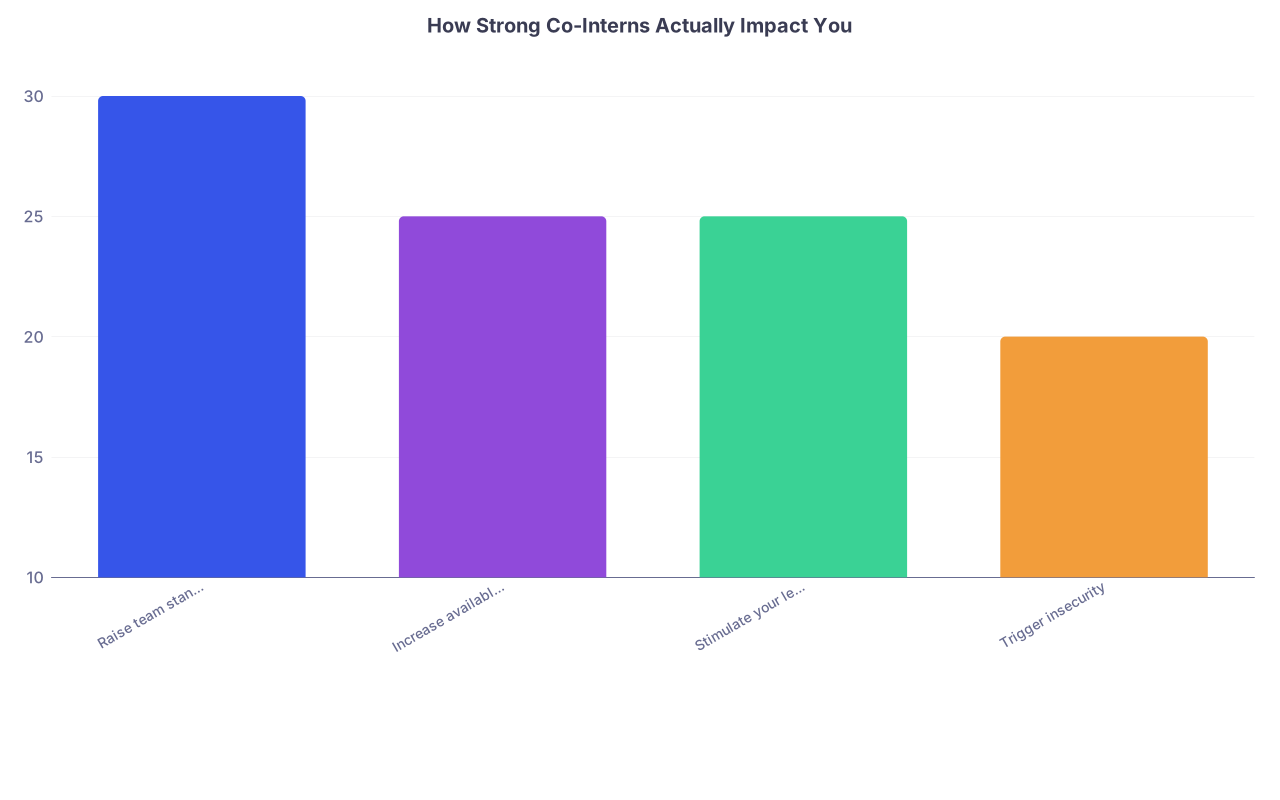
| Category | Value |
|---|---|
| Raise team standard | 30 |
| Increase available help | 25 |
| Stimulate your learning | 25 |
| Trigger insecurity | 20 |
When you flip the frame from “they make me look bad” to “they plug gaps I have,” the intimidation loses some power.
8. Anti-Imposter Protocol For Rough Days
Let me be real. There will be days you get crushed:
- You miss a subtle lab trend.
- An attending embarrasses you in front of your team.
- A co-intern presents a flawless, polished, guideline-laden plan and you feel like a pre-med again.
Those days are exactly when your comparison habit will go nuclear. You need a standing protocol you do not negotiate with.
The 10-minute post-shift reset
1. Three factual wins (no matter how small)
- “I correctly recognized early sepsis and escalated.”
- “I rewrote that note after feedback and it was much clearer.”
- “I asked for help when I was stuck instead of guessing.”
One neutral description of the bad moment You do not let your brain narrate it as a character flaw.
Instead of “I am dumb,” write:
- “During rounds, I did not have a good differential for hyponatremia in this context.”
One specific adjustment
- “Tomorrow, I will spend 15 minutes reviewing hyponatremia pathways.”
- “Next time I am unsure, I will say ‘I am not certain, but my initial thought is X because Y.’”
Text one trusted person—not to vent endlessly, but for grounding
- “Today was rough; remind me I am not an imposter.”
Or: - “Just need a 10-word pep talk after getting grilled on rounds.”
- “Today was rough; remind me I am not an imposter.”
You are allowed short-term emotion. You are not allowed to let a bad day rewrite your entire self-concept.

9. When the Group Really Is Toxic or Braggy
Sometimes the intimidation is not just in your head. Some co-intern groups are objectively competitive, braggy, or dismissive.
You cannot fix their personalities. You can control exposure and boundaries.
Signs the culture is unhealthy
- GroupMe threads full of:
- Step score flexing.
- “I got invited to speak at X” humblebrags.
- Subtle jabs at “less competitive” schools or paths.
- Repeated talking over quieter interns on rounds.
- Social plans that consistently exclude the same 1–2 people.
- Jokes that punch down: foreign grads, DOs, community schools.
Here is what you do.
Curate your exposure
- Mute the group chat notifications. Check it 2–3 times a day instead of living in it.
- Step back from side conversations that always end in compare-and-despair.
Find your micro-tribe
- You do not need the whole co-intern class to be your people. You need 1–3.
- Identify the ones who:
- Ask “How are you doing?” and listen.
- Admit when they do not know things.
- Do not treat every interaction like a networking event.
Use quiet boundaries
- When a conversation turns into flex theater:
- Change the topic: “Hey, can anyone help me figure out the best workflow for rapid discharges?”
- Or excuse yourself: “I need to finish these notes before sign-out; talk later.”
- When a conversation turns into flex theater:
Document and escalate only when needed
- If actual harassment, discrimination, or serious undermining happens:
- Write down dates, quotes, witnesses.
- Talk to a chief or advisor you trust.
- You are not “weak” for asking leadership to address problems.
- If actual harassment, discrimination, or serious undermining happens:
You are allowed to decide that certain people’s opinions do not matter. Even if they are “stars.”
10. Long Game: Six Months From Now, This Will Look Different
Here is what usually happens by November of intern year (and I have watched this play out repeatedly):
- The “intimidating” Step 270 person has made at least 1–2 solid mistakes. They are now human.
- The quiet, non-flashy intern becomes the one nurses trust most.
- The research machine realizes floor medicine is not the same as PubMed strength.
- The PD and chiefs start caring much more about:
- Who is safe.
- Who is dependable.
- Who does not melt down when things get busy.
Your job is not to win the “Most Impressive on Paper” contest. That ended on Match Day. Your job now is to become:
- The intern whose name nurses are relieved to see on the schedule.
- The one seniors actually request.
- The colleague whose presence drops the collective heart rate of the team by 10 points.
If you follow even 60% of what I laid out here—skill build, social strategy, anti-imposter protocol—you will get there.
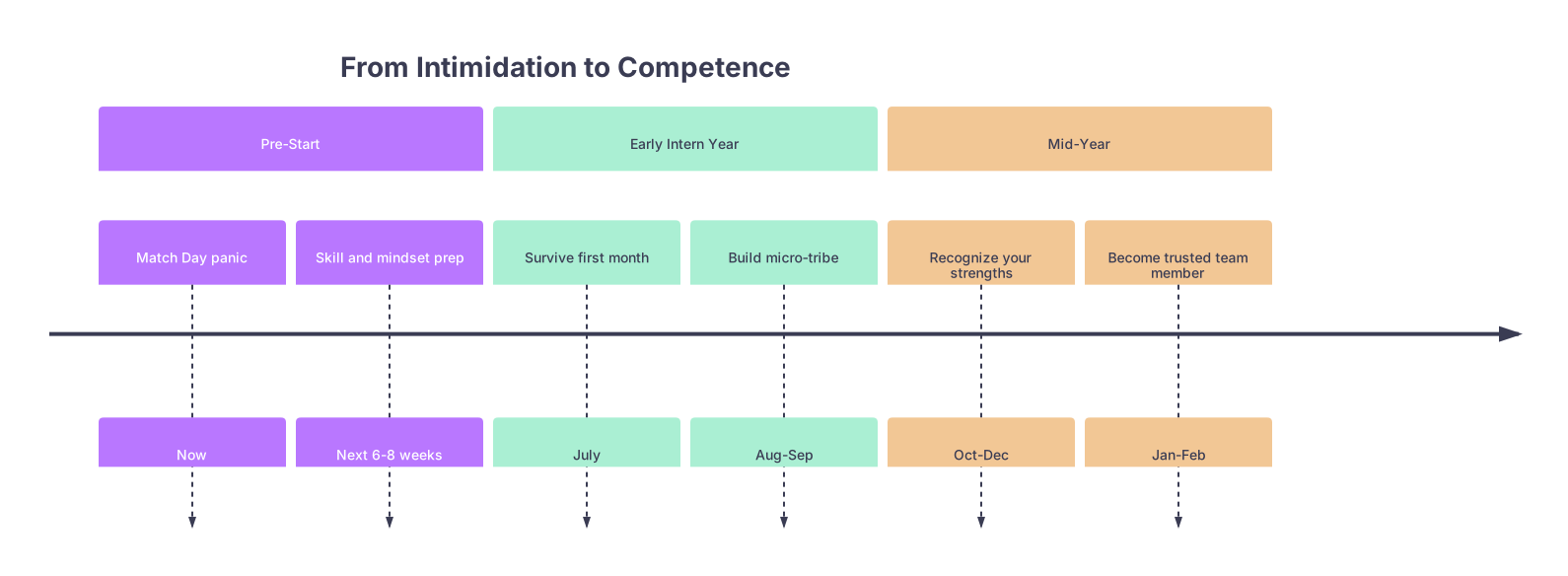
| Period | Event |
|---|---|
| Pre-Start - Match Day panic | Now |
| Pre-Start - Skill and mindset prep | Next 6-8 weeks |
| Early Intern Year - Survive first month | July |
| Early Intern Year - Build micro-tribe | Aug-Sep |
| Mid-Year - Recognize your strengths | Oct-Dec |
| Mid-Year - Become trusted team member | Jan-Feb |
Your Next Step Today
Do this right now:
- Open a blank note titled: “Intern Year Reality File.”
- Write:
- One sentence: “Why I feel intimidated by my co-intern group.”
- One sentence: “What I bring to this class that is actually valuable.”
- One simple action you will take this week from this playbook (for example, “Build a 6-week pre-intern plan” or “Draft my GroupMe intro message.”)
Then actually schedule 30 minutes on your calendar in the next 3 days labeled: “Intern Coping Playbook—Implementation.”
Reading this gives you perspective. Putting it in your calendar is how you stop intimidation from running your entire year.