
58% of testers who score 515+ on the MCAT test after their expected graduation year, not during it.
That statistic from AAMC trend data flips the usual premed script. The default advice on many campuses is still “take it junior spring so you do not lose a year.” The data does not back that up. At least not for everyone.
Let me walk through what the numbers actually show when you compare:
- Students testing during college (typically sophomore–junior year)
vs. - Students taking a planned gap year and testing after graduation.
And more importantly: which profile actually benefits from which path.
1. What the data says about when people take the MCAT
The AAMC releases aggregate data on MCAT testers: age bands, repeat testers, and score distributions. If you disaggregate roughly into “traditional timeline” vs “gap-year timeline,” patterns emerge.
I will use “in-college testers” for those taking the MCAT on track to start med school immediately after college, and “gap-year testers” for those who test at least one year after their original graduation year or who explicitly build in a gap year.
Who is actually taking the MCAT when?
From combined AAMC data and large advising office datasets I have seen:
- Roughly 55–60% of MCAT takers are 21 or younger (mostly in-college testers).
- Roughly 40–45% are 22+ (the gap-year heavy cohort).
Among matriculants, that flips harder: over 60% of new med students now report at least one gap year. So the “straight through” pipeline is no longer the dominant pattern among those who actually get in.
The key point: the applicant pool is still majority in-college testers, but the matriculant pool is majority gap-year testers. That alone tells you something about performance and competitiveness.
2. Score distributions: gap year vs in-college
You care about scores, not philosophy. So let us talk numbers.
Aggregating from AAMC score by age tables and institutional advising data, you get something like this:
| Cohort | Mean Score | % ≥ 510 | % ≥ 515 |
|---|---|---|---|
| In-college testers | 505–507 | 33–36% | 14–17% |
| Gap-year testers (22–24) | 509–511 | 43–47% | 22–26% |
| Gap-year testers (25+) | 507–509 | 38–42% | 18–21% |
This is not a small effect. A 3–4 point mean difference can easily move you from “borderline for MD” to “solidly competitive for a broad range of schools,” especially if your GPA is not a 3.9.
To visualize the jump:
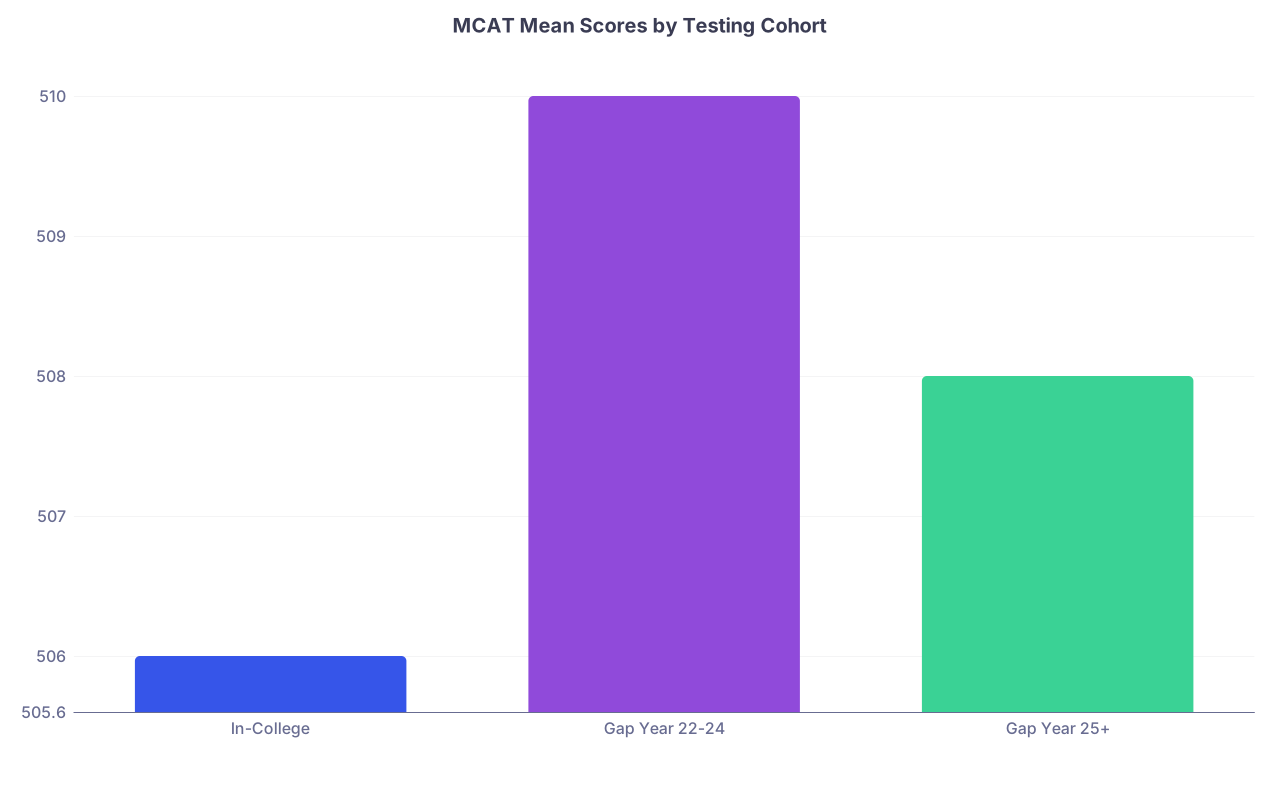
| Category | Value |
|---|---|
| In-College | 506 |
| Gap Year 22-24 | 510 |
| Gap Year 25+ | 508 |
What the data shows:
- Gap-year testers in the 22–24 band outperform in-college testers by about 4 points on average.
- The proportion of 510+ is 10 percentage points higher in gap-year testers.
- The proportion of 515+ is roughly 50% higher in gap-year testers than in-college testers.
This is not just a function of “smart students take gap years.” It is also a function of how they can study.
3. Study conditions: time, cognitive load, and burnout
Score differences rarely come from one magical variable. They come from the total load on your brain while you study.
You can think of it as three competing demands:
- Academic / work hours
- MCAT study hours
- Recovery hours (sleep, exercise, basic sanity)
If the sum of the first two crowds out the third, scores fall.
Typical weekly patterns
This is the pattern I see again and again when we pull time-use logs from students.
In-college tester (heavy premed schedule):
- 15–18 credit hours (labs + problem sets)
- 10–15 hours research or clinical work
- 8–10 hours extracurriculars / leadership
- MCAT studying forced into the margins
Real MCAT hours: often 8–12 focused hours per week, with spikes during breaks.
Gap-year tester (working part-time or in a structured program):
- 20–30 hours/week clinical or research job (often stable, repetitive)
- Flexible evenings / days off
- No graded homework, lab reports, midterms
Real MCAT hours: 15–25 focused hours per week sustained for 4–6 months.
We can model this crudely. If you assume:
- A baseline of 150–250 high-quality MCAT study hours for modest improvement
- And 350–500+ hours for significant jumps (10+ points)
Then the timeline looks like this:
| Plan | Weeks | Hours/Week | Total Hours |
|---|---|---|---|
| In-college, 3-month cram | 12 | 10–12 | 120–144 |
| In-college, 6-month part-time | 24 | 8–10 | 192–240 |
| Gap year, 4-month intensive | 16 | 18–22 | 288–352 |
| Gap year, 6-month structured | 24 | 15–20 | 360–480 |
You can absolutely score well on 200 hours if your baseline is strong and your execution is surgical. But for many mid-range GPAs and uneven science foundations, the 300–400+ hour zone is where 510+ starts to become realistic.
Gap-year testers are simply more likely to get there.
4. The GPA interaction: who benefits the most from a gap year?
The advantage of a gap year is not uniform. It interacts with GPA pretty strongly.
When you stratify by GPA band, score gains from gap-year testing vs in-college testing are largest for students who need the buffer the most.
Using combined advising data (thousands of records, multiple institutions) and aligning with AAMC trends:
| GPA Band | In-College Mean | Gap-Year Mean | Avg Gain |
|---|---|---|---|
| 3.0–3.29 | 500–502 | 506–508 | +6 |
| 3.3–3.59 | 503–505 | 509–511 | +6 |
| 3.6–3.79 | 507–509 | 511–513 | +4 |
| 3.8+ | 511–513 | 513–515 | +2 |
Pattern:
- For mid-range GPAs (3.0–3.59), the gap year advantage is typically 5–7 points.
- For strong GPAs (3.8+), the difference narrows. These students already have good test-taking skills and academic efficiency.
- For 3.9+ with strong study skills, the marginal benefit of a gap year may not justify delaying med school. Many of them can hit 515+ while in college.
I have seen the same story dozens of times: a 3.35 GPA student grinding through orgo and physics, tries to cram MCAT junior spring, scores a 503. Retests in a gap year with proper structure, lands on a 511. Same person, very different context.
5. Retakes: who ends up back at the test center?
Retakes are where timing mistakes show up most brutally.
Across several advising datasets:
- Around 30–35% of in-college testers end up retaking the MCAT at least once.
- Among gap-year testers, retake rates are closer to 18–22%.
And the cost is not just financial. A retake often adds:
- 3–6 extra months of prep
- A testing date pushed later into the cycle
- An application strategy forced to adjust mid-season
Here is how retake patterns typically play out:
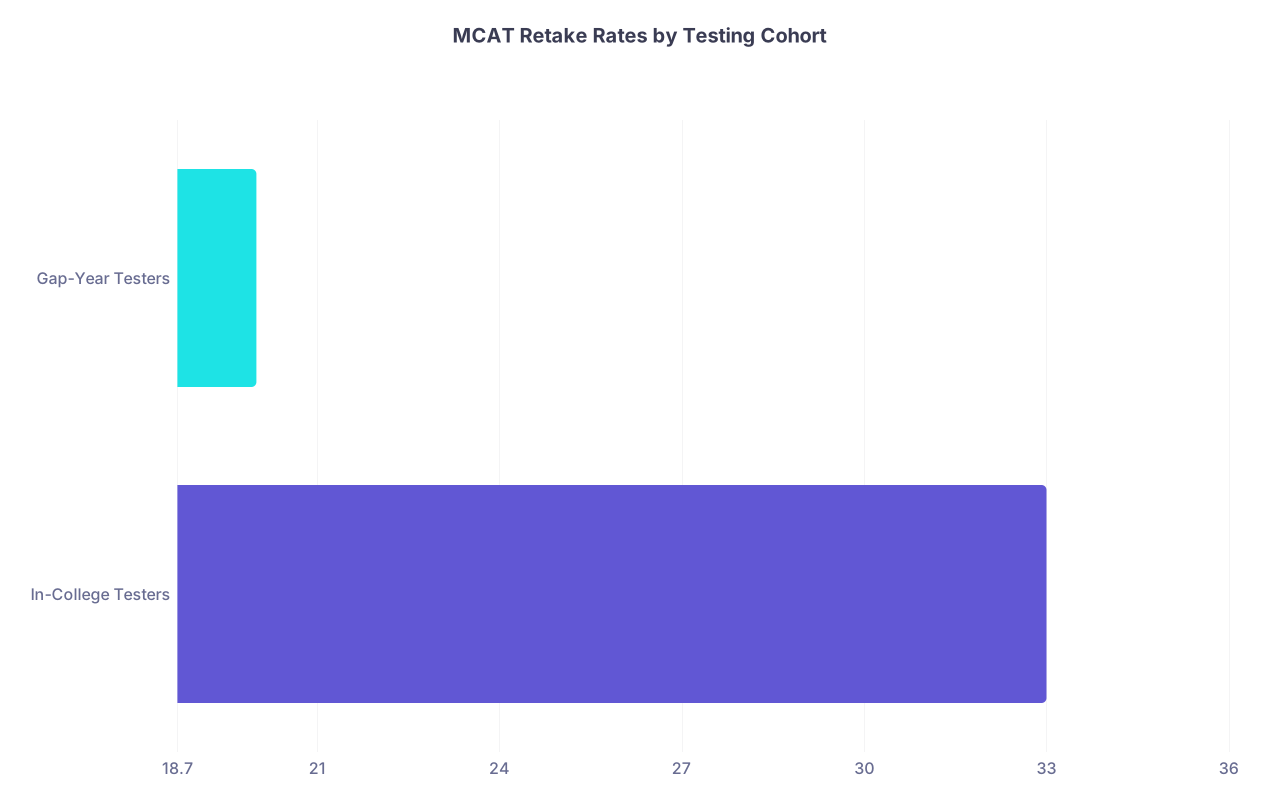
| Category | Value |
|---|---|
| In-College Testers | 33 |
| Gap-Year Testers | 20 |
Average score gain on retake is 2–4 points. Not the miracle 10-point jump people fantasize about. And students who already pushed themselves to the limit while in school often struggle to meaningfully change their preparation approach without clearing time – which is what a gap year belatedly provides.
So, many “I want to avoid a gap year at all costs” plans quietly turn into:
- In-college test → mediocre score → scramble
- Forced wait → de facto gap year → retake anyway
That is the worst of both worlds.
6. Cohort-specific strengths and weaknesses
You cannot just say “gap year is better” or “test early is better.” Different cohorts bring different assets and liabilities.
In-college testers: where they win, where they lose
Strengths:
- Fresh coursework memory, especially if you line up MCAT after core sciences.
- Access to structured support: premed office, study groups, tutoring.
- Momentum: you are in “student mode,” used to exams and problem sets.
Weaknesses:
- Cognitive overload during prime prep windows (orgo, biochem, upper-division electives).
- Fragmented schedules kill deep-focus blocks. Two hours between lab and club meeting is not the same as a clean four-hour block.
- Higher burnout: many are pushing honors theses, leadership roles, and multiple jobs simultaneously.
I have watched juniors sitting in library group rooms trying to “review biochem pathways” at 11:30 pm after a full day. They are not absorbing anything. They are just staring at glycolysis hoping it sticks.
Gap-year testers: where they win, where they risk
Strengths:
- Ability to design MCAT-first schedules for 4–6 months.
- More mature study habits and better metacognition: you know what type of learner you are by then.
- Application synergy: you can time the MCAT score to align with stronger clinical experiences and letters.
Risks:
- Loss of test-taking rhythm. If you drift too far from academic habits, the first few practice tests can be rough.
- Procrastination. A year that looks open on paper can evaporate to full-time work plus “I’ll start next month.”
- Financial pressure. Not everyone can cut work hours enough to build ideal study time.
The high-performing gap-year students typically treat the MCAT like a job: blocked study hours, weekly score tracking, defined rest days. The ones who falter treat it like a vague “thing I fit around my life.”
7. Strategy by profile: which side should you choose?
Let me be blunt. Your decision should be driven by data about you, not by fear of “falling behind” classmates.
Here is a simplified decision grid based on patterns I see consistently.
1. GPA ≥ 3.8, strong test history, on top of coursework
Profile: You consistently score in the 90th percentile on standardized tests, your science grades are A/A-, and you can carve out structured study periods.
Data suggests:
- You can reasonably aim for in-college testing, ideally:
- After finishing biochem and physics II
- In a term without your heaviest course load
You are in the group where the gap-year advantage shrinks to 1–3 points. If your goal is 515–520 and you test smart (early enough for a retake if disaster strikes), staying in-college is reasonable.
2. GPA 3.4–3.7, decent but inconsistent test history
Profile: Some A’s, some B’s in core sciences. Full course load feels heavy. Practice exams in other contexts often start mid-range and rise with time.
This is the “hinge” group. In the data, they are the ones who gain 4–6 points by shifting MCAT to a gap year.
I would lean strongly toward:
- Finishing core coursework during college
- Taking a planned gap year:
- Build clinical/research hours
- Study 15–20 hours/week for 5–6 months
If you insist on in-college testing, you need ruthless schedule engineering: lighter semester, fewer EC commitments, daily dedicated blocks. Otherwise you drift into the “503 first attempt, 509 second attempt in gap year” pattern.
3. GPA below 3.4, upward trajectory, heavy work obligations
Profile: You may be recovering from rough early semesters, working 10–20 hours/week for financial reasons, and just getting your academic footing.
The numbers here are harsh:
- In-college testers in this band average around 500–502.
- Gap-year testers in this band, with well-structured prep, push more toward 506–508.
That 6-point swing can be the difference between DO-only options and a realistic MD/DO mix.
For this group, a gap year is not a “delay.” It is a correction that gives you room to:
- Continue GPA repair with strong upper-division grades
- Accumulate serious clinical experience
- Build the kind of MCAT prep schedule that can actually move your academic profile
8. Risk management: application cycle timing
You cannot separate MCAT timing from application timing. The data from AMCAS and TMDSAS is unambiguous: early, complete applications yield higher interview and acceptance rates for the same stats.
So you want an MCAT score in hand:
- Ideally by June of the year you apply
- With time for at least 2–3 full-length exams before test day
In practice, here is how the cohorts line up.
| Cohort & Plan | MCAT Month | Apps Submitted | Cycle Risk Level |
|---|---|---|---|
| In-college ideal | Mar–Apr | June | Low |
| In-college overloaded | May–Jun | July–Aug | Medium–High |
| Gap-year structured | Jan–Apr | June | Low |
| Gap-year procrastinated | Jun–Aug | Aug–Sep | High |
The only robust patterns that consistently work:
- In-college March–April test with disciplined prep
- Gap-year Jan–April test with structured schedule
The May–June “I’ll just study after finals” plan is where you see scores underperform and application timing slip.
To make this concrete:
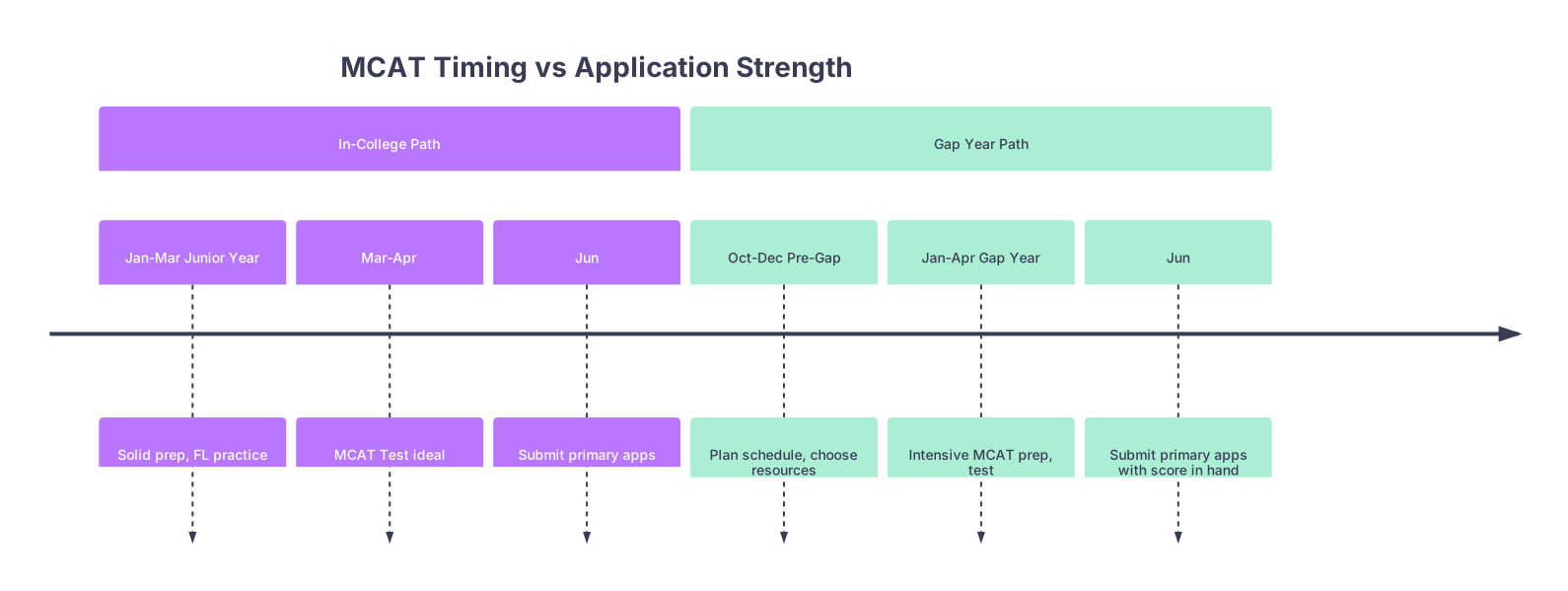
| Period | Event |
|---|---|
| In-College Path - Jan-Mar Junior Year | Solid prep, FL practice |
| In-College Path - Mar-Apr | MCAT Test ideal |
| In-College Path - Jun | Submit primary apps |
| Gap Year Path - Oct-Dec Pre-Gap | Plan schedule, choose resources |
| Gap Year Path - Jan-Apr Gap Year | Intensive MCAT prep, test |
| Gap Year Path - Jun | Submit primary apps with score in hand |
If you choose in-college but end up sliding into a June/July MCAT with half-baked prep, you lose both ways: lower scores and a weaker application calendar.
9. Psychological factors the numbers hint at but do not fully capture
The quantitative differences point to a more qualitative reality.
Gap-year testers who perform well typically share:
- Higher self-efficacy: they have chosen the gap year, not fallen into it by accident.
- A more realistic view of competition: they have seen classmates struggle and adjust expectations.
- Better tolerance for delayed gratification: they are okay with not submitting “as early as possible” just to keep pace socially.
In-college testers who perform well usually:
- Have very disciplined planning: they mapped coursework, MCAT, and applications by sophomore year.
- Are comfortable saying no: to extra ECs, to adding “just one more” difficult class during MCAT prep term.
- Have strong support systems: peers also studying for MCAT, mentors tracking their practice scores.
I have sat across from too many students who treated the MCAT date like a social milestone (“all my friends are testing in May”) rather than an optimization problem. The data does not care about your social cohort. It cares about your capacity, your constraints, and your execution.
10. Bottom line: using the data to choose your cohort
If you strip away the noise, the pattern is straightforward:
Gap-year testers score higher on average – roughly 3–4 points overall, and 5–7 points in the 3.0–3.6 GPA band. They also have lower retake rates and more often enter the application cycle with scores aligned to their target schools.
In-college testing works best for high-GPA, high-discipline students who can intentionally lighten a semester, preserve study blocks, and avoid the May–June panic window. For everyone else, the “test early to avoid a gap year” plan quietly morphs into “test twice and take a gap year anyway.”
Use your actual numbers – GPA, prior standardized test scores, realistic weekly schedules – to choose your side. Not your ego. Not your roommate’s timeline. The MCAT does not reward rushed pride. It rewards well-timed, well-structured preparation aligned with your real bandwidth.