
The internet is lying to you about the MCAT curve.
You’ve probably seen the posts: “August MCAT is easier,” “Summer curves are brutal,” “AAMC scaled down everyone’s scores this year.” None of that lines up with how the test is actually built, scored, or equated. It just sounds comforting when you walk out of an exam feeling wrecked.
Let me be blunt: there is no magical “curve” where AAMC looks at your test date and decides, “Too many high scores today, let’s knock them down.” That’s not how standardized testing works in 2026, and it hasn’t for a long time.
What does exist is a very specific, very boring psychometric process that people keep misunderstanding and then turning into conspiracy theories.
You want to stop guessing about “good test dates” and “lenient curves”? Then you need to understand how scaling really works.
The myth: AAMC curves your test like a college exam
You’ve heard this conversation. Maybe you’ve had it.
“Bro, the exam was brutal. But it’s okay, the curve will save us.”
Or:
“August is always harder but it has a generous curve. January has a harsher curve because everyone is prepared.”
This is the wrong mental model. People are importing college exam logic into a standardized test world where it does not apply.
In a typical college orgo exam, your professor might do a norm-referenced curve. They look at how the class did, then decide that a 65 is now an A– because the average was a 45. The distribution of your cohort determines your grade.
The MCAT is not that.
The MCAT is not curved to your test date group. It is not curved to the month. It is not even curved to the year in the way people imagine. It is scaled to a reference standard AAMC has already established.
If the people who tested on June 15 are all geniuses, they do not punish them. If the people who tested on August 26 all walked in hungover and exhausted, they do not give them a pity curve. The scale is built to mean the same thing across forms and across dates.
And yes, AAMC has the data and the psychometric tools to actually do that, even if Reddit doesn’t.
What’s really going on: scaling vs “curving”
The MCAT uses equating and scaling, not group-based curving.
Equating: different question sets (forms) are statistically linked so that a particular scaled score reflects roughly the same underlying performance level on every form.
Scaling: your raw score (number correct) is converted to a reported score (118–132 per section) using a conversion table specific to that form, based on its difficulty.
Let’s kill the biggest misconception first: harder tests really do require fewer questions correct for the same score, and easier tests require more. That part of the rumor mill is actually true. What people get wrong is how that’s determined and who it depends on.
It doesn’t depend on whether the kids on your particular day were smart, dumb, “gunners,” or “gap-year burnout.” It depends on how that set of questions behaved in large calibration samples and ongoing data.
Here’s the basic structure:
| Form Difficulty | Raw Correct (out of ~59) | Approx Scaled Score |
|---|---|---|
| Easier form | 51 | 125 |
| Average form | 49 | 125 |
| Harder form | 47 | 125 |
Those numbers are illustrative, not real. But this is the principle: if your form is statistically harder, the conversion table will give you the same scaled score for fewer questions right.
Notice what’s missing? Any reference to “how your group did that day.” The test is form-referenced, not cohort-referenced.
How question difficulty is actually determined (not by vibes)
People love saying, “My CARS was insane; AAMC better give us a good curve.” As if difficulty is decided by how stunned the group chat feels afterward.
That’s not how they do it.
AAMC uses a pretty standard psychometric framework (Item Response Theory, or close cousins) to estimate both:
- how hard each question is
- how well each question discriminates between stronger and weaker examinees
They don’t randomly throw new passages into your exam and hope for the best. New questions are pretested, calibrated, and their parameters are estimated on earlier large samples. That way, by the time your form goes live, AAMC already has a decent sense of how hard each item is.
There’s also ongoing monitoring. They watch how items perform in real administrations and make sure score scales are still aligned. It’s not one-and-done.
This is why two people can walk out of different exam versions with very different feelings, yet still end up with comparable scaled scores for similar underlying performance.
Your subjective sense of “that felt awful” is a terrible measure of standardized difficulty. The model doesn’t care about your feelings, only about patterns in answer choices across thousands of takers.
The “August MCAT is curved differently” fantasy
Let’s address a few specific myths head‑on.
Myth 1: “August MCAT has a better curve because more unprepared people take it.”
Wrong premise. The quality of the people sitting next to you is largely irrelevant. Scaling isn’t built off your cohort’s performance. It’s built off pre-established item parameters and equating.
Myth 2: “January MCAT is brutal because serious applicants cluster there, so the curve is harsher.”
Again, this only makes sense if the test is normed to the group. It is not. If the January group is genuinely stronger overall, you’d just see more high scores. AAMC does not artificially compress the top because too many people did well.
Myth 3: “COVID year / X year had deflated MCAT scores because AAMC tightened the curve.”
What actually happened in those years? A massive shift in who decided to apply and when. You had more high-achieving applicants applying in some cycles, more gap‑years, more re-applicants. That changes the applicant pool, not the scale.
If more strong test-takers show up one year, the distribution of scores can shift upward. Schools can respond by adjusting expectations. That doesn’t mean AAMC changed the 128 bar.
You can see this if you look at MCAT percentile charts across years.
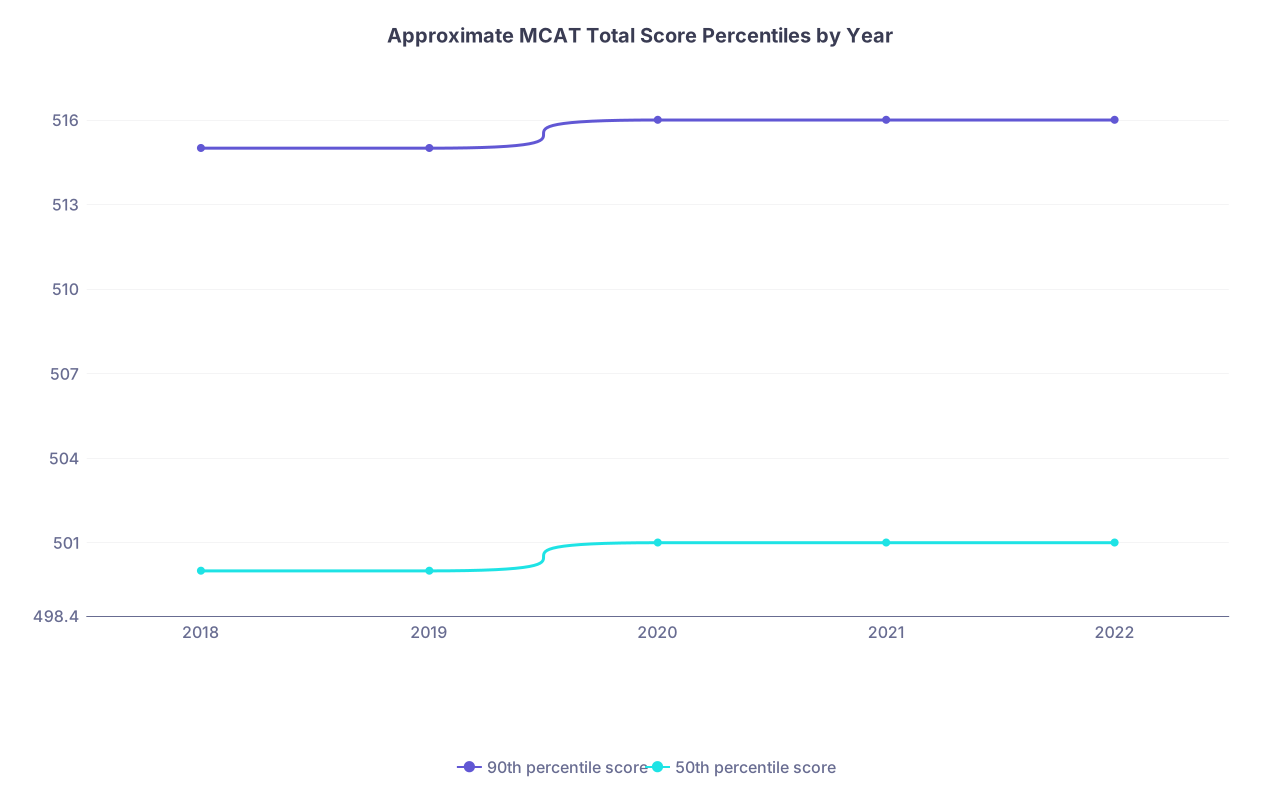
| Category | 90th percentile score | 50th percentile score |
|---|---|---|
| 2018 | 515 | 500 |
| 2019 | 515 | 500 |
| 2020 | 516 | 501 |
| 2021 | 516 | 501 |
| 2022 | 516 | 501 |
Those numbers stay remarkably stable. A 515 in 2019 and a 515 in 2022 are basically the same neighborhood of performance relative to all test takers. Not perfect, but close enough that adcoms can treat them as equivalent.
If there were a secret “harsh curve” year, you’d see big jumps in percentile tables. You don’t.
So what does vary by test date?
Let’s talk about the few things that actually change with your test date, because there are some.
Which questions you see.
Yes, forms differ. Some will emphasize certain subtopics a bit more. Some will have weirdly dense CARS passages. That is real. But the scaling machinery exists precisely to make that not matter much in your final score.Testing conditions and your own readiness.
Taking the test in August when you’re exhausted from a research internship and volunteering 20 hours a week is not the same as taking it in May after a dedicated 3-month study block. People then misattribute their poor performance to a “bad curve” instead of bad timing.Applicant behavior downstream.
When people cluster around certain dates because of advising folklore (“Take the early summer MCAT so you can apply right away!”), you may see more or fewer high scorers in a given calendar window. That affects who you’re competing against for interviews, not how your raw score is converted.
The only rational reason to “strategically pick” a date is based on your own prep timeline and application plan, not mythical curves.
Stop picking dates based on Reddit vibes. Pick based on whether you can consistently hit or exceed your target scores on AAMC full-lengths under realistic conditions for several weeks in a row.
The curve paranoia vs actual score data
Students insist “they curved this one down; everyone I know scored lower than their FLs.” I’ve heard that for every single test month, year after year. It can’t be true for all of them.
What’s actually going on?
One, people over-interpret a small sample of anecdotes from friends and Discord groups. Two, many treat their best full-length score as “my score,” even if it was an outlier. Three, they ignore testing-day factors: sleep, nerves, timing mistakes, meltdown on one passage that cascades.
When you zoom out to actual data, score distributions are boringly stable.
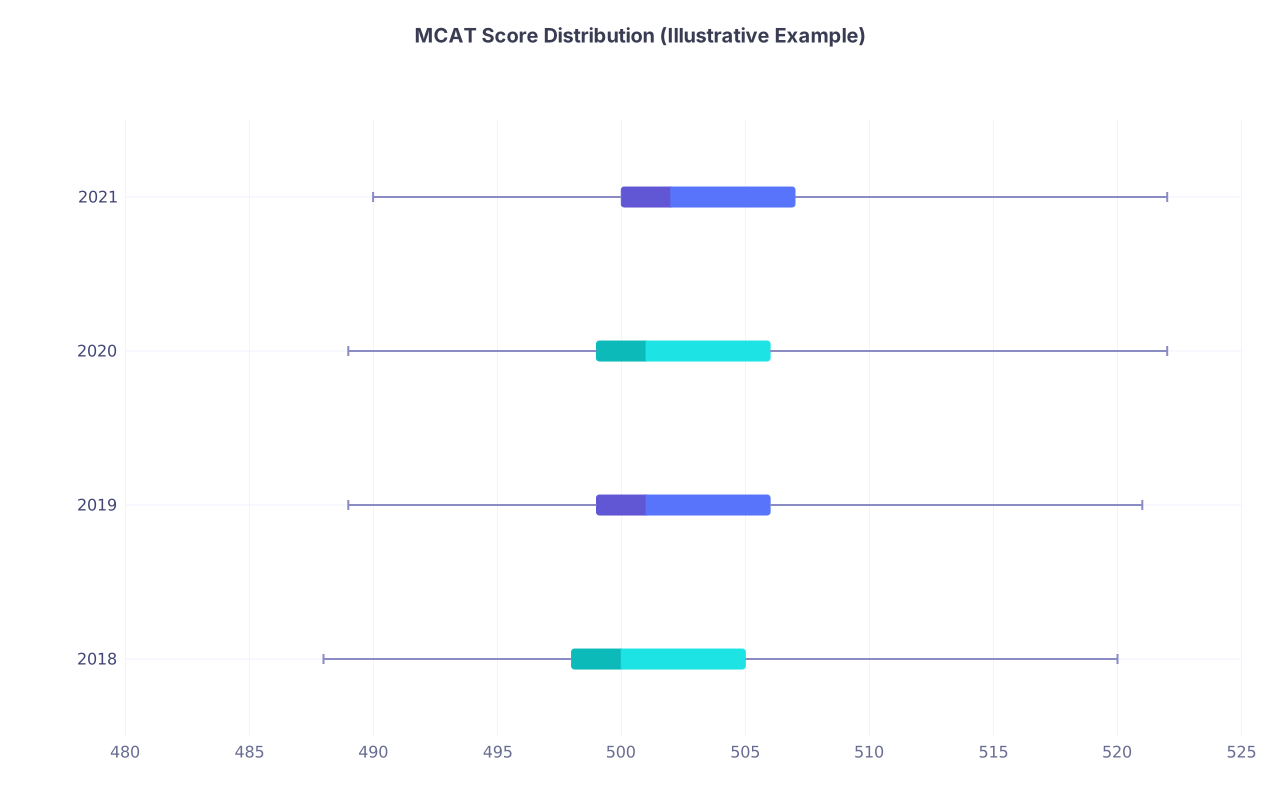
| Category | Min | Q1 | Median | Q3 | Max |
|---|---|---|---|---|---|
| 2018 | 488 | 498 | 500 | 505 | 520 |
| 2019 | 489 | 499 | 501 | 506 | 521 |
| 2020 | 489 | 499 | 501 | 506 | 522 |
| 2021 | 490 | 500 | 502 | 507 | 522 |
Again, those exact numbers are illustrative, but this is the pattern: medians hovering around 500–502, upper quartiles clustering around 506–507, with small year-to-year wiggles.
If AAMC were secretly tightening or loosening curves based on some conspiratorial logic, you’d expect to see visible structural shifts in these distributions. You don’t. You see a pretty reliable, slightly right-skewed distribution of scores, year after year.
The false comfort of “the curve will save me”
Here’s the uncomfortable truth: most “curve talk” is just anxiety management.
You walk out feeling like CARS punched you in the face. Your brain grasps for a story: “But if it felt hard for me, it felt hard for everyone. So they’ll curve it.”
No. They already built the difficulty into the scale. Long before you walked into that testing center.
If a section genuinely is more difficult—statistically, not just emotionally—the equating process accounts for that. That’s baked into the conversion table you’ll never see. You don’t need a second rescue curve on top of that.
The fantasy of a generous curve is a way to avoid the obvious: if you were consistently scoring 503 on official practice tests, you’re deluding yourself expecting a 518 because “my test felt hard, so the curve will be great.”
The MCAT is not surprised by its own difficulty. You are.
What you should focus on instead of curve lore
If you want to play this game like an adult and not a superstition addict, here’s where your attention belongs.
1. Your true score range, not your best score
Your “real” level is not your single highest FL. It’s the cluster of your last 3–5 AAMC full-lengths under exam conditions.
If your last four official FLs were 505, 507, 508, 506, that’s roughly your performance band. Can you outperform it slightly on test day? Maybe. But you are not secretly a 520 “if the curve is nice.”
2. Content mastery and pattern recognition
Scaling cannot rescue:
- holes in biochem pathways
- chronic timing problems in CARS
- inability to interpret graphs fast
I’ve seen plenty of students moan about “brutal curves” who still couldn’t explain Le Châtelier or read a Kaplan-style CARS passage efficiently. The scale cannot fix what you didn’t learn.
3. Test-day execution
You know what actually does swing scores by a few points? Not psychometric wizardry. Things like:
- starting to panic in the second half of CARS and speed-reading everything
- burning 5 minutes on a brutal discrete question instead of cutting losses
- impulsively changing answers in the last 30 seconds of a passage
The curve isn’t what ruins people. Their own behavior does.
The only “curve” that matters for you: percentiles and admissions
One more piece people mix up: the difference between MCAT scaling and admissions competitiveness.
The scale tries to keep a 515 meaning roughly the same level of performance across years.
Admissions, on the other hand, is pure competition. If a particular cycle has an unusually high number of applicants scoring 515+, schools can raise their effective cutoffs in practice, even if they don’t say it out loud.
So if more people score well, it becomes harder to stand out. That’s real. And it has nothing to do with “tightening the MCAT curve.”
This is where percentiles come back in. AAMC explicitly publishes them so both applicants and schools can see where a score sits relative to the national testing pool.
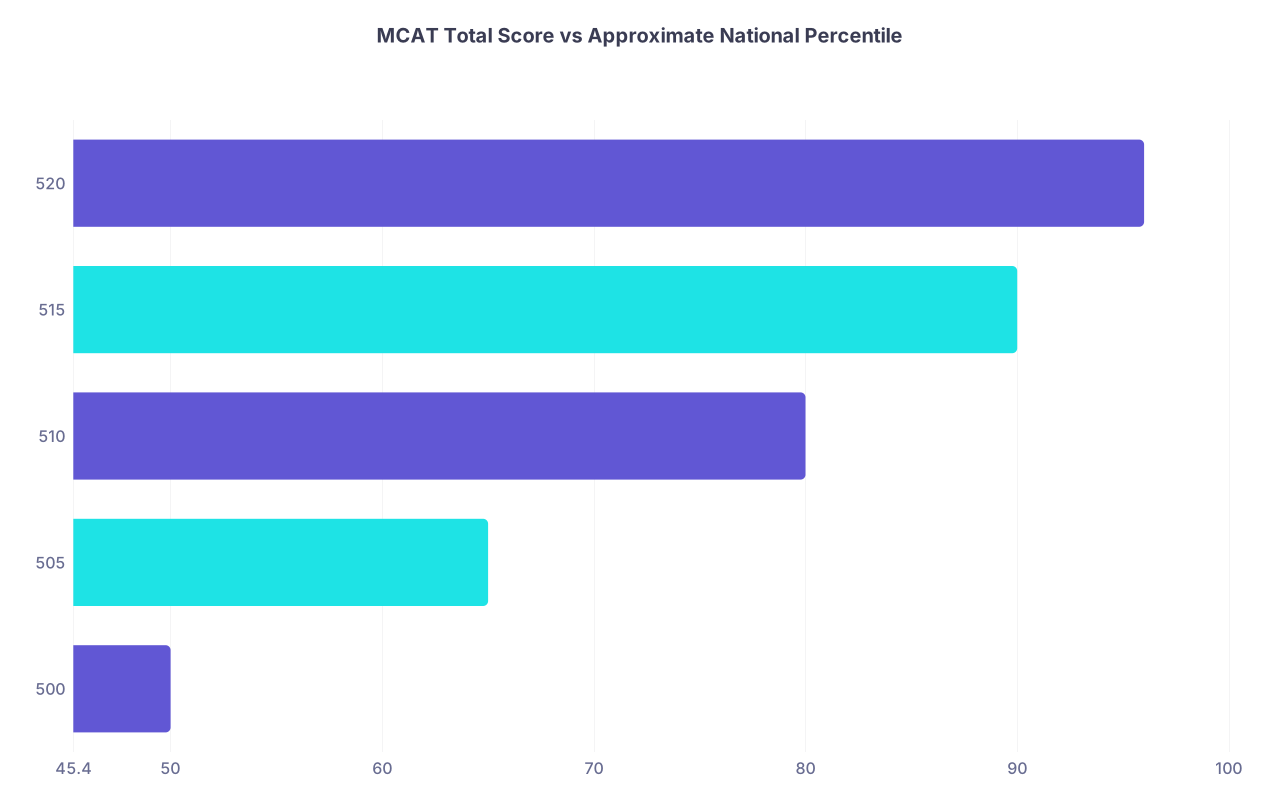
| Category | Value |
|---|---|
| 500 | 50 |
| 505 | 65 |
| 510 | 80 |
| 515 | 90 |
| 520 | 96 |
If schools start to see thousands of applicants in the 90th+ percentile, they may quietly lean harder on 516–520+ for certain programs. That’s an admissions shift, not a scaling conspiracy.
So, how should you think about the MCAT “curve”?
Drop the word “curve” altogether. It’s poisoning how you think.
Replace it with this mental model:
- The MCAT is pre‑calibrated so that each scaled score corresponds to a stable level of performance.
- The specific questions you see are equated to that standard.
- Your job is to hit the performance level that maps to your target score. The rest is noise.
If you want to obsess about something semi‑technical, obsess over this: your practice test environment should mimic the real exam as closely as possible. The closer your conditions match, the more your FL scores approximate your future scaled score. That’s the only “prediction system” that matters.
Not astrology by test date. Not TikTok rumors about “easy” months. Just boring, reproducible AAMC practice data.
The short version
You made it this far, so here’s the concise reality:
- The MCAT is scaled and equated, not curved to your specific test group or date. A harder form already requires fewer correct answers for the same scaled score.
- AAMC is not secretly tightening or loosening the curve by month or year. The stability of percentiles and score distributions over time completely contradicts that narrative.
- Your outcome depends overwhelmingly on your preparation and execution, not on choosing some mythical “good curve” test date.
Believe the psychometrics, not the group chat.