
You are sitting in a med school interview. You just nailed the “tell me about yourself” question. The interviewer leans back, looks at your research blurb on the screen, and says:
“So, what do you think about AI in medicine? Excited? Worried?”
This is where a lot of otherwise strong applicants crash. They either:
- Gush like a tech evangelist: “AI will revolutionize everything!”
- Or perform anxiety theater: “I’m very concerned about AI replacing doctors…”
Both answers are shallow. Both scream “hasn’t thought this through.”
You need something else: structured, nuanced, balanced. Interview-ready.
Let me walk you through how to talk about AI and technology in medicine like someone who has done the reading, seen a bit of reality, and understands the culture of medicine.
Not a TED Talk. Not a doom spiral. Something a seasoned academic physician would nod at and think: “Okay, this person gets it.”
Core Principle: You Are Not Interviewing for Data Scientist, You’re Interviewing for Physician
Start here mentally.
The interviewer is not trying to assess whether you can architect large language models. They are probing:
- Do you understand that medicine is about patients, not gadgets?
- Can you see both benefits and risks without getting lost in hype?
- Do you recognize that technology is a tool, not a replacement for judgment?
- Do you have an ethic: privacy, equity, responsibility?
So your answers about AI must always orbit around:
- Patient care
- Clinical judgment
- Equity and safety
- Professional identity
If your answer sounds like it would impress a Silicon Valley product manager more than a cautious academic chair in Internal Medicine, you have missed the mark.
A Simple, Interview-Proof Framework
When they ask about AI/technology, structure your answer in four layers:
- What excites you (concrete use cases)
- What worries you (specific, not vague dystopia)
- What you think the physician’s role should be
- How you personally plan to engage with it responsibly
If you hit those four with good examples, you are ahead of 80% of applicants.
Let’s break each down with language you can actually use.
1. The “I’m Not Naive, I’ve Seen Some of the Good” Layer
You need at least 3–4 specific, grounded examples of how AI/tech is already useful or realistically promising. Not sci‑fi.
Examples that play well in interviews:
Radiology and pattern recognition
AI tools that assist in reading chest X‑rays or mammograms, flagging nodules or subtle findings that might be missed at 3 a.m. fatigue levels.Documentation support / ambient scribing
Systems that listen to encounters and generate draft notes so the physician spends more time facing the patient than the keyboard.Triage and risk prediction
Algorithms in EDs or inpatient wards that identify sepsis risk early, or predict clinical deterioration from vital sign trends.Decision support
Clinical decision support systems embedded in the EMR that check med interactions, suggest dose adjustments in renal impairment, or flag guideline‑based care gaps.Population health and screening
Models that identify patients overdue for cancer screening, vaccination, or at rising risk for complications in chronic diseases.
You want to sound like this:
“I am excited about AI primarily as a way to reduce cognitive and administrative load so clinicians can be more present at the bedside. For example, tools that pre‑screen radiology images or generate first‑pass documentation can catch subtle findings and give us back time. I see AI as augmenting pattern recognition and paperwork, not replacing the human relationship with the patient.”
Notice what this does:
- Grounded in reality (radiology, documentation).
- Emphasizes “augment,” not “replace.”
- Keeps focus on time with patients, which interviewers care about.
If you want a compact, interview‑ready list in your head, think: “rad, notes, triage, population health.” Those four alone will give you enough to riff on.
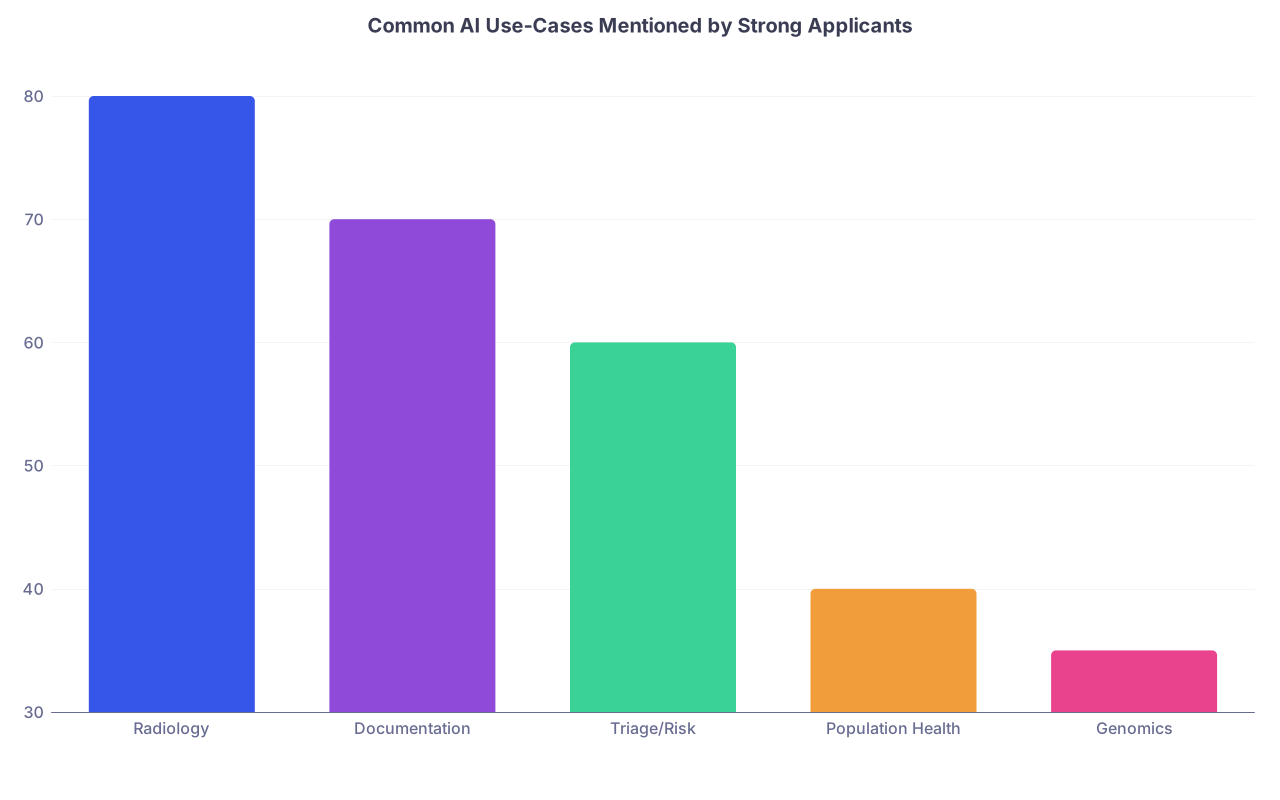
| Category | Value |
|---|---|
| Radiology | 80 |
| Documentation | 70 |
| Triage/Risk | 60 |
| Population Health | 40 |
| Genomics | 35 |
2. The “I’m Not Starry-Eyed, I See the Problems” Layer
Hand‑wavy “bias and privacy” answers are common. You need sharper edges than that. Bring up 3 categories of concern and 1–2 concrete examples.
Three high‑yield concern buckets:
Bias and equity
Models trained on skewed data can underperform for underrepresented groups. Classic example: pulse oximetry overestimating oxygen saturation in patients with darker skin; you can reference this as an analogy for what happens when tech is not validated broadly.Opaque decision‑making and overreliance
Black‑box models that produce recommendations without transparent reasoning. The risk is clinicians clicking through alerts or blindly trusting outputs (“automation bias”) instead of using judgment.Data security and patient trust
AI means large volumes of patient data, cloud services, external vendors. Breaches or misuse can erode trust quickly, especially in already marginalized communities.
You can phrase it like:
“My concerns are less about ‘robots replacing doctors’ and more about three things:
first, bias—if an algorithm is trained on non‑representative data, it may worsen care for the very patients who already face disparities.
Second, opacity—if a model gives a recommendation but clinicians do not understand its limitations, you risk automation bias.
And third, data governance—patients are trusting us with extremely sensitive information, and if that is misused or breached, you lose something that is very hard to rebuild.”
That is nuanced. It sounds like you have read beyond headlines.
Then, you pivot.
3. The “What Should Physicians Actually Do About This?” Layer
This is where most applicants go silent. They can describe the tech. They can gesture at the concerns. But when you ask, “So what is the physician’s role in all this?” you get mush.
Here is the answer structure that works extremely well:
Physicians should be:
Interpreters, not coders
Most physicians will not build models, but they must understand what questions to ask about them.Stewards of patient welfare and trust
The moral responsibility does not shift to the algorithm.Final decision‑makers
Legally and ethically, the physician remains accountable for care.
How to express this in an interview:
“I do not think every physician needs to become a machine learning engineer, but I do think we have to become literate consumers of these tools. That means asking: What data is this model trained on? How is it validated across different populations? What is its false positive and false negative pattern?
Even if a tool is FDA‑cleared, I do not see that as outsourcing responsibility. The physician still has to integrate the model’s suggestion with the patient’s context, values, and their own clinical exam, and be willing to override it when it does not make sense.”
Strong phrasing: “literate consumers of tools” and “responsibility is not outsourced.” That lands well with faculty who have lived through multiple waves of over‑promised tech.
4. The “How I Personally Plan to Engage With AI” Layer
You do not need to pretend you will build the next Epic replacement. But you should not sound like a passive bystander to technology either.
You want a stance like: “thoughtful adopter and critic.”
Pick 2–3 commitments that feel real to you:
Staying literate
Reading major medical journals’ digital health sections, occasionally scanning regulatory or professional guidance (AMA, ACP, specialty societies).Engaging in quality improvement
Joining institutional committees or QI projects that evaluate new decision support systems or AI‑driven tools.Considering research or electives in informatics
If you have genuine interest, mention you would be open to rotations in clinical informatics, outcomes research, or working with hospital IT/innovation teams.
Example answer:
“As a future physician, I see my role as someone who will neither blindly adopt every new tool nor reject them on principle. I want to be able to read a study about an AI sepsis prediction tool and actually understand its limitations and implementation challenges. In medical school, I would like to get involved in projects that look at how decision support tools affect workflow and equity, not just accuracy on a test dataset.”
That is interview‑grade. Concrete, modest, thoughtful.
Putting It Together: A Full, Nuanced 60–90 Second Answer
Here is a composite you can adapt to your own voice:
“Overall, I am cautiously optimistic about AI in medicine. I am most excited about areas where it can reduce cognitive and administrative burden—things like radiology image triage, decision support that catches medication interactions, or ambient documentation tools that might let physicians face their patients instead of a screen. If we can use AI to take over repetitive pattern recognition and paperwork, that frees us to do the human work: listening, explaining, building trust.
At the same time, I am worried about a few things. Bias is a major one—if a model is trained mostly on data from one demographic, we risk worsening disparities for patients who are already underserved. I am also concerned about opacity and overreliance; if clinicians treat a model as an oracle rather than a tool with known limitations, you can see automation bias creeping in. And then there is data governance—patients are sharing very sensitive information with us, and large‑scale AI systems raise fair questions about who accesses that data and how it is protected.
I see the physician’s role here as staying literate and accountable. Most of us will not be writing code, but we should be able to ask: what data was this tool trained on, how was it validated, and when should I override it? AI can be a powerful ally, but the responsibility for the decision stays with the clinician. Personally, I hope to engage with these tools critically—getting involved in quality improvement or informatics projects in medical school so I can help shape how they are implemented safely and equitably.”
You do not need to memorize it. But you should be able to hit those beats, in your own words, consistently.
Adapting This To Different Question Variants
Interviewers rarely ask, “Please give a comprehensive overview of AI in medicine.” They ask messy variants. Let’s pre‑wire answers to a few common ones.
1. “Do you think AI will replace doctors?”
Resist the urge to give the joke answer (“Hopefully not before I finish residency”). Use humor if it is natural to you, then land a serious point.
Structure:
- Reject simplistic replacement narrative.
- Differentiate tasks vs roles.
- Emphasize irreplaceable parts of physician work.
Example:
“I do not think AI will replace physicians as a whole, but it will absolutely replace or reshape specific tasks we do. A lot of medicine is pattern recognition and paperwork—those are exactly the things machine learning is good at.
What it cannot replace is sitting with a family to explain a new cancer diagnosis, negotiating goals of care, or integrating messy, incomplete social context into a plan a patient can actually follow. So I expect the role of the physician to shift: less time on rote tasks, more on complex decision‑making and communication, if we implement these tools well.”
You sound neither naive nor defensive. That is the goal.
2. “What are the ethical issues with AI in healthcare?”
Go with 3–4 specific words, then expand 1–2 sentences each:
- Bias and fairness
- Transparency and explainability
- Consent and privacy
- Accountability and liability
That keeps you from rambling. Example:
“The big ethical issues I see are bias, transparency, consent, and accountability.
Bias, because many datasets underrepresent marginalized groups, which can lead to systematically worse performance.
Transparency, because black‑box models make it hard for clinicians and patients to understand why a recommendation was made.
Consent and privacy, because large‑scale data use for model training is not always clearly explained to patients.
And accountability, because even if an algorithm recommends an action, the clinician is the one facing the patient and should remain ultimately responsible.”
That sounds like someone who could sit in on an ethics seminar and not embarrass themselves.
3. “You did research / shadowed in a tech‑heavy area. What did you actually see?”
Here you must be specific.
If you shadowed in radiology: talk about how much of the day was actually spent navigating the PACS and EMR, how nodule‑flagging tools are respected but also double‑checked, how radiologists worry about overreliance or alert fatigue.
If you did informatics research: mention concrete things—AUROC vs actual clinical relevance, issues with integration into workflow, clinicians ignoring an otherwise decent model because the alert pops up at the wrong time.
Do not say: “It was interesting to see how technology is being integrated into healthcare.” That is content‑free.
Say something more like:
“In my informatics project, we tested an AI sepsis prediction tool that looked great on paper, with a high AUROC. But when we tried to think about implementation, two issues came up: first, the model was less accurate in patients with certain comorbidities who were underrepresented in the training data. Second, the alerts tended to fire frequently on busy wards, and clinicians were already dealing with a lot of pop‑ups. That experience made me realize that a model can be statistically impressive yet not automatically improve real‑world care unless you address both equity and workflow.”
That is exactly the sort of nuance academic clinicians like hearing. They live in the gap between papers and practice.

Bringing EMRs, Telemedicine, and Wearables into the Same Conversation
Not every interviewer will say “AI.” Some will just say “technology in medicine.”
You can reuse the same framework, swapping in:
- EMRs and clinical decision support
- Telehealth and remote monitoring
- Wearables and patient‑generated health data
Use the same four‑layer approach:
What is good?
EMRs enabling data retrieval and order safety checks, telehealth expanding access for rural or mobility‑limited patients, wearables identifying atrial fibrillation or sleep issues.What is problematic?
EMRs causing documentation burden and click fatigue, telehealth exacerbating digital divides, wearables generating false positives and anxiety.Physician role?
Advocate for user‑centered EMR design, ensure telehealth is accessible and still patient‑centered, interpret and contextualize wearable data rather than reacting to every alert.Your stance?
Want to use tech to reduce friction, not increase it. Interested in workflow efficiency, not just new features.

How to Practice This Without Sounding Rehearsed
You do not need a script. You need a spine.
Here is a practical way to train this in 20–30 minutes:
- Write down your 4 key “exciting” examples and 3 key “concern” points.
- For each, jot a one‑line explanation in your own words.
- Record yourself answering:
- “What do you think about AI in medicine?”
- “Do you think AI will replace doctors?”
- “What are the ethical concerns with healthcare technology?”
- Listen once. Ask:
- Did I mention patients, or just algorithms?
- Did I show both upside and downside?
- Did I sound like a human, or like a poster?
Tighten. Drop buzzwords that do not add meaning. Keep specifics.

| Step | Description |
|---|---|
| Step 1 | Start: Asked about AI in medicine |
| Step 2 | State overall stance: cautious optimism |
| Step 3 | Give 2-3 concrete benefits |
| Step 4 | Give 2-3 specific concerns |
| Step 5 | Explain physicians role |
| Step 6 | State your personal approach/plan |
| Step 7 | Connect back to patient-centered care |
How This Plays Across Different Types of Interviewers
Different interviewers listen for different things. Your balanced approach protects you with all of them.
| Interviewer Type | What They Like Hearing |
|---|---|
| Basic science PhD | You understand data, bias, validation |
| Clinician-educator | You prioritize patients and workflow |
| Ethicist / humanist | You see equity, consent, responsibility |
| Tech-enthusiast doc | You know concrete use cases, not just hype |
Your job is not to perfectly target one type. It is to sound like someone thoughtful enough to pass through all four filters without raising red flags.
Common Mistakes That Make You Sound Superficial
You can have all the right content and still step on rakes. Avoid these:
Pure futurism without present reality
“In 10 years AI will…” but you cannot name a single thing being used today.Zero mention of patients
If you talk about models, datasets, hospitals, but not people, it shows.Tech maximalism
“AI will eliminate human error.” No. Different error profile, not elimination.Fatalistic cynicism
“Tech always makes things worse.” Untrue and unhelpful. You sound like someone who will resist anything new out of habit.Hiding ignorance behind buzzwords
If you say “deep learning” or “large language models,” you should be able to explain what you mean in plain language. Otherwise, do not say it.
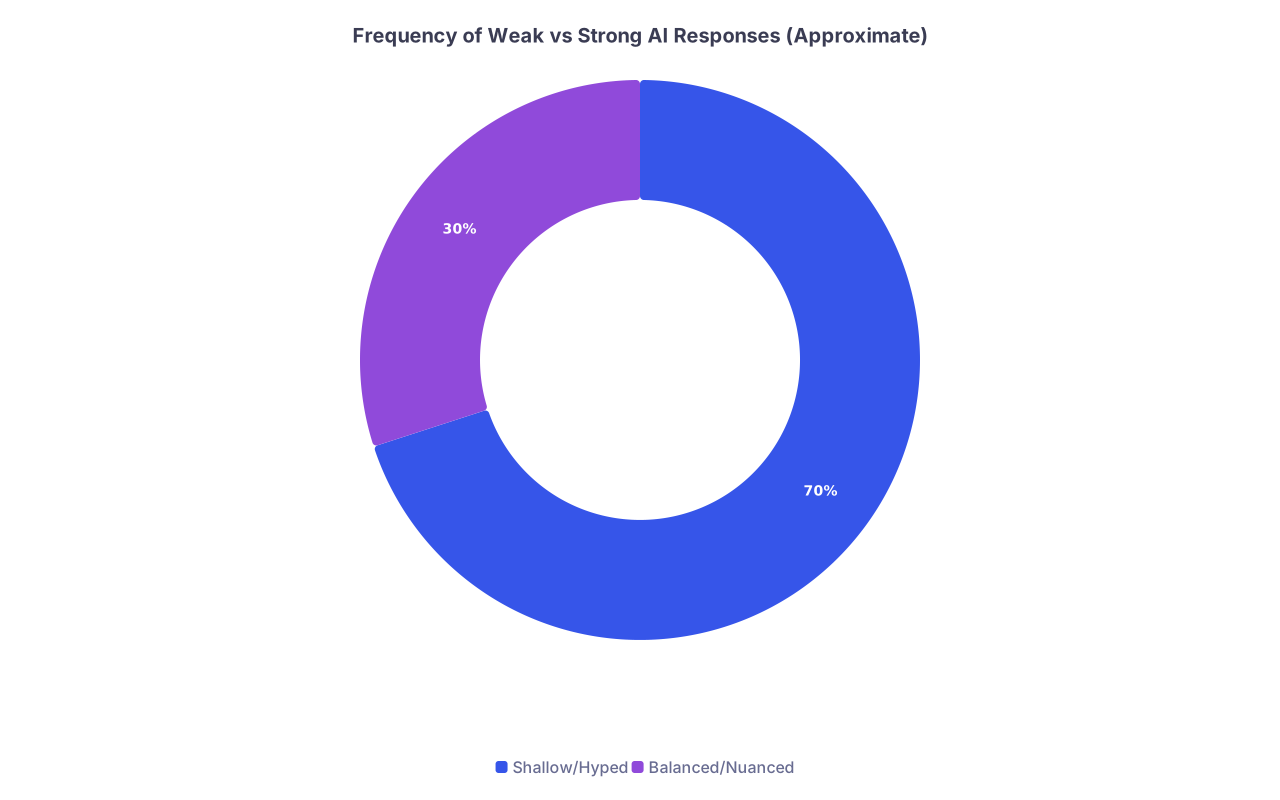
| Category | Value |
|---|---|
| Shallow/Hyped | 70 |
| Balanced/Nuanced | 30 |
FAQs
1. Do I need to know technical details of machine learning algorithms for interviews?
No. You are not being evaluated on your ability to derive backpropagation. You should, however, understand basic concepts at a conceptual level: that models learn patterns from data; that they can be biased if the data is biased; that performance metrics in a paper do not equal flawless real‑world behavior. If you can explain those ideas in normal language, you are more than fine.
2. Is it risky to criticize technology or AI in an interview?
It is risky to sound ignorant or reactionary. It is not risky to be critical in a thoughtful way. In fact, most experienced clinicians are somewhat skeptical of tech because they have lived through bad EMR rollouts and clunky decision support. If you show balanced, informed critique anchored in patient welfare, you will usually earn respect, not pushback.
3. What if I honestly do not care much about technology?
You do not need to be passionate about tech. But you do need to be able to function in a healthcare system that is saturated with it. Frame your stance as: “I am not a tech enthusiast, but I recognize that understanding these tools is part of modern patient care, and I want to be competent enough to use them responsibly and advocate for my patients when the tools fall short.” That is perfectly acceptable.
4. Should I mention specific products or companies by name?
You can, but you do not have to. Dropping a product name to sound “in the know” rarely helps. It is more important that you can discuss categories: AI‑assisted radiology, ambient documentation, predictive risk models. If you do name something (for example, a well‑known sepsis prediction system or scribe tool), make sure you actually understand what it does and are not just parroting a headline.
Key points to keep:
- Always bring AI and technology back to patients, equity, and clinical judgment.
- Use concrete, current examples for both benefits and risks; avoid vague hype or doom.
- Position yourself as a future physician who is literate, critical, and responsible in how you will engage with these tools.