

The fastest way to destroy a team’s credibility is to ignore serious errors in the chart.
If you’ve just spotted a big mistake in a colleague’s recent note—wrong patient, wrong laterality, dangerous med plan, fake exam, you name it—you’re in one of those moments that quietly define your career. Not by what you say your ethics are. By what you actually do in the next few hours.
Let’s walk through it like I’m standing next to you in the workroom and you just whispered, “Uh… I think Dr. X’s note is seriously wrong.”
1. First: Decide if this is “serious” or just annoying
Not every discrepancy is a crisis. But some are time bombs.
Run through this mental triage:
Could this note cause real patient harm if someone follows it?
Examples:- Documented “no allergy” when the patient has anaphylaxis to that drug
- Wrong side listed for a planned surgery or procedure
- Insulin dose mistyped (e.g., 10 units vs 100 units)
- Anticoagulation plan documented as “restart tonight” when the surgeon clearly said “hold 72 hours”
Does this note misrepresent reality in a way that’s clearly unprofessional or dishonest?
Examples:- A full physical exam documented on a patient you know was never actually seen
- Billing-level exam with systems “examined” while the patient was intubated and sedated, and there’s no way it was done
- Copy‑paste from an old admission with obviously outdated problems and meds
Does this error propagate through downstream care or medico‑legal risk?
Examples:- Code status charted as “Full Code” when the patient and family had an extended DNR discussion earlier that day
- Incorrect diagnosis (e.g., labeling TIA when neurology clearly ruled out stroke/TIA) that will mislead future clinicians
- Wrong attending of record, wrong consultant attribution, or false documentation about who made a decision
If the answer to any of those is “yes,” treat it as serious.
If it’s something like a typos in ROS, slightly outdated past surgical history, or a mild disagreement in assessment language, that’s a lower tier. You still may fix or clarify, but you’re not in “drop everything” mode.
Here’s a quick way to frame it:
| Type of problem | Example | Urgency level |
|---|---|---|
| Direct patient safety risk | Wrong insulin dose, wrong side surgery | Immediate |
| Critical value / status mismatch | Code status, allergies, anticoagulation plan | Immediate |
| Major misrepresentation/dishonesty | Fake exam, fabricated encounter | High |
| Misleading clinical impression | Wrong diagnosis carried forward | Moderate |
| Annoying but low risk | Minor copy-paste errors, ROS boilerplate | Low |
If you’re on the fence, assume it’s serious enough to act on.
2. Lock down what actually happened
Before you start confronting anyone, get your facts straight. This is where people screw up—they jump straight to accusation based on half‑remembered impressions.
Do this quietly:
- Re‑read the actual note. Slowly. Make sure you understand what was documented and when.
- Check the timestamps: Was this before or after a key event, order, or result?
- Look at the rest of the chart: prior notes, orders, lab trends, nursing notes, consult notes.
Ask yourself:
- “Could there be a reasonable interpretation where this isn’t actually wrong?”
- “Is there any chance I’m the one who’s misinformed?”
You don’t need a full detective investigation. But you do need enough context to confidently say:
- What’s wrong
- Why it’s wrong
- How it could affect the patient
Document for yourself, outside the chart, the key elements: date/time, note author, content that concerns you, and specific reasons. This is for your own clarity, not to upload somewhere.
3. Always, always start with the patient
Your first duty is not to protect your colleague’s feelings. It’s to make sure the patient doesn’t get hurt.
So: while you’re thinking through the ethics, ask: “Is there anything that needs to be corrected in the actual plan of care right now?”
If the error affects current orders or management:
- Correct the orders or plan immediately if you’re in a position to do so safely (e.g., you’re also on the team, you’re in the same service, you’re on call).
- If you can’t correct it alone (e.g., surgical plan, specialty‑specific orders), escalate quickly: contact the senior resident, attending, or on‑call consultant.
Example:
You’re on nights. You see that the day intern wrote: “Restart apixaban tonight” on a fresh post‑op hip fracture. Surgeon’s op note clearly says “Hold all anticoagulation 72 hours.”
You do not wait until tomorrow to “ask nicely.” You page the night senior, clarify with the on‑call ortho if needed, and correct the plan in a new note or signout update: “After clarification with orthopedics, apixaban to remain held for 72 hours post-op.”
Then you address the documentation issue.
4. Talk to your colleague directly—if it’s safe and feasible
If you’re not dealing with immediate patient harm, your next move is almost always a direct, non‑accusatory conversation. This is the part people dread. Do it anyway.
Here’s a script you can steal and modify:
“Hey, I was reviewing [patient name]’s chart and saw your note from yesterday. I’m probably missing something, but I got worried about this part: [quote the line]. Can we look at it together?”
“I’m concerned that if someone follows this as written, they might [state harm]. Would you be ok updating the note or adding an addendum?”
A few things you’re doing on purpose here:
- You’re assuming good intent, at least at first. Most real errors aren’t malicious. They’re fatigue, copy‑paste, distraction.
- You’re specific. “This sentence” vs “your note is wrong.”
- You’re giving them a path to fix it on their own.
Best‑case scenario: they say, “Oh wow, you’re right, I’ll correct that right now.” Done.
If they push back with something like:
- “It doesn’t matter, everyone knows what I meant.”
- “No one reads these anyway.”
- “Whatever, it’s fine, I don’t have time.”
Now you’re moving out of “simple error” into “professionalism problem.” Make a mental note of their reaction. That becomes relevant if you have to escalate.
5. When and how to involve your attending or supervisor
If:
- The colleague won’t correct a serious error
- Or you can’t reach them promptly
- Or the error is so significant you’re not comfortable leaving it to private resolution
- Or you’re a student/PGY1 without authority to override the plan
You escalate. This isn’t betrayal. This is what being a responsible professional looks like.
Who you go to depends on where you sit:
- Medical student: usually your resident first, then attending if resident is the one who made the error or is dismissive.
- Intern/resident: your senior, chief resident, or attending.
- APP or fellow: service attending, section chief, or medical director if needed.
- Attending: another attending on the service, section chief, or risk management/compliance if it’s really bad.
How to say it:
- “I need your help with something serious in the chart. I was reviewing [patient] and found this in [colleague]’s note from [time]. Based on [these facts], I think it’s wrong and could cause [harm]. I spoke with them, and they [response]. I don’t feel comfortable leaving it uncorrected.”
Do not editorialize more than you need to. Stick to:
- What’s written
- What the actual facts are
- What you did so far
- What you’re worried will happen
You’re not there to psychoanalyze why your colleague did it.
6. Fixing the record: what you can and cannot do
You never, ever alter someone else’s signed note. That’s how people end up in hearings and depositions saying, “I only meant to help,” and it does not go well.
What you can do:
- Add your own note (progress note, cross‑cover note, or brief addendum) documenting the correct information as you understand it, including the date and time.
Example language:
“On review of the chart, prior note dated 1/8/26 at 10:15 by Dr. Smith lists code status as Full Code. Patient and family discussion this evening (1/8/26 at 21:30) confirms prior decision for DNR/DNI as documented in the goals of care note dated 1/7/26 by Dr. Jones. Code status confirmed as DNR/DNI and updated in orders.”
Or:
“Previous plan listed restart apixaban tonight. After discussion with orthopedics on call (Dr. Lee) at 23:10, clarified that anticoagulation to remain held for 72 hours post-op.”
You’re not attacking. You’re correcting.
If your institution supports it, you can also message the colleague through the EHR messaging function: “Flagging this so you can adjust your note if needed.” But do not rely on that being seen promptly.
One thing: resist the urge to write a long narrative within the chart about interpersonal drama. Document only what’s clinically relevant and necessary for legal clarity. Keep the “who refused to do what” piece for conversations with your supervisors, not the medical record.
7. Distinguishing sloppy from dishonest
There’s a line between “tired and sloppy” and “actually falsifying records.” You need to be clear in your own mind which side you’re seeing, because the response is different.
Red flags for dishonesty:
- Documenting “Patient seen and examined” at a time you know the clinician was not in the hospital at all
- Physical exam findings that are copy‑pasted identically day after day despite nursing notes describing huge changes (e.g., “lungs clear” in a patient with documented massive pulmonary edema)
- Notes filed that justify billing levels with exams impossible in context (full neuro exam in a combative, uncooperative patient, every system normal, etc.)
- Back‑dated notes entered as if they were contemporaneous, without addendum or clarification
This is not just an “oops.” This is a professional and often legal violation.
In these cases:
- You still start by confirming facts.
- You may or may not speak with the colleague directly, depending on power dynamics and your safety. If it’s your attending or a notoriously retaliatory person, you may skip straight to a trusted program director, chief, or ombuds.
- You bring it up explicitly as a professionalism or fraud concern, not just clinical disagreement.
Example to a supervisor:
“I’m worried about potential falsification of documentation. Dr. X’s note from [time] states ‘patient seen and examined at bedside,’ but I was on that call with them when they said they were at home and would not be in until morning. The physical exam is detailed and conflicts with nursing notes. I don’t feel able to address this alone.”
Will this feel uncomfortable? Yes. Do people get angry when they’re called on this? Often. But this is exactly the kind of behavior that boards and regulators expect someone to speak up about.
8. Protecting yourself while doing the right thing
You’ve probably heard stories: the person who reported a problem ends up being the one frozen out of the team. That does happen. So you’re not required to be naive.
A few ground rules to protect yourself:
- Keep your tone factual, not emotional. No “they’re always like this,” no generalizations.
- Use institutional channels when things escalate: program director, GME office, patient safety/risk, compliance, ethics committee, anonymous reporting lines.
- If you send emails about this, assume they may one day be read in a legal setting. Write accordingly.
- Do not gossip about it with other residents or students. Venting in the call room feels good for 10 minutes and then bites you.
- Document your own clinical reasoning in your notes. Make it very clear what you did and why.
Remember: in any later review, the question is often, “Given what they knew, did they act reasonably?” You want your answer to be an easy yes.
9. When you are the one who made the serious error
You’re not immune. One day you’ll open your own note and realize you put the wrong dose, the wrong laterality, or that you were lazy and copied an exam you never did.
Here’s the grown‑up response:
- Admit it fast. To yourself and to your team.
- Fix the clinical fallout immediately (orders, plans, handoffs).
- Correct the record with a clear addendum:
“Correction: Prior note dated 1/8/26 at 09:15 incorrectly listed patient as Full Code. After chart review and direct discussion with patient, code status confirmed as DNR/DNI. Error acknowledged and corrected here.”
- If it’s big—wrong side surgery documentation, fake exam, anything that looks like fraud—tell your attending or supervisor proactively. Do not wait for someone else to catch you.
A single serious mistake, handled honestly and fast, rarely ruins a career. A cover‑up can.
10. Turning this into your own ethical “muscle memory”
You don’t build ethical reflexes reading policy PDFs. You build them by running a simple playbook in messy real life.
Here’s the compressed version you can keep in your head:

| Step | Description |
|---|---|
| Step 1 | See serious error |
| Step 2 | Fix orders/plan immediately |
| Step 3 | Document your correction |
| Step 4 | Clarify facts in chart |
| Step 5 | Discuss directly and request fix |
| Step 6 | Go to supervisor |
| Step 7 | Monitor and move on |
| Step 8 | Supervisor decides next steps |
| Step 9 | Patient at risk now |
| Step 10 | Safe to talk to colleague |
| Step 11 | Colleague corrects note |
Last point: you will remember the first time you spoke up about someone else’s serious error. The room, the faces, how your heart was racing. You will also remember the cases where people stayed quiet and things went bad.
Given the choice, you want to be on the side where you can sleep at night.
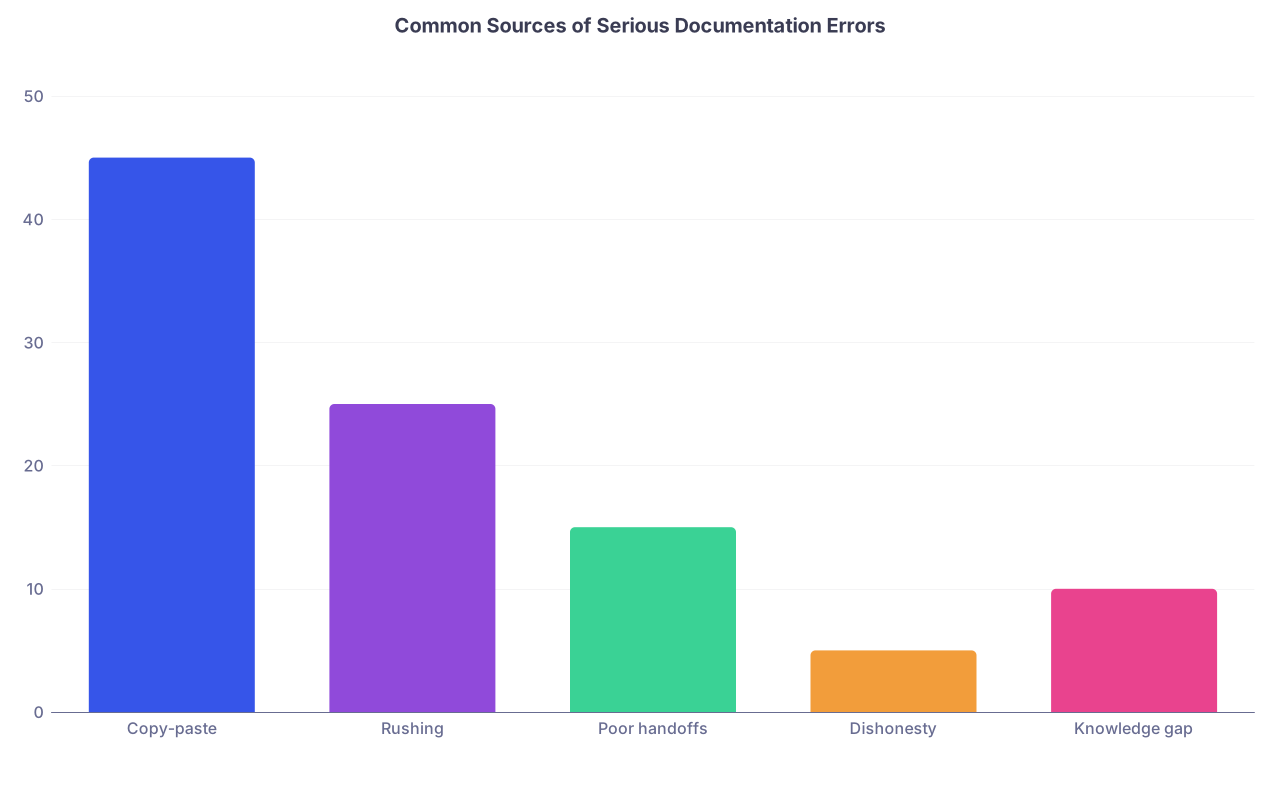
| Category | Value |
|---|---|
| Copy-paste | 45 |
| Rushing | 25 |
| Poor handoffs | 15 |
| Dishonesty | 5 |
| Knowledge gap | 10 |

3 things to remember when you discover a serious error
- Patient safety first: fix dangerous plans and document accurate information promptly.
- Address the colleague directly if you can; escalate to supervisors when they refuse, you’re not safe, or the issue is grave (dishonesty, repeated behavior).
- Never alter someone else’s note; correct the record with your own documentation and protect yourself by staying factual, professional, and using proper institutional channels.


