

If You’re Asked to Alter Documentation After a Bad Outcome
What do you do when, after a bad outcome, someone tells you: “Go back in and clean up your note”?
I do not mean correct an obvious typo or add a late entry. I mean: patient died, family is angry, risk management is circling, and a senior person suggests your chart should now “better reflect what we actually did.” You feel your stomach drop because you know exactly what that means.
Let’s walk through what to do. Step by step. Because this is one of those career-defining situations where one bad choice follows you forever.
1. Get Extremely Clear on What’s Being Asked
First move: strip away the euphemisms.
People rarely say “please falsify the chart.” You’ll hear:
- “Document that we discussed X.”
- “Can you add that the patient refused?”
- “Make sure the note reflects that this was a shared decision.”
- “Just tweak the timing so it lines up better.”
Your job in this moment is to quietly classify the request into one of three buckets:
Legitimate correction / completion
- Fixing errors in fact (wrong dose, wrong time, wrong name).
- Adding missing but true information with a clearly dated late entry.
- Clarifying ambiguous wording.
- Adding objective data that already exists (lab values, vitals, imaging results).
Borderline / concerning
- Adding something you think might have happened but you do not specifically remember.
- “Everyone does it this way, so just put that in.”
- “You probably said it, so just chart it.”
Clearly improper / falsification
- Documenting conversations that did not happen.
- Backdating notes to look like they were done earlier.
- Changing timing of events to improve appearances.
- Deleting or altering prior entries so it looks like something different happened.
If it didn’t happen, you do not chart that it happened. That’s the ethical and legal line.
You’re allowed—actually expected—to add late documentation. You are never allowed to rewrite history.
That distinction is everything.
2. Understand the Legal Landmine You’re Standing On
Let me be blunt: altering documentation after a bad outcome is one of the fastest ways to turn a defensible case into a disaster.
Here’s why:
- In any lawsuit, credibility is the whole game. If the record looks manipulated, your credibility blows up.
- Plaintiff attorneys love altered records. Jurors hate them. You look like you’re hiding something, even if the original care was reasonable.
- Many jurisdictions treat intentional falsification as fraud or even criminal conduct. Different ballgame than simple negligence.
And there’s the EHR problem no one seems to emphasize enough to trainees: the system logs everything.
- When the note was created.
- When it was edited.
- By whom.
- What was added or deleted (audit trails, version histories).
I’ve sat in meetings where defense counsel scrolls through the audit log and you watch faces drain. “So, doctor, can you explain why, two days after the patient died, you added a note saying they refused the CT scan?”
That’s the moment the case flips from defensible to “we’re going to have to talk about settlement and perhaps reporting.”
You must assume:
- Every change is visible.
- Every timestamp is discoverable.
- Every “helpful tweak” will eventually be read in front of a jury.
So, before you touch a single keystroke after a bad outcome, you decide: Am I documenting legitimately, or am I being pulled into a cover story?
3. How to Respond in the Moment When Someone Pressures You
Let’s say the attending, senior resident, or even a department chair tells you:
“You need to go back and make sure your note reflects that you talked about X risk. If it’s not in the note, it didn’t happen, and we need it to have happened.”
You feel intimidated. They control your grades, your evals, your job.
Here’s how to handle it verbally without blowing up the relationship, but also without sacrificing your integrity.
First, buy time and clarify:
- “I’m happy to correct any inaccuracies. Can you clarify: are you asking me to add something that actually happened but I didn’t document, or something we’re assuming happened?”
If they say, “Well, you always talk about this risk, right?”:
- “I usually do, but I don’t specifically remember this conversation, and I’m not comfortable documenting it as if I do.”
If they push:
- “I’m more than willing to write a late entry with what I do remember and label it as such, but I can’t create documentation of something I can’t recall or know didn’t happen. That puts me at risk too.”
If they hint at consequences:
- “I respect your position. I still have to chart honestly. I’m open to involving risk management or compliance to make sure we do this correctly.”
Notice what you’re doing:
- You’re not accusing them of asking you to lie.
- You’re framing it as your legal risk and ethical boundary.
- You’re suggesting a neutral third party (risk management / compliance) instead of escalating into a fight.
Is this comfortable? No. But I have seen residents torpedo their careers because they were “being a team player” for five minutes.
4. What Ethical Late Documentation Actually Looks Like
You are allowed to go back and add:
- Clarifications.
- Additional context.
- Things you genuinely forgot that did happen.
But you have to do it the right way.
Principles:
Never alter the original content silently.
- Do not delete or rewrite the old note to make it look like it was always perfect.
- Use addendums or late entries where possible.
Time-stamp your honesty.
- “Addendum created on [date/time] to clarify events on [prior date].”
- Explicit is safer than cute.
Stick to facts, not “now-remembered” heroics.
- What you actually recall.
- What objective data shows.
- Avoid dramatic narrative that appears designed to justify.
An ethically defensible late entry looks like this:
“Addendum 1/8/2026 14:32 – After reviewing the record and reflecting on the encounter, I want to clarify that on 1/6/2026 I discussed likely viral vs bacterial etiologies with the patient, advised that if fever persisted beyond 5 days or if new shortness of breath, chest pain, or confusion developed, they should return immediately or seek emergency care. This was communicated verbally; no written instructions were provided at discharge. – J. Smith, MD”
That’s a late entry. It acknowledges timing. It describes what actually occurred, to the best of your recollection. It doesn’t pretend it was written at the original time.
What you do not do:
- Backdate it to 1/6 so it looks contemporary.
- Claim you provided a detailed written handout if you didn’t.
- Insert it into the original note as if it had always been there.
If your EHR has a dedicated “addendum” function, use it. That’s exactly what it’s for.
5. When You’re a Trainee and Power Dynamics Are Ugly
This is where things get messy. Because as a med student, intern, or junior resident, your power is limited and the pressure can be massive.
You’re trying to match, graduate, or secure a job, and the person leaning on you writes your evals.
Here’s a practical way to protect yourself without going nuclear immediately.
Step 1: Document the interaction for yourself
Separate from the chart, in a secure and private place (not on hospital email, not in the EHR):
- Date, time.
- Who spoke to you.
- Exact phrases as close as you can remember.
- What they asked you to change/add.
- What you said in response.
This isn’t for you to wave around tomorrow. This is to anchor your memory if things blow up a year later.
Step 2: Give them one clean, principled “no”
You can say:
- “I’m not comfortable changing the note to say we did something we didn’t do. I’m comfortable correcting errors or adding a late addendum documenting what actually happened.”
Then stop talking. Do not argue yourself into a corner. Do not start negotiating over individual sentences.
Step 3: Seek a quiet, credible ally
Depending on your structure, this might be:
- Program director (if they’re not the problem).
- Associate PD.
- Trusted faculty mentor.
- Ombudsperson.
- GME office.
- Hospital risk management.
You open with something like:
“I want to run a situation by you because I’m worried about being asked to change documentation in a way that doesn’t feel honest or safe for me.”
Then you describe facts, not your interpretations. Let them react.
Good programs take this seriously. Even mediocre ones get very nervous about documentation tampering once you say “legal risk” and “EHR audit trail.”
6. Involve Risk Management Earlier Than You Think
Most people think risk management is the enemy. That’s not true. They’re not your personal lawyers, but they do care deeply about not making the situation worse.
If anyone—even with good intentions—is leaning on you to “adjust” the record after a bad outcome, looping in risk management is usually the smartest move.
What this looks like:
You call or email risk management:
- “We had an adverse event with patient X on [date]. I’ve been asked to modify my documentation. I want to make sure any changes are done appropriately and lawfully.”
You ask:
- “Can you advise on what is appropriate for a late entry in this situation?”
- “Is there a recommended format or approval step for addenda related to adverse events?”
This does two things:
- Protects you: you’ve now created a trail that you were trying to handle it correctly.
- Slows down reckless behavior: people tend to chill once they know risk management is aware.
If your institution has in-house counsel that handles clinical issues, similar idea. You are not asking them to be your personal defense lawyer; you’re asking for guidance on hospital policy and legal standards.
7. How to Balance Honesty with Not Self-Destructing in the Chart
There’s another side to this: people overcorrect. They get scared and write a confession in the chart that reads like a plaintiff’s closing argument.
The chart is not the place for:
- “In retrospect, I should have ordered a CT.”
- “I now realize I missed X diagnosis.”
- “This was an error in judgment on my part.”
You can be honest without writing legal suicide notes.
Stick to:
- Objective facts.
- What was known/available at the time.
- What you did and did not do.
- What was communicated to the patient/family.
Do not:
- Rewrite your mental state.
- Add hindsight commentary about what “should” have been done.
- Use value-laden language like “negligent,” “error,” “mistake,” etc.
If you had a debrief or M&M later where you learned more, that usually does not go into the medical record. That belongs in quality-improvement channels, protected by peer-review privilege (varies by jurisdiction, but the point stands).
8. Concrete Scenarios and How to Respond
Let’s get specific. A few common situations I’ve seen.
Scenario 1: The “we discussed risks” pressure
Bad outcome after a procedure. Family says they were never told about a particular complication. Attending texts you:
“Make sure your pre-op note specifically says we discussed risk of X complication.”
But you know you did a generic “bleeding, infection, damage to surrounding structures” spiel and never named this exact rare complication.
Your move:
- Write a factual late entry:
- “Addendum [date/time]: During pre-op consent on [date], I discussed with patient the general risks of the procedure including bleeding, infection, and potential injury to surrounding structures, as well as need for possible additional procedures. We did not specifically discuss [rare complication] by name.”
- Then tell attending: “I added a late entry clarifying the consent discussion as I remember it. I didn’t specifically discuss [complication] by name, so I didn’t include that.”
You’re honest. You’re not throwing anyone under the bus. You’re just not lying.
Scenario 2: The “change the timing” request
Patient had a deterioration at 14:00. The rapid response was actually called at 14:25. Family is angry. Someone suggests:
“Move the note so it looks like the RRT was activated right after the vitals changed.”
Your move: hard no.
You can add:
- “Rapid response team was activated at approximately 14:25 in response to [vitals] documented at 14:00.”
You do not alter the vitals timestamps. You do not pretend you called the RRT earlier than you did.
If pushed:
- “Changing the timestamps isn’t something I can do honestly. I can clarify sequence and reasoning, but the system tracks the actual times.”
Scenario 3: The vanished entry
You wrote an honest note yesterday that reflects your uncertainty and limited differential. Today, bad outcome. A senior says:
“That note makes us look clueless. Just delete it; we’ll write a better one.”
Depending on your system, outright deletion might not be possible—but soft deletion or heavy editing may be.
Your move:
- Do not delete.
- If you must edit (some systems allow amendment only), make only minor clarifications and clearly state it’s an addendum/amendment, not a clean rewrite.
- If you think what they’re doing is improper, document privately, and go to risk management or GME.
9. Building Your Own Line in the Sand Now
You can’t improvise your morals at 3 a.m. with a furious attending staring at you. You decide your line before you’re in the fire.
My version is simple:
- If it didn’t happen, I will not write that it did.
- If I don’t remember it clearly enough to swear to it later, I will not chart it as fact.
- I will add late entries only as late entries, with honest timestamps and content.
- If documentation changes are requested after a bad outcome, I will, at minimum, loop in risk management if I feel pressured to cross the line.
Yours should be something like that. Clear enough that, when you feel scared and small, it still holds.
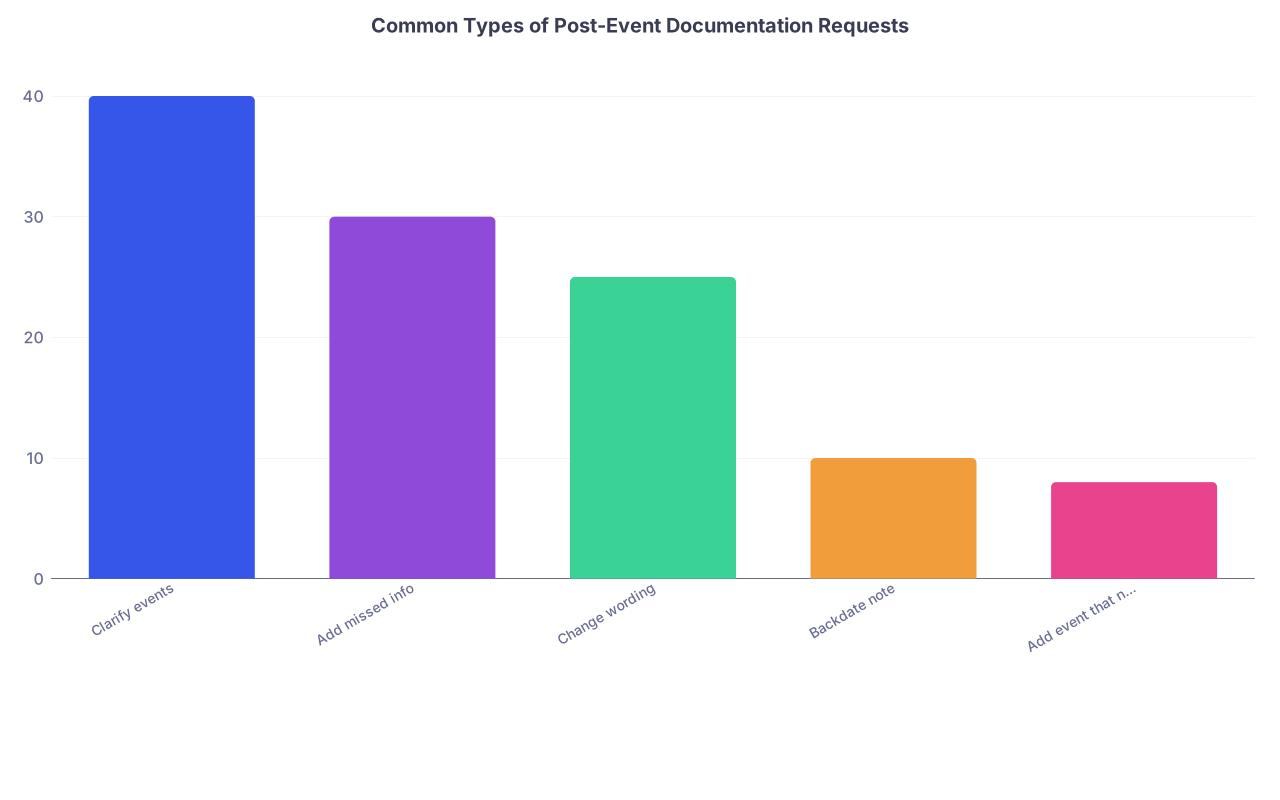
| Category | Value |
|---|---|
| Clarify events | 40 |
| Add missed info | 30 |
| Change wording | 25 |
| Backdate note | 10 |
| Add event that never happened | 8 |
10. Practical Steps Checklist When This Actually Happens
You’re in the situation now. Here’s your quick-and-dirty playbook.
Pause. Do not touch the chart immediately.
- Take a breath. Give your prefrontal cortex a chance to come online.
Clarify the request in plain language.
- “Just so I’m clear—you’re asking me to add that we did X, even though it’s not in my original note. Is that correct?”
Mentally classify: correction vs. cover.
- Correction/completion = likely okay via addendum.
- Cover story = no.
If it’s a cover story, give a firm, calm boundary.
- “I can’t document something that didn’t happen / that I don’t specifically remember. I can add what I do recall as a late entry.”
If appropriate, write a factual, time-stamped late entry.
- Label it “Addendum” or “Late entry.”
- State what you remember, not what would be helpful.
Write yourself a private contemporaneous note about the pressure.
- Date, time, who, what was said.
Loop in a neutral party.
- Risk management, GME, PD, or trusted mentor.
Do not discuss the specifics of the chart on text, social media, or personal email.
- Those become discoverable too.
You don’t need to be perfect. You just need to not lie.

| Step | Description |
|---|---|
| Step 1 | Bad outcome occurs |
| Step 2 | Ask to change documentation |
| Step 3 | Use late entry or addendum with timestamp |
| Step 4 | Politely decline to falsify |
| Step 5 | Document request privately |
| Step 6 | Contact risk management or mentor |
| Step 7 | Agree on ethically safe documentation |
| Step 8 | Is it factual correction or addition? |
11. Final Reality Check
You will almost certainly face this at some point if you stay in clinical medicine long enough. Not always malicious. Often just fear-driven, panicked attempts to make a bad situation look neater in the record.
Your job is to be the adult in the room even when you’re the most junior.
Three things to walk away with:
- You never chart something that didn’t happen, no matter who tells you to.
- Late entries and addenda are fine—if they’re honest, time-stamped, and factual.
- If you feel pressured to alter the story after a bad outcome, pause, document the pressure privately, and bring in risk management or a trusted senior who still remembers what ethics is.
You can recover from a lot of clinical mistakes if you’re honest and humble.
You do not recover easily from being the person who lied in the chart.


