

What happens ethically when a “choice” in medicine doesn’t really feel like a choice?
Let’s be blunt: a lot of what gets labeled “shared decision‑making” (SDM) in clinics today is actually soft pressure dressed up as collaboration. The forms are signed, the EHR box is checked, but the patient walked out feeling like they’d been steered more than heard.
You’re asking the right question: where’s the line between genuine shared decision‑making and subtle coercion?
Here’s the answer you’re looking for.
The core difference in one sentence
Shared decision‑making:
Patient could reasonably choose any option on the table and feel respected, supported, and safe.
Subtle coercion:
Patient technically “agrees,” but they feel they can’t safely say no, ask for time, or pick against your preference.
Everything else is detail.
What actually counts as shared decision‑making?
Forget the buzzword slides from grand rounds. Real SDM has a few non‑negotiable components.
1. There’s a real choice on the table
If there’s only one medically reasonable option, that’s informed consent, not SDM. SDM requires:
- At least two legitimate paths (including “do nothing” or “wait and see” when appropriate).
- You’re willing to live with any choice the competent patient makes, even if it’s not what you’d pick for yourself.
Concrete examples of true choice:
- Starting vs deferring a statin in primary prevention with borderline risk.
- Lumpectomy plus radiation vs mastectomy for early‑stage breast cancer.
- Trial of labor after cesarean vs elective repeat C‑section.
If you’d be quietly angry or punitive if they chose option B, you don’t really see it as a valid option. That’s your first red flag.
2. Risks, benefits, and alternatives are presented neutral‑ish
You don’t have to pretend all options are equal. But you can’t stack the deck verbally.
Shared decision‑making sounds like:
- “Here are the main options I see… Here’s what we know about each, and where the uncertainty is.”
- “Some people prioritize avoiding surgery. Others prioritize getting the most aggressive treatment. Let’s see what matters most to you.”
Not:
- “Well, you could decide not to treat, but most people don’t want to take that risk.”
- “The guideline‑recommended thing is X, and that’s what all responsible patients choose.”
Watch your adjectives. “Aggressive,” “gold‑standard,” “doing nothing,” “playing with fire” — those carry judgment.
3. The patient’s values actually change the recommendation
If the outcome is the same no matter what they say, it’s not SDM, it’s theater.
Real SDM looks like:
- “For someone who hates taking daily meds, I’d lean more toward procedure A.”
- “Given how strongly you feel about maintaining fertility, that rules out option C for you.”
- “You told me you value staying at home and avoiding hospital. That makes hospice a very reasonable choice.”
If you’re not explicitly tying options back to their priorities, you’re just doing informed consent plus vibes.
4. The patient has space to disagree, delay, or revisit
A key SDM test: Can the patient safely say any of these?
- “I want to think about this and come back.”
- “I disagree; I’d rather try the conservative option first.”
- “My family and I see this differently; I’d like to talk with them.”
If the room gets tense when they say that, or you subtly punish them (shorter visits, less warmth, less responsiveness), you’ve drifted into pressure territory.
Subtle coercion: what it actually looks and feels like
Most coercion in healthcare isn’t overt threats. It’s small, “normal” behaviors that push patients toward what we want.
Here’s how it shows up.
A. Framing the “wrong” choice as irresponsible
You’ll recognize these lines. I’ve heard them in workrooms and exam rooms:
- “Well, I can’t stop you if you want to risk a stroke, but I wouldn’t recommend it.”
- “If you were my mother, I’d never let you go without this surgery.”
- “I really don’t want you to be the one percent who regrets not doing this.”
Technically, there’s a choice. Practically, you’ve framed one option as foolish, selfish, or reckless. That’s moral pressure, not information.
B. Using fear or guilt to tip the scales
Classic soft‑coercion moves:
- Emphasizing rare worst‑case scenarios out of proportion.
- Saying “I don’t want to see you back here on a ventilator” in a way that clearly implies “and it’ll be your fault.”
- Showing graphic images (“this is what happens if you don’t”) without the same energy for showing benefits/risks of the other choice.
Coercion is about emotional leverage. If the patient is deciding in panic, shame, or fear of your disapproval, you’re not in SDM anymore.
C. Time pressure that isn’t actually clinical
Sometimes urgency is real (stroke thrombolysis, ruptured AAA, cord prolapse). That’s not coercion; that’s emergency medicine.
But often there’s fake urgency:
- “We should really get this scheduled today or the wait will be long” — when there’s no medical harm in waiting.
- “Your insurance year resets soon; you might want to do this now” — presented as if it’s clinically pressing.
- Rushing through consent because you’re behind schedule, then using that rush to push the fastest path: “Let’s just do this today.”
If the time pressure is driven by clinic flow, coverage, or convenience — and you’re using that to push a choice — that’s subtle coercion.
D. Overstating how “standard” your preferred choice is
Lines like:
- “Everyone chooses this.”
- “This is what we always do.”
- “I’ve never had a patient regret going ahead with this.”
Those are social pressure tools. Patients don’t want to be the “difficult” or “weird” one. You’re leveraging that.
Law vs ethics: when is this a legal problem?
Legally, you’re mostly inside the doctrine of informed consent and, in some countries, specific SDM statutes or case law.
In most jurisdictions, lawful consent requires:
- The patient has decision‑making capacity.
- They’re given adequate information about:
- Nature and purpose of the intervention.
- Material risks and benefits.
- Reasonable alternatives (including no treatment).
- Consent is voluntary, not obtained under coercion or undue influence.
Here’s the key:
Law tends to care about gross coercion (threats, fraud, outright lies, withholding crucial info). Ethics cares about the softer stuff long before a judge would.
You can be legally safe and still ethically off.
| Aspect | Shared Decision-Making | Subtle Coercion |
|---|---|---|
| Legal consent validity | Usually valid | Often still legally valid |
| Info on options | Balanced | Framed to favor one choice |
| Emotional tone | Supportive | Fear, guilt, social pressure |
| Patient feels free to say no | Yes | Not really |
| Ethical assessment | Respecting autonomy | Undermining autonomy |
Where it clearly crosses into legal trouble:
- You hide a reasonable alternative because you think they’ll choose it and you dislike it.
- You materially misrepresent risk/benefit (“There are no real risks” when there are).
- You threaten or suggest withdrawal of care if they don’t comply (“If you don’t do this, I can’t keep seeing you,” outside of narrow, defensible scenarios).
- You coerce vulnerable patients (e.g., involuntary psych, incarcerated people) without required safeguards.
Quick self‑check: are you really doing SDM?
Run your last “shared decision‑making” conversation through these questions:
Could a reasonable colleague defend not doing what I recommended?
If not, it was probably informed consent, not SDM. That’s okay. Just call it what it is.Did I explicitly invite their goals, fears, and preferences and tie them back to the choice?
If not, you informed; you didn’t share the decision.Could they have safely said “no” or “not yet” without feeling I’d be annoyed or abandon them?
Be honest. If no, there was pressure.If a transcript existed, would a neutral ethicist say I was neutral in tone and framing?
Recall your adjectives, metaphors, and “everyone does this” lines.If the patient chose the option I least liked, would I still feel I’d done right by them?
If not, you’re more invested in the outcome than in the process. That’s a recipe for coercion.
How to stay on the right side: practical scripts and habits
You don’t have to overcomplicate this. A few habits make a huge difference.
1. Name that there really is a choice
Say it out loud:
- “There are a few reasonable options here. I want to walk you through them and then hear what fits you best.”
- “There’s not a single right answer; different patients choose differently.”
That alone lowers perceived pressure.
2. Separate facts from recommendations
Try this structure:
- Facts: “Here’s what we know about each option.”
- Values: “Here’s what people usually care about in this decision: longevity, side effects, independence, cost, etc. What matters most to you?”
- Recommendation: “Given what you’ve said, here’s what I’d recommend.”
- Permission: “How does that sit with you? Does that fit, or does something feel off?”
That’s SDM in four moves.
3. Make “no” explicitly safe
Use language that permits disagreement:
- “It’s completely okay if you’d rather wait or choose something else. My job is to help you understand the options, not decide for you.”
- “If we choose not to do X, I’ll still be here with you and we’ll monitor things closely.”
Many patients assume refusal means abandonment. If you don’t fix that assumption, your “choice” is coercive.
4. Watch your nonverbals
This is where a lot of coercion leaks out:
- Checking the clock right after they express doubt.
- Sighing or subtly stiffening when they lean away from your preference.
- Turning to the computer instead of holding the silence while they think.
If you say “take your time” while your body screams “I’m late,” they’ll read your body.
5. Use time wisely when it’s not truly urgent
For non‑emergent, high‑stakes decisions (chemo, major surgery, device implantation):
- Normalize a second visit:
“Most people take at least a day or two to think this over. We can schedule a follow‑up or phone call.” - Offer decision aids: short printouts, reputable websites, videos.
- Encourage bringing a support person:
“If you’d like, next time you can bring a family member or friend to talk this through.”
That’s not just ethically clean, it actually improves adherence because they feel ownership.
Special high‑risk zones for subtle coercion
There are areas where subtle coercion is almost baked into the culture. Watch yourself more closely in these:
- Obstetrics – “We really don’t want a dead baby,” used to push induction, C‑section, continuous monitoring.
- End‑of‑life care – “Doing everything” vs “comfort care” framing; equating hospice with giving up.
- Psychiatry – Implied threats about involuntary admission, housing, or legal consequences.
- Pediatrics – Talking to parents like there’s no real option but to agree “for the child’s sake.”
- Public health settings – Vaccines, quarantine, reporting; using shame rather than clear risk communication.
In these settings, “everyone talks this way” is not a defense. It just means the culture is skewed.
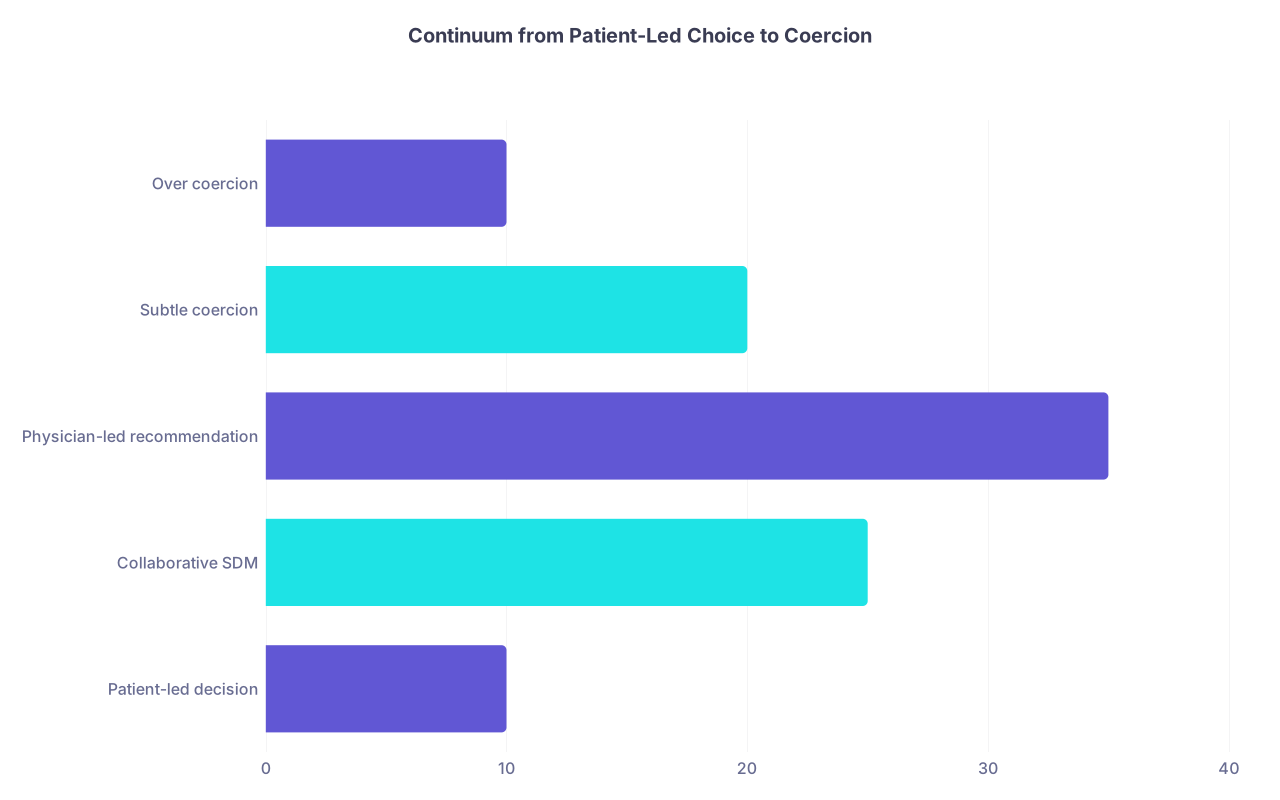
| Category | Value |
|---|---|
| Patient-led decision | 10 |
| Collaborative SDM | 25 |
| Physician-led recommendation | 35 |
| Subtle coercion | 20 |
| Over coercion | 10 |
Decision flow: is this SDM, guidance, or coercion?

| Step | Description |
|---|---|
| Step 1 | Clinical situation |
| Step 2 | Informed consent only |
| Step 3 | Best interest decision |
| Step 4 | Risk of coercion |
| Step 5 | Shared decision making |
| Step 6 | More than one reasonable option? |
| Step 7 | Patient has capacity? |
| Step 8 | Patient free to refuse without penalty? |
| Step 9 | Information balanced and values explored? |
Use this mentally. You don’t need a whole ethics consult every time — just clarity on where you are on this map.
FAQ: Shared Decision‑Making vs Subtle Coercion
1. Is it coercion if I strongly recommend one option?
Not automatically. You’re allowed — actually expected — to recommend. It becomes coercion when you:
- Misrepresent or hide alternatives.
- Use fear, shame, or guilt to push agreement.
- Make the patient feel that refusal will lead to abandonment or punishment. A strong, honest recommendation with clear room for disagreement is fine. “Here’s what I’d do, but it’s your body and your call. I’ll support you either way.”
2. Do I really have to be “neutral” about all options?
No, and pretending you are is fake. Patients want your expertise. Your job is to be truthful and proportional. You can say, “Option A has a much stronger evidence base, and I’m worried option B exposes you to significant risk,” as long as:
- That’s actually true.
- You still describe option B fairly.
- You allow them to pick B without punishment.
3. What if a patient chooses something I think is bad or dangerous?
Three steps:
- Check capacity: if they understand, appreciate, reason, and can communicate a choice, they’re allowed to make bad ones.
- Make sure they truly understand the consequences and alternatives.
- Clarify your boundaries honestly:
“I’m uncomfortable prescribing X because I think the risk is too high. I won’t do that, but I can help you explore other options or seek a second opinion.” That’s not coercion; that’s professional integrity + respect for autonomy.
4. How does shared decision‑making work with children or adults who lack capacity?
You shift from pure autonomy to best interests and substituted judgment:
- Use parents/surrogates’ understanding of the patient’s values when possible.
- Explore options with surrogates the same way you would with patients.
- Avoid “for the child’s sake” emotional pressure as your main tool. Legally and ethically, surrogates shouldn’t be bulldozed either. They deserve real choices and honest framing.
5. Can institutional policies themselves be coercive?
Yes. Examples:
- “We don’t offer VBAC here” when there’s no medical reason, just liability fear.
- Mandatory “consent” forms that are basically scare documents.
- Incentives/bonuses tied to specific intervention rates (e.g., certain procedures, certain screenings). You can’t always fix the system immediately, but you can be transparent: “Our hospital doesn’t provide option X. Clinically, it’s reasonable, and if you want to pursue it, I can help you find where it’s offered.” That’s how you keep your ethics intact when the system is messy.
Key takeaways:
- Shared decision‑making isn’t a checkbox; it requires real options, real respect, and room for “no.”
- Subtle coercion shows up in framing, emotion, time pressure, and social pressure long before it becomes illegal.
- You can recommend strongly and still be ethical — as long as the patient’s values can genuinely change the outcome and they’re free to choose differently without fear.


