

It’s 4:45 p.m. Clinic is running an hour behind. You still have three patients in rooms, one add-on consult for a possible procedure, and your phone keeps lighting up with messages from the OR. The next patient needs informed consent for a lumbar epidural injection and is clearly anxious. You feel the clock in your spine.
Here’s the question you’re actually asking yourself:
How much detail is enough for informed consent without blowing up the rest of the day—or cutting ethical and legal corners?
Let me be direct: you can be both efficient and ethically solid. But you need a clear internal rule set so you are not renegotiating this every single patient when you’re already stressed.
The Core Rule: “Material” Information, Not Every Detail
The law does not require you to tell patients every conceivable thing that could happen. It requires you to disclose material information.
Most jurisdictions use one of two standards:
| Standard Type | Key Question | Who Decides What's Material? |
|---|---|---|
| Reasonable physician | What would a typical competent physician disclose? | The profession (expert witnesses, guidelines) |
| Reasonable patient | What would a reasonable patient want to know to decide? | The hypothetical reasonable patient (jury, judge) |
| Hybrid / mixed | Blend of both standards | Court, with expert input |
Translated into practice:
Material = information that could reasonably influence a patient’s decision to say yes or no.
On a busy day, that means you always cover, at minimum:
- What you’re proposing (nature of the intervention)
- Why (diagnosis / problem, expected benefit)
- Alternatives (including doing nothing)
- The most common risks
- The serious risks, even if rare
- Key uncertainties or special considerations for this patient
If you hit those six elements, you’re usually within both ethical and legal safety zones, even if the conversation is brief.
A Practical Formula You Can Use Under Time Pressure
You do not need a 20‑minute ethics seminar for every injection or CT with contrast. You need a repeatable, efficient script you can flex up or down.
Think of a 5-sentence minimum standard, then expand if time and complexity demand it.
Diagnosis & Purpose (1 sentence).
“You have [condition/problem], and this [test/procedure/medication] is to help [goal].”What It Is / What Happens (1–2 sentences).
“This involves [key steps in plain language]. You’ll be [awake/asleep], and it usually takes about [time].”Benefits (1 sentence).
“The main benefit we’re aiming for is [symptom relief, better diagnosis, prevention].”Risks (2–3 sentences).
“Common things we see are [common, mild/moderate side effects]. Rare but serious risks include [1–3 that a reasonable patient would care about], including [death/serious disability] though that’s very uncommon.”Alternatives / Option to Decline (1–2 sentences).
“Alternatives are [option A, B, including doing nothing]. You do not have to do this today; we can [wait / consider other options / refer].”
If you do only that—clearly, in plain language—with a chance for questions, your consent is almost always ethically defensible, even in a packed clinic.
Where Busy Doctors Go Wrong
I’ve watched this play out in real clinics and ORs. When the schedule is collapsing, people tend to:
- Skip alternatives altogether: “This is what we’re doing” instead of “Here’s what we can do.”
- Bury serious but rare risks: “Complications are rare” with no specifics.
- Hide uncertainty: presenting something as “standard” when in reality it’s an option among several.
- Use jargon as a shortcut: “We’ll do an ERCP, risks include pancreatitis, bleeding, perforation,” said at full speed, then “OK?”
Legally and ethically, those are weak spots. If a complication hits and the patient says, “No one told me that could happen,” you’ll have a hard time defending “Well, I didn’t have time.”
The fix is not more time. It’s more structure and less fluff.
How Much Detail Do You Really Owe? A Tiered Approach
You do not owe the same level of detail for a saline nasal spray as you do for a Whipple. You need a mental triage system for the depth of consent.
Here’s a simple tiered framework I recommend:
| Tier | Typical Risk Level | Examples | Depth of Detail |
|---|---|---|---|
| 1 | Minimal | Flu shot, basic blood draw | Very brief, focus on common mild risks |
| 2 | Low–Moderate | CT with contrast, colonoscopy | Standard 5-sentence script plus key specifics |
| 3 | Moderate–High | Surgery, invasive procedures, chemo | Expanded discussion, more personalized detail |
| 4 | High / Life-altering | Organ transplant, high-risk surgery | In-depth, possibly multiple conversations |
On busy days, most of your angst is around tiers 2 and 3. For those:
- Do not try to list every obscure complication.
- Do list anything that:
- Is common and unpleasant (nausea, pain, short-term loss of function), or
- Is rare but catastrophic (death, paralysis, stroke, loss of limb, infertility, major organ injury).
A patient who hears, “Small chance of serious bleeding that might need transfusion or even more surgery” and chooses to proceed has had a meaningful consent discussion, even if you didn’t list every ICD‑10 code.
Using Tools Without Letting Them Replace You
Busy services lean on pre-printed forms, standardized phrases, and educational videos. These are fine. They are not enough by themselves.
Think of them as support, not substitutes:
- Forms = documentation backbone
- Handouts/videos = patient education booster
- Your conversation = the actual consent
A safe, efficient pattern on a slammed day:
- Patient gets the standardized handout or video before you walk in.
- You use your 5-sentence script, tailored to them.
- You ask: “What questions do you have about this?” (Not “Do you have questions?” which often gets an automatic “No.”)
- You document 2–3 patient-specific points (“Discussed higher infection risk due to diabetes,” “Patient declined further alternatives, wants to proceed today”).
That’s maybe 3–5 minutes. It’s usually doable—even on bad days—if you avoid the temptation to either rush through or over-explain every tiny risk.
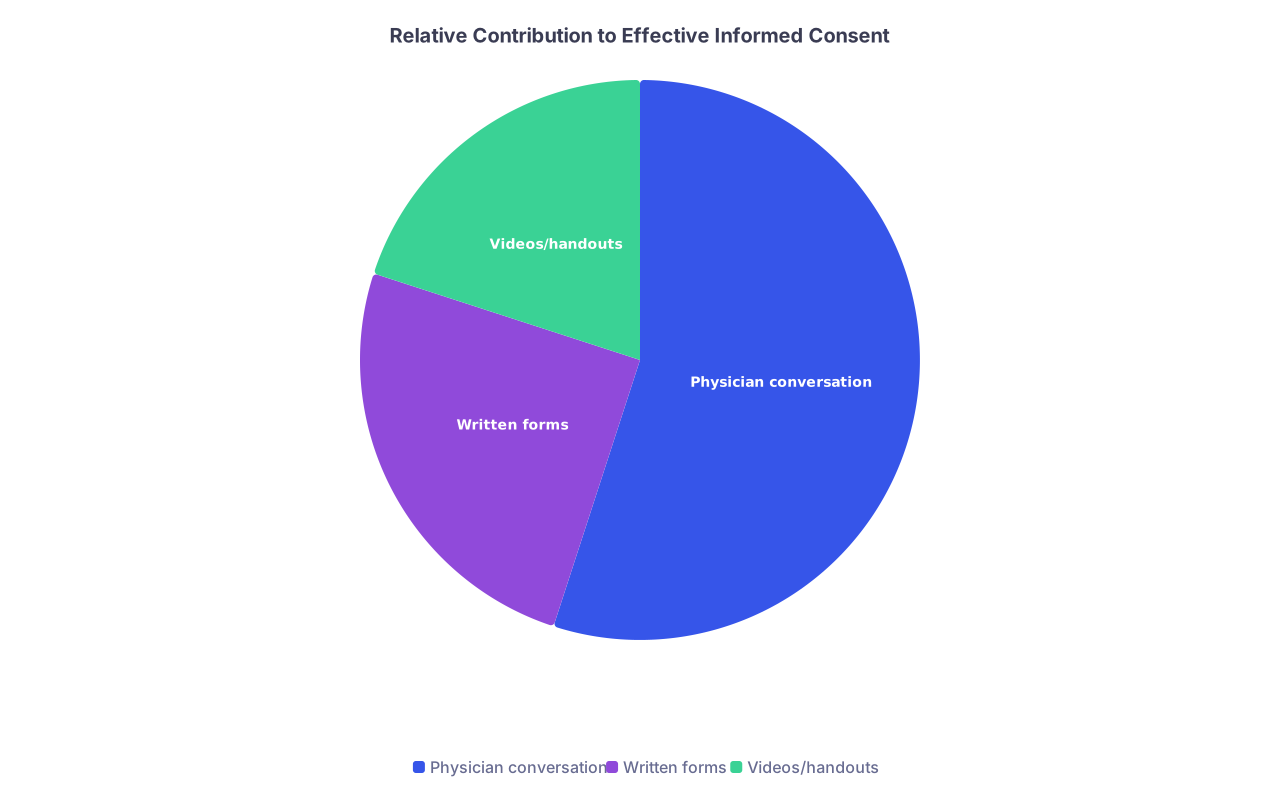
| Category | Value |
|---|---|
| Physician conversation | 55 |
| Written forms | 25 |
| Videos/handouts | 20 |
Time Pressure vs. Ethical Duty: Where You Cannot Cut Corners
There are a few hard lines you should not cross, no matter how behind you are.
You cannot omit serious, decision-changing risks.
If there is a small but real chance of something that would matter enormously to a reasonable person—death, permanent disability, loss of fertility, major organ damage—you disclose it. Always.You cannot skip alternatives because it’s inconvenient.
Telling a patient, “Surgery is the standard of care” while never mentioning that non-surgical options exist—even if less effective—puts you on thin ethical ice. At minimum, acknowledge them briefly.You cannot bulldoze capacity or voluntariness.
This includes:- Sedated or delirious patients “consenting” on the way to the OR
- Family pressuring a confused elder in front of you
- Patients clearly overwhelmed and saying “whatever you think” without any real grasp
If capacity is marginal or the stakes are high, you slow down. You involve a surrogate, an interpreter, or ethics/psych as needed, even if it wrecks your schedule.
You cannot use consent as a shield for sloppy explanation.
“They signed the form” is worthless if your explanation was rushed, jargon-heavy, and dismissive.
Those are the red zones. If you’re cutting those corners, the problem is not busyness. It is your practice pattern.
How to Be Efficient Without Being Cold
Patients can feel the difference between “I’m busy but I still care” and “You’re an obstacle between me and home.”
Tiny communication moves buy you a lot:
- Sit down, even if only for a minute. It slows the room down psychologically.
- One empathy line: “I know this is a lot of information quickly; I want to make sure you have the key points.”
- One check: “Can you tell me in your own words what we’re planning and what the main risks are?” (Takes 30–60 seconds. Saves misunderstandings.)
On very busy days, I’d rather see you give a slightly shorter list of risks and actually check understanding, than recite a long risk monologue at auction speed and run out the door.
Special Scenarios That Trip People Up
The “Routine” Procedure That Isn’t Routine for the Patient
You do three colonoscopies before 10 a.m. For the patient, it’s once a decade and terrifying.
Don’t shortcut it to: “Standard colonoscopy, tiny risk of bleeding or perforation, you’ll be fine.”
Better, still under 2–3 minutes:
- Why we’re doing it (screening, symptoms)
- What they’ll experience (sedation, discomfort)
- Common issues (bloating, minor bleeding with biopsies)
- The big rare one: “Very small risk of a tear in the bowel that could require surgery and even be life threatening, though that’s uncommon.”
- Alternatives (stool testing, CT colonography) and tradeoffs.
On your side, that’s maybe 90 seconds of clear talking. On their side, it feels like respect.
The “No Time, They’re on the Table” Situation
OR running late. Surgeon wants to “get consent” as anesthesia is rolling the bed.
If this is elective or semi-elective and consent has not happened yet, that’s not a time problem. That’s system failure. You should be doing the real consent earlier—clinic visits, pre-op calls, day-before admissions.
If it’s truly emergent (life or limb at risk, no surrogate, no prior discussion), you’re in the emergency exception to consent. Ethically and legally, you act in the patient’s best interests. But do not kid yourself: that’s the exception, not the convenient workaround.
Language Barriers on a Busy Day
If you’re tempted to use a family member as interpreter for complex consent because you “don’t have time” to call the interpreter line, you’re already drifting into unsafe territory.
Use professional interpreters for:
- High-risk procedures
- Complex decisions
- Any situation where misunderstanding could be catastrophic
Yes, it costs time. It saves you from both ethical failure and the worst kind of lawsuit: the one you know, in your gut, they’re right about.

| Step | Description |
|---|---|
| Step 1 | Need consent |
| Step 2 | Brief standard script |
| Step 3 | 5-sentence script plus key serious risks |
| Step 4 | Longer or multiple conversations |
| Step 5 | Use interpreter or surrogate |
| Step 6 | Confirm understanding |
| Step 7 | Risk tier 1-4 |
| Step 8 | Language or capacity issue |
Documenting Wisely When Time Is Tight
You do not have to write a novel in the note. You do need a few smart lines that show you did more than get a signature.
Aim for:
- “Discussed nature of procedure, expected benefits, common risks (pain, nausea, infection) and rare but serious risks (bleeding, organ injury, death).”
- “Reviewed alternatives including [X, Y, doing nothing]; patient prefers to proceed.”
- “All questions answered; patient verbalized understanding and consented.”
If there were patient-specific issues, add one sentence:
- “Discussed increased cardiac risk due to prior MI; patient understands elevated but acceptable risk.”
- “Patient initially unsure; after discussing alternatives, elected to proceed today.”
Again, this is 2–4 sentences. It’s not what sinks your schedule.
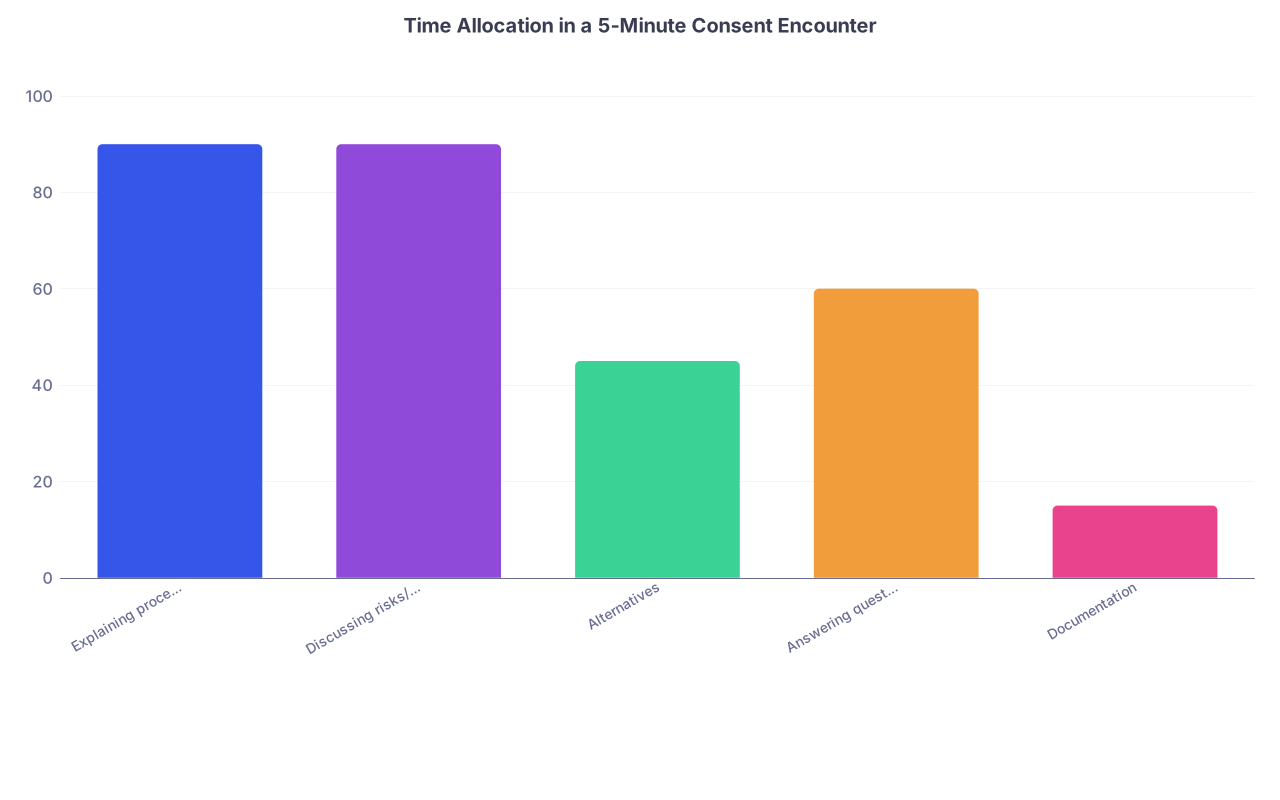
| Category | Value |
|---|---|
| Explaining procedure | 90 |
| Discussing risks/benefits | 90 |
| Alternatives | 45 |
| Answering questions | 60 |
| Documentation | 15 |
Building Your Personal “Minimum Standard” So You Don’t Re-Decide Every Time
The real way to make busy days safer is to pre-decide what “enough detail” means for you.
Do this once, not every clinic session:
- For your 5–10 most common procedures or meds, write a 2–3 line consent “mini‑script” in plain English.
- Mark which 2–3 serious risks you always mention.
- Decide your default alternatives sentence for each.
- Practice saying them out loud until they’re muscle memory.
Then, when the wheels are coming off the day, you’re not improvising. You’re executing a standard you already know is ethically acceptable.

When In Doubt: This Simple Test
If you’re still unsure whether you’ve given “enough” detail, use this mental shortcut:
“If this patient had the bad outcome I’m thinking about, and they (or their family) later said, ‘You never told us that was a possibility,’ would I feel comfortable, honestly, saying, ‘Yes, I did, and I remember the conversation’?”
If your honest answer is yes, you’re probably fine.
If your honest answer is no, add one more sentence now.

Key points to keep:
- You do not owe patients every microscopic detail; you owe them material information—nature, purpose, alternatives, common risks, and serious risks.
- Busy days demand structure, not shortcuts. A repeatable 5-sentence script plus clear documentation will keep you both ethical and efficient.
- There are hard lines you cannot cross—serious risks, alternatives, capacity, and language barriers still require real consent, even when the schedule is on fire.


