

What do you actually do, in the room, when a parent looks you straight in the eye and says, “We’re not doing that,” about treatment you know their child needs?
Not in a textbook. Not in an ethics OSCE. In a real clinic or ED, when time is ticking and the kid is watching both of you.
This is where theory falls apart for a lot of trainees. They know “respect autonomy” and “protect the child.” They do not know what to say next, who to call, or how far they can push without crossing legal and ethical lines.
Let’s fix that.
Step 1: Get Clear On What Kind of Refusal You’re Dealing With
You cannot respond well until you know what, exactly, the parent is refusing and how serious that refusal is.
There are three big buckets.
Mild but concerning:
Parent refuses vaccines. Declines recommended lab work. Says no to staying for observation. The child isn’t in immediate danger, but this is substandard care.Moderate risk:
Parent refuses antibiotics for pneumonia. Says no to imaging after a concerning head injury. Refuses an admission you think is strongly indicated. The child is at real risk, but not minutes-from-death.Immediate danger:
Parent refuses a life-saving blood transfusion. Pulls off the oxygen and wants to leave with a child in respiratory distress. Says “no surgery” when you’re looking at torsion, septic abdomen, or meningitis.
Your first task in the room is to silently categorize the situation:
Is this ethically uncomfortable, clinically risky, or emergently dangerous?
If it’s emergent, you’re in “protect the child now, sort out consent later” territory. We’ll come back to that.
Step 2: Slow Down the Conversation and Actually Listen
Most refusals are not about the thing you think they are about.
You say “blood draw.” They hear “trauma and pain.”
You say “chemo.” They hear “my kid might die anyway and suffer in the meantime.”
You say “vaccine.” They hear “I don’t trust the system that has failed my community before.”
Your move is not to start arguing the guidelines. Your move is to get quiet and specific.
Try phrases like:
- “Walk me through what worries you most about this.”
- “What have you heard about this treatment that makes you uncomfortable?”
- “Has someone you know had a bad experience with this?”
Then shut up. Do not pounce on the first misconception. Let them finish the whole story.
You’re listening for:
- Misunderstanding (they don’t actually get what you’re proposing)
- Mistrust (they don’t trust you, the hospital, or medicine in general)
- Values clash (religious belief, cultural norms, past trauma)
- Practical barriers (money, transportation, undocumented status)
You cannot fix what you haven’t named. And I’ll be blunt: a huge amount of poor outcomes in these cases comes from clinicians who never really found out what the parent was scared of.
Step 3: Test and Strengthen Their Understanding (Not Their Agreeableness)
Your legal and ethical anchor here is informed consent (and its cousin, informed refusal). That means:
- They understand the diagnosis as you see it
- They understand the recommended treatment
- They understand the likely outcomes with and without that treatment
- They understand alternatives and their risks
Do not ask, “Do you understand?” They’ll say yes, often just to get out of the room.
Ask them to explain it back:
- “Just so I know I explained this clearly, can you tell me in your own words what you understand is going on with your child?”
- “What do you think will happen if we don’t do this treatment?”
If they say, “He just has a little cold,” and you’re staring at a child with oxygen sats of 88% and a lobar pneumonia, you know you’re not at informed refusal. You’re at misunderstanding.
Then you try again, simpler, more concrete:
- “I’m worried this is not just a cold. The infection is in his lungs. That’s why he’s breathing fast and his oxygen is low. Without this medicine, he could get much sicker. Some children in this situation end up in the ICU or can even die. I wish that weren’t true, but it is.”
You do not need to terrify them theatrically. You do need to be honest about risk. Sugarcoating is how you end up in court later with a chart that reads like you described a mild inconvenience, not a life-threatening condition.
Step 4: Clarify the Legal and Ethical Ground You’re Standing On
Different country or state, different details. But the basic structure is consistent in most places.
Here’s the simple principle: Parents can make bad decisions for themselves. They cannot make decisions that cross over into neglect or abuse for their child.
You’re balancing:
- Respect for parental authority and family values
- Duty to act in the child’s best interest
- Legal obligations to report or intervene when a child is at serious risk of harm
Typical pattern (US, but similar logic elsewhere):
- Low-risk refusal (e.g., routine vaccines, some minor tests): respect the refusal, document, don’t call CPS because they said no to the flu shot.
- Medium-risk refusal (e.g., rejecting recommended admission for moderate asthma exacerbation): negotiate, safety-plan, consider ethics or risk management consult if you’re uneasy.
- High-risk / life-threatening refusal (e.g., blood transfusion for severe anemia, insulin for DKA, emergent surgery): you may be legally empowered—and obligated—to override refusal using emergency doctrine or court orders.
If you do not know the rules where you practice, that’s on you. Spend an afternoon with risk management or your hospital lawyer. You’ll use that knowledge more than some of the obscure biochemistry you memorized.
Step 5: Use the Tools You Actually Have (Not Just Your Personality)
Too many trainees think this is about “being persuasive enough.” It is not. When things get serious, you need structures, not charm.
Here are the tools you often have:
| Resource | When to Use |
|---|---|
| Senior physician | Any moderate or high-risk refusal |
| Ethics consult | Value conflicts, complex chronic cases |
| Social work | Mistrust, social barriers, CPS questions |
| Risk management | High-risk, legal liability concerns |
| Legal/court order | Imminent serious harm, life-saving care |
You should not be handling serious refusals alone as a student, intern, or even junior resident. If you’re in the room and feel that adrenal shot of “this is bad,” your next move after the conversation is simple: get your attending.
Why? Because:
- They’ve usually seen this before.
- They take responsibility for the medical and legal decisions.
- Their presence often changes how seriously parents take the situation.
And yes, sometimes you call security. Not because you like drama, but because an agitated parent trying to pull a critical child out of the ED against medical advice is a safety issue, not just an ethical one.
Step 6: For Non-Emergent Refusal, Focus on Relationship and Safety-Netting
Let’s take a non-ED example. Clinic visit. Six-year-old with moderate persistent asthma. You recommend daily inhaled steroids. Parent says:
“We don’t want steroids. That stuff stunts growth. We’ll just keep using the rescue inhaler.”
The kid isn’t in distress now. This is not a 911 moment. Here’s a decent sequence:
Explore and reflect: “You’re worried about him not growing properly and putting something strong in his body every day. That makes sense as a parent to worry about.”
Provide targeted info: “The daily inhaler is a very low-dose medicine that goes straight to the lungs. It actually helps him avoid emergency visits, oral steroids, and long-term lung damage. The rescue inhaler is great for emergencies but if that’s all we use, his lungs take more hits over time.”
Offer options: “We could start at a lower dose and follow his growth closely. If he drops percentiles, we reassess. We could also do a trial period of three months and then review how he’s doing.”
Safety net: “Here’s when I want you to come back or go to urgent care: if he’s using the rescue inhaler more than every 4 hours, if he’s breathing fast at rest, if he can’t speak full sentences. If any of that happens, I want him seen immediately.”
Document carefully: “Discussed diagnosis of moderate persistent asthma, recommended daily low-dose inhaled corticosteroids, parent expressed concern about growth. Explained risks of uncontrolled asthma including ER visits, ICU, long-term lung damage, death (rare). Parent declined daily ICS but agreed to close follow-up in 1 month. Provided strict return precautions.”
You respect their refusal. You make it hard for the situation to spiral silently. You keep the relationship intact so maybe they’ll say yes later.
Step 7: For Emergent Refusal, Protect the Child First
Now flip it. Child in DKA. Glucose through the roof, acidotic, K+ a mess. Parent is a devout member of a religion that opposes certain interventions and starts refusing insulin and IV fluids.
This is not a “let’s agree to disagree” situation. This is a “child may die in hours” situation.
Your mindset changes:
- You still communicate respectfully.
- But you stop acting like refusal is final if it endangers the child’s life.
What it looks like, bluntly:
Be clear and direct with the parent: “Your child’s blood is very acidic right now. Without insulin and fluids, his heart could stop or his brain could swell. This is life-threatening. I cannot allow him to die from something we can treat.”
Call backup immediately:
- Your attending
- Charge nurse
- Possibly risk management / legal
- Social work if available
Use emergency doctrine if your jurisdiction allows: Many legal systems allow physicians to provide life-saving care to minors without parental consent in an emergency when delay would increase risk of serious harm.
Practically: you start treatment. You do not wait three hours for a court order while the kid crashes.
If time allows and risk is very high but not minutes-away: You or your attending may contact:
- Hospital legal team
- On-call judge (yes, that’s a thing in many places)
- Child protective services
To obtain temporary authority to proceed.
Stay human while you’re doing what you must: “I know this goes against your beliefs, and I respect how deeply you hold them. But I have a legal and ethical duty to protect your child’s life. We will provide this treatment.”
Is this comfortable? Not even a little. But ethically, letting a child die from a treatable condition because you’re afraid to override a parent is worse.
Step 8: Document Like a Future Lawyer Will Read It (Because They Might)
Your chart is your shield. And your memory.
Do not write, “Discussed with mom, she refused.” That’s lazy and dangerous.
You need:
- What you recommended
- Why (diagnosis, findings)
- Specific risks you discussed (and that the parent could reasonably understand)
- Parent’s stated reasons for refusal (their words if possible)
- Who was present in the conversation (witnesses help)
- What alternatives or compromises you offered
- Clear safety-netting instructions
- What consultants were involved (ethics, social work, legal, CPS)
Example of solid documentation:
“Discussed with father that child has bacterial pneumonia with hypoxia (O2 sat 89% RA, RR 42). Recommended hospital admission for IV antibiotics and monitoring. Explained risk of worsening respiratory distress, sepsis, ICU admission, and death if untreated or if deteriorates at home. Father concerned about missing work, lack of childcare for siblings. Declined admission despite explanation of risks. Offered social work assistance for childcare; father declined. Father verbalized understanding of risk: ‘I know it could get worse, I just have to take that chance.’ Provided detailed return precautions (increased WOB, persistent fever, poor PO, decreased responsiveness) and arranged follow-up in 24 hours. Attending Dr. Smith present for discussion.”
That entry has saved physicians more than once.
Step 9: Know the Red-Flag Situations That Should Trigger CPS or Legal Involvement
Not every refusal is neglect. But some are.
These patterns should make you pause hard:
- Parent chronically refusing necessary treatments for a chronic condition (e.g., repeatedly not giving insulin, repeatedly refusing seizure meds leading to frequent status epilepticus).
- Parent refusing treatment for serious infections or injuries (e.g., open fracture, meningitis, sepsis).
- Parent whose refusal is clearly rooted in impaired capacity (acutely intoxicated, floridly psychotic).
- Evidence of overall neglect or abuse layered on top (malnutrition, untreated injuries, unsafe home).
Here’s the rule: You are mandated to report when you have reasonable suspicion of abuse or neglect. You are not mandated to prove it.
CPS/child welfare then decides what to do with that information. Reporting does not automatically mean the child is removed. It means someone else with that job evaluates the situation.
If you’re unsure, talk to social work and your attending. But do not sit on obvious danger because you’re “not 100% sure.”
Step 10: Take Care of Yourself and Actually Learn From the Case
These encounters are draining. They’re also the ones that turn students and residents into actual physicians.
After one of these cases:
- Debrief with your team. Ask your attending why they drew the line where they did.
- Ask what the legal framework is in your hospital and region.
- Reflect on your own biases. Did you push harder with the low-income family than you would have with the well-dressed, articulate parents from your own background? It happens. Catch it.
- Write down the phrases that worked and the ones that escalated things, so next time you’re not improvising from zero.
You’re going to see this again. Parents refusing blood work. Parents wanting to leave AMA with a febrile neonate. Parents convinced the internet knows more than you.
The goal is not to win every disagreement. That’s impossible.
The goal is to consistently:
- Respect parents where you can
- Protect the child where you must
- Use the system’s tools so you are not improvising law and ethics at 2 a.m.
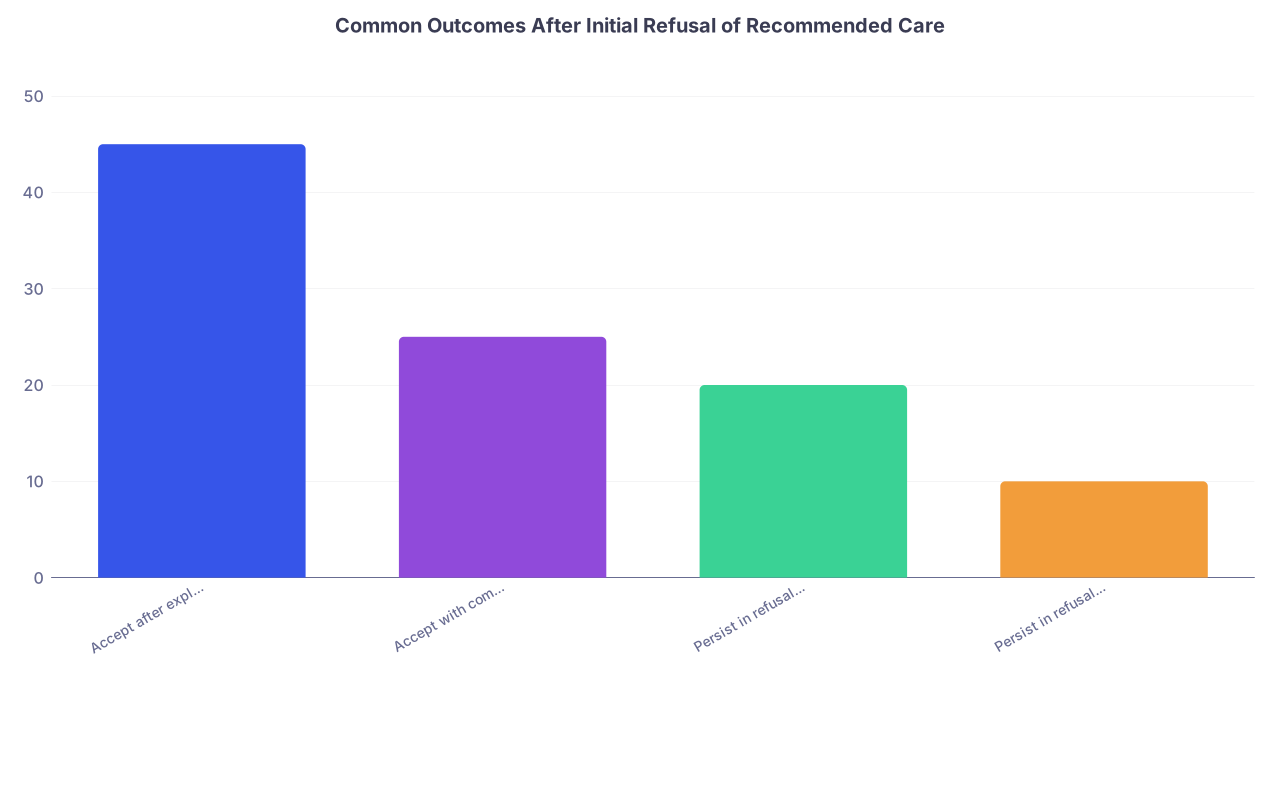
| Category | Value |
|---|---|
| Accept after explanation | 45 |
| Accept with compromise | 25 |
| Persist in refusal, low risk | 20 |
| Persist in refusal, high risk | 10 |

| Step | Description |
|---|---|
| Step 1 | Parent refuses care |
| Step 2 | Call senior + start emergency care |
| Step 3 | Contact legal/CPS if needed |
| Step 4 | Assess understanding |
| Step 5 | Clarify risks and benefits |
| Step 6 | Proceed with care |
| Step 7 | Document and safety net |
| Step 8 | Consult senior, ethics, social work |
| Step 9 | Immediate danger to child |
| Step 10 | Refusal persists |
| Step 11 | Meets neglect threshold |
The Core Moves to Remember
- Separate the scenarios: mild refusal you document and watch, versus life-threatening refusal where you may have to override to protect the child.
- Do the basics well: clear risk explanation, check true understanding, try to preserve the relationship, and document like it matters.
- Do not handle high-risk refusals alone: bring in seniors, ethics, social work, and legal when needed—and if a child’s life is on the line, prioritize protection over parental approval.


