
Fellowship-level humor is what separates “I passed Step 1” from “I have seen the abyss of prior authorizations and I can laugh about it.”
You do not really belong to a subspecialty until you understand why everyone groans at the same three phrases. Or why a single lab value can make an entire team chuckle darkly. The fellowship itself is mostly suffering, Excel sheets, and call; the consolation prize is that you gain access to jokes that no normal human would find remotely funny.
Let me break this down specialty by specialty. I am going to explain why these jokes land, what insecurity or reality they reflect, and how they actually map to the culture and workflow of the fellowship.
1. What Makes “Fellowship-Level” Humor Different
Before we go subspecialty by subspecialty, you need to understand the basic architecture of this kind of humor.
Intern humor: “Haha, I just did my first rectal exam.”
Resident humor: “Haha, we admitted 24 patients and cross-cover 70.”
Fellow humor: “Haha, that troponin is 0.04 and someone called a STEMI alert. Again.”
By fellowship, jokes stop being about medicine is hard and become about:
- Perverse incentives (reimbursement, RVUs, billing)
- Turf wars between services
- Hyper-specific workflows (e.g., transplant evals, cath lab timeouts)
- Longitudinal emotional exhaustion (endless relapses, nonadherence, impossible families)
- The absurd mismatch between guidelines and reality
In other words, fellowship humor is less about “gross” and more about “this system is structurally absurd and I am trapped in it, so at least let me laugh.”
2. Cardiology: Troponins, STEMI Alerts, and Ejection Fractions
Cardiology humor is aggressive, numbers-obsessed, and slightly malignant. It reflects a culture of speed, high stakes, and constant over-activation.
Common inside jokes:
- “Is it type 2 NSTEMI, demand ischemia, or a positive troponin because the nurse walked past the lab?”
- “EF 35%? That is pristine.”
- “The solution to every problem: start a beta blocker, ACE inhibitor, MRA, SGLT2, and then argue about whether they can afford any of it.”
Why the troponin jokes?
Because by fellowship you know most elevated troponins are not PCI problems. Yet every borderline bump triggers:
- A panic ED call.
- A STEMI page that wakes everyone.
- A cardiology consult for a patient with sepsis, chronic kidney disease, and a troponin trending 0.04 → 0.05.
You do this enough times and “mildly elevated troponin” becomes the punchline, not the concern.
The EF humor:
Cardiology fellows spend their life quantifying ejection fraction and pretending we have precise control over it. Echo gives 35–40%? The fellow squints at the images and mutters, “That is more like 38%.” As if that changes anything.
Cardiology’s dark comedy is that you:
- Work brutally hard
- Have powerful tools (PCI, LVAD, transplant, devices)
- Still watch people die regularly from cardiogenic shock and advanced heart failure
- Then get dinged on door-to-balloon time.
3. Gastroenterology: Everything Is Either IBS or “Needs a Scope”
GI humor is body-fluid-heavy, but fellowship-level jokes revolve around two realities:
- The entire hospital thinks “GI can scope it and fix it.”
- Half of outpatient clinic could be summarized as “bloating and vague abdominal pain, normal labs.”
Typical GI fellow lines:
- “Your BMI is 42, you drink a six-pack nightly, and your LFTs are 200s—probably just a ‘little fatty liver.’”
- “IBS: the diagnosis of exclusion and also the exclusion of my will to live.”
- “Nothing like a STAT 4 a.m. consult for a 7-day history of constipation.”
There is also the scope scheduling humor. You hear things like:
“Can GI do an urgent inpatient colonoscopy today for outpatient anemia that has been going on for 6 months?”
Of course they can. You will bump three other patients, beg anesthesia for a slot, and then find one hemorrhoid and nothing else. Classic.
The fellowship identity-forming joke:
“GI is plumbing.”
Said mostly by everyone except GI. The GI fellow will respond: “We are interventional hepatology, motility, advanced endoscopy, IBD… and, fine, also plumbing.”
The humor is partly defensive. Their consult list is full of cases that should have been outpatient, cases bounced by surgery, vague “rule out GI bleed” for any drop in Hgb, and requests for PEG placement in patients who are clearly dying. You make jokes because the moral distress would otherwise crush you.
4. Pulm/Critical Care: The MICU, Vent Settings, and “Goals of Care”
Pulm/CC fellows make jokes that outsiders mistake for actual despair. They are not entirely wrong.
Common MICU jokes:
- “I changed the PEEP, so now we are all emotionally satisfied even if the patient does not care.”
- “We are on vasopressor number three; time to call it ‘multi-organ failure’ and page palliative.”
- “Nothing like an intubated 95-year-old full-code with metastatic cancer whose family says ‘Do everything.’”
Ventilator humor:
You spend hours arguing about low tidal-volume ventilation, PEEP ladders, and ARDSNet settings, fully aware that half the mortality is decided before they ever reach you. This is why a pulm fellow will deadpan:
“Did you try turning the FiO2 down and your expectations up?”
Pulm’s key inside phrase: “Goals of care conversation.”
By month three you realize “GOC conversation” often means “this patient is going to die, let us see if we can prevent an unnecessarily violent death.” The jokes get dark: “I am fluent in vent settings and family dynamics.”
The other side is outpatient pulm:
- Endless COPD with nonadherence.
- Sleep apnea where CPAP is somehow less acceptable than slowly dying.
- Sarcoid clinic where half the notes are “still asymptomatic, still granulomas.”
So they cope with jokes about “never smokers” with 40-pack-year histories and the mystical power of albuterol inhalers.
5. Hematology/Oncology: Scanxiety, Lineages, and Relapse
Heme/Onc humor is quieter, darker, and often misunderstood by anyone who has not sat in a clinic when the PET result drops.
Common jokes:
- “The PET is ‘a little more active’—so are my cortisol levels.”
- “Solid tumor vs heme malignancy? Different religions, same amount of paperwork.”
- “R-CHOP: the national anthem of community oncology.”
You will hear fellows say things like:
“If you can name the mutation, we will name a $20,000/month drug after it.”
“New therapy, same overall survival curve, more optimistic Kaplan-Meier.”
The inside-joke structure here is interesting:
- They are very smart.
- They are very aware of survival curves and how relatively little some treatments move them.
- They still invest deeply in patients and families.
So they joke ruthlessly about CT scans, tumor markers, and the “NED for now” dance. “Scanxiety” is not just for patients; the fellow also gets that end-of-treatment CT and starts pre-writing either the happy speech or the “it has grown” version.
Heme fellows add their own layer of niche:
- The weird joy of nailing a bone marrow differential.
- Amused contempt for how little anyone else understands coagulation.
- Dark humor about HIT, DIC, and “consult heme for thrombocytopenia in a septic ICU patient.”
If you hear someone say “pan-cyto-penic” with a weird little grin, that is a heme fellow who likes puzzles a little too much.
6. Nephrology: Sodium, Dialysis, and Chronic Disappointment
Nephrology humor is self-effacing, nerdy, and heavily focused on sodium, potassium, and the complete disregard everyone else has for them.
They will say things like:
- “You can give that ACE inhibitor. I need the business.”
- “Another sodium of 118 with no symptoms. My time has come.”
- “Nothing like being consulted for diuresis management on a patient already on three diuretics and 5 liters positive.”
There is a running nephrology joke: “Nephrology is where good fellows go to disappear.” They work insanely hard, think in detailed physiology, and get relatively little glory. The rest of the hospital will:
- Ignore fluid restrictions.
- Ignore diet recommendations.
- Call them as a last resort: “Maybe nephro can fix this.”
Dialysis humor is relentless:
- “Crash start on dialysis” becomes a phrase you say three times a week.
- Nonadherent ESRD patients who miss sessions then present in flash pulmonary edema, acting surprised.
- Endless debates about starting or stopping dialysis in frankly terminal patients.
The inside joke: every nephrology fellow has at least one attending who genuinely gets excited about a complicated acid-base problem. They will write Henderson–Hasselbalch on the board like it is art. The fellow will roll their eyes and make coffee.
7. Endocrinology: Diabetes, Thyroids, and the Curse of “Mildly Abnormal”
Endo humor is dry, subtle, and slightly bitter. They deal almost entirely with chronic disease in patients who often do not want to change anything.
Common phrases:
- “A1c 13, but they ‘only drink soda on weekends.’”
- “TSH of 4.7 and the entire primary care team is in a panic.”
- “Everything is either diabetes, thyroid, or ‘probably not endocrine.’”
The inside joke here is that endocrinology’s bread and butter (diabetes) is both overwhelming and… boring. It is the same counseling, the same resistance, the same access issues with GLP-1s and insulin. You start to joke that every endocrine visit is Mad Libs: “Your [A1c] is [terrible]. Let us [adjust insulin] and [hope you actually do it].”
On the other side, you have:
- Rare adrenal tumors
- Pituitary nonsense
- MEN syndromes
- Weird calcium problems
Endocrine fellows secretly live for those cases. That is where the intellectual ego lives. So there is a very specific brand of humor:
“The TSH consults pay the bills. The adrenal masses protect my sanity.”
8. Infectious Disease: Cultures, “Antibiotic Stewardship,” and HIV Clinic
ID humor is famously sarcastic. This is the fellowship that sees the whole hospital’s mistakes in one place. They are professional pattern recognizers, detectives, and antibiotic police.
Baseline jokes:
- “Yes, we could give meropenem, but we also like having antibiotics that still work in 10 years.”
- “Fever of unknown origin? More like ‘nobody took a proper history.’”
- “You called ID to bless your ceftriaxone/azithro combo. I see you.”
They derive comedy from:
- Being consulted on day 10 of inappropriate antibiotics when cultures are now useless.
- Being asked to “just recommend the strongest antibiotic.”
- Being called for “rule out endocarditis” with one blood culture drawn from a line after antibiotics started.
HIV clinic adds another dimension. You see patients for years. You know their partners, their life stories, their relapses. The humor there often pokes at the healthcare system:
“We have a once-daily pill that basically normalizes life expectancy, but sure, let us make it 14 prior auth steps.”
And then there is the ID fellow’s favorite pastime: mocking bad antibiograms and terrible discharge prescriptions. They live for that “no, this E. coli laughs at ciprofloxacin” moment.
9. Rheumatology: Everything Is Autoimmune Until Proven Otherwise
Rheum humor is niche and often invisible to outsiders. It is built on the fact that everything they manage:
- Is chronic
- Is complex
- Has labs that never align neatly with symptoms
You will hear:
- “Positive ANA in a healthy 25-year-old? Welcome to 40 minutes of explaining why they do not have lupus.”
- “If you cannot classify it, call it undifferentiated connective tissue disease and move on.”
- “ESR 100, CRP 0.8, and everyone is confused except rheum.”
The jokes often revolve around:
- Overuse and misinterpretation of serologies
- Being the “mystery disease” consultants
- Watching everyone blame “rheumatologic something” when they have no idea
Rheum fellows secretly enjoy zebra hunting. But they also get pummeled by consults that are just “joint pain, rule out autoimmune” with no workup and four pages of irrelevant labs. So the coping mechanism is humor around “the Venn diagram of fibromyalgia, depression, and social disaster.”
10. Emergency Medicine and All the Subspecialties They Annoy
Even though EM is a residency, every fellowship interacts with the ED. ED humor becomes the shared reference point.
Standard ED-adjacent jokes among fellows:
- “The ED called it a ‘cardiac workup’—aka CBC, BMP, troponin, chest X-ray, no history.”
- “Admit to medicine for social reasons” is everyone’s favorite punchline.
- “Consulted at 2 a.m. for a 2-month-old problem.”
On the flip side, EM folks have their own fellowship-level jokes about subspecialties:
- Cardiology will cath anything that twitches, until it is a hypotensive septic old person, then “not a cath lab candidate.”
- Surgery refuses everything, then shows up once the patient is crashing.
- Medicine says “can manage as outpatient” on someone who literally has no outpatient access.
The cross-specialty humor is basically grievance poetry. And it is consistent across institutions.
11. Turf Wars: Where Most Cross-Specialty Jokes Are Born
Several recurring “comedy franchises” run through all fellowships:
Admit-vs-consult turf war
- “This is clearly a medicine admit with surgical issues.”
- “No, this is clearly surgical with underlying medical issues.”
Procedure ownership turf war
- GI vs Gen Surg over PEG tubes.
- IR vs Vascular vs Cardiology over certain endovascular procedures.
- Pulm vs Anesthesia vs ENT over trachs and difficult airways.
ICU vs everyone else
- “MICU is not a step-up from the floor. Stop sending us multi-organ failure that you sat on all day.”
These turf wars are not just annoyance. They are structural. They happen because:
- RVUs matter.
- Staffing is limited.
- No one wants responsibility for messy, unsatisfying borderline patients.
The jokes are basically a pressure valve for genuine inter-service resentment. A fellow will complain loudly in the workroom, make a joke thread about “Surgical Triage Logic 101,” then pick up the patient and do the right thing. But the comedic processing comes first.
12. Burnout, Cynicism, and Why None of This Is Actually Harmless
Let us be clear about something: fellowship-level humor is funny because it is dangerously close to burnout.
Patterns you see:
- Jokes that cross into dehumanization of frequent-flyer patients
- Reflexive mocking of other services instead of direct communication
- Laughing about moral distress situations because actually processing them would take too much time and emotional energy
Every program has that one fellow who covers distress with relentless sarcasm. The entire call room laughs. Then you realize three months later that this person has not slept normally, is detached from family, and is “fine” in the way that clearly means not fine.
Humor is a coping tool. It is also a diagnostic sign. When the jokes become:
- Constantly about “I do not care”
- Focused on patients as burdens, not people
- Bitter rather than wry
that is a red flag. That is not just culture, that is someone cracking.
13. Digital Age Twist: Meme Culture in Fellowship
Modern fellows do not just joke in the call room. They create memes. Low-effort PowerPoint-quality images slapped into WhatsApp groups, Slack channels, private Facebook groups, and locked Twitter accounts.
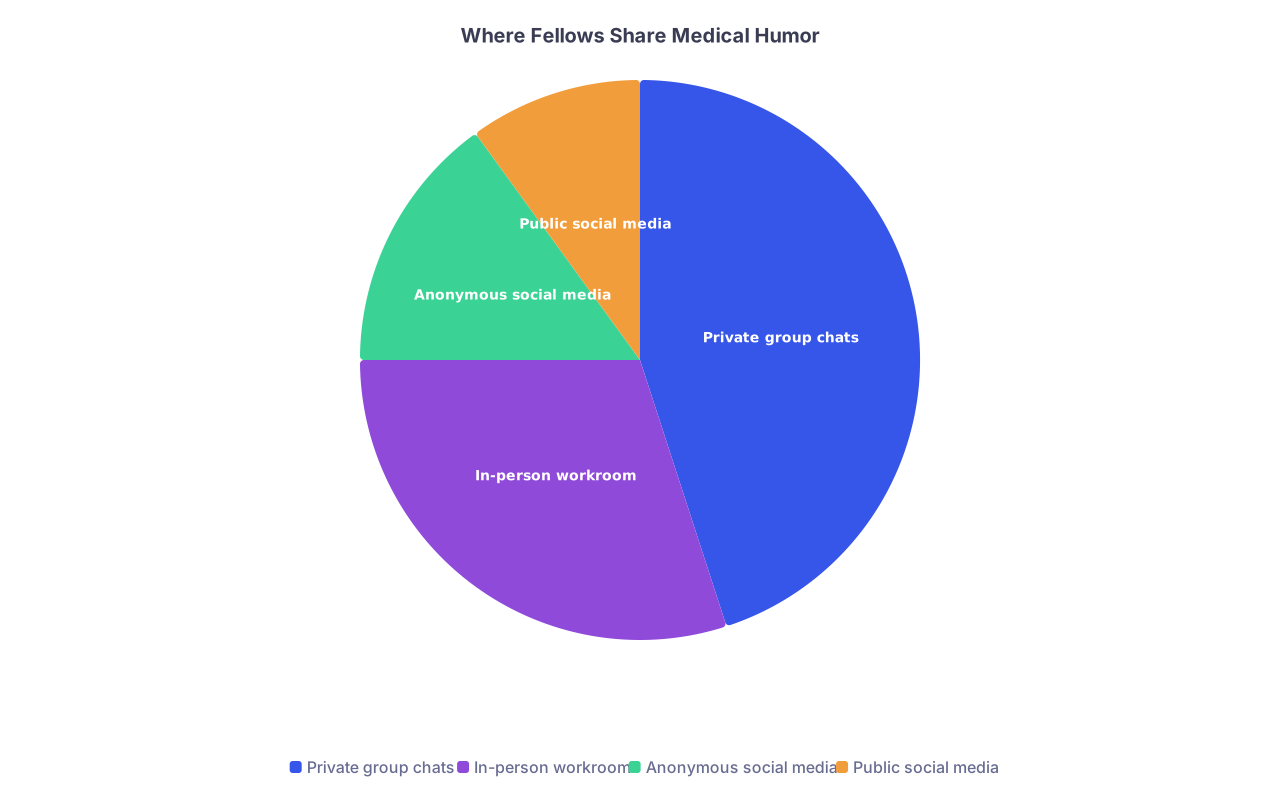
| Category | Value |
|---|---|
| Private group chats | 45 |
| In-person workroom | 30 |
| Anonymous social media | 15 |
| Public social media | 10 |
Examples you see:
- “Starter packs” for each subspecialty (e.g., Cardiology Fellow Starter Pack: Apple Watch, triple espresso, STEMI pager, resentment)
- “How it started / how it is going” memes for burnout
- Screenshots of consult notes with names redacted, captioned with “ID when they see vanc/zosyn day 14”
This meme layer does two things:
- Makes the culture portable and scalable. You can be at different institutions and still share the same in-jokes.
- Amplifies both healthy and unhealthy versions of the humor. Sarcastic toxicity can spread just as fast as solidarity.

14. “Future of Medicine” Angle: Will This Humor Survive AI, Remote Monitoring, and Value-Based Care?
You wanted future-of-medicine. Let us go there.
The systems are changing fast:
- AI reads imaging and EKGs.
- Clinical decision support suggests antibiotics.
- Remote monitoring shifts some care out of the hospital.
- Value-based care means someone is watching length of stay and readmissions more closely than ever.
You know what will not change? The human absurdities that create jokes.
Cardiology will still roll its eyes at false-positive STEMI alerts, even if the alert comes from an algorithm instead of a resident.

| Step | Description |
|---|---|
| Step 1 | ED triage |
| Step 2 | AI ECG interpretation |
| Step 3 | Page cardiology fellow |
| Step 4 | Routine eval |
| Step 5 | Coronary angiogram or not |
| Step 6 | STEMI alert |
Pulm/CC will still make dark jokes about the 99-year-old with 10 chronic illnesses who is somehow full-code in 2035.
Nephrology will still get consulted last-minute when the AI flags an “AKI alert” that everyone ignored for 18 hours.
The content of the jokes will evolve:
- Less about manually reading films, more about arguing with black-box algorithms.
- Less about paging systems, more about glitchy EHR-integrated chat messages.
- New kind of turf war: “Is this an AI decision problem or a physician responsibility problem?”
But the fundamental structure—smart people trapped in a misaligned system, using humor to stay sane—will not go away.

I am willing to predict you will see memes like:
- “AI suggested unnecessary MRI again; radiology revenue secured.”
- “When AI says ‘low risk discharge’ and your gut says ‘train wreck’—who do you trust?”
- “New fellowship: Advanced Prompt Engineering and Prior Auth Negotiation.”
The humor will expand to include:
- Arguing with administrative dashboards
- Mandatory AI override documentation
- “Safety huddles” about why humans ignored or followed automated alerts
The humans will still be there. As long as they are, there will be jokes.
15. How to Read and Use Fellowship-Level Humor Without Becoming Awful
If you are early in training and trying to figure out what is acceptable, here is the practical, non-sugar-coated guide.
| Aspect | Healthy Pattern | Toxic Pattern |
|---|---|---|
| Target | Systems, processes, your own specialty | Individual vulnerable patients, specific colleagues |
| Function | Stress relief, bonding, perspective | Venting hatred, reinforcing cynicism |
| Tone | Wry, self-aware, often self-deprecating | Contemptuous, mocking suffering |
| Aftermath | You feel lighter, more connected | You feel darker, more numb |
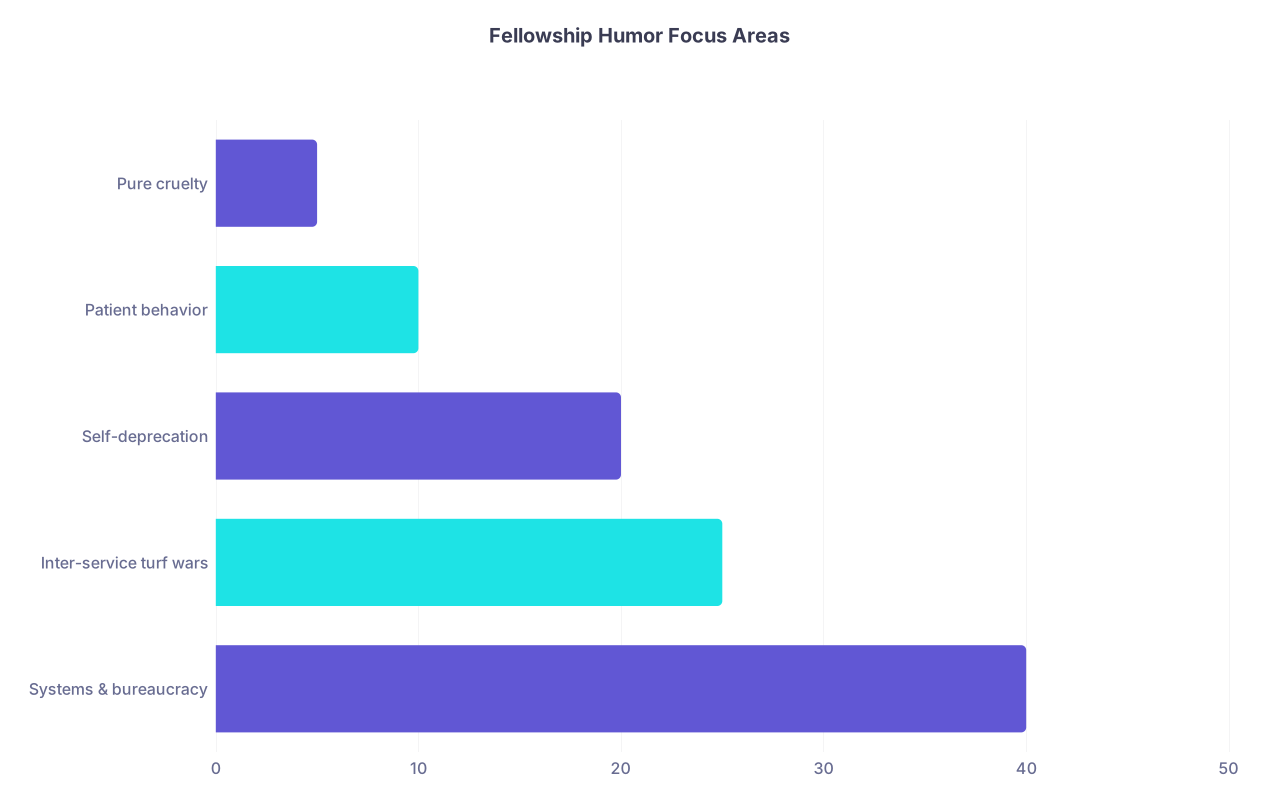
| Category | Value |
|---|---|
| Systems & bureaucracy | 40 |
| Inter-service turf wars | 25 |
| Self-deprecation | 20 |
| Patient behavior | 10 |
| Pure cruelty | 5 |
A few practical rules:
- If you would be ashamed for the patient or their family to overhear it, think twice.
- If the joke punches up at systems, good. If it punches down at vulnerable patients, bad.
- If you notice you can only talk about certain cases as jokes, not as human stories, that is a signal you might need something other than another meme—maybe supervision, therapy, or an honest conversation with someone you trust.
And yes, I know. No fellow has time. Everyone is drowning. That is why fellowship-level humor exists at all.

16. A Few Concrete Subspecialty Jokes, Deconstructed
Let me give you a final set of very real-sounding lines and decode them. This is the Rosetta Stone part.
Cardiology fellow: “Troponin of 0.03? So the ED called it NSTEMI, the hospitalist called us, and I call it ‘I will see them in the morning.’”
- Meaning: Over-calling NSTEMI, inappropriate urgency, and the fellow’s triage instinct sharpened by too many false alarms.
GI fellow: “Bleeding scan negative, EGD negative, colon negative. Must be ‘small bowel’—the final frontier.”
- Meaning: There is always a mystery source that conveniently lives where scoping is hardest; also, diagnostic uncertainty is constant.
Pulm/CC fellow: “We are on 80% FiO2, PEEP 14, and vibes.”
- Meaning: ARDS is brutal, tools are limited, and sometimes you are maxed out and just hoping for a miracle.
ID fellow: “Empiric vanc/zosyn is the new ‘I do not know, but I am scared.’”
- Meaning: Broad-spectrum overuse reflects fear and knowledge gaps; they both mock and resent it.
Endo fellow: “Your TSH is 4.8, you feel tired, and Google told you it is your thyroid. My condolences. It is not.”
- Meaning: Internet-fueled anxiety, over-attribution to thyroid, and the endless patient-education grind.
Nephro fellow: “We have two kidneys and zero respect.”
- Meaning: Chronic under-appreciation, late consults, and the fact that nearly every specialty abuses the kidneys with contrast, NSAIDs, and bad fluid orders.
These are not just one-liners. They encode real pain points, workflow problems, and identity narratives for each subspecialty.
17. The Bottom Line
Fellowship-level humor is not random snark. It is a structured, shared language built out of:
- Repeated, absurd patterns in clinical work.
- Real moral distress and system failure, processed sideways through jokes.
- Subspecialty identity—who they think they are, what they think others get wrong about them.
If you understand that, you will stop hearing these lines as “cynical doctors” and start hearing what they actually say: smart people trying very hard to stay human in a system that constantly pushes them toward numbness.
That is the real punchline. And it is not actually funny. Which is why everyone keeps making jokes.