
The biggest unspoken rule in the operating room is simple: you’re not just learning surgery, you’re learning a language. And most students have no idea they’ve walked into a foreign country.
Let me be blunt. People do not get in trouble in the OR for not knowing anatomy. They get in trouble for not knowing when to shut up.
You want “OR humor”? Fine. But if you do not understand hierarchy, timing, and what topics are radioactive, your “funny comment” turns into “we are never inviting that student back.”
Let me break this down specifically.
The OR Is Not a Comedy Club. It Is a Monarchy with Jokes.
The OR runs on hierarchy disguised as teamwork. The banter you hear is not random. It is permissioned, filtered, and heavily context‑dependent.
You’ve basically got a stack of “speaking privileges” that looks like this:
| Role | Banter Privilege Level |
|---|---|
| Attending Surgeon | 10/10 |
| Senior Resident/Fellow | 8/10 |
| Anesthesiologist | 8/10 |
| Scrub Nurse/Tech | 7/10 |
| Circulating Nurse | 7/10 |
| Junior Resident | 5/10 |
| Medical Student | 2/10 |
This is not “fair.” It is reality.
The attending sets the tone. If they are stone silent, staring into the field, answering questions in single syllables, you are not in a “Grey’s Anatomy” episode. You are in “Just Do the Case.”
If they are asking the scrub how the kids are, arguing about football with anesthesia, and chuckling about the last M&M, you are in a banter‑friendly OR—but that still does not mean you are a co‑equal participant.
Your position as a medical student:
You are part of the audience until explicitly invited on stage.
You earn speaking privileges by:
- Showing you know the procedure basics
- Being technically useful (retracting, following sutures, not contaminating)
- Reading the room correctly multiple times in a row
The OR has an incredible memory. If you talk at the wrong time on your first case, you get labeled as “that student” before you even know it happened.
The Three Phases of an Operation (and How Much You Can Talk)
OR banter is not constant. It follows a rough timeline, and your window for safe chatter expands and contracts.
Think of the case in three phases:
- High-focus
- Cruise control
- Exit strategy
Phase 1: High-Focus – “No Jokes, Only Questions That Matter”
This is:
- Incision and entry into body cavities
- Major vascular steps
- First critical dissection in a tough re‑op abdomen
- Anything that requires the attending to say “quiet” or “hold on”
In this phase, your safe speaking options are:
- Directly relevant answers to the attending’s questions
- Brief clarifying questions about what you are supposed to do right now
- Vital sign updates if anesthesia calls something out and you are the only one who heard
Examples of what is fine:
- “Do you want more tension here?”
- “Should I move my retractor more lateral?”
- Attending: “Where’s the cystic duct?” You: “Here, just medial to the artery.”
What is not fine:
- “So yesterday I saw this TikTok about—”
- “Haha this kind of looks like spaghetti.”
- “Do you ever get hungry doing these?”
That kind of thing gets remembered. And mocked in the workroom.
You want a simple rule here:
If suction just turned on, cautery is active, or they are entering something that can bleed or leak—keep your mouth shut unless spoken to.
Phase 2: Cruise Control – “This Is Where Most Banter Lives”
Once the dangerous or technically demanding part is over, you slide into the middle of the case:
- Bowel run in a laparotomy that looks benign
- Closing layers, running a skin stapler
- Harvesting something tedious but routine (e.g., LIMA in a CABG for someone who has done this 2,000 times)
This is where OR banter thrives.
Typical topics:
- Sports scores
- Residents complaining about consults
- Last night’s call disaster
- The “one time this went horribly wrong” story
- Light teasing of the fellow or PGY‑1
Your lane as a medical student in Phase 2 is still reactive, not initiating.
You can:
- Answer when they ask where you are from, what you want to go into
- Give brief, normal-human contributions (“Yeah, call nights in the ED were brutal on my sub‑I”)
- Ask one or two well-chosen, case-related questions
You should not:
- Try to dominate the story
- Bring up controversial topics (politics, money, interdepartmental drama)
- Start roasting anyone in the room—even if everyone else is doing it
Residents can roast each other because they know the boundaries. Nurses can roast the surgeons because they have five years of history with them. You have been here 30 minutes.
You want to be the person who adds to the flow without ever making people work to recover from your comment.
Phase 3: Exit Strategy – “Almost Done, Still Not Casual Friday”
This is:
- Final counts
- Dressing placement
- Extubation and transfer to stretcher
- Order writing, sign-out, and PACU handoff
The danger here is people mentally “leaving” the room while the patient is still in it.
Safe approach:
- Do not add banter during counts. Silence is normal.
- Stay focused on positioning, lines, tubes, securing drains.
- If asked to do something, repeat back and execute. No flourishes.
Most of your talking in this phase should be:
- “Do you want me to remove the Foley now or leave it?”
- “Should I help move the patient to the stretcher from this side?”
- “Where do you want the arm boards?”
This phase is where students often try to “network” or squeeze in an extra question about research or letters. Wrong time. Wait until you are out of the room, or walking back to the workroom, or at least after extubation and sign-out.
Hierarchy: Who Gets to Joke About What
Here is the part people do not say out loud: different people have different “joke permissions” about the same topics.
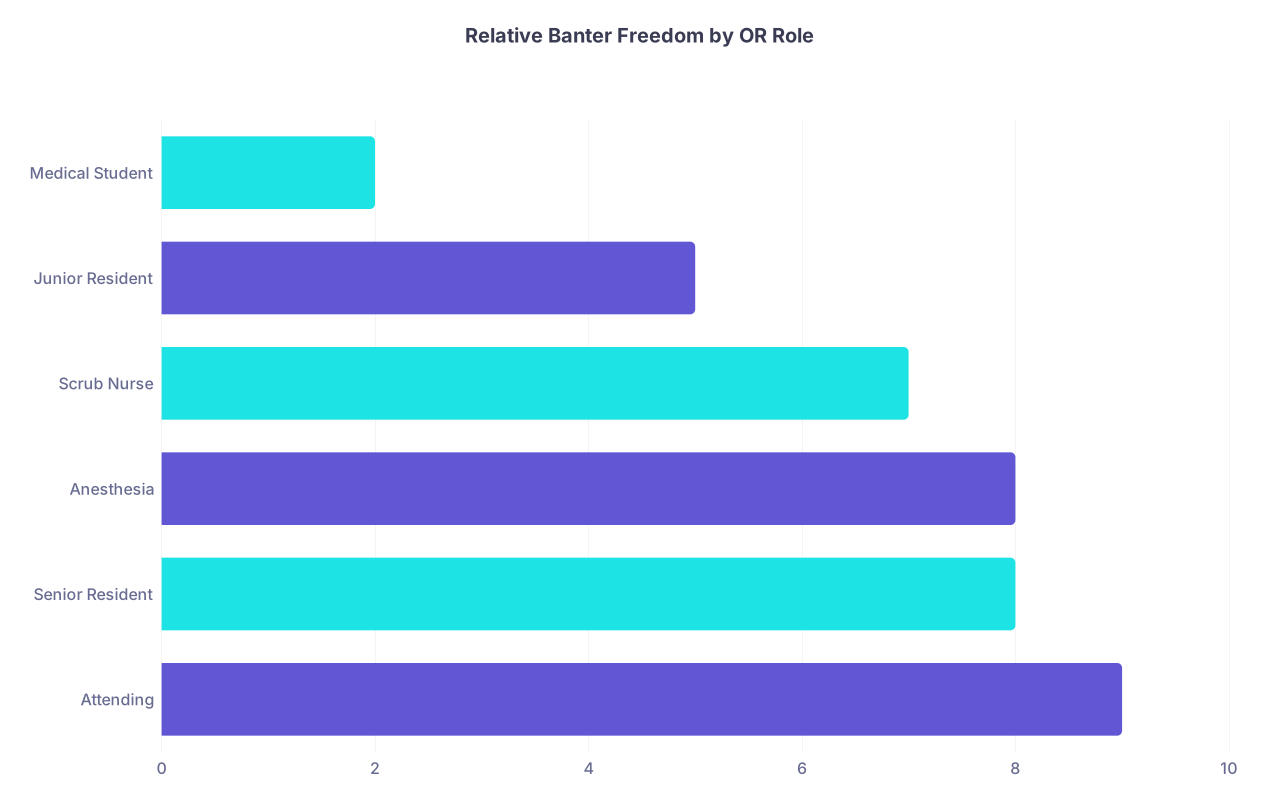
| Category | Value |
|---|---|
| Attending | 9 |
| Senior Resident | 8 |
| Anesthesia | 8 |
| Scrub Nurse | 7 |
| Junior Resident | 5 |
| Medical Student | 2 |
Some patterns I have seen over and over:
Attending vs resident:
Attendings can make jokes about residents’ sleep, pager misery, and career crises. Residents can lightly tease attendings’ music choices or coffee addiction. That is the usual direction. You flipping it as a student? Risky.Residents vs medical students:
Residents will often invite you in: “It is OK, you can laugh, we do this all the time.” That is not a green light to start punching up the chain.Intra‑nursing banter:
Nurses and techs can be savage with each other and with surgeons—because they have years of context. You don’t.
As a student, your safe “banter zones” are:
- Yourself (self-deprecating but not pathetic)
- Neutral, boring topics (weather, food, sports) if drawn into it
- Medicine‑related curiosity when the room is clearly open to teaching
What you absolutely do not joke about:
- The patient. Anything about their weight, comorbidities, social situation, or anatomy being “gross.”
- Complications. “As long as we don’t hit the…”—do not finish that sentence.
- Litigation, malpractice, or hospital politics. That is shark water.
- Any interdepartmental rivalry when you are on a sub‑I (surgery vs medicine, anesthesia vs surgery, etc.). You have no idea who is married to whom or who used to work where. It backfires fast.
Timing Micro‑Signals: How to Read the Room (Correctly)
There are a few reliable signals that banter is welcome:
The attending prompts a story:
“Tell the student what you did last weekend.”
This is a clear open door. Participate modestly.People are talking about something completely non-medical and no one is at a tense portion of the case:
“That restaurant downtown is overrated.”
You can add one comment, no monologue.The scrub or circulator deliberately brings you in:
“Hey, didn’t you say you rotated at X hospital too?”
Answer normally. They are humanizing you.
On the other hand, watch for these as “no banter” flags:
- Sudden drop in conversation volume when something difficult comes up on screen
- Attending responds to a joke with a flat “uh‑huh” and no eye contact
- Anesthesiologist switches to short, clipped language about vitals or drugs
- The same command repeated twice: “More retraction… more retraction…”
Your response: go silent, focus on your job, do not try to “rescue the mood.”
One trick: if you are not sure if it is a “talking” moment, wait a full minute. If people are still chatting, you lost nothing. If the room goes quiet, you avoided stepping into a silence for a reason.
When Humor Works in Your Favor (and When It Murders Your Evaluation)
Used well, subtle humor makes you memorable in a good way. But you are not auditioning for stand‑up. You are auditioning for “someone I would not mind being in my OR at 2 a.m.”
Good uses:
Light self-awareness
“I promise I am pulling, not leaning—if I start leaning, please yell at me.”
Shows you get the culture and you are coachable.Quick, relevant wit
Attending: “You see this adhesed mess? This is why your future patients should not smoke.”
You: “Got it, I will add that to my ‘don’t do this’ counseling list.”
You’re aligned with the teaching point, with a small smile.A single solid line at the right time
Residents complaining about endless consults and someone says “You still want to do surgery after this?”
You: “You have not scared me off yet.”
Short, positive, signals interest without syrupy flattery.
Bad uses that I have literally seen destroy a student’s day:
- Jokes about work-hour violations to an attending who is on the clinical competency committee
- Comments like “That looks gross” about intra-abdominal fat in an obese patient
- Making fun of another specialty while an anesthesia attending from that background is literally across the drape
One specific scenario: You will sometimes hear brutally dark humor regarding complications, deaths, or disasters from the staff. Your job is not to out‑dark them.
You can:
- Stay neutral
- Offer a quiet “That sounds tough” if the tone is serious
- Let the moment pass
You do not match their level of cynicism. You have not earned it.
“When Not to Speak” – The Short Answer People Ignore
Let’s spell out the big “no-speak” zones clearly.
Do not speak (unless directly asked):
- During induction and intubation
- During line placement (a-lines, central lines)
- During incision and first 10–15 minutes of exploration
- During any obvious scramble: unexpected bleeding, equipment failure, crash conversions
- During counts, sign-in, and sign-out portions of the WHO checklist
- When anesthesia is managing unstable vitals (pressors going up, alarms sounding)
- When you are scrubbing in or donning sterile gown for the first time in that OR and still figuring out the room’s rhythm
Still want a heuristic? Here:
- If anyone in the room raises their voice above baseline, you stop talking.
- If two people start giving instructions at once, you stop talking.
- If you are about to make a joke and have even a 5% doubt, swallow it.
What You Should Say in the OR (Instead of Trying to Be Funny)
Most students overestimate how much originality is required to make a good impression.
Here is the boring stuff that actually works:
Procedural curiosity at the right time
“After this case, could you recommend a resource to review this operation?”
You respect their time and focus, and you are asking for homework, not handing them work.Tactical self-preservation
“Is my hand placement okay here? I do not want to be in your way.”
You prevent problems and show awareness.Clear, precise confirmations
“You asked for 2-0 Vicryl on a CT-1, correct?”
This is better than guessing and fishing around the suture drawer as a circulator glares at you.Follow-up about teaching points
On the way to the lounge, not during closure:
“You mentioned that this patient’s BMI changed your port placement. Could you walk me through how you decide?”
You position yourself as engaged, thoughtful, and focused on the work. If you get a reputation for that, no one will care that you were not the funniest person in the room.
The Invisible Rules Around Gossip and Complaints
Humor often slides into gossip without people noticing. That is where students get burned.
Some red-line areas:
Do not complain about another service in front of this one.
“Cards always screws up their notes”—coming from you, that is suicide.Do not laugh along too hard when people dump on another trainee.
Laugh once, then go quiet. You are not part of that inner circle.Do not share stories from other rotations about “how bad” someone was.
OR staff talk. Across services. Across hospitals. You will be stunned how fast it gets back.
If an attending or senior goes on a rant and looks at you for a reaction, nod slightly, maybe “I see what you mean,” and stay out of specifics.
How Residents Actually Judge You (Hint: It’s Not Your One Good Joke)
Here is the cynical truth: the median resident does not deeply analyze your fund of knowledge. They give you about five blunt scores in their head:
| Dimension | Silent Rating Scale |
|---|---|
| Helpfulness | Liability / Neutral / Asset |
| Neediness | Draining / Manageable / Easy |
| Social Fit | Awkward / Fine / Fun to Have |
| Focus Under Stress | Flaky / Solid / Rock |
| Future Colleague? | No / Maybe / Yes |
Your behavior during banter affects:
- Social fit
- Focus under stress
- “Future colleague” score
The resident who later says, “Yeah, she was great in the OR” is usually thinking:
- Did not talk over attendings
- Knew when to be quiet
- Asked smart, concise questions
- Did not make it weird when we joked about call or life
Your single funniest one-liner is irrelevant if you caused an awkward silence or annoyed the scrub three times.
A Few Concrete Scenarios (And Exactly What I’d Say)
Let me give you some specific, real-feeling situations.
Scenario 1: Heavy Banter, First Time in That Room
You walk in, and the team is already mid‑roast. Attending is making fun of the fellow’s parking tickets. Scrub is firing back. Anesthesia is chiming in.
What you do:
- Smile behind your mask, polite chuckles.
- When introduced, say: “Nice to meet you, thanks for having me.”
- If directly asked something casual—“You a local?”—you answer briefly and return focus to your task.
You do not:
- Add, “Haha, yeah surgeons are always terrible drivers” as your first contribution. That is how you speedrun “unknown” to “annoying.”
Scenario 2: Attending Asks About Your Career Plans Mid‑Case
They are closing fascia, mood is relaxed.
Attending: “So, what are you thinking for specialty?”
Good answer:
“I am strongly considering surgery. I like being in the OR a lot, but I am still keeping an open mind and trying to see different services.”
If they respond positively and banter about lifestyle, call, or regret, you can lightly engage—but do not turn it into a therapy session about your anxiety.
Bad answer:
“I do not know, I am kind of torn, I like derm but my parents think I should do ortho, and honestly internal medicine terrifies me—”
Too long. Too personal. Zero added value.
Scenario 3: Something Goes Wrong
Sudden bleeding. Attending: “Suction. Suction. No, more.”
Anesthesia’s voice gets sharper. Someone calls for extra instruments.
Your job:
- Absolute silence
- Stay exactly where directed
- If you are holding anything, keep holding it until someone tells you otherwise
- Do not ask, “Is everything okay?” You already know the answer.
Afterward, when the room decompresses, you still do not make the first joke about it. If someone teaches off it, you listen and say, “Understood” or “That makes sense.”
Scenario 4: Resident Tests Your Sense of Humor
Resident (while waiting for the attending): “So, how many times have they asked you about your five-year plan this week?”
You can smile and say:
“Enough that I should probably have a better answer.”
Short, light. You demonstrated you get the joke. Then you can add, if the tone stays casual:
“I mostly just want to be competent and not drop anything important at this stage.”
That is self-deprecating in a way surgeons respect.
The Future of OR Culture: Is This Going Away?
You might wonder if all of this will vanish with more emphasis on wellness, simulation, and structured teaching.
Some of it will soften. You will see:
- More explicit teaching time baked into cases
- Less tolerance for outright bullying disguised as “jokes”
- A bit more flattening of hierarchy in language
But human beings in high-risk environments will always use humor to cope. Surgeons will always roast residents. Residents will always be a little cynical. Nurses will always have their own internal culture.
The part that will not change: the need to read the room, respect the hierarchy, and avoid creating emotional work for the team during critical tasks.
If anything, as cases get more complex—robotics, hybrid endovascular procedures, combined specialty cases—the importance of knowing when not to speak will only go up.
Key Takeaways
- The OR is a hierarchy first and a comedy venue second. Attendings, anesthesia, and senior staff have far more banter privilege than you do.
- Timing matters: stay quiet during induction, incision, critical steps, and crises; participate lightly during stable, routine parts of the case when invited.
- As a student, you win by being calm, useful, and selectively humorous—never by trying to be the funniest person in the room.