
The popular narrative about robotic surgery is financially backwards. Hospitals are paying Ferrari prices for Honda-level value, and the data from 2024 is finally blunt enough to say that out loud.
“Robotic vs laparoscopic” is not a technology debate. It is a cost-effectiveness problem with real ethical implications: resource stewardship, access, and how honestly surgeons disclose trade-offs to patients who fund all of this through premiums and taxes. When you look at the numbers instead of the marketing decks, the story changes quickly.
Let’s walk through what the data actually shows in 2024: acquisition costs, per-case cost, outcomes, learning curves, and then the ethics of offering—or pushing—robotic surgery.
1. The hard cost structure: what you pay before you ever touch a patient
Start with the fixed costs. These are not fuzzy.
Typical 2024 ranges from large published series, vendor reports, and hospital capital budgeting data:
| Component | Robotic System (2024) | Laparoscopic Setup (2024) |
|---|---|---|
| Acquisition cost (capital) | \$1.5M–\$2.5M per robot | \$80k–\$250k |
| Annual service contract | \$120k–\$200k | \$10k–\$25k |
| Dedicated instruments per case | \$1,500–\$2,500 | \$200–\$500 |
| Useful life (depreciation) | 7–10 years | 7–10 years |
| Typical annual case volume/OR | 250–400 | 300–600 |
If you amortize those capital and service costs over 8 years and 350 cases per year (moderate utilization), you are at roughly:
Robotic system:
• Capital: $2,000,000 / (8 × 350) ≈ $714 per case
• Service: $150,000 / 350 ≈ $429 per case
→ Fixed cost load ≈ $1,100–$1,200 per case before you buy a single instrument.Laparoscopy tower and equipment:
• Capital: $150,000 / (8 × 450) ≈ $42 per case
• Service: $15,000 / 450 ≈ $33 per case
→ Fixed cost load ≈ $60–$80 per case.
So before variable costs, the robot is adding on the order of $1,000+ per case in overhead on realistic assumptions. That is the baseline handicap robotic surgery must overcome via shorter length of stay, fewer complications, or better long-term outcomes.
Now layer on instruments and OR time.
Typical per-case incremental cost, 2024 figures from multi-center cost studies and payer data:
- Robotic instruments & disposables: $1,500–$2,500 per case
- Laparoscopic instruments & disposables: $250–$500 per case
- Extra OR time (early phase of adoption): 30–60 minutes longer robotic vs experienced laparoscopic, at $20–$40 per OR-minute fully loaded (staff, overhead) = $600–$2,400. At a mature center, that gap can shrink to 0–15 minutes.
Put together, a conservative delta looks like this:
| Cost Category | Increment vs Laparoscopy (USD) |
|---|---|
| Capital + service | +\$1,050 |
| Instruments/disposables | +\$1,200 |
| Additional OR time | +\$300 |
| **Total per case** | **≈ +\$2,550** |
Even if you argue the OR time difference is negligible (experienced teams), you still land near $2,000 more per case for the robot in direct hospital costs. That is the hurdle.
2. Where robotic surgery actually buys you something: clinical outcomes and LOS
Now the other side of the equation: does the robot save enough downstream cost (fewer complications, shorter stays, fewer conversions) to justify that $2,000+ delta?
The answer is very procedure-specific. There is no “robot is better” general rule.
2.1 Colorectal surgery
The best data for some value is in complex colorectal resections.
Meta-analyses (many updated through 2023, data still relevant in 2024 practice) across thousands of robotic vs laparoscopic colectomies show patterns like:
- Conversion to open:
- Robotic: ~5–8 %
- Laparoscopic: ~10–15 %
- Length of stay:
- Robotic: 4–6 days
- Laparoscopic: 5–7 days
- Overall morbidity: similar or marginally lower for robotic (absolute difference often 1–3 percentage points).
Let’s quantify using a simple model per 100 colectomy cases:
Assumptions (representative, not cherry-picked best-case):
- Extra robotic direct cost: $2,000 per case → $200,000 / 100 cases.
- Conversion costs: open conversion adds ~$8,000 (longer OR, longer LOS, more complications).
- Laparoscopy: 12 % conversion → 12 × $8,000 = $96,000.
- Robotic: 7 % conversion → 7 × $8,000 = $56,000.
- Savings: $40,000 per 100 cases.
- LOS savings: robotic LOS shorter by 0.5 day on average.
- Hospital bed-day fully loaded ≈ $1,200–$1,800, call it $1,500.
- 0.5 day × $1,500 × 100 cases = $75,000 saved.
- Slight reduction in complication rate (e.g., 20 % → 18 %), each complication adding $6,000:
- Laparoscopy: 20 complications → $120,000
- Robotic: 18 complications → $108,000
- Savings: $12,000.
Total downstream savings per 100 cases ≈ $40k + $75k + $12k = $127,000.
Extra direct cost of robotics per 100 cases ≈ $200,000.
Net: robotic still costs $73,000 more per 100 cases, or $730 per case in this simplified model.
That is the core pattern: some savings, but usually not enough to erase the full robotic premium in 2024 pricing, unless you are in subgroups with much higher open-conversion or complication risks.
To visualize where the cost difference comes from:
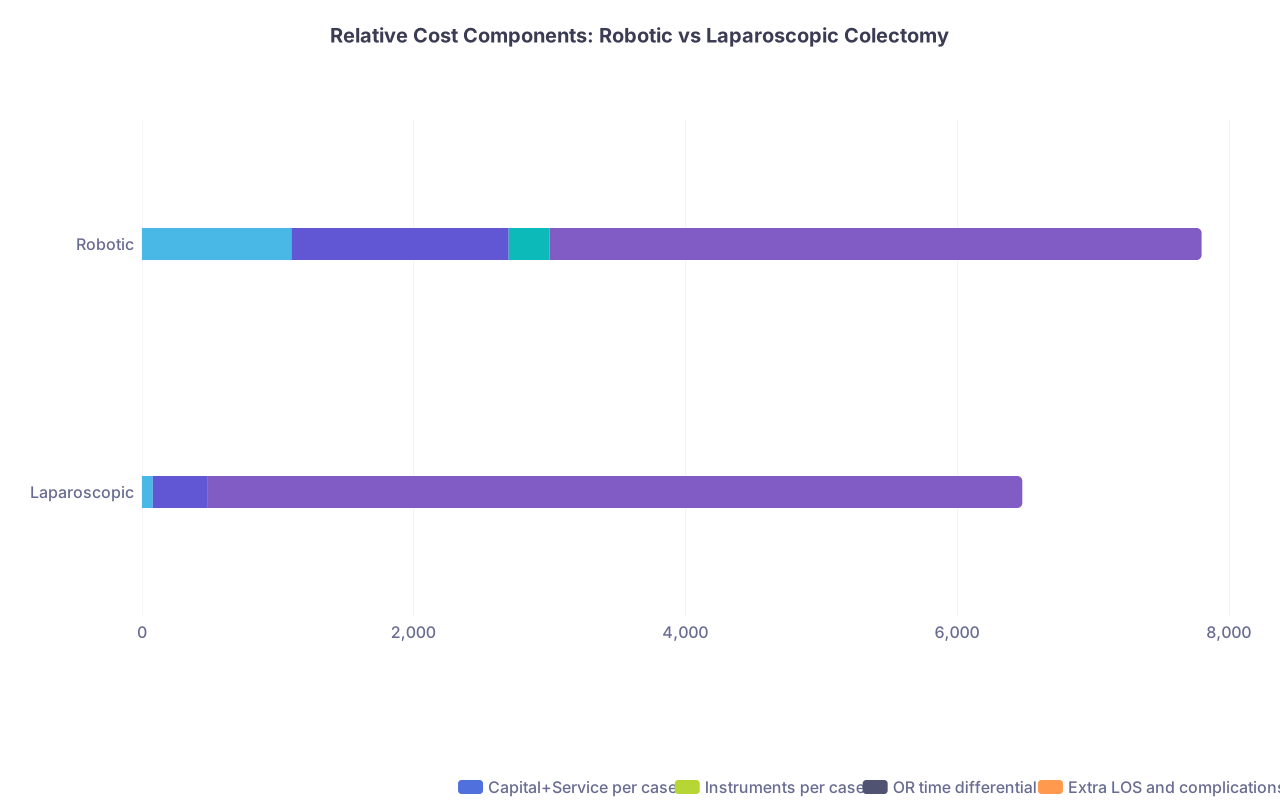
| Category | Capital+Service per case | Instruments per case | OR time differential | Extra LOS and complications |
|---|---|---|---|---|
| Laparoscopic | 80 | 400 | 0 | 6000 |
| Robotic | 1100 | 1600 | 300 | 4800 |
Interpretation: the robot reduces downstream medical costs (LOS, complications) by a modest amount, but the front-loaded technology cost is overwhelming.
2.2 Prostatectomy
Robotic prostatectomy is where the robot won the market, not because of ironclad cost-effectiveness, but because of surgeon ergonomics and patient demand.
Data from large insurers and hospital cost accounts still show:
- Robotic prostatectomy per-case hospital cost: often $2,000–$3,000 higher than open or lap approaches.
- Clinical advantages: less blood loss, shorter LOS (often 1–2 days shorter than open), fewer wound complications. Functional outcomes (continence, potency) show mixed but often slightly favorable results for robotic in high-volume centers.
Health economists who model this typically conclude:
- From a hospital perspective (direct costs only), robotic prostatectomy is more expensive without proportional reimbursement upside.
- From a societal perspective, if you include patient time off work and QoL utilities for quicker recovery, the incremental cost-effectiveness ratio (ICER) can fall into “borderline acceptable” territory, like $40,000–$80,000 per QALY—depending heavily on assumptions about functional benefit.
There is no clean win. Just a pattern: the robot raises direct costs; whether the incremental quality-adjusted benefit is “worth it” depends on what a system is willing to pay per QALY and how optimistic you are about those functional outcome gains.
3. When robotic surgery is clearly a bad deal (right now)
Some use-cases are not defensible on cost-effectiveness grounds in 2024, and pretending otherwise is dishonest.
Common examples from cost datasets and published series:
- Simple cholecystectomy
- Inguinal hernia repair without complex factors
- Uncomplicated appendectomy
- Many straightforward gynecologic procedures in low–medium BMI patients
For laparoscopic cholecystectomy, real-world numbers:
- Laparoscopic cost: $6,000–$9,000 total hospital cost (varies widely by region).
- Robotic incremental direct cost: ~$2,000 per case.
- Outcomes: near-identical for LOS, complication rates, conversion rates once you control for surgeon experience and patient complexity.
So you are essentially paying $2,000 extra for the same result. There is no coherent cost-effectiveness argument for that, unless you start inventing unmeasured benefits.
When I have watched administrators review service line data, this is where the pushback is harshest. You see dashboards where robotic cholecystectomy is 30–40 % more expensive than lap cases with no measurable outcome difference. That is a red flag.
4. Learning curve, volume, and economies of scale
A lot of robotic proponents hide behind the phrase “once the learning curve is passed.” Data does support significant efficiency gains with experience, but the magnitude matters.
Common estimates from learning-curve studies:
- Proficiency thresholds:
- 20–40 cases: basic competence (no major safety penalty).
- 100–150 cases: plateau in OR time and conversion for many procedures.
- OR time reduction with experience:
- Early robotic colectomies: often 45–60 minutes longer than lap.
- After 100+ cases: gap shrinks to 0–20 minutes, occasionally shorter than lap if lap skills are weak.
Now the cost math: suppose your early phase extra OR time is 45 minutes per case at $30 per OR-minute fully loaded = $1,350 extra per case. Over the first 50 cases, that is $67,500 of “training cost” just in OR time, on top of the instrument and capital load. Someone pays that.
Volume also changes capital amortization. If you can push robotic volume to 450–500 cases per robot per year, your capital+service per-case load might drop from $1,100 to ~$800. That is meaningful but does not erase the entire premium.
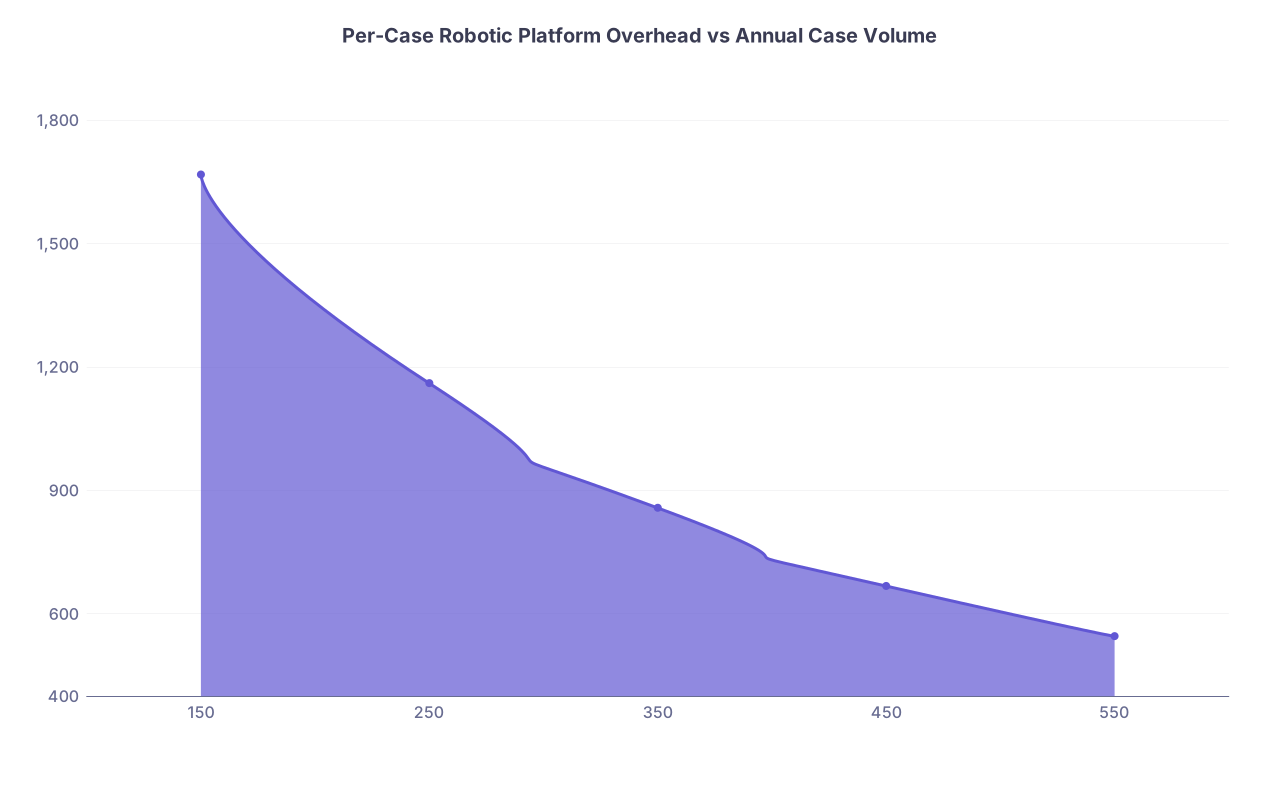
Let’s plot a simple scenario for per-case robotic overhead vs annual volume, holding capital = $2M, service = $150k, 8-year life:
| Category | Value |
|---|---|
| 150 | 1667 |
| 250 | 1160 |
| 350 | 857 |
| 450 | 667 |
| 550 | 545 |
Interpretation:
- At 150 cases/year: capital+service ≈ $1,667 per case.
- At 350 cases/year: ≈ $857 per case.
- At 550 cases/year: ≈ $545 per case.
Many community hospitals never get above 200–250 robotic cases per platform annually, particularly if they have multiple robots. So they are paying near the worst point on that curve and will never see the theoretical economies of scale that academic boosters like to quote.
5. Health-economic outcomes: QALYs and ICERs where available
Formal cost-utility analyses are limited and heavily procedure-specific, but some patterns appear across studies up to 2024:
Robotic hysterectomy vs lap hysterectomy:
- Incremental cost: ~$2,000–$3,000.
- Quality of life and recovery differences: marginal at best when controlling for ERAS pathways.
- Many models put ICERs above $100,000 per QALY, often far higher, essentially “not cost-effective” under traditional thresholds.
Robotic colorectal surgery:
- Incremental cost: $700–$1,500 depending on series and whether you include avoided conversions.
- Utility gain: small due to slightly fewer conversions and complications.
- ICERs sometimes fall in a “gray zone” of $50,000–$100,000 per QALY, but with huge uncertainty and very sensitive to conversion-rate assumptions.
Robotic prostatectomy:
- Already mentioned: ICERs cluster in $40,000–$80,000 per QALY range in many models, with optimistic assumption about long-term continence and potency benefits.
If your system uses a $50,000/QALY threshold (traditional) or $100,000/QALY (the newer, more permissive U.S. reality), robotic surgery is often marginal, sometimes acceptable, sometimes clearly non-viable economically.
From a public-payer, population-level view, adopting robotics widely for “easy” cases is simply a poor allocation of limited health dollars.
6. Ethical obligations: what the data demands from clinicians and institutions
Now we shift gears. Because this is not just economics; it is ethics.
The key ethical axes tied directly to the cost-effectiveness data are:
Transparency with patients.
Patients routinely hear “robotic is more precise” without any mention that, for their specific operation, the outcomes are equivalent to laparoscopy and the cost to the system is substantially higher. That is misleading by omission.Ethically defensible counseling for a routine laparoscopic-appropriate case should sound like:
- “For you, robotic and laparoscopic approaches have similar safety and recovery data.”
- “Robotic uses more expensive equipment that does not change your risk profile in a meaningful way.”
- “If you have a preference or concerns about scars/recovery, we can talk through it, but this is not a situation where the robot clearly benefits you medically.”
If you would be embarrassed to say that out loud because it undercuts your case volume on the robot, that is exactly the ethical problem.
Resource stewardship.
For a resident or early-attending reading this, the data is blunt: every time you move an uncomplicated cholecystectomy or hernia from lap to robot “for practice,” you are burning an extra $1,500–$2,500 of system resources for no patient gain. Multiply that by hundreds of cases.In a world where hospitals are cutting nursing staff and mental health programs to “control costs,” there is no morally neutral way to ignore that.
Conflicts of interest and CV-building.
Surgeons push robotics because:- It is ergonomically easier.
- It looks prestigious.
- Marketing loves it.
- The case-logs matter for credentialing and industry partnerships.
None of these is a valid ethical justification for materially higher cost in low-value indications. If your robotic case mix is driven by what is easy and available rather than where the technology adds clinical or economic value, you are shifting cost without benefit.
Training accountability.
Teaching hospitals use “routine” cases to train on the robot. That is reality. The ethical way to handle that is:- Restrict robotic training for residents and fellows to cases where robotics plausibly improves outcomes or at least is neutral on cost-effectiveness.
- Explicitly tell patients when their case is being used for console time. Many will still consent. Some will not. That is their right.
Equity and access.
Robotic platforms tend to cluster in high-revenue, urban hospitals. Meanwhile, rural or safety-net hospitals are often struggling to maintain basic laparoscopic capacity.System-level investment into more robots instead of expanding high-quality laparoscopy across regions widens disparities. It is very hard to defend a $2M robot in a metro area that already has three, while patients two hours away lack basic minimally invasive options.
7. So what should an ethically-minded clinician do in 2024?
From the data, there is a reasonable middle ground, not the all-or-nothing rhetoric you usually hear.
A responsible stance, based on current cost-effectiveness evidence:
Favor laparoscopy as default for:
- Routine cholecystectomy, appendectomy, primary inguinal hernia.
- Standard gynecologic procedures in low–average BMI, absent significant adhesions or endometriosis.
- Any case where your lap outcomes are already excellent and the literature shows no meaningful robotic advantage.
Use robotics strategically for:
- Complex pelvic surgery (deep endometriosis, difficult rectal resections) where conversion rates and nerve preservation are genuinely better with experienced robotic teams.
- Prostatectomy in high-volume centers that can credibly demonstrate superior functional outcomes.
- Morbidly obese or anatomically challenging patients where laparoscopy is associated with higher conversion or complication risk in your own data.
Track your own numbers.
Do not hide behind global averages. Run the report:- Per-case cost by approach.
- LOS by approach.
- 30-day complications and readmissions.
- Conversion to open.
Then compare robotic vs lap within your institution. If your robot cases cost $3,000 more with no clinical improvement, the ethical obligation is to adjust your practice or be honest that this is a convenience/marketing choice, not a medical necessity.
Be explicit in consent.
For any patient where robotic cost-effectiveness is weak or absent, include a line in your counseling that:
“The robotic approach is more expensive to the health system; in your situation it does not clearly reduce complications or speed recovery compared with laparoscopy.”That one sentence forces you to align your practice with what the data actually says.
Key takeaways
- The data shows robotic surgery in 2024 adds roughly $1,500–$2,500 in direct cost per case versus laparoscopy, and only in select complex procedures does it partially offset this via lower conversions and shorter length of stay.
- For common routine operations—cholecystectomy, simple hernia, straightforward gynecologic cases—robotics is not cost-effective by any reasonable threshold; outcomes are equivalent and the cost premium is pure waste.
- Ethically, clinicians and institutions have a duty to align robotic use with procedures where either outcomes improve or cost per QALY is defensible, and to be transparent with patients that “robotic” does not automatically mean “better”—just more expensive.