
The hype around VR simulation training is wildly overstated—but the cold data show that when it is done correctly, it delivers real, measurable skill gains that traditional training simply does not match.
This is not about flashy headsets or “gamifying” medicine. It is about quantifiable improvements in time-to-task completion, error rates, motion efficiency, and downstream patient outcomes. If a training intervention cannot move those numbers, it is noise.
Let us look at what actually improves, by how much, and under what conditions VR becomes ethically mandatory rather than optional “innovation theater.”
What VR Simulation Actually Improves (In Numbers)
Strip away the marketing and you are left with four primary buckets of objective metrics:
- Speed (task completion time)
- Accuracy / safety (error rates, complications, breaches)
- Efficiency (motion economy, unnecessary movements, instrument path length)
- Transfer (how much simulator performance predicts real-world outcomes)
The evidence base is strongest in procedural fields: laparoscopic surgery, endoscopy, interventional cardiology, and emergency procedures.
Representative effect sizes
Across randomized and controlled studies, you routinely see:
- 20–40% reductions in procedure time for novices after structured VR training.
- 30–60% reductions in technical error counts compared with traditionally trained controls.
- 15–30% improvements in motion efficiency (shorter path lengths, fewer movements).
- Moderate to strong correlations (r ≈ 0.4–0.7) between simulator scores and OR / clinical performance.
To make that concrete, here is a simplified comparison drawn from the typical ranges reported in the surgical VR literature (think laparoscopic cholecystectomy or basic laparoscopy tasks used in multiple studies):
| Metric | Traditional Training Only | With Structured VR Training | Relative Improvement |
|---|---|---|---|
| Task time (min) | 30 | 21–24 | 20–30% faster |
| Number of technical errors | 10 | 4–6 | 40–60% fewer errors |
| Instrument path length (cm) | 1000 | 700–800 | 20–30% more efficient |
| Unnecessary movements (count) | 50 | 30–35 | 30–40% reduction |
| Global rating score (1–5 scale) | 2.5 | 3.5–4.0 | +1 to +1.5 points |
These are not trivial deltas. If a drug cut complication-related errors by 40–60%, we would be calling it a breakthrough and fast‑tracking it.
Key Performance Metrics: What Actually Gets Measured
If you want to use VR simulation in a way that is defensible—educationally and ethically—you have to anchor it in hard metrics, not “felt confidence.”
Here is the core metric set that good VR platforms expose, and that you should be tracking.
1. Time-to-completion
Crude but powerful.
- How long does it take to complete a standardized task or procedure step?
- What is the time to specific milestones (e.g., trocar placement complete, critical view achieved, bleeding controlled)?
Interpreting it:
- Early on, time reduction is a proxy for cognitive load dropping and motor sequences becoming automated.
- However, speed without safety is useless, so time must always be paired with error metrics.
2. Error counts and severity
The data show that a simple error count is not enough. High‑value VR systems break errors into categories and weight them.
Common categories:
- Instrument errors: wrong plane, tissue damage, collisions with non‑target structures.
- Safety violations: entering forbidden zones, exceeding pressure/force thresholds, uncontrolled bleeding, wrong anatomical structure manipulated.
- Protocol errors: skipped steps, out-of-order steps, incorrect device settings.
Many simulators use weighted error scoring: minor errors (–1), major errors (–3 to –5), critical/sentinel (–10 or scenario termination). That composite error score correlates more tightly with expert ratings and real-world complications.
3. Motion analysis
This is where VR has a clear edge over low‑fidelity models.
Measured items typically include:
- Total path length of instruments (cm or m)
- Number of movements (peaks in motion profile)
- Idle time (time with no purposeful motion)
- Economy indices (ratio of effective to total movement)
The pattern is consistent: as learners progress, path length and movement counts drop while accuracy improves. You literally see the “wobble” disappear from their hands in the data.
4. Force / pressure metrics
Not all VR systems have good haptics, but when they do, you get:
- Peak force applied to tissues
- Mean force over time
- Instances above damage thresholds
- Rate of force change (jerky vs controlled application)
This matters directly for specialties where excessive force equals real harm: endoscopy, bronchoscopy, catheterization, orthopedic manipulation.
5. Process and checklist compliance
Beyond psychomotor execution, better VR curricula track:
- Step completion (yes/no)
- Step order (correct sequence vs deviations)
- Time spent per step (bottlenecks)
- Use of safety checks (e.g., timeouts, anatomical confirmation steps)
These are easy to gloss over in a live OR. In VR, the system can log every deviation.
Learning Curves: What “Good Progress” Actually Looks Like
If you look at the raw data from repeated VR sessions, you rarely see a straight line. Performance follows a classic learning curve with rapid early gains, then a plateau.
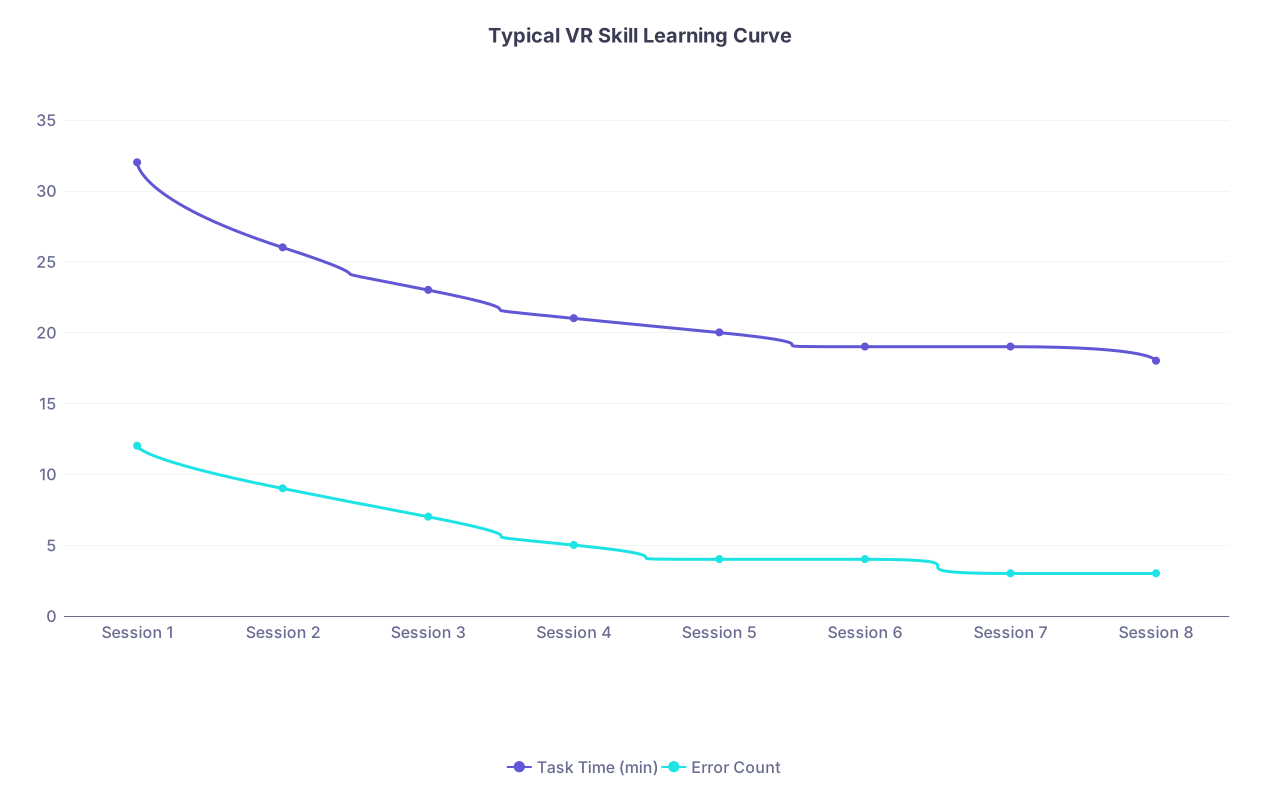
| Category | Task Time (min) | Error Count |
|---|---|---|
| Session 1 | 32 | 12 |
| Session 2 | 26 | 9 |
| Session 3 | 23 | 7 |
| Session 4 | 21 | 5 |
| Session 5 | 20 | 4 |
| Session 6 | 19 | 4 |
| Session 7 | 19 | 3 |
| Session 8 | 18 | 3 |
The pattern you want:
- Sessions 1–3: steep drop in time and errors. Biggest efficiency wins.
- Sessions 4–6: more modest improvements, but error severity decreases.
- Sessions 7–8: performance stabilizes; variability between runs shrinks.
A reasonable mastery criterion for a given task:
- Time within 10–20% of expert mean.
- Error count below a predefined threshold (for many basic tasks, ≤2 minor errors, 0 major).
- Low intra‑individual variance across 3–5 consecutive runs.
If someone’s learning curve flat‑lines early while still far from expert benchmarks, that is a flag for targeted coaching or re‑teaching the conceptual side, not “more random reps.”
Transfer to the Real World: Where the Ethics Kick In
You can have perfect VR scores and still be unsafe in the OR if the training is poorly aligned with reality or assessed badly. The ethical question is simple:
Does VR training measurably reduce risk for patients compared with not using it?
Here is what the data show across multiple procedural domains:
- Residents with structured VR training reach proficiency in real cases with fewer supervised procedures. You see reductions on the order of 20–30% in the number of live cases required to hit a defined safety/competence metric.
- VR‑trained groups tend to have:
- Shorter operative times at equivalent training levels.
- Fewer intraoperative errors (needle misplacements, unintentional injuries, scope collisions).
- Fewer instructor takeovers and verbal corrections.
The correlations between VR scores and OR performance are not perfect, but they are meaningful.
Typical numbers:
- Correlation between simulator global score and expert OR rating: r ≈ 0.5–0.7.
- Correlation between simulator errors and intraoperative errors: r ≈ 0.4–0.6.
- Residents in the lowest VR performance quartile are consistently overrepresented in the bottom quartile of real‑world performance.
In other words: ignoring VR metrics and throwing people straight into patient care when their simulated performance is weak is not just bad education. It starts to look ethically indefensible.
Benchmarking: Where Are You Compared to Peers?
You can treat VR as a personal sandbox, or you can treat it like a dataset. The second approach is smarter.
When enough learners run the same VR modules, you get reference distributions:
- Median time and error rates for your PGY level
- Interquartile ranges (what the middle 50% achieves)
- Thresholds for top 10–20% performers
Here is a simplified view of how benchmarks might split across residents at different stages for a standardized endoscopy module:
| Level | Median Time (min) | IQR Time (min) | Median Errors | IQR Errors |
|---|---|---|---|---|
| Intern | 28 | 25–32 | 11 | 9–13 |
| PGY-2 | 22 | 20–25 | 7 | 5–9 |
| PGY-3 | 18 | 16–20 | 4 | 3–6 |
| Senior | 15 | 14–17 | 2 | 1–3 |
If you are a PGY‑2 functioning at intern‑level metrics after multiple sessions, that is a signal. It is not a label of “unsafe,” but it is data arguing for more deliberate practice and supervision.
Aggregated data also show program‑level patterns:
- Are your residents systematically slower than multi‑center averages but with similar error rates? That is a curricular issue, not an individual one.
- Are error counts acceptable but step-sequence errors high? Your teaching is missing cognitive scaffolding even if manual skills look fine.
Done correctly, program‑level VR data can serve as an early‑warning system for training weaknesses long before they show up in patient outcomes or board pass rates.
Personal Development: How To Use the Data Yourself
Most learners make the same mistake: they focus on “passing the module” instead of mining the metrics.
Here is a more analytical way to use VR for your own development:
Establish a baseline.
- Do 2–3 runs of a module without coaching or “gaming the system.”
- Record time, error count, error types, path length, and step-sequence issues.
Set explicit numeric targets.
- “Cut time from 28 to under 20 minutes.”
- “Reduce major errors to zero and total errors to under 4.”
- “Reduce instrument path length by 20%.”
Run short, focused blocks.
- Instead of 20 mindless repetitions, do 3–5 runs, analyze the metrics, then adjust.
- Look for one dominant error category (e.g., repeated tissue collisions on entry).
Track your personal learning curves.
- Export or log key metrics each session.
- After 5–10 sessions, you should see a roughly asymptotic curve; if you do not, your approach is off.
Validate transfer.
- When you go into a real case, note: did the specific errors you eliminated in VR show up less?
- Ask your attending for a specific global score or use a standardized assessment tool. Compare to your VR scores.
This is not about obsessing over numbers for their own sake. It is about reducing guesswork in where to focus your limited practice time.
Ethical Dimensions: When VR Becomes a Duty, Not a Toy
There is a blunt ethical question here:
If a low‑risk VR intervention has strong evidence for reducing technical errors and improving performance, is it ethical to let novices touch patients without it?
Look at it from three angles.
1. Non‑maleficence (do no harm)
We already accept:
- It is unethical to skip hand hygiene.
- It is unethical to train on patients when safe simulation exists for high‑risk first attempts (e.g., central lines, airway management) if that simulation is available and effective.
VR, when validated for a given procedure, belongs in the same family. If you have a module that demonstrably drops novice error rates by 40–60% before they enter your OR, and you choose not to use it, you are tolerating preventable risk.
2. Justice and equity
There is another layer: who gets access.
If one program invests in VR and its trainees reach competence faster and safer, while another cannot or will not, patients are effectively receiving different risk profiles based purely on geography and institutional wealth.
Within programs, if VR access is informal—“whoever asks can use it”—you will amplify disparities. Aggressive self‑advocates and those with lighter rotations get extra reps; quieter or overworked residents lag behind, not because of potential, but logistics.
For VR to be ethical, access must be:
- Structured: scheduled time, required modules.
- Transparent: clear benchmarks and progression criteria.
- Supported: technical help and coaching so that everyone can use the system effectively.
3. Professional responsibility and transparency
As metrics become more robust, competency‑based decisions will increasingly lean on simulator data. That includes:
- Promotion decisions (ready for more complex cases or independent call).
- Remediation plans.
- Documentation for privileging bodies.
There is an ethical obligation to be transparent about how VR data are used:
- What is formative only?
- What contributes to high‑stakes decisions?
- How are false positives and measurement errors handled?
If programs quietly use VR metrics to label people “weak” without clear standards and feedback, they are misusing a powerful tool.
Where VR Underperforms or Misleads
You will see plenty of shiny demos that are pedagogically useless. The data show several recurring failure modes.
Poor fidelity in key cues
- Visuals look fine, but haptics are wrong.
- Instruments do not behave like the real thing.
- Force thresholds and tissue responses are inaccurate.
Result: learners optimize for the simulator, then struggle in the real environment. That is negative transfer.
Gamification over metrics
- Points for speed, but weak or missing penalties for errors.
- Leaderboards that reward risk‑taking behavior.
Result: “fast but sloppy” habits that may impress on a scoreboard but are dangerous at the bedside.
No integration with curriculum
- Unstructured, drop‑in use with no defined goals.
- No debriefing or linkage to real cases.
- No progression rules (e.g., moving to advanced tasks before mastering basics).
Result: noise. Residents burn hours without targeted gains, then blame “VR doesn’t help.”
Overreliance on single metrics
- Programs that chase time reductions without checking error severity.
- Or obsess over path length while ignoring wrong structure manipulations.
Result: superficially better numbers that do not track with patient outcomes.
The fix is not more VR. It is better, higher‑fidelity VR tied to clear, validated performance metrics and educational design.
Practical Data Strategy for Programs
If you are in a position to shape VR training, this is the minimal data‑driven framework you should implement.
Define, for each module:
- Target population (PGY level, specialty).
- Key metrics: time, weighted error score, specific critical errors, step compliance.
Establish benchmarks:
- Have a panel of experts run the modules to create “gold standard” ranges.
- Collect initial trainee data over a few months to generate local medians and IQRs.
Set progression thresholds:
- Example: “Residents must complete 3 consecutive runs with time ≤120% of expert mean, 0 critical errors, ≤3 total errors before performing this task on patients.”
Monitor distributions regularly:
- Quarterly review of VR data:
- Proportion meeting thresholds.
- Trends by cohort and PGY year.
- Modules with persistent high error rates (poor design or unrealistic expectations).
- Quarterly review of VR data:
Use the data ethically:
- Share aggregate trends with residents.
- Use individual metrics to guide coaching, not just gatekeeping.
- Make clear what metrics are formative vs summative.
If you are not doing at least this, you are underutilizing your VR investment and leaving both educational and ethical value on the table.
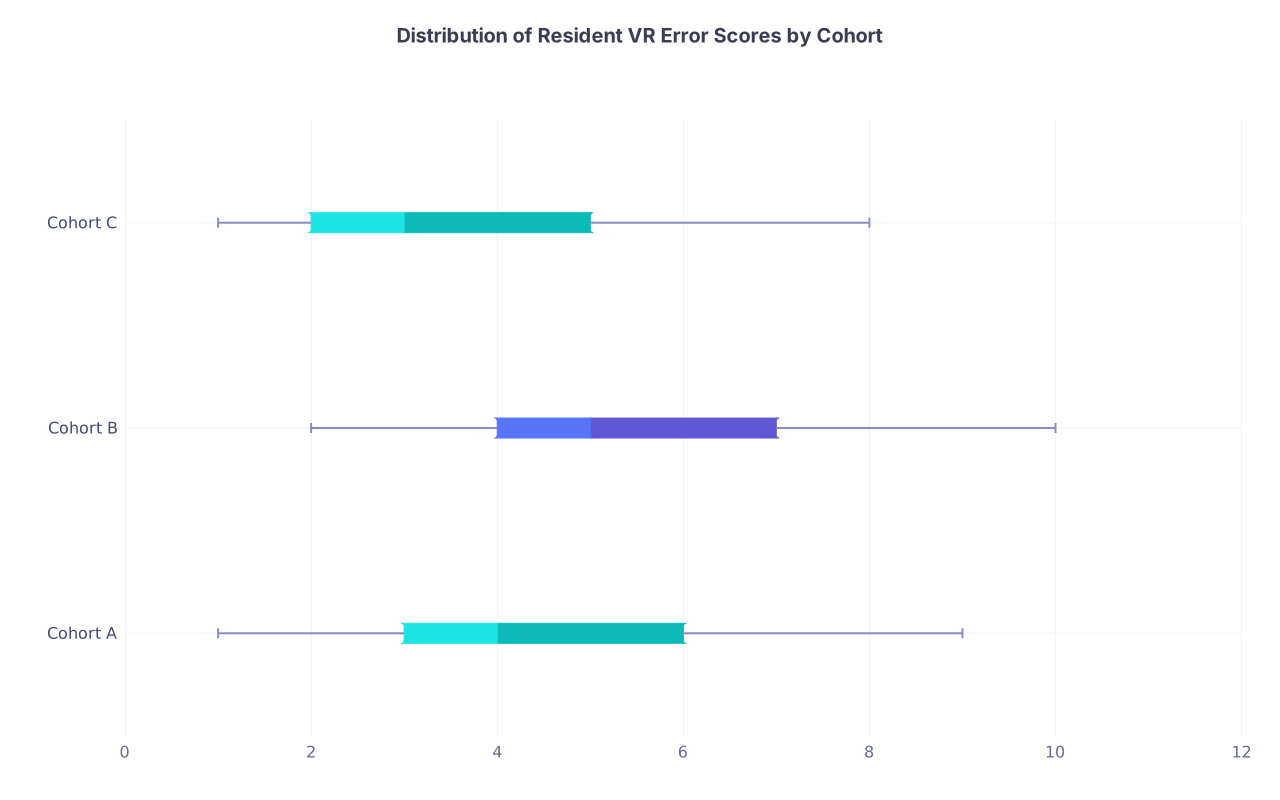
| Category | Min | Q1 | Median | Q3 | Max |
|---|---|---|---|---|---|
| Cohort A | 9 | 6 | 4 | 3 | 1 |
| Cohort B | 10 | 7 | 5 | 4 | 2 |
| Cohort C | 8 | 5 | 3 | 2 | 1 |
The pattern you want to see over cohorts: median error scores trending downward and the upper quartile getting closer to the median, meaning fewer stragglers.
Summary: What the Data Actually Say
Three core points:
Properly designed, metrics‑driven VR simulation yields large, reproducible gains in objective performance—often 20–40% faster completion and 40–60% fewer errors for novices compared to traditional pathways.
Those gains do transfer to real procedures and correlate meaningfully with intraoperative performance and safety, making serious VR use less a luxury and more an emerging ethical expectation for high‑risk skills.
The value lives in the metrics and how you use them: benchmarked thresholds, learning curves, and error analytics—not in the headset itself. Without that data discipline, VR is just expensive entertainment.